PUBLISHER: Global Market Insights Inc. | PRODUCT CODE: 1959635

PUBLISHER: Global Market Insights Inc. | PRODUCT CODE: 1959635
Battery Pack Market Opportunity, Growth Drivers, Industry Trend Analysis, and Forecast 2026 - 2035
The Global Battery Pack Market was valued at USD 161.1 billion in 2025 and is estimated to grow at a CAGR of 12.1% to reach USD 521.6 billion by 2035.
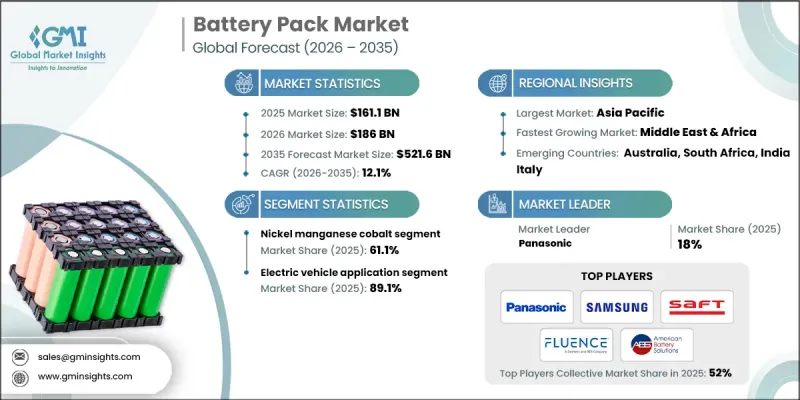
Market growth is driven by worldwide policy initiatives focused on lowering carbon emissions and accelerating the transition toward electrification and clean energy systems. Governments across regions are actively supporting energy storage deployment, which is encouraging sustained investment in advanced battery technologies. Continuous improvements in battery chemistry and design are enhancing performance parameters such as energy density, safety, charging efficiency, and operational life. These advancements are improving cost-effectiveness and reliability, making battery packs increasingly viable across a wide range of applications. As electrification expands beyond transportation into industrial systems, energy storage, and consumer technologies, battery packs are becoming a core component of modern infrastructure. The market is also benefiting from growing confidence in next-generation storage technologies and broader acceptance of batteries as essential tools for energy resilience, efficiency, and sustainability across global value chains. A battery pack is defined as an integrated energy storage system that combines multiple battery cells with protective housing, thermal regulation, electrical interfaces, and control electronics. It is designed to deliver stable power output, monitor operating conditions, ensure safety, and support reliable energy delivery across consumer electronics, automotive platforms, industrial equipment, and large-scale energy storage systems. Rising adoption of personal electronic devices is strengthening demand for lightweight, compact, and high-performance battery packs. Shorter product replacement cycles, longer operating time expectations, and rapid charging requirements are encouraging manufacturers to integrate advanced battery solutions.
| Market Scope | |
|---|---|
| Start Year | 2025 |
| Forecast Year | 2026-2035 |
| Start Value | $161.1 Billion |
| Forecast Value | $521.6 Billion |
| CAGR | 12.1% |
The nickel manganese cobalt chemistry segment accounted for 61.1% share in 2025 and is expected to grow at a CAGR of 11.7% through 2035. Strong demand for high-energy density solutions is driving adoption of this chemistry, which offers a balance of performance, weight efficiency, and power output suitable for space-constrained and high-demand applications.
The utility-scale applications segment is forecast to grow at a CAGR of 12.8% by 2035, supported by the accelerating integration of renewable power generation. Energy storage systems are increasingly required to manage variability in power supply, improve grid reliability, and optimize load distribution, driving higher demand for large-format battery packs.
North America Battery Pack Market held 94.4% share in 2025 and is projected to generate USD 67.5 billion by 2035. Growth is supported by rising electric vehicle adoption, policy incentives, and strengthening domestic manufacturing capabilities, which are reinforcing supply chain resilience and long-term market expansion.
Key companies operating in the Global Battery Pack Market include Panasonic, Samsung, SK Innovation, Saft, Fluence Energy, Powin Energy, Rivian, VARTA, Inventus Power, American Battery Solutions, Dynapack International Technology, Amara Raja Energy & Mobility, FRIWO, PMBL Limited, AGreatE, Blue Line Battery, Emerging Power, Apex Mobile Power, Rapport, and Omnitron Bulgaria OOD. Companies in the battery pack market are strengthening their competitive position through capacity expansion, technology innovation, and strategic localization of manufacturing. Many players are investing heavily in next-generation chemistries and modular pack designs to improve scalability and reduce production costs. Vertical integration across cell manufacturing, pack assembly, and energy management software is helping improve efficiency and supply security. Firms are also forming long-term partnerships with end users to co-develop application-specific solutions.
Table of Contents
Chapter 1 Methodology & Scope
- 1.1 Research design
- 1.2 Quality commitment
- 1.2.1 GMI AI policy & data integrity commitment
- 1.2.1.1 Source consistency protocol
- 1.2.1 GMI AI policy & data integrity commitment
- 1.3 Research Trail & Confidence Scoring
- 1.3.1 Research Trail Components
- 1.3.2 Scoring Components
- 1.4 Data Collection
- 1.4.1 Partial list of primary sources
- 1.5 Data mining sources
- 1.5.1 Paid sources
- 1.5.1.1 Sources, by region
- 1.5.1 Paid sources
- 1.6 Base estimates and calculations
- 1.6.1 Base year calculation for any one approach
- 1.7 Forecast model
- 1.8 Research transparency addendum
- 1.8.1 Source attribution framework
- 1.8.2 Quality assurance metrics
- 1.8.3 Our commitment to trust
- 1.9 Market definitions
Chapter 2 Executive Summary
- 2.1 Industry synopsis, 2022 - 2035
- 2.2 Business trends
- 2.3 Battery chemistry trends
- 2.4 Application trends
- 2.5 Regional trends
Chapter 3 Industry Insights
- 3.1 Industry ecosystem
- 3.1.1 Raw material availability & sourcing analysis
- 3.1.2 Manufacturing capacity assessment
- 3.1.3 Supply chain resilience & risk factors
- 3.1.4 Distribution network analysis
- 3.2 Regulatory landscape
- 3.3 Industry impact forces
- 3.3.1 Growth drivers
- 3.3.2 Industry pitfalls & challenges
- 3.4 Growth potential analysis
- 3.5 Cost structure analysis
- 3.6 Porter's analysis
- 3.6.1 Bargaining power of suppliers
- 3.6.2 Bargaining power of buyers
- 3.6.3 Threat of new entrants
- 3.6.4 Threat of substitutes
- 3.7 PESTEL analysis
- 3.7.1 Political factors
- 3.7.2 Economic factors
- 3.7.3 Social factors
- 3.7.4 Technological factors
- 3.7.5 Legal factors
- 3.7.6 Environmental factors
- 3.8 Emerging opportunities & trends
- 3.8.1 Digitalization & IoT integration
- 3.8.2 Emerging market penetration
- 3.9 Investment analysis and future outlook
Chapter 4 Competitive landscape, 2026
- 4.1 Introduction
- 4.2 Company market share analysis, by region, 2025
- 4.2.1 North America
- 4.2.2 Europe
- 4.2.3 Asia Pacific
- 4.2.4 Latin America
- 4.2.5 Middle East & Africa
- 4.3 Strategic dashboard
- 4.4 Strategic initiatives
- 4.5 Company benchmarking
- 4.6 Innovation & technology landscape
Chapter 5 Market Size and Forecast, By Battery Chemistry, 2022 - 2035 (USD Billion)
- 5.1 Key trends
- 5.2 Electric vehicles
- 5.3 Utility-scale batteries
- 5.4 Behind-the-meter batteries
Chapter 6 Market Size and Forecast, By Application, 2022 - 2035 (USD Billion)
- 6.1 Key trends
- 6.2 Lithium iron phosphate
- 6.3 Nickel cobalt aluminum
- 6.4 Nickel manganese cobalt
- 6.5 Lithium manganese oxide
- 6.6 Others
Chapter 7 Market Size and Forecast, By Region, 2022 - 2035 (USD Billion)
- 7.1 Key trends
- 7.2 North America
- 7.2.1 U.S.
- 7.2.2 Canada
- 7.3 Europe
- 7.3.1 Germany
- 7.3.2 France
- 7.3.3 Spain
- 7.3.4 UK
- 7.3.5 Italy
- 7.4 Asia Pacific
- 7.4.1 China
- 7.4.2 India
- 7.4.3 Japan
- 7.4.4 Australia
- 7.5 Middle East & Africa
- 7.5.1 Saudi Arabia
- 7.5.2 South Africa
- 7.6 Latin America
- 7.6.1 Brazil
- 7.6.2 Argentina
Chapter 8 Company Profiles
- 8.1 AGreatE
- 8.2 Amara Raja Energy & Mobility
- 8.3 American Battery Solutions
- 8.4 Apex Mobile Power
- 8.5 Blue Line Battery
- 8.6 Dynapack International Technology
- 8.7 Emerging Power
- 8.8 Fluence Energy
- 8.9 FRIWO
- 8.10 Inventus Power
- 8.11 Omnitron Bulgaria OOD
- 8.12 Panasonic
- 8.13 PMBL Limited
- 8.14 Powin Energy
- 8.15 Rapport
- 8.16 Rivian
- 8.17 Saft
- 8.18 Samsung
- 8.19 SK Innovation
- 8.20 VARTA

