PUBLISHER: Global Market Insights Inc. | PRODUCT CODE: 1982268

PUBLISHER: Global Market Insights Inc. | PRODUCT CODE: 1982268
Power-to-Liquids Logistics Market Opportunity, Growth Drivers, Industry Trend Analysis, and Forecast 2026 - 2035
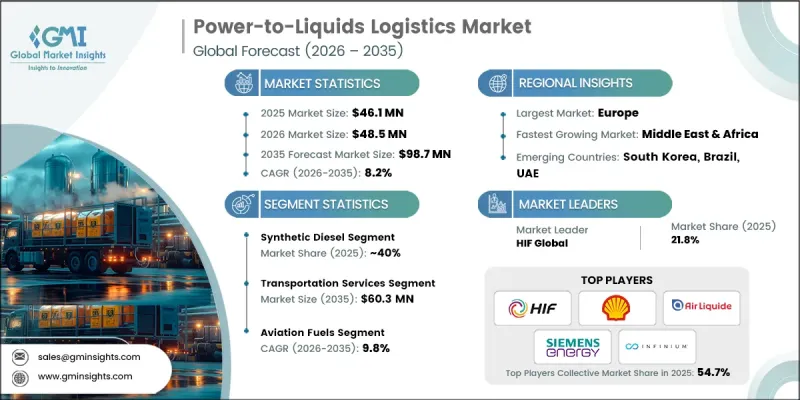
The Global Power-to-Liquids Logistics Market was valued at USD 46.1 million in 2025 and is estimated to grow at a CAGR of 8.2% to reach USD 98.7 million by 2035.
Market growth is gaining momentum as global industries accelerate efforts to decarbonize hard-to-electrify transportation segments such as aviation and maritime shipping. The market reflects the growing need for specialized infrastructure to manage fuels synthesized from renewable electricity and captured carbon. This upward trajectory is fueled by climate-driven regulations, evolving sustainability targets, and the increasing commercialization of synthetic fuels. Because production sites are typically located near renewable energy hubs or carbon capture facilities, efficient storage, handling, and transportation systems are crucial to ensure safe delivery to end-users. As a result, stakeholders are channeling investments into upgraded terminals, advanced transport networks, and digital monitoring platforms tailored to power-to-liquids logistics requirements. Supportive policy frameworks continue to shape infrastructure development, while innovation is improving operational reliability, traceability, and safety standards across the supply chain.
| Market Scope | |
|---|---|
| Start Year | 2025 |
| Forecast Year | 2026-2035 |
| Start Value | $46.1 Million |
| Forecast Value | $98.7 Million |
| CAGR | 8.2% |
The power-to-liquids logistics market is benefiting significantly from regulatory mandates designed to lower carbon emissions. Policy incentives and compliance frameworks are encouraging infrastructure upgrades and private investment across storage and distribution systems. Technological progress is also transforming logistics performance, with modernized pipelines being adapted to accommodate synthetic fuels and newly engineered railcars, marine vessels, and tanker systems entering service. Industry collaboration is accelerating development, as energy producers, logistics providers, and technology companies work together to create integrated distribution models. Companies are deploying digital tracking platforms, automation tools, and advanced safety systems to streamline operations. Joint initiatives are supporting the construction of specialized blending facilities, reinforced storage installations, and seamless connectivity between production plants and multimodal transport corridors.
Within the power-to-liquids logistics market, the synthetic diesel segment accounted for 40% of the share in 2025, generating USD 18.2 million. Its leadership position is driven by strong adoption across marine and transportation applications. Synthetic diesel offers compatibility with conventional diesel infrastructure, allowing it to move through established road, rail, and maritime networks without requiring extensive modifications to storage terminals or fuel distribution systems. This operational flexibility enhances cost efficiency and accelerates market uptake.
The transportation services segment held 62.7% share in 2025 and is forecast to reach USD 60.3 million by 2035. Transportation remains the most critical component of the power-to-liquids logistics market because production facilities are often geographically distant from consumption centers. Synthetic fuel plants are typically positioned near renewable energy resources and carbon capture zones, while major demand hubs, including industrial clusters, ports, and airports, are located elsewhere. The physical separation between supply and demand increases reliance on coordinated, multimodal transport networks, making logistics a substantial contributor to overall project costs and market growth.
U.S. Power-to-Liquids Logistics Market reached USD 8.6 million in 2025. The United States is emerging as a strategic center for commercial-scale synthetic fuel production, which directly stimulates logistics expansion. Federal and state-level sustainability policies are encouraging capital allocation toward specialized storage, rail connectivity, marine export capacity, and road transport solutions designed to handle growing fuel volumes. As domestic production capacity scales, the need for integrated and compliant logistics systems continues to strengthen across regional corridors.
Key participants operating in the Global Power-to-Liquids Logistics Market include Air Liquide, BP, HIF Global, INERATEC, Infinium, Nordic Electrofuel, Shell, Siemens Energy, Sunfire, and Twelve. Companies competing in the Power-to-Liquids Logistics Market are strengthening their foothold through strategic partnerships, infrastructure investments, and technology integration. Many players are forming alliances with renewable energy producers, carbon capture developers, and transportation operators to secure long-term supply and distribution agreements. Firms are also investing in upgraded storage terminals, specialized tanker fleets, and adaptable pipeline systems to improve operational flexibility. Digitalization remains a central strategy, with companies deploying real-time tracking systems, predictive maintenance tools, and data-driven optimization platforms to enhance efficiency and safety.
Table of Contents
Chapter 1 Methodology
- 1.1 Research approach
- 1.2 Quality commitments
- 1.2.1 GMI AI policy & data integrity commitment
- 1.3 Research trail & confidence scoring
- 1.3.1 Research trail components
- 1.3.2 Scoring components
- 1.4 Data collection
- 1.4.1 Partial list of primary sources
- 1.5 Data mining sources
- 1.5.1 Paid sources
- 1.6 Base estimates and calculations
- 1.6.1 Base year calculation
- 1.7 Forecast model
- 1.8 Research transparency addendum
Chapter 2 Executive Summary
- 2.1 Industry 360° synopsis, 2022 - 2035
- 2.2 Key market trends
- 2.2.1 Regional
- 2.2.2 Fuel
- 2.2.3 Logistics Service
- 2.2.4 End-Use
- 2.3 TAM analysis, 2026-2035
- 2.4 CXO perspectives: Strategic imperatives
Chapter 3 Industry Insights
- 3.1 Industry ecosystem analysis
- 3.1.1 Supplier landscape
- 3.1.2 Profit margin
- 3.1.3 Cost structure
- 3.1.4 Value addition at each stage
- 3.1.5 Factor affecting the value chain
- 3.1.6 Disruptions
- 3.2 Industry impact forces
- 3.2.1 Growth drivers
- 3.2.1.1 Rising sustainable aviation fuel (SAF) mandates
- 3.2.1.2 Stringent global decarbonization and net-zero targets
- 3.2.1.3 Government incentives and carbon pricing mechanisms
- 3.2.1.4 Development of cross-border green fuel trade corridors
- 3.2.2 Industry pitfalls and challenges
- 3.2.2.1 Limited dedicated storage and transport facilities
- 3.2.2.2 Dependence on renewable power availability
- 3.2.3 Market opportunities
- 3.2.3.1 Development of dedicated e-fuel export terminals
- 3.2.3.2 Public-private partnerships for sustainable fuel corridors
- 3.2.3.3 Expansion into emerging renewable-rich regions
- 3.2.1 Growth drivers
- 3.3 Growth potential analysis
- 3.4 Regulatory landscape
- 3.4.1 North America
- 3.4.1.1 U.S. Environmental Protection Agency (EPA)
- 3.4.1.2 Federal Energy Regulatory Commission (FERC)
- 3.4.1.3 National Renewable Energy Laboratory (NREL)
- 3.4.1.4 Canada Energy Regulator (CER)
- 3.4.2 Europe
- 3.4.2.1 Renewable Fuels Regulators Club (REFUREC)
- 3.4.2.2 European Commission - DG ENERGY
- 3.4.2.3 Council of European Energy Regulators (CEER)
- 3.4.2.4 European Union Aviation Safety Agency (EASA)
- 3.4.3 Asia Pacific
- 3.4.3.1 ASEAN Energy Regulators’ Network (AERN)
- 3.4.3.2 Energy Regulatory Commission (Thailand)
- 3.4.3.3 National Energy Administration (China)
- 3.4.3.4 Australian Renewable Energy Agency (ARENA)
- 3.4.4 Latin America
- 3.4.4.1 National Agency of Petroleum, Natural Gas and Biofuels (ANP)
- 3.4.4.2 Comision Reguladora de Energia (CRE)
- 3.4.4.3 National Energy Policy Council (CNPE)
- 3.4.5 Middle East & Africa
- 3.4.5.1 RAERESA
- 3.4.5.2 National Energy Regulator of South Africa (NERSA)
- 3.4.5.3 Gulf Cooperation Council Interconnection Authority (GCCIA)
- 3.4.1 North America
- 3.5 Porter's analysis
- 3.6 PESTEL analysis
- 3.7 Technology and innovation landscape
- 3.7.1 Current technological trends
- 3.7.1.1 Electrolyzer efficiency improvements
- 3.7.1.2 Fischer Tropsch synthesis optimization
- 3.7.1.3 Renewable hydrogen integration into fuel synthesis
- 3.7.2 Emerging technologies
- 3.7.2.1 Direct air capture (DAC) integration with PtL systems
- 3.7.2.2 Solid oxide electrolysis (SOEC) at commercial scale
- 3.7.1 Current technological trends
- 3.8 Production statistics
- 3.8.1 Production hubs
- 3.8.2 Consumption hubs
- 3.8.3 Export and import
- 3.9 Price trends
- 3.9.1 By region
- 3.9.2 By fuel
- 3.10 Cost breakdown analysis
- 3.11 Sustainability and environmental impact
- 3.11.1 Environmental impact assessment
- 3.11.2 Social impact & community benefits
- 3.11.3 Governance & corporate responsibility
- 3.11.4 Sustainable finance & investment trends
- 3.12 Infrastructure Readiness & Capacity Analysis
- 3.12.1 Global PtL production facility mapping
- 3.12.2 Logistics infrastructure gaps by region
- 3.12.3 Terminal and blending facility availability
- 3.12.4 Pipeline and transportation network adequacy
- 3.12.5 Future infrastructure investment requirements
- 3.13 Logistics Risk Assessment & Mitigation
- 3.13.1 Storage stability and degradation risks
- 3.13.2 Transportation safety protocols
- 3.13.3 Supply chain disruption scenarios
- 3.13.4 Contingency planning and alternative routing
- 3.14 Case studies
- 3.15 Future outlook & opportunities
Chapter 4 Competitive Landscape, 2025
- 4.1 Introduction
- 4.2 Company market share analysis
- 4.2.1 North America
- 4.2.2 Europe
- 4.2.3 Asia Pacific
- 4.2.4 LATAM
- 4.2.5 MEA
- 4.3 Competitive analysis of major market players
- 4.4 Competitive positioning matrix
- 4.5 Key developments
- 4.5.1 Mergers & acquisitions
- 4.5.2 Partnerships & collaborations
- 4.5.3 New product launches
- 4.5.4 Expansion plans and funding
Chapter 5 Market Estimates & Forecast, By Fuel, 2022 - 2035 ($Mn)
- 5.1 Key trends
- 5.2 Synthetic Aviation Fuel (SAF)
- 5.3 Synthetic diesel
- 5.4 E-methanol
- 5.5 Others
Chapter 6 Market Estimates & Forecast, By Logistics Service, 2022 - 2035 ($Mn)
- 6.1 Key trends
- 6.2 Transportation services
- 6.2.1 Rail
- 6.2.2 Road
- 6.2.3 Sea
- 6.2.4 Pipeline
- 6.3 Storage services
- 6.4 Others
Chapter 7 Market Estimates & Forecast, By End Use, 2022 - 2035 ($Mn)
- 7.1 Key trends
- 7.2 Aviation fuels
- 7.3 Marine fuels
- 7.4 Road transport fuels
Chapter 8 Market Estimates & Forecast, By Region, 2022 - 2035 ($Mn)
- 8.1 Key trends
- 8.2 North America
- 8.2.1 US
- 8.2.2 Canada
- 8.3 Europe
- 8.3.1 Germany
- 8.3.2 UK
- 8.3.3 France
- 8.3.4 Italy
- 8.3.5 Spain
- 8.3.6 Belgium
- 8.3.7 Russia
- 8.3.8 Netherlands
- 8.4 Asia Pacific
- 8.4.1 China
- 8.4.2 India
- 8.4.3 Japan
- 8.4.4 South Korea
- 8.4.5 Australia
- 8.4.6 Singapore
- 8.4.7 Malaysia
- 8.4.8 Indonesia
- 8.4.9 Vietnam
- 8.4.10 Thailand
- 8.5 Latin America
- 8.5.1 Brazil
- 8.5.2 Mexico
- 8.5.3 Argentina
- 8.5.4 Colombia
- 8.6 MEA
- 8.6.1 South Africa
- 8.6.2 Saudi Arabia
- 8.6.3 UAE
Chapter 9 Company Profiles
- 9.1 Global players
- 9.1.1 HIF Global
- 9.1.2 Infinium
- 9.1.3 Siemens Energy
- 9.1.4 Sunfire
- 9.1.5 Shell
- 9.1.6 Air Liquide
- 9.1.7 BP
- 9.2 Regional players
- 9.2.1 Nordic Electrofuel
- 9.2.2 P2X Solutions
- 9.2.3 Repsol
- 9.2.4 Twelve
- 9.2.5 INERATEC
- 9.2.6 Linde
- 9.3 Logistics players
- 9.3.1 Kuehne + Nagel
- 9.3.2 DHL
- 9.3.3 Hoyer
- 9.4 Emerging players
- 9.4.1 Synhelion
- 9.4.2 Aemetis
- 9.4.3 Carbon Engineering
- 9.4.4 Dimensional Energy

