PUBLISHER: Global Market Insights Inc. | PRODUCT CODE: 1982274

PUBLISHER: Global Market Insights Inc. | PRODUCT CODE: 1982274
Europe Trading Card Games Market Opportunity, Growth Drivers, Industry Trend Analysis, and Forecast 2026 - 2035
Europe Trading Card Games Market was valued at USD 1.34 billion in 2025 and is estimated to grow at a CAGR of 7.6% to reach USD 2.82 billion by 2035.
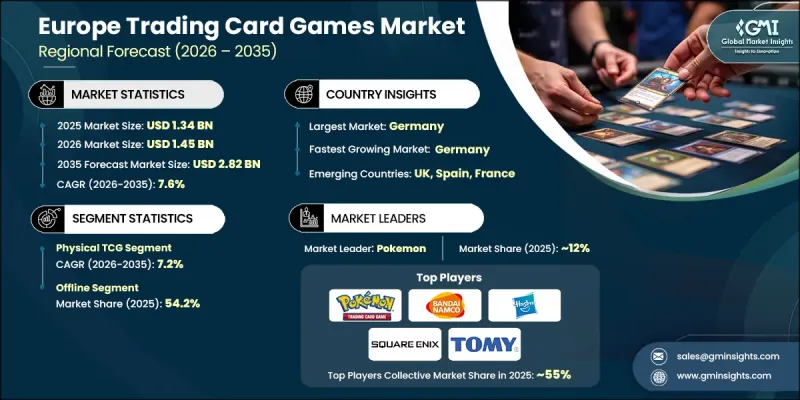
Growth across the region is supported by sustained demand for physical trading cards, which continue to dominate overall consumption. European players and collectors show a strong preference for tangible collectibles that combine visual appeal, rarity, and perceived long-term value. High production standards, limited-run releases, and a deeply rooted culture of in-person collecting reinforce the strength of the physical segment. The market is also benefiting from renewed enthusiasm among adult hobbyists, reflecting nostalgia-driven purchasing behavior that is influencing buying patterns across demographics. Many returning consumers are approaching trading cards both as a leisure pursuit and as an alternative asset class, strengthening resale activity and secondary-market liquidity. This resurgence is contributing to higher card valuations, greater event participation, and increased engagement across trading platforms and community gatherings. As a result, Europe's trading card games ecosystem remains dynamic, community-oriented, and investment-conscious, supporting steady revenue growth through 2035.
| Market Scope | |
|---|---|
| Start Year | 2025 |
| Forecast Year | 2026-2035 |
| Start Value | $1.34 Billion |
| Forecast Value | $2.82 Billion |
| CAGR | 7.6% |
The physical trading card games segment generated USD 1,120.7 million in 2025 and is anticipated to grow at a CAGR of 7.2% from 2026 to 2035. Collectors across Europe continue to favor physical cards due to their tactile qualities, display potential, and appreciation prospects over time. Unlike digital formats, physical cards provide direct ownership, allow in-person exchanges, and can be preserved under controlled conditions to maintain quality. Market value is often influenced by scarcity, condition grading, and brand longevity, which further enhances their appeal. The ability to store, showcase, and trade these items physically reinforces their status as both collectibles and investment-oriented assets.
The offline distribution channel accounted for 54.2% share in 2025 and is expected to grow at a CAGR of 6.9% between 2026 and 2035. Physical retail outlets remain central to the European trading card games landscape, offering direct purchasing opportunities and immersive community engagement. Dedicated hobby retailers and specialty stores serve as hubs where enthusiasts gather to participate in organized play, exchange products, and receive expert guidance. Immediate product access and face-to-face interaction provide a competitive advantage that digital platforms cannot fully duplicate, preserving the importance of brick-and-mortar channels within the regional ecosystem.
Germany Trading Card Games Market represented 26.9% share in 2025, positioning it as a leading national contributor. The country benefits from a well-established hobby gaming culture supported by an active community of collectors and competitive players. A broad retail infrastructure, including specialty stores and digital sales platforms, ensures strong product accessibility. Domestic publishing capabilities further strengthen market development by tailoring offerings to local demand. German consumers demonstrate a pronounced interest in strategy-focused gameplay and premium production quality, contributing to steady demand for higher-value trading card products.
Key companies active in the Europe Trading Card Games Market include Konami, Hasbro, Ravensburger AG, Nintendo Co., Ltd., Bandai Namco, Panini S.p.A., Bushiroad Inc., Square Enix, Upper Deck Company, Tomy Co. Ltd., Fanatics, Fantasy Flight, Legend Story Studios, Pokemon, and Kayou. These players compete through product innovation, franchise expansion, limited-edition launches, and strong organized-play ecosystems that reinforce long-term brand loyalty.
Companies operating in the Europe Trading Card Games Market are strengthening their foothold through strategic product differentiation, localized publishing initiatives, and expansion of organized competitive events. Many publishers are introducing premium print runs, graded collectibles, and controlled-release strategies to enhance scarcity and value perception. Firms are also investing in community-building initiatives, tournament sponsorships, and retailer partnerships to reinforce in-person engagement. Strengthening omnichannel distribution models allows brands to balance physical retail presence with digital commerce growth.
Table of Contents
Chapter 1 Methodology & Scope
- 1.1 Market scope and definition
- 1.2 Research design
- 1.2.1 Research approach
- 1.2.2 Data collection methods
- 1.3 Data mining sources
- 1.3.1 Global
- 1.3.2 Regional/Country
- 1.4 Base estimates and calculations
- 1.4.1 Base year calculation
- 1.4.2 Key trends for market estimation
- 1.5 Primary research and validation
- 1.5.1 Primary sources
- 1.6 Forecast model
- 1.7 Research assumptions and limitations
Chapter 2 Executive Summary
- 2.1 Industry 360° synopsis
- 2.2 Key market trends
- 2.2.1 Regional
- 2.2.2 Product type
- 2.2.3 Franchise
- 2.2.4 Release type
- 2.2.5 Price range
- 2.2.6 Consumer group
- 2.2.7 Distribution channel
Chapter 3 Industry Insights
- 3.1 Industry ecosystem analysis
- 3.1.1 Supplier landscape
- 3.1.2 Profit margin
- 3.1.3 Value addition at each stage
- 3.1.4 Factor affecting the value chain
- 3.2 Industry impact forces
- 3.2.1 Growth drivers
- 3.2.1.1 Strong expansion of physical card demand
- 3.2.1.2 Growing collector community & nostalgia effect
- 3.2.1.3 Expanding demographics and cross-generational engagement
- 3.2.2 Industry pitfalls & challenges
- 3.2.2.1 Counterfeit products and authenticity challenges
- 3.2.2.2 Environmental and sustainability concerns
- 3.2.1 Growth drivers
- 3.3 Growth potential analysis
- 3.4 Future market trends
- 3.5 Technology and innovation landscape
- 3.5.1 Current technological trends
- 3.5.2 Emerging technologies
- 3.6 Price trends
- 3.6.1 By product type
- 3.7 Regulatory landscape
- 3.7.1 Standards and compliance requirements
- 3.7.2 Regional regulatory frameworks
- 3.7.3 Certification standards
- 3.8 Trade data analysis
- 3.8.1 Import/export volume & value trends
- 3.8.2 Key trade corridors & tariff impact
- 3.9 Impact of ai & generative ai on the market
- 3.9.1 AI-driven disruption of existing business models
- 3.9.2 Genai use cases & adoption roadmap by segment
- 3.9.3 Risks, limitations & regulatory considerations
- 3.10 Porter's analysis
- 3.11 PESTEL analysis
- 3.12 Consumer behavior analysis
- 3.12.1 Purchasing patterns
- 3.12.2 Preference analysis
- 3.12.3 Regional variations in consumer behavior
- 3.12.4 Impact of e-commerce on buying decisions
Chapter 4 Competitive Landscape, 2025
- 4.1 Introduction
- 4.2 Company market share analysis
- 4.3 Company matrix analysis
- 4.4 Competitive analysis of major market players
- 4.5 Competitive positioning matrix
- 4.6 Key developments
- 4.6.1 Mergers & acquisitions
- 4.6.2 Partnerships & collaborations
- 4.6.3 New product launches
- 4.6.4 Expansion plans
Chapter 5 Market Estimates & Forecast, By Product Type, 2022 - 2035, (USD Million) (Million Units)
- 5.1 Key trends
- 5.2 Physical TCG
- 5.2.1 Booster packs
- 5.2.2 Booster boxes
- 5.2.3 Starter decks
- 5.2.4 Collector/premium products
- 5.2.5 Tins & blister packs
- 5.3 Digital TCG
Chapter 6 Market Estimates & Forecast, By Franchise, 2022 - 2035, (USD Million) (Million Units)
- 6.1 Key trends
- 6.2 Pokemon
- 6.3 Magic: the gathering
- 6.4 Yu-gi-oh!
- 6.5 Anime/manga tcgs
- 6.6 Star wars
- 6.7 Others (vanguard, etc.)
Chapter 7 Market Estimates & Forecast, By Release Type, 2022 - 2035, (USD Million) (Million Units)
- 7.1 Key trends
- 7.2 Standard sets
- 7.3 Special/limited editions
- 7.4 Promotional products
- 7.5 Reprints/reissues
Chapter 8 Market Estimates & Forecast, By Price, 2022 - 2035, (USD Million) (Million Units)
- 8.1 Key trends
- 8.2 Economy (USD 3- USD 15)
- 8.3 Mid-Tier (USD 15 - USD 50)
- 8.4 Premium (USD 50 - USD 150)
- 8.5 Ultra-Premium (Above USD 150)
Chapter 9 Market Estimates & Forecast, By Consumer Group, 2022 - 2035, (USD Million) (Million Units)
- 9.1 Key trends
- 9.2 Players/gamers
- 9.3 Investors/collector
- 9.4 Children/families
Chapter 10 Market Estimates & Forecast, By Distribution Channel, 2022 - 2035, (USD Million) (Million Units)
- 10.1 Key trends
- 10.2 Online
- 10.2.1 E-commerce website
- 10.2.2 Company owned website
- 10.3 Offline
- 10.3.1 Mass retail stores
- 10.3.2 Specialty stores
- 10.3.3 Others
Chapter 11 Market Estimates & Forecast, By Country, 2022 - 2035, (USD Million) (Million Units)
- 11.1 Key trends
- 11.2 Germany
- 11.3 UK
- 11.4 France
- 11.5 Italy
- 11.6 Spain
- 11.7 Russia
Chapter 12 Company Profiles
- 12.1 Bandai Namco
- 12.2 Bushiroad Inc.
- 12.3 Fanatics/Topps
- 12.4 Fantasy Flight
- 12.5 Hasbro
- 12.6 Kayou
- 12.7 Konami
- 12.8 Legend Story Studios
- 12.9 Nintendo Co., Ltd.
- 12.10 Panini S.p.A.
- 12.11 Pokemon
- 12.12 Ravensburger AG
- 12.13 Square Enix
- 12.14 Tomy Co. Ltd.
- 12.15 Upper Deck Company

