
PUBLISHER: Global Market Insights Inc. | PRODUCT CODE: 1982332

PUBLISHER: Global Market Insights Inc. | PRODUCT CODE: 1982332
Plate Heat Exchanger Market Opportunity, Growth Drivers, Industry Trend Analysis, and Forecast 2026 - 2035
The Global Plate Heat Exchanger Market was valued at USD 5.1 billion in 2025 and is estimated to grow at a CAGR of 8.4% to reach USD 11.5 billion by 2035.
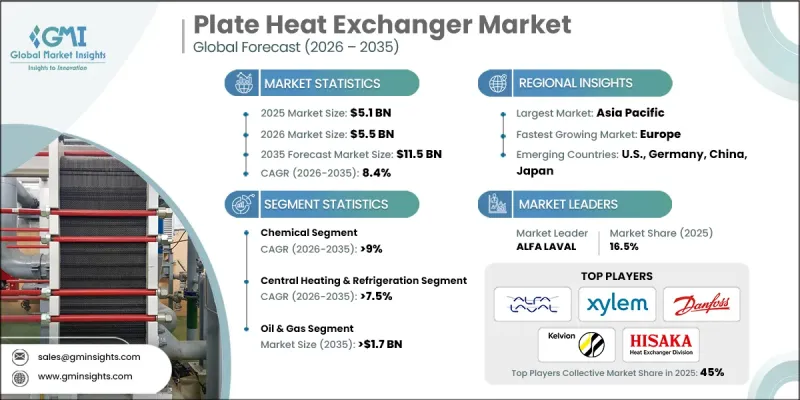
Growth in heavy industrial activities, coupled with rising demand for efficient heating and cooling solutions in industrial processes, is shaping the market landscape. Regulatory initiatives to lower carbon emissions, along with increasing adoption of high-efficiency equipment and smart digital monitoring systems, are further boosting demand. There is a notable shift toward sustainable and low-emission energy solutions, reinforcing the need for energy-efficient technologies. Manufacturers are focusing on compact, lightweight, and high-performance heat exchanger designs, integrating advanced materials, modular structures, and sensor-enabled smart systems to enhance operational efficiency. The adoption of heat recovery systems, low-carbon technologies, and improvements in industrial infrastructure are driving market expansion while promoting optimized thermal management and energy conservation.
| Market Scope | |
|---|---|
| Start Year | 2025 |
| Forecast Year | 2026-2035 |
| Start Value | $5.1 Billion |
| Forecast Value | $11.5 Billion |
| CAGR | 8.4% |
The chemical sector accounted for 27% share in 2025 and is projected to grow at a CAGR of 9% through 2035. Growth is fueled by rising chemical production and the increasing requirement for compact, energy-efficient heat exchangers capable of handling high-temperature and corrosive fluids. Plate heat exchangers provide high heat transfer efficiency, easy maintenance, and customization, making them ideal for chemical processes and industrial applications.
U.S. Plate Heat Exchanger Market held 83.3% in 2025, generating USD 776.3 million. The region's growth is supported by rising industrial demand for efficient and reliable heat transfer solutions, government emission reduction initiatives, ongoing industrial expansion, renewable energy projects, and the integration of automated and smart monitoring systems.
Key players in the Global Plate Heat Exchanger Market include ALFA LAVAL, HRS Heat Exchangers, Kelvion Holding, BARRIQUAND Group, UNITED HEAT Exchangers, SPX FLOW, TENEZ, Funke Warmeaustauscher Apparatebau, Accessen Group, Kinam Engineering Industries, SonFlow, Dry Coolers, Thermofin, API Heat Transfer, HISAKA WORKS, SWEP International, HFM, Wessels, and Xylem. Companies operating in the Plate Heat Exchanger Market are pursuing strategies to strengthen their market position by investing in R&D to develop high-efficiency, modular, and sensor-enabled systems. Firms are expanding production capacities, adopting advanced materials, and improving customization options for various industrial processes. Strategic partnerships with end-users and service providers enhance market penetration, while geographic expansion into emerging industrial hubs increases their global footprint. Emphasis on energy-efficient and environmentally friendly solutions, integration of smart monitoring systems, and digitalization initiatives also help companies improve customer retention, operational efficiency, and brand recognition, solidifying their presence in a competitive landscape.
Table of Contents
Chapter 1 Methodology & Scope
- 1.1 Research design
- 1.2 Quality commitment
- 1.2.1 GMI AI policy & data integrity commitment
- 1.2.1.1 Source consistency protocol
- 1.2.1 GMI AI policy & data integrity commitment
- 1.3 Research Trail & Confidence Scoring
- 1.3.1 Research Trail Components
- 1.3.2 Scoring components
- 1.4 Data Collection
- 1.4.1 Partial list of primary sources
- 1.5 Data mining sources
- 1.5.1 Paid Sources
- 1.5.1.1 Sources, by region
- 1.5.1 Paid Sources
- 1.6 Base estimates and calculations
- 1.6.1 Base year calculation for any one approach
- 1.7 Forecast model
- 1.8 Research transparency addendum
- 1.8.1 Source attribution framework
- 1.8.2 Quality assurance metrics
- 1.8.3 Our commitment to trust
- 1.9 Market definitions
Chapter 2 Executive Summary
- 2.1 Industry synopsis, 2022 - 2035
- 2.2 Business trends
- 2.3 Application trends
- 2.4 Regional trends
Chapter 3 Industry Insights
- 3.1 Industry ecosystem analysis
- 3.1.1 Raw material availability & sourcing analysis
- 3.1.2 Key factors affecting the value chain
- 3.1.3 Disruptions
- 3.2 Regulatory landscape
- 3.3 Industry impact forces
- 3.3.1 Growth drivers
- 3.3.2 Industry pitfalls & challenges
- 3.4 Growth potential analysis
- 3.5 Porter's analysis
- 3.5.1 Bargaining power of suppliers
- 3.5.2 Bargaining power of buyers
- 3.5.3 Threat of new entrants
- 3.5.4 Threat of substitutes
- 3.6 PESTEL analysis
- 3.6.1 Political factors
- 3.6.2 Economic factors
- 3.6.3 Social factors
- 3.6.4 Technological factors
- 3.6.5 Legal factors
- 3.6.6 Environmental factors
- 3.7 Cost structure analysis of plate heat exchanger
- 3.8 Emerging opportunities & trends
- 3.8.1 Digital transformation with IoT technologies
- 3.8.2 Emerging market penetration
- 3.9 Investment analysis & future outlook
Chapter 4 Competitive Landscape, 2025
- 4.1 Introduction
- 4.2 Company market share analysis, by region, 2025
- 4.2.1 North America
- 4.2.2 Europe
- 4.2.3 Asia Pacific
- 4.2.4 Middle East & Africa
- 4.2.5 Latin America
- 4.3 Strategic initiatives
- 4.3.1 Key partnerships & collaborations
- 4.3.2 Major M&A activities
- 4.3.3 Product innovations & launches
- 4.3.4 Market expansion strategies
- 4.4 Competitive benchmarking
- 4.5 Strategic dashboard
- 4.6 Innovation & sustainability landscape
Chapter 5 Market Size and Forecast, By Application, 2022 - 2035 (USD Million)
- 5.1 Key trends
- 5.2 Oil & gas
- 5.3 Chemical
- 5.4 Power generation & metallurgy
- 5.5 Marine
- 5.6 Mechanical industry
- 5.7 Central heating & refrigeration
- 5.8 Food processing
- 5.9 Others
Chapter 6 Market Size and Forecast, By Region, 2022 - 2035 (USD Million)
- 6.1 Key trends
- 6.2 North America
- 6.2.1 U.S.
- 6.2.2 Canada
- 6.2.3 Mexico
- 6.3 Europe
- 6.3.1 Germany
- 6.3.2 UK
- 6.3.3 France
- 6.3.4 Russia
- 6.3.5 Italy
- 6.3.6 Spain
- 6.3.7 Poland
- 6.3.8 Turkey
- 6.4 Asia Pacific
- 6.4.1 China
- 6.4.2 Japan
- 6.4.3 South Korea
- 6.4.4 India
- 6.4.5 Indonesia
- 6.4.6 Malaysia
- 6.4.7 Thailand
- 6.4.8 Vietnam
- 6.4.9 Philippines
- 6.4.10 Australia
- 6.5 Middle East & Africa
- 6.5.1 Saudi Arabia
- 6.5.2 UAE
- 6.5.3 Egypt
- 6.5.4 South Africa
- 6.5.5 Nigeria
- 6.6 Latin America
- 6.6.1 Brazil
- 6.6.2 Argentina
- 6.6.3 Colombia
- 6.6.4 Chile
Chapter 7 Company Profiles
- 7.1 ALFA LAVAL
- 7.2 Accessen Group
- 7.3 API Heat Transfer
- 7.4 BARRIQUAND Group
- 7.5 Danfoss
- 7.6 Dry Coolers
- 7.7 FUNKE Warmeaustauscher Apparatebau GmbH
- 7.8 HFM
- 7.9 HISAKA WORKS
- 7.10 HRS Heat Exchangers
- 7.11 Kelvion Holding
- 7.12 Kinam Engineering Industries
- 7.13 SonFlow
- 7.14 SPX FLOW
- 7.15 SWEP International
- 7.16 TENEZ
- 7.17 Thermofin
- 7.18 UNITED HEAT EXCHANGERS
- 7.19 Wessels Company
- 7.20 Xylem

