
PUBLISHER: Global Market Insights Inc. | PRODUCT CODE: 1998657

PUBLISHER: Global Market Insights Inc. | PRODUCT CODE: 1998657
Latin America Passenger Electric Vehicle Market Opportunity, Growth Drivers, Industry Trend Analysis, and Forecast 2026 - 2035
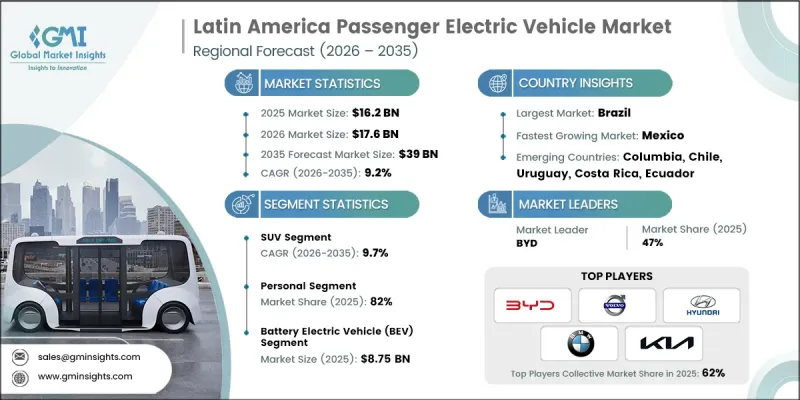
Latin America Passenger Electric Vehicle Market was valued at USD 16.2 billion in 2025 and is estimated to grow at a CAGR of 9.2% to reach USD 39 billion by 2035.
Across the region, policy frameworks encouraging low-emission transportation, combined with rising awareness of environmental sustainability, are driving the shift toward electric mobility. Investments in renewable energy integration and electrified urban infrastructure are also strengthening the ecosystem needed to support EV adoption. Consumers are becoming more interested in efficient and environmentally responsible transportation, particularly in densely populated urban centers where fuel costs and pollution concerns continue to grow. At the same time, technological progress in battery performance and vehicle efficiency is improving driving range, reliability, and overall vehicle value. The expansion of charging networks and improved energy distribution systems is further supporting this transition. As the region continues to modernize its transportation infrastructure, the passenger EV sector is evolving into an important pillar of Latin America's broader clean-energy and mobility transformation.
| Market Scope | |
|---|---|
| Start Year | 2025 |
| Forecast Year | 2026-2035 |
| Start Value | $16.2 Billion |
| Forecast Value | $39 Billion |
| CAGR | 9.2% |
Brazil continues to stand at the center of the Latin America passenger electric vehicle market, supported by a growing wave of international investment and favorable industrial policies that encourage electrification. The country is attracting substantial funding from global automotive manufacturers seeking to establish production capabilities and expand their presence in emerging EV markets. Ongoing development of public and private charging infrastructure is also strengthening consumer confidence in electric mobility. As the market matures, buyers are increasingly drawn to practical vehicle categories designed for everyday urban travel, especially models positioned at accessible price points. These trends are reinforcing Brazil's role as the leading hub for electric vehicle deployment in the region while creating opportunities for both domestic and international manufacturers to expand their portfolios and supply chains.
The SUV segment held 56% share in 2025 and is estimated to grow at a CAGR of 9.7% between 2026 and 2035 as consumers continue to favor versatile vehicles suited for both city driving and family transportation needs. Across South America, electric SUVs are gaining traction as manufacturers invest in expanding model availability and improving affordability. Competitive pricing strategies and increased product diversity are helping stimulate consumer adoption, while the segment's combination of practicality, interior space, and modern design continues to resonate with buyers seeking electric alternatives to traditional vehicles. As charging infrastructure improves and vehicle technology advances, the SUV segment is expected to remain a primary driver of EV demand across Latin America.
The personal use segment captured 82% share in 2025 and is expected to register a CAGR of 8.9% from 2026 to 2035 as more consumers transition toward electric mobility for daily transportation. Growing affordability of electric vehicles, combined with increased consumer awareness of sustainability and fuel savings, is encouraging individuals and families to consider EV ownership. Several countries across the region are experiencing rising adoption as urban drivers recognize the advantages of electric vehicles for commuting and routine travel. Expanding charging infrastructure, government incentives, and higher conventional fuel prices are further strengthening the appeal of electric vehicles for personal mobility, particularly in metropolitan areas where efficiency and operating costs are key considerations.
Brazil Passenger Electric Vehicle Market generated USD 11.1 billion in 2025. The country is rapidly evolving into a major destination for EV investments, with projected commitments from automakers expected to reach USD 25-26 billion by 2030. Continuous expansion of charging infrastructure, including both public stations and private installations, is playing a crucial role in accelerating adoption. Increasing public awareness of environmental sustainability and clean transportation is also encouraging consumers to explore electric vehicle options. Market demand is being shaped by vehicles that offer practicality for family transportation and daily urban mobility while supporting the country's broader environmental objectives. As Brazil continues strengthening its renewable energy integration and sustainable mobility policies, it is expected to maintain a dominant role in the regional electric vehicle industry.
Major companies operating in the Latin America Passenger Electric Vehicle Market include BMW, BYD, Chevrolet (GM), Ford, Honda, Hyundai, Kia, Nissan, Renault, and Volvo. Companies participating in the Latin America Passenger Electric Vehicle Market are focusing on several strategic initiatives to strengthen their competitive positions and expand their regional footprint. Automakers are increasing investments in local manufacturing facilities and supply chains to reduce production costs and respond more effectively to regional demand. Many companies are also expanding their electric vehicle portfolios by introducing models designed specifically for Latin American consumers, emphasizing affordability, efficiency, and practicality. Strategic partnerships with energy providers and infrastructure developers are being formed to accelerate the deployment of charging networks across major urban areas. In addition, companies are prioritizing battery technology improvements, digital connectivity features, and after-sales service networks to enhance customer experience and brand loyalty while reinforcing their long-term market presence.
Table of Contents
Chapter 1 Methodology & Scope
- 1.1 Research approach
- 1.2 Quality Commitments
- 1.2.1 GMI AI policy & data integrity commitment
- 1.2.1.1 Source consistency protocol
- 1.2.1 GMI AI policy & data integrity commitment
- 1.3 Research Trail & Confidence Scoring
- 1.3.1 Research Trail Components
- 1.3.2 Scoring Components
- 1.4 Data Collection
- 1.4.1 Partial list of primary sources
- 1.5 Data mining sources
- 1.5.1 Paid sources
- 1.5.1.1 Sources, by region
- 1.5.1 Paid sources
- 1.6 Base estimates and calculations
- 1.6.1 Base year calculation for any one approach
- 1.7 Forecast
- 1.7.1 Quantified market impact analysis
- 1.7.1.1 Mathematical impact of growth parameters on forecast
- 1.7.1 Quantified market impact analysis
- 1.8 Research transparency addendum
- 1.8.1 Source attribution framework
- 1.8.2 Quality assurance metrics
- 1.8.3 Our commitment to trust
Chapter 2 Executive Summary
- 2.1 Industry 360° synopsis
- 2.2 Key market trends
- 2.2.1 Regional
- 2.2.2 Drive
- 2.2.3 Propulsion
- 2.2.4 Vehicle
- 2.2.5 Application
- 2.2.6 Price
- 2.3 TAM Analysis, 2026-2035
- 2.4 CXO perspectives: Strategic imperatives
Chapter 3 Industry Insights
- 3.1 Industry ecosystem analysis
- 3.1.1 Supplier landscape
- 3.1.1.1 Battery Manufacturer
- 3.1.1.2 Component Supplier
- 3.1.1.3 OEM (Original Equipment Manufacturer)
- 3.1.1.4 Distributor / Dealer
- 3.1.1. 5 End user
- 3.1.2 Cost structure
- 3.1.3 Profit margin
- 3.1.4 Value addition at each stage
- 3.1.5 Vertical integration trends
- 3.1.6 Disruptors
- 3.1.1 Supplier landscape
- 3.2 Impact on forces
- 3.2.1 Growth drivers
- 3.2.1.1 Expansion of EV manufacturing hubs in Brazil and Mexico
- 3.2.1.2 Growing government incentives, subsidies, and tax benefits for EV
- 3.2.1.3 Rising environmental awareness and urban demand.
- 3.2.1.4 Increasing availability of affordable EV models
- 3.2.2 Industry pitfalls & challenges
- 3.2.2.1 Limited charging infrastructure in smaller cities and rural areas.
- 3.2.2.2 High upfront cost of EVs is relative to internal combustion vehicles.
- 3.2.3 Market opportunities
- 3.2.3.1 Premium EV segment expansion
- 3.2.3.2 Local battery production & supply chain development
- 3.2.1 Growth drivers
- 3.3 Technology trends & innovation ecosystem
- 3.3.1 Current technologies
- 3.3.2 Emerging technologies
- 3.4 Growth potential analysis
- 3.5 Regulatory landscape
- 3.5.1 Brazil
- 3.5.2 Mexico
- 3.5.3 Argentina
- 3.5.4 Peru
- 3.5.5 Columbia
- 3.5.6 Chile
- 3.6 Porter's analysis
- 3.7 PESTEL analysis
- 3.8 Patent analysis (Driven by Primary Research)
- 3.9 Pricing Analysis (Driven by Primary Research)
- 3.9.1 Historical Price Trend Analysis
- 3.9.2 Pricing Strategy by Player Type
- 3.10 Production statistics
- 3.10.1 Production hubs
- 3.10.2 Consumption hubs
- 3.11 Trade Data Analysis (Driven by Paid Database)
- 3.11.1 Import/Export Volume & Value Trends
- 3.11.2 Key Trade Corridors & Tariff Impact
- 3.12 Sustainability and environmental aspects
- 3.12.1 Sustainable practices
- 3.12.2 Waste reduction strategies
- 3.12.3 Energy efficiency in production
- 3.12.4 Eco-friendly initiatives
- 3.12.5 Carbon footprint considerations
- 3.13 Impact of AI & generative AI on the market
- 3.13.1 AI-driven disruption of existing business models
- 3.13.1.1 Predictive Maintenance & Operations Optimization
- 3.13.1.2 Automated design optimization
- 3.13.1.3 Supply chain AI for demand forecasting
- 3.13.1.4 GenAI use cases & adoption roadmap by segment
- 3.13.1.4.1 Tread pattern design generation
- 3.13.1.4.2 Customer service chatbots & technical support
- 3.13.1.4.3 Marketing content creation
- 3.13.1.4.4 Risks, limitations & regulatory considerations
- 3.13.1.4.4.1 Data privacy in IoT-enabled smart products
- 3.13.1.4.4.2 AI algorithm transparency requirements
- 3.13.1.4.4.3 Liability in AI-driven product failures
- 3.13.1 AI-driven disruption of existing business models
- 3.14 Forecast assumptions & scenario analysis (Driven by Primary Research)
- 3.14.1 Base Case - key macro & industry variables driving CAGR
- 3.14.2 Optimistic Scenarios - Favorable Macro and Industry Tailwinds
- 3.14.3 Pessimistic Scenario - Macroeconomic slowdown or industry headwinds
Chapter 4 Competitive Landscape, 2025
- 4.1 Introduction
- 4.2 Company market share analysis
- 4.2.1 Brazil
- 4.2.2 Mexico
- 4.2.3 Argentina
- 4.2.4 Peru
- 4.2.5 Columbia
- 4.2.6 Chile
- 4.3 Competitive analysis of major market players
- 4.4 Competitive positioning matrix
- 4.5 Company Tier Benchmarking
- 4.5.1 Tier Classification Criteria & Qualifying Thresholds
- 4.5.2 Tier Positioning Matrix by Revenue, Geography & Innovation
- 4.6 Key developments
- 4.6.1 Mergers & acquisitions
- 4.6.2 Partnerships & collaborations
- 4.6.3 New product launches
- 4.6.4 Expansion plans and funding
Chapter 5 Market Estimates & Forecast, By Vehicle, 2022 - 2035 ($ Bn, Units)
- 5.1 Key trends
- 5.2 Hatchback
- 5.3 Sedan
- 5.4 SUV
- 5.5 Others
Chapter 6 Market Estimates & Forecast, By Drive , 2022 - 2035 ($ Bn, Units)
- 6.1 Key trends
- 6.2 Front-wheel drive
- 6.3 Rear-wheel drive
- 6.4 All-wheel drive
Chapter 7 Market Estimates & Forecast, By Propulsion, 2022 - 2035 ($ Bn, Units)
- 7.1 Key trends
- 7.2 Battery Electric Vehicle (BEV)
- 7.3 Fuel Cell Electric Vehicle (FCEV)
- 7.4 Plug-in Hybrid Electric Vehicle (PHEV)
Chapter 8 Market Estimates & Forecast, By Application, 2022 - 2035 ($ Bn, Units)
- 8.1 Key trends
- 8.2 Personal
- 8.3 Commercial
Chapter 9 Market Estimates & Forecast By Price, 2022 - 2035 ($ Bn, Units)
- 9.1 Key trends
- 9.2 Entry
- 9.3 Mid-Range
- 9.4 Luxury
Chapter 10 Market Estimates & Forecast, By Region, 2022 - 2035 ($ Bn, Units)
- 10.1 Key trends
- 10.2 Brazil
- 10.3 Mexico
- 10.4 Argentina
- 10.5 Peru
- 10.6 Columbia
- 10.7 Chile
- 10.8 Uruguay
- 10.9 Costa Rica
- 10.10 Ecuador
- 10.11 Peru
- 10.12 Paraguay
Chapter 11 Company Profiles
- 11.1 Global players
- 11.1.1 Audi
- 11.1.2 BMW
- 11.1.3 Chevrolet (GM)
- 11.1.4 Ford
- 11.1.5 Hyundai
- 11.1.6 Kia
- 11.1.7 Mercedes-Benz
- 11.1.8 Nissan
- 11.1.9 Renault
- 11.1.10 Tesla
- 11.1.11 Toyota
- 11.1.12 Volkswagen
- 11.1.13 Volvo
- 11.2 Regional players
- 11.2.1 BYD
- 11.2.2 Chery
- 11.2.3 Great Wall Motors
- 11.2.4 JAC Motors
- 11.2.5 MG (SAIC)
- 11.3 Emerging players
- 11.3.1 Chery Automobile
- 11.3.2 Geely
- 11.3.3 Quantum Motors

