PUBLISHER: Global Market Insights Inc. | PRODUCT CODE: 1998673

PUBLISHER: Global Market Insights Inc. | PRODUCT CODE: 1998673
Europe Industrial Labels Market Opportunity, Growth Drivers, Industry Trend Analysis, and Forecast 2026 - 2035
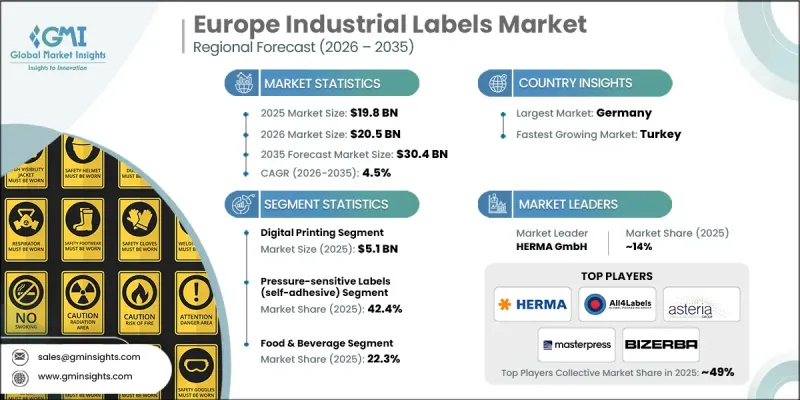
Europe Industrial Labels Market was valued at USD 19.8 billion in 2025 and is estimated to grow at a CAGR of 4.5% to reach USD 30.4 billion by 2035.
The Europe industrial labels industry is experiencing stable expansion as industrial activity and manufacturing capacity continue to increase across the region. As production environments grow more complex, companies require dependable labeling systems that support operational efficiency and equipment identification throughout facilities. Industrial labels play an essential role in identifying machinery, components, and operational assets while also conveying critical safety information within industrial settings. Expanding industrial infrastructure further increases the requirement for durable labeling solutions capable of withstanding challenging environments. Businesses across various sectors rely on labels to manage inventory visibility and promote supply chain transparency. Over the coming years, continued industrial development in automotive manufacturing, chemical processing, and electronics production will reinforce long-term demand for labeling technologies. Industrial environments often expose labels to extreme temperatures, chemicals, and abrasion, creating a strong demand for highly durable materials. Regulatory compliance across European markets also requires accurate product identification and hazard communication. In addition, the growth of cross-border trade across the European Union is encouraging the adoption of more uniform labeling practices. Organizations are increasingly prioritizing traceability and asset management systems supported by high-performance labeling solutions. The Europe industrial labels market is also benefiting from the growing integration of RFID and smart labeling technologies designed to improve operational monitoring and tracking capabilities.
| Market Scope | |
|---|---|
| Start Year | 2025 |
| Forecast Year | 2026-2035 |
| Start Value | $19.8 Billion |
| Forecast Value | $30.4 Billion |
| CAGR | 4.5% |
The digital printing segment generated USD 5.1 billion in 2025 and is forecast to grow at a CAGR of 5.1% between 2026 and 2035. Digital printing continues to lead the Europe industrial labels market because it provides exceptional operational flexibility and production efficiency. Modern digital technologies deliver highly consistent color output and precise print quality across various industrial labeling applications. The ability to produce shorter print runs helps reduce material waste while minimizing excess inventory storage requirements. Variable data printing capabilities support traceability initiatives used throughout manufacturing and logistics operations. Faster production cycles also allow businesses to respond quickly to regulatory updates and evolving product identification needs. Lower setup costs make digital printing particularly appealing to small and medium-sized businesses seeking efficient labeling solutions.
The pressure-sensitive labels segment accounted for 42.4% share in 2025 and is expected to grow at a CAGR of 5% from 2026 to 2035. These labels remain the most widely adopted product type due to their simple application process and adaptability across different surfaces. The self-adhesive design enables quick attachment without the need for specialized equipment, making them highly practical for industrial operations. Strong adhesive properties also ensure reliable performance in demanding environments where labels must remain intact over extended periods. Another advantage is their compatibility with both digital and traditional printing methods, allowing businesses to produce customized labeling solutions tailored to operational needs. As companies increasingly focus on product visibility and identification, pressure-sensitive labels continue to gain widespread adoption across industrial applications.
Germany Industrial Labels Market reached USD 3.2 billion in 2025 and is projected to grow at a CAGR of 4.2% through 2035. The Germany industrial labels industry benefits from the country's strong industrial base and highly developed logistics network. Large-scale manufacturing operations drive consistent demand for durable labeling solutions designed to perform in demanding environments. Strict regulatory frameworks also support the need for highly accurate and compliant labeling systems across multiple industries. The growth of logistics and distribution infrastructure contributes to steady demand for industrial labeling products. Companies in Germany are increasingly adopting advanced printing technologies that support barcode and RFID-based identification systems. Industrial sectors handling sensitive materials also require specialized labels designed to tolerate exposure to heat, chemicals, and other challenging conditions.
Key participants operating in the Europe Industrial Labels Market include All4Labels Global Packaging Group, Asteria Group, Bizerba SE & Co. KG, CS Labels, etifix GmbH, Etisoft Group, Euro Labels, HERMA GmbH, LabelExpress.eu, Masterpress S.A., MD Labels, Nordic Label Oy, OTK Group, S&K LABEL, and Schafer Etiketten GmbH. Companies active in the Europe Industrial Labels Market are strengthening their market position through several strategic initiatives. Many manufacturers focus on expanding production capabilities and upgrading printing technologies to improve efficiency and product quality. Businesses are also investing in advanced labeling solutions that support traceability and digital identification systems. Strategic partnerships with industrial clients and supply chain stakeholders help companies expand their customer base and secure long-term contracts. Product innovation remains another major strategy, with firms developing durable labeling materials designed for demanding industrial environments. Additionally, companies are strengthening distribution networks across European markets to improve service coverage and delivery speed.
Table of Contents
Chapter 1 Methodology & Scope
- 1.1 Market scope and definition
- 1.2 Research design
- 1.2.1 Research approach
- 1.2.2 Data collection methods
- 1.3 Data mining sources
- 1.3.1 Global
- 1.3.2 Country
- 1.4 Base estimates and calculations
- 1.4.1 Base year calculation
- 1.4.2 Key trends for market estimation
- 1.5 Primary research and validation
- 1.5.1 Primary sources
- 1.6 Forecast model
- 1.7 Research assumptions and limitations
Chapter 2 Executive Summary
- 2.1 Industry 360° synopsis
- 2.2 Key market trends
- 2.2.1 Country
- 2.2.2 Product Type
- 2.2.3 Material
- 2.2.4 Mechanism
- 2.2.5 Printing Technology
- 2.2.6 End Use Industry
- 2.3 CXO perspectives: Strategic imperatives
- 2.3.1 Key decision points for industry executives
- 2.3.2 Critical success factors for market players
- 2.4 Future outlook and strategic recommendations
Chapter 3 Industry Insights
- 3.1 Industry ecosystem analysis
- 3.1.1 Supplier landscape
- 3.1.2 Profit margin
- 3.1.3 Value addition at each stage
- 3.1.4 Factor affecting the value chain
- 3.2 Industry impact forces
- 3.2.1 Growth drivers
- 3.2.1.1 Growth of manufacturing and industrial operations
- 3.2.1.2 Rising adoption of RFID and smart label technologies
- 3.2.1.3 Stringent regulatory and compliance requirements
- 3.2.2 Pitfalls & Challenges
- 3.2.2.1 Raw material cost volatility
- 3.2.2.2 Complex and fragmented regulatory environment
- 3.2.3 Opportunities
- 3.2.3.1 Anti-counterfeit and security labeling technologies
- 3.2.3.2 Sustainable and eco-friendly labeling materials
- 3.2.1 Growth drivers
- 3.3 Growth potential analysis
- 3.4 Future market trends
- 3.5 Technology and innovation landscape
- 3.5.1 Current technological trends
- 3.5.2 Emerging technologies
- 3.6 Price trends
- 3.6.1 By region
- 3.6.2 By product
- 3.7 Regulatory landscape
- 3.7.1 Standards and compliance requirements
- 3.7.2 Regional regulatory frameworks
- 3.7.3 Certification standards
- 3.8 Trade statistics (HS Code - 4821)
- 3.8.1 Major importing countries
- 3.8.2 Major exporting countries
- 3.9 Porter’s analysis
- 3.10 PESTEL analysis
Chapter 4 Competitive Landscape, 2025
- 4.1 Introduction
- 4.2 Company market share analysis
- 4.2.1 By Country
- 4.2.1.1 Germany
- 4.2.1.2 UK
- 4.2.1.3 France
- 4.2.1.4 Italy
- 4.2.1.5 Spain
- 4.2.1.6 Netherlands
- 4.2.1.7 Turkey
- 4.2.1.8 Russia
- 4.2.1.9 Nordic Countries
- 4.2.1.10 Rest of Europe
- 4.2.1 By Country
- 4.3 Company matrix analysis
- 4.4 Competitive analysis of major market players
- 4.5 Competitive positioning matrix
- 4.6 Key developments
- 4.6.1 Mergers & acquisitions
- 4.6.2 Partnerships & collaborations
- 4.6.3 New product launches
- 4.6.4 Expansion plans
Chapter 5 Market Estimates & Forecast, By Product Type, 2022 - 2035, (USD Billion) (Thousand Units)
- 5.1 Key trends
- 5.2 Warning & Security Labels
- 5.3 Branding Labels
- 5.4 Tracking & Logistics Labels
- 5.5 Identification Labels
- 5.6 Regulatory & Compliance Labels
- 5.7 Smart Labels
- 5.8 Others
Chapter 6 Market Estimates & Forecast, By Material, 2022 - 2035, (USD Billion) (Thousand Units)
- 6.1 Key trends
- 6.2 Metal Labels
- 6.3 Plastic & Polymer Labels
- 6.4 Paper Labels
- 6.5 Sustainable & Recyclable Materials
- 6.6 Others
Chapter 7 Market Estimates & Forecast, By Mechanism, 2022 - 2035, (USD Billion) (Thousand Units)
- 7.1 Key trends
- 7.2 Pressure-Sensitive Labels (Self-Adhesive)
- 7.3 Glue-Applied Labels (Wet-Glued)
- 7.4 Heat Transfer Labels
- 7.5 In-Mold Labels (IML)
- 7.6 Sleeve Labels (Shrink & Stretch)
- 7.7 Multi-Part Tracking Labels
- 7.8 Linerless Labels
- 7.9 Others
Chapter 8 Market Estimates & Forecast, By Printing Technology, 2022 - 2035, (USD Billion) (Thousand Units)
- 8.1 Key trends
- 8.2 Digital Printing
- 8.3 Flexography
- 8.4 Lithography & Offset Printing
- 8.5 Screen Printing
- 8.6 Gravure Printing
- 8.7 Letterpress Printing
- 8.8 Laser Marking & Coding
- 8.9 Thermal Transfer Printing
- 8.10 Hybrid Printing Technologies
- 8.11 Others
Chapter 9 Market Estimates & Forecast, By End Use Industry, 2022 - 2035, (USD Billion) (Thousand Units)
- 9.1 Key trends
- 9.2 Transportation & Logistics
- 9.3 Automotive Industry
- 9.4 Healthcare & Pharmaceuticals
- 9.5 Food & Beverage
- 9.6 Electronics & Consumer Goods
- 9.7 Chemicals & Industrial Manufacturing
- 9.8 Personal Care & Cosmetics
- 9.9 Retail & E-Commerce
- 9.10 Others
Chapter 10 Market Estimates & Forecast, By Region, 2022 - 2035, (USD Billion) (Thousand Units)
- 10.1 Key trends
- 10.1.1 Germany
- 10.1.2 UK
- 10.1.3 France
- 10.1.4 Italy
- 10.1.5 Spain
- 10.1.6 Netherlands
- 10.1.7 Turkey
- 10.1.8 Russia
- 10.1.9 Nordic Countries
- 10.1.10 Rest of Europe
Chapter 11 Company Profiles
- 11.1 All4Labels Global Packaging Group
- 11.2 Asteria Group
- 11.3 Bizerba SE & Co. KG
- 11.4 CS Labels
- 11.5 etifix GmbH
- 11.6 Etisoft Group
- 11.7 Euro Labels
- 11.8 HERMA GmbH
- 11.9 LabelExpress.eu
- 11.10 Masterpress S.A.
- 11.11 MD Labels
- 11.12 Nordic Label Oy
- 11.13 OTK Group
- 11.14 S&K LABEL
- 11.15 Schafer Etiketten GmbH

