PUBLISHER: Global Market Insights Inc. | PRODUCT CODE: 1998826

PUBLISHER: Global Market Insights Inc. | PRODUCT CODE: 1998826
Industrial Labels Market Opportunity, Growth Drivers, Industry Trend Analysis, and Forecast 2026 - 2035
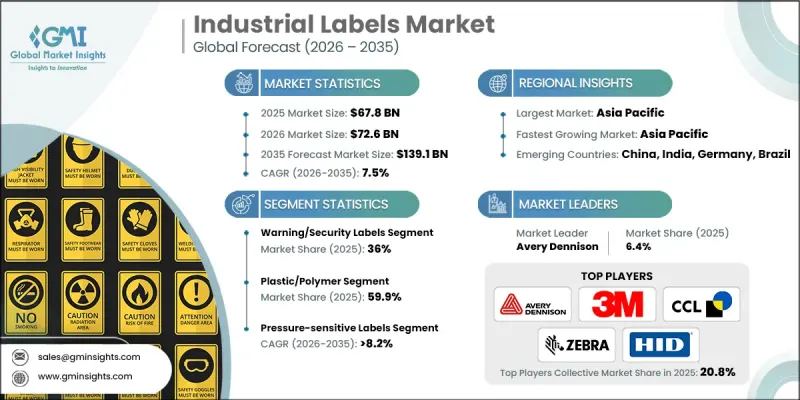
The Global Industrial Labels Market was valued at USD 67.8 billion in 2025 and is estimated to grow at a CAGR of 7.5% to reach USD 139.1 billion by 2035.
Growth within the industrial labels industry is supported by the increasing need for transparent supply chain operations, heightened focus on product security, and the expansion of various industrial sectors worldwide. Companies are also adopting advanced labeling solutions to address rising concerns related to counterfeit products and to ensure accurate product identification throughout manufacturing and distribution processes. In addition, the continued expansion of digital commerce and retail logistics networks has significantly increased the need for efficient product tracking and shipment identification. Businesses are increasingly deploying advanced labeling technologies to improve inventory management, enhance operational visibility, and maintain accurate product information across supply chains. The development of modern printing technologies has also enabled highly customizable labeling solutions that improve operational efficiency while reducing overall production costs. As industrial activity expands globally, the demand for advanced labeling solutions is expected to remain strong.
| Market Scope | |
|---|---|
| Start Year | 2025 |
| Forecast Year | 2026-2035 |
| Start Value | $67.8 Billion |
| Forecast Value | $139.1 Billion |
| CAGR | 7.5% |
The growth of multiple industries is further strengthening demand for labeling solutions used in identification and operational tracking. Increased manufacturing activity and expanding commercial operations are creating greater requirements for durable labeling technologies capable of supporting logistics and product tracking processes. At the same time, sustainability initiatives are encouraging the adoption of environmentally responsible labeling materials designed to reduce environmental impact. In addition, the growing scale of digital commerce operations has significantly increased parcel volumes and distribution complexity, which requires efficient labeling systems to maintain supply chain transparency and inventory accuracy across transportation networks.
The warning and security labels segment held 36% share in 2025. This segment maintains strong demand due to the increasing need for regulatory compliance, workplace safety standards, and secure product identification across industrial environments. These labels are widely utilized to communicate safety information, maintain equipment identification, and support compliance with industrial safety guidelines. Their durability and resistance to harsh environmental conditions make them suitable for long-term use in demanding operational environments, contributing to steady demand across multiple industries.
The plastic and polymer segment held 59.9% share in 2025. The widespread use of plastic-based labeling materials is largely driven by their durability, adaptability, and cost efficiency. Industrial-grade polymer materials provide strong resistance to moisture, chemicals, and temperature variations, making them suitable for demanding industrial conditions. Their lightweight structure and flexibility also enable efficient handling and large-scale production, supporting high-volume labeling requirements across manufacturing and logistics sectors.
North America Industrial Labels Market held a 31.7% share in 2025. The region's growth is largely driven by the increasing adoption of industrial automation and advanced manufacturing technologies. Businesses are implementing modern labeling solutions to improve asset tracking, minimize operational errors, and comply with strict regulatory requirements related to product identification and workplace safety. The expansion of logistics networks and the modernization of warehouse infrastructure are also contributing to rising demand for advanced labeling systems in the region. The rapid development of digital retail logistics and modern supply chain infrastructure in North America continues to support widespread adoption of industrial labels. Growing cargo volumes and increasingly complex distribution systems require accurate labeling solutions that enable efficient inventory management and operational visibility.
Key companies operating in the Global Industrial Labels Market include 3M, Avery Dennison, CCL Industries, Zebra Technologies, SATO, HERMA, Fuji Seal, HID Global, Multi-Color, Taghleef, UPM Raflatac, AWT, Camcode, Dura-ID, DYMO, ID Images, Inovar, Linepro Controls, MaverickLabel, Novexx Solutions, and Resource Label. Companies within the Global Industrial Labels Market are implementing several strategic initiatives to strengthen their competitive position and expand market presence. Leading manufacturers are investing heavily in research and development to create innovative labeling materials that offer enhanced durability, improved print quality, and greater environmental sustainability. Many organizations are focusing on developing smart labeling technologies integrated with digital identification solutions to improve supply chain transparency and operational tracking. Strategic partnerships with logistics providers and manufacturing companies are also helping firms expand their customer base and strengthen distribution networks. In addition, companies are increasing production capacity and introducing advanced digital printing technologies to deliver customized labeling solutions.
Table of Contents
Chapter 1 Methodology and Scope
- 1.1 Market scope and definition
- 1.2 Research design
- 1.2.1 Research approach
- 1.2.2 Data collection methods
- 1.3 Data mining sources
- 1.3.1 Global
- 1.3.2 Regional/Country
- 1.4 Base estimates and calculations
- 1.4.1 Base year calculation
- 1.4.2 Key trends for market estimation
- 1.5 Primary research and validation
- 1.5.1 Primary sources
- 1.6 Forecast model
- 1.7 Research assumptions and limitations
Chapter 2 Executive Summary
- 2.1 Industry 360° synopsis, 2022 - 2035
- 2.2 Key market trends
- 2.2.1 Product type trends
- 2.2.2 Material trends
- 2.2.3 Mechanism trends
- 2.2.4 Printing technology trends
- 2.2.5 End-use industry trends
- 2.2.6 Regional trends
- 2.3 TAM Analysis, 2026-2035
- 2.4 CXO perspectives: Strategic imperatives
Chapter 3 Industry Insights
- 3.1 Industry ecosystem analysis
- 3.1.1 Supplier Landscape
- 3.1.2 Profit Margin
- 3.1.3 Cost structure
- 3.1.4 Value addition at each stage
- 3.1.5 Factor affecting the value chain
- 3.1.6 Disruptions
- 3.2 Industry impact forces
- 3.2.1 Growth drivers
- 3.2.1.1 Increasing demand for supply chain traceability
- 3.2.1.2 Rising focus on product safety and security
- 3.2.1.3 Growth in e-commerce and retail sectors
- 3.2.1.4 Increasing concerns about counterfeit products
- 3.2.1.5 Expansion of industrial sectors
- 3.2.2 Industry pitfalls and challenges
- 3.2.2.1 Counterfeit labeling solutions
- 3.2.2.2 Technological integration costs
- 3.2.3 Market opportunities
- 3.2.3.1 Adoption of RFID and smart industrial labels
- 3.2.3.2 Sustainable and eco-friendly labeling solutions
- 3.2.1 Growth drivers
- 3.3 Growth potential analysis
- 3.4 Regulatory landscape
- 3.4.1 North America
- 3.4.2 Europe
- 3.4.3 Asia Pacific
- 3.4.4 Latin America
- 3.4.5 Middle East & Africa
- 3.5 Porter's analysis
- 3.6 PESTEL analysis
- 3.7 Technology and Innovation landscape
- 3.7.1 Current technological trends
- 3.7.2 Emerging technologies
- 3.8 Emerging business models
- 3.9 Compliance requirements
- 3.10 Patent and IP analysis
- 3.11 Trade Data Analysis (Based on Paid Databases)
- 3.11.1 Import/export volume & value trends
- 3.11.2 Key trade corridors & tariff impact
- 3.12 Impact of AI & generative AI on the market (Driven by Primary Research)
- 3.12.1 AI-driven disruption of existing business models
- 3.12.2 GenAI use cases & adoption roadmap by segment
- 3.12.3 Risks, limitations & regulatory considerations
- 3.13 Capacity & production landscape (Driven by Primary Research)
- 3.13.1 Production capacity by region & key producer
- 3.13.2 Capacity utilization rates & expansion pipelines
Chapter 4 Competitive Landscape, 2025
- 4.1 Introduction
- 4.2 Company market share analysis
- 4.2.1 By region
- 4.2.1.1 North America
- 4.2.1.2 Europe
- 4.2.1.3 Asia Pacific
- 4.2.1.4 Latin America
- 4.2.1.5 Middle East & Africa
- 4.2.2 Market concentration analysis
- 4.2.1 By region
- 4.3 Competitive benchmarking of key players
- 4.3.1 Financial performance comparison
- 4.3.1.1 Revenue
- 4.3.1.2 Profit margin
- 4.3.1.3 R&D
- 4.3.2 Product portfolio comparison
- 4.3.2.1 Product range breadth
- 4.3.2.2 Technology
- 4.3.2.3 Innovation
- 4.3.3 Geographic presence comparison
- 4.3.3.1 Global footprint analysis
- 4.3.3.2 Service network coverage
- 4.3.3.3 Market penetration by region
- 4.3.4 Competitive positioning matrix
- 4.3.4.1 Leaders
- 4.3.4.2 Challengers
- 4.3.4.3 Followers
- 4.3.4.4 Niche players
- 4.3.1 Financial performance comparison
- 4.4 Key developments
- 4.4.1 Mergers and acquisitions
- 4.4.2 Partnerships and collaborations
- 4.4.3 Technological advancements
- 4.4.4 Expansion and investment strategies
- 4.4.5 Digital transformation initiatives
- 4.5 Emerging/ startup competitors landscape
Chapter 5 Market Estimates and Forecast, By Product Type, 2022 - 2035 (USD Billion)
- 5.1 Key trends
- 5.2 Warning/security labels
- 5.3 Branding labels
- 5.4 Tracking labels
- 5.5 Identification labels
- 5.6 Others
Chapter 6 Market Estimates and Forecast, By Material, 2022 - 2035 (USD Billion & Units)
- 6.1 Key trends
- 6.2 Metal
- 6.3 Plastic/polymer
- 6.4 Paper
Chapter 7 Market Estimates and Forecast, By Mechanism, 2022 - 2035 (USD Billion & Units)
- 7.1 Key trends
- 7.2 Pressure-sensitive labels
- 7.3 Glue-applied labels
- 7.4 Heat transfer labels
- 7.5 Others
Chapter 8 Market Estimates and Forecast, By Printing Technology, 2022 - 2035 (USD Billion & Units)
- 8.1 Key trends
- 8.2 Digital printing
- 8.3 Lithography
- 8.4 Flexography
- 8.5 Screen printing
- 8.6 Others
Chapter 9 Market Estimates and Forecast, By End-use Industry, 2022 - 2035 (USD Billion & Units)
- 9.1 Key trends
- 9.2 Transportation & logistics
- 9.3 Construction
- 9.4 Automotive
- 9.5 Healthcare
- 9.6 Electronics & electrical
- 9.7 Chemicals
- 9.8 Others
Chapter 10 Market Estimates and Forecast, By Region, 2022 - 2035 (USD Billion & Units)
- 10.1 Key trends
- 10.2 North America
- 10.2.1 U.S.
- 10.2.2 Canada
- 10.3 Europe
- 10.3.1 Germany
- 10.3.2 UK
- 10.3.3 France
- 10.3.4 Spain
- 10.3.5 Italy
- 10.3.6 Netherlands
- 10.4 Asia Pacific
- 10.4.1 China
- 10.4.2 India
- 10.4.3 Japan
- 10.4.4 Australia
- 10.4.5 South Korea
- 10.5 Latin America
- 10.5.1 Brazil
- 10.5.2 Mexico
- 10.5.3 Argentina
- 10.6 Middle East and Africa
- 10.6.1 South Africa
- 10.6.2 Saudi Arabia
- 10.6.3 UAE
Chapter 11 Company Profiles
- 11.1 Global Key Players
- 11.1.1 3M
- 11.1.2 Avery Dennison
- 11.1.3 CCL Industries
- 11.1.4 Zebra Technologies
- 11.1.5 HID Global
- 11.1.6 SATO
- 11.1.7 UPM Raflatac
- 11.1.8 Multi-Color
- 11.1.9 Fuji Seal
- 11.2 Regional Players
- 11.2.1 AWT
- 11.2.2 Camcode
- 11.2.3 Dura-ID
- 11.2.4 DYMO
- 11.2.5 HERMA
- 11.2.6 Inovar
- 11.2.7 Novexx Solutions
- 11.2.8 Taghleef
- 11.2.9 Linepro Controls
- 11.3 Niche Players
- 11.3.1 ID Images
- 11.3.2 MaverickLabel
- 11.3.3 Resource Label

