
PUBLISHER: Global Market Insights Inc. | PRODUCT CODE: 1998685

PUBLISHER: Global Market Insights Inc. | PRODUCT CODE: 1998685
Laboratory and Medical Scale Ozone Generator Market Opportunity, Growth Drivers, Industry Trend Analysis, and Forecast 2026 - 2035
The Global Laboratory and Medical Scale Ozone Generator Market was valued at USD 57 million in 2025 and is estimated to grow at a CAGR of 9.3% to reach USD 136.7 million by 2035.
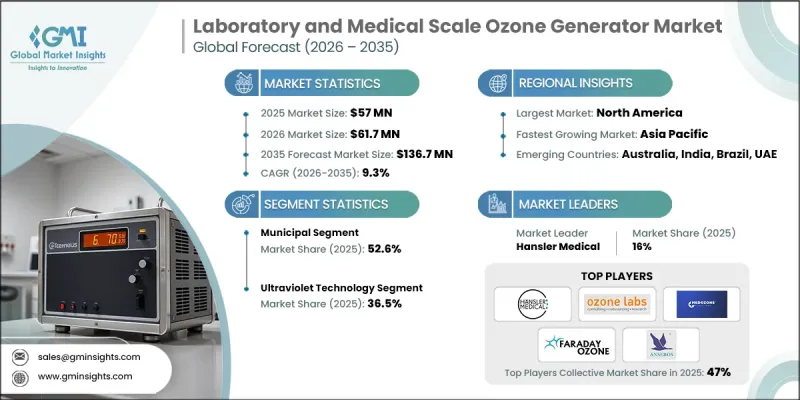
Growth in the laboratory and medical scale ozone generator market is influenced by the increasing need for efficient and cost-effective sterilization equipment that operates without producing hazardous residues. Healthcare and laboratory environments are placing stronger emphasis on environmentally responsible solutions that reduce reliance on chemical disinfectants while maintaining high sanitation standards. Ozone-based sterilization technologies are increasingly recognized for their ability to deliver strong microbial inactivation while supporting sustainable operational practices. Demand is also rising as institutions search for sterilization techniques capable of functioning effectively at lower temperatures, which supports the protection of delicate equipment and sensitive instruments. In addition, the focus on infection prevention across medical and research facilities is accelerating the adoption of advanced disinfection systems that can neutralize microorganisms in controlled environments. As regulatory bodies continue to promote improved hygiene standards across healthcare systems, ozone generators are becoming a preferred option for organizations seeking safe, residue-free, and environmentally responsible sterilization technologies.
| Market Scope | |
|---|---|
| Start Year | 2025 |
| Forecast Year | 2026-2035 |
| Start Value | $57 Million |
| Forecast Value | $136.7 Million |
| CAGR | 9.3% |
The commercial segment is projected to grow at a CAGR of 7.9% through 2035. Growing attention toward strict hygiene and contamination control protocols in professional laboratory and medical environments is encouraging the adoption of advanced ozone-based sterilization systems. Facilities are increasingly implementing technologies that support rapid and efficient microbial removal while minimizing the use of chemical disinfectants. The ability of ozone generators to deliver thorough sterilization without leaving residual substances is strengthening their appeal in operational environments that require high levels of cleanliness and safety.
The corona discharge technology segment is anticipated to register a CAGR of 8.4% by 2035. Adoption of this technology is rising due to its strong ozone production efficiency and adaptability for compact system designs. Corona discharge systems are widely preferred because they offer scalable performance while maintaining relatively lower operating costs compared with alternative ozone generation technologies. Their reduced dependence on consumable components further enhances their suitability for continuous sterilization processes commonly required in healthcare and research settings.
U.S. Laboratory and Medical Scale Ozone Generator Market is forecast to reach USD 49 million by 2035. Growth in the country is supported by strict healthcare regulations that encourage the use of effective sterilization technologies designed to minimize chemical exposure. Healthcare institutions and research laboratories across the United States are also increasing their focus on environmentally responsible operational practices. As a result, demand for ozone-based sterilization systems is expanding, particularly as organizations prioritize technologies that help eliminate hazardous chemical residues while maintaining high sanitation standards.
Prominent companies operating in the Global Laboratory and Medical Scale Ozone Generator Market include A2Z Ozone, Anseros Klaus Nonnenmacher GmbH, Aurozone, Bieffe Italia, Dinies Technologies, Eltech Ozone, Faraday Ozone, Hansler Medical, Jelight Company, LNI Swissgas, Longfian Scitech Co., Ltd, Medozons, MKS Instruments, OzoneLab, Oxidation Technologies, Ozone Engineering, Relyon plasma GmbH, Sedecal, Veolia Water Technologies & Solutions, and Xylem Water Solutions. Companies participating in the Laboratory and Medical Scale Ozone Generator Market are strengthening their market position through strategic investments in product development, technological innovation, and global distribution expansion. Many manufacturers are focusing on improving ozone generation efficiency, system reliability, and compact equipment designs to meet the operational needs of healthcare and research facilities. Businesses are also enhancing their research capabilities to develop advanced sterilization technologies that support sustainable and chemical-free disinfection practices. Strategic collaborations with healthcare providers, laboratory equipment suppliers, and research institutions are helping companies broaden product adoption and strengthen industry partnerships.
Table of Contents
Chapter 1 Methodology & Scope
- 1.1 Research design
- 1.2 Quality commitment
- 1.2.1 GMI AI policy & data integrity commitment
- 1.2.1.1 Source consistency protocol
- 1.2.1 GMI AI policy & data integrity commitment
- 1.3 Research Trail & Confidence Scoring
- 1.3.1 Research Trail Components
- 1.3.2 Scoring Components
- 1.4 Data Collection
- 1.4.1 Partial list of primary sources
- 1.5 Data mining sources
- 1.5.1 Paid sources
- 1.5.1.1 Sources, by region
- 1.5.1 Paid sources
- 1.6 Base estimates and calculations
- 1.6.1 Base year calculation for any one approach
- 1.7 Forecast model
- 1.8 Research transparency addendum
- 1.8.1 Source attribution framework
- 1.8.2 Quality assurance metrics
- 1.8.3 Our commitment to trust
- 1.9 Market definitions
Chapter 2 Executive Summary
- 2.1 Industry synopsis, 2022 - 2035
- 2.2 Business trends
- 2.3 Technology trends
- 2.4 End use trends
- 2.5 Regional trends
Chapter 3 Industry Insights
- 3.1 Industry ecosystem
- 3.1.1 Raw material availability & sourcing analysis
- 3.1.2 Manufacturing capacity assessment
- 3.1.3 Supply chain resilience & risk factors
- 3.1.4 Distribution network analysis
- 3.2 Regulatory landscape
- 3.3 Industry impact forces
- 3.3.1 Growth drivers
- 3.3.2 Industry pitfalls & challenges
- 3.4 Growth potential analysis
- 3.5 Porter's analysis
- 3.5.1 Bargaining power of suppliers
- 3.5.2 Bargaining power of buyers
- 3.5.3 Threat of new entrants
- 3.5.4 Threat of substitutes
- 3.6 PESTEL analysis
- 3.6.1 Political factors
- 3.6.2 Economic factors
- 3.6.3 Social factors
- 3.6.4 Technological factors
- 3.6.5 Legal factors
- 3.6.6 Environmental factors
- 3.7 Cost structure analysis
- 3.8 Price trend analysis (USD/Units)
- 3.8.1 By technology
- 3.9 Investment analysis & future outlook
- 3.9.1 Decentralization of water treatment
- 3.9.2 Digitalization and IoT integration
- 3.9.3 Energy efficiency innovations
- 3.10 Technology Innovation Landscape
- 3.10.1 Corona discharge technology advancements
- 3.10.2 Electrolytic ozone generation innovations
- 3.10.3 UV-based generation developments
- 3.10.4 Cold plasma technology evolution
Chapter 4 Competitive landscape, 2026
- 4.1 Introduction
- 4.2 Company market share analysis, by region, 2025
- 4.2.1 North America
- 4.2.2 Europe
- 4.2.3 Asia Pacific
- 4.2.4 Latin America
- 4.2.5 Middle East & Africa
- 4.3 Strategic dashboard
- 4.4 Strategic initiatives
- 4.5 Company benchmarking
- 4.6 Innovation & technology landscape
Chapter 5 Market Size and Forecast, By Technology, 2022 - 2035 (USD Million & Units)
- 5.1 Key trends
- 5.2 Ultraviolet
- 5.3 Cold plasma
- 5.4 Corona discharge
- 5.5 Electrolytic
Chapter 6 Market Size and Forecast, By End Use, 2022 - 2035 (USD Million & Units)
- 6.1 Key trends
- 6.2 Commercial
- 6.3 Municipal
- 6.4 Industrial
Chapter 7 Market Size and Forecast, By Region, 2022 - 2035 (USD Million & Units)
- 7.1 Key trends
- 7.2 North America
- 7.2.1 U.S.
- 7.2.2 Canada
- 7.3 Europe
- 7.3.1 Germany
- 7.3.2 UK
- 7.3.3 France
- 7.3.4 Russia
- 7.3.5 Italy
- 7.3.6 Spain
- 7.4 Asia Pacific
- 7.4.1 China
- 7.4.2 Australia
- 7.4.3 India
- 7.4.4 Japan
- 7.5 Middle East & Africa
- 7.5.1 Saudi Arabia
- 7.5.2 UAE
- 7.5.3 Egypt
- 7.6 Latin America
- 7.6.1 Brazil
- 7.6.2 Argentina
Chapter 8 Company Profiles
- 8.1 A2Z Ozone
- 8.2 Anseros Klaus Nonnenmacher GmbH
- 8.3 Aurozone
- 8.4 Bieffe Italia
- 8.5 Dinies Technologies
- 8.6 Eltech Ozone
- 8.7 Faraday Ozone
- 8.8 Hansler Medical
- 8.9 Jelight Company
- 8.10 LNI Swissgas
- 8.11 Longfian Scitech Co., Ltd
- 8.12 Medozons
- 8.13 MKS Instruments
- 8.14 OzoneLab
- 8.15 Ozone Engineers
- 8.16 Oxidation Technologies
- 8.17 Relyon plasma GmbH
- 8.18 Sedecal
- 8.19 Veolia Water Technologies & Solutions
- 8.20 Xylem Water Solutions

