
PUBLISHER: Global Market Insights Inc. | PRODUCT CODE: 2038712

PUBLISHER: Global Market Insights Inc. | PRODUCT CODE: 2038712
Industrial Ozone Generator Market Opportunity, Growth Drivers, Industry Trend Analysis, and Forecast 2026 - 2035
The Global Industrial Ozone Generator Market was valued at USD 156.6 million in 2025 and is estimated to grow at a CAGR of 7.3% to reach USD 311.2 million by 2035.
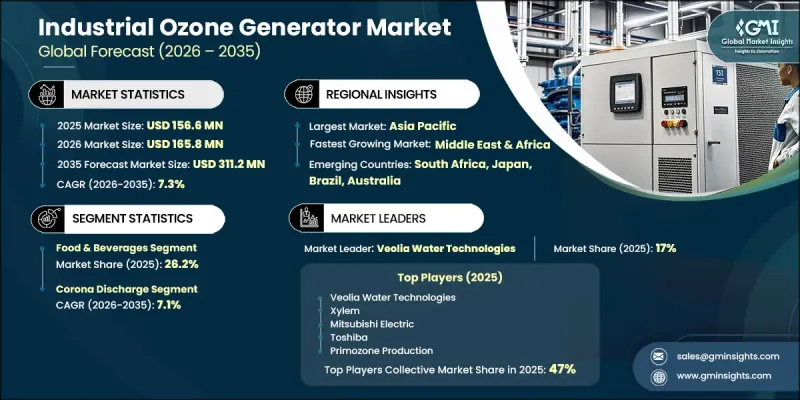
Market expansion is driven by increasing concerns surrounding chemical residues, workplace safety, and environmental impact, prompting industries to transition away from conventional disinfection methods toward ozone-based technologies. Ozone generators offer an effective on-site solution that eliminates the need for storing hazardous chemicals while naturally decomposing after use, aligning with corporate sustainability goals. Stricter enforcement of water quality standards and ongoing upgrades to aging infrastructure are further accelerating adoption across industrial sectors. Operators are increasingly shifting toward cleaner disinfection processes to meet tighter compliance requirements related to contaminants and by-products. The growing emphasis on hygiene, pathogen control, and operational efficiency is also supporting demand, as ozone delivers rapid microbial elimination and improved sanitation outcomes. Its ability to reduce downtime and enhance process efficiency makes it particularly valuable in high-volume industrial environments facing increased regulatory scrutiny and operational challenges.
| Market Scope | |
|---|---|
| Start Year | 2025 |
| Forecast Year | 2026-2035 |
| Start Value | $156.6 Million |
| Forecast Value | $311.2 Million |
| CAGR | 7.3% |
The food & beverages segment accounted for 26.2% share in 2025 and is expected to grow at a CAGR of 7.6% through 2035. Demand in this segment is supported by the rising need for chemical-free sanitation solutions that ensure product safety without leaving residues. Ozone is increasingly utilized for disinfection in processing environments due to its effectiveness in eliminating microorganisms and maintaining hygiene standards, contributing to longer product shelf life and improved safety compliance.
The ultraviolet technology segment is projected to grow at a CAGR of 7.6% by 2035. Its growth is driven by increasing demand for compact, low-maintenance, and energy-efficient ozone generation systems. This technology offers a simplified approach without reliance on high-voltage components, making it safer and easier to operate. Its suitability for controlled environments and applications requiring lower ozone concentrations further supports its adoption.
United States Industrial Ozone Generator Market is expected to reach USD 45.7 million by 2035. Growth in the region is supported by stringent regulatory requirements related to air and water quality, along with increasing demand for advanced sanitation and treatment solutions across industrial sectors. Rising focus on hygiene standards and regulatory compliance is further strengthening product adoption.
Key players operating in theGlobal Industrial Ozone Generator Market include Veolia Water Technologies, Xylem, Toshiba, Mitsubishi Electric, BIO-UV Group, Metawater, Primozone Production, Lenntech Water Treatment, Oxidation Technologies, Absolute Ozone, DEL Ozone, Mellifiq, Ebara Technologies, ORAIPL, Oxyzone Air Pvt. Ltd, Faraday Ozone, Guolin Industry, Guangzhou Quanju Ozone Technology, Guangzhou Jiahuan Appliance Technology, and ZonoSistem. Companies in the Industrial Ozone Generator Market are strengthening their market position through continuous innovation and strategic expansion initiatives. They are focusing on developing advanced, energy-efficient, and compact systems that meet evolving industrial requirements. Investments in research and development are enabling improvements in performance, safety, and operational efficiency. Strategic partnerships and collaborations with industrial operators are helping companies expand their customer base and enhance solution integration. Firms are also increasing their presence in emerging markets to capitalize on growing industrialization and infrastructure development.
Table of Contents
Chapter 1 Methodology & Scope
- 1.1 Research design
- 1.2 Quality commitment
- 1.2.1 GMI AI policy & data integrity commitment
- 1.2.1.1 Source consistency protocol
- 1.2.1 GMI AI policy & data integrity commitment
- 1.3 Research Trail & Confidence Scoring
- 1.3.1 Research Trail Components
- 1.3.2 Scoring Components
- 1.4 Data Collection
- 1.4.1 Partial list of primary sources
- 1.5 Data mining sources
- 1.5.1 Paid sources
- 1.5.1.1 Sources, by region
- 1.5.1 Paid sources
- 1.6 Base estimates and calculations
- 1.6.1 Base year calculation for any one approach
- 1.7 Forecast model
- 1.8 Research transparency addendum
- 1.8.1 Source attribution framework
- 1.8.2 Quality assurance metrics
- 1.8.3 Our commitment to trust
- 1.9 Market definitions
Chapter 2 Executive Summary
- 2.1 Industry synopsis, 2022 - 2035
- 2.2 Business trends
- 2.3 Technology trends
- 2.4 Application trends
- 2.5 End use trends
- 2.6 Capacity trends
- 2.7 Regional trends
Chapter 3 Industry Insights
- 3.1 Industry ecosystem
- 3.1.1 Raw material availability & sourcing analysis
- 3.1.2 Manufacturing capacity assessment
- 3.1.3 Supply chain resilience & risk factors
- 3.1.4 Distribution network analysis
- 3.2 Regulatory landscape
- 3.3 Industry impact forces
- 3.3.1 Growth drivers
- 3.3.2 Industry pitfalls & challenges
- 3.4 Growth potential analysis
- 3.5 Porter's analysis
- 3.5.1 Bargaining power of suppliers
- 3.5.2 Bargaining power of buyers
- 3.5.3 Threat of new entrants
- 3.5.4 Threat of substitutes
- 3.6 PESTEL analysis
- 3.6.1 Political factors
- 3.6.2 Economic factors
- 3.6.3 Social factors
- 3.6.4 Technological factors
- 3.6.5 Legal factors
- 3.6.6 Environmental factors
- 3.7 Cost structure analysis of industrial ozone generator
- 3.8 Price trend analysis (Driven by Primary Research)
- 3.8.1 Historical price trend analysis (Driven by Primary Research)
- 3.8.2 Industrial ozone generator pricing by technology (USD/Units) (Driven by Primary Research)
- 3.9 Trade data analysis (Driven by Primary Research)
- 3.9.1 Import/export value trends (Driven by Primary Research)
- 3.9.2 Key trade corridors & tariff impact (Driven by Primary Research)
- 3.10 Production capacity & utilization (Driven by Primary Research)
- 3.10.1 Production capacity by region (Driven by Primary Research)
- 3.10.2 Utilization rates and expansion pipeline (Driven by Primary Research)
- 3.11 Impact of AI & generative AI on the market [SOLUTION CORE]
- 3.11.1 Predictive maintenance & fault detection
- 3.11.2 Grid Optimization & Load Forecasting
- 3.11.3 Digital twin simulation & testing
- 3.12 Emerging opportunities & trends
- 3.12.1 Digitalization & IoT integration
- 3.12.2 Emerging market penetration
- 3.13 Overall investment scenario and future outlook
Chapter 4 Competitive landscape, 2026
- 4.1 Introduction
- 4.2 Company market share analysis, by region, 2025
- 4.2.1 North America
- 4.2.2 Europe
- 4.2.3 Asia Pacific
- 4.2.4 Latin America
- 4.2.5 Middle East & Africa
- 4.3 Strategic dashboard
- 4.4 Strategic initiatives
- 4.5 Company benchmarking
- 4.6 Innovation & technology landscape
Chapter 5 Market Size and Forecast, By Technology, 2022 - 2035 (USD Million & Units)
- 5.1 Key trends
- 5.2 Ultraviolet
- 5.3 Cold plasma
- 5.4 Corona discharge
- 5.5 Electrolytic
Chapter 6 Market Size and Forecast, By Application, 2022 - 2035 (USD Million & Units)
- 6.1 Key trends
- 6.2 Water treatment
- 6.3 Laboratory & medical equipment
- 6.4 Air treatment
- 6.5 Others
Chapter 7 Market Size and Forecast, By End Use, 2022 - 2035 (USD Million & Units)
- 7.1 Key trends
- 7.2 Automotive
- 7.3 Food & beverages
- 7.4 Textile
- 7.5 Pharmaceutical
- 7.6 Others
Chapter 8 Market Size and Forecast, By Capacity, 2022 - 2035 (USD Million & Units)
- 8.1 Key trends
- 8.2 ≤ 5 gm/hr
- 8.3 5 gm/hr - 100 gm/hr
- 8.4 100 gm/hr - 1 kg/hr
- 8.5 1 kg/hr - 5 kg/hr
- 8.6 > 5 kg/hr
Chapter 9 Market Size and Forecast, By Region, 2022 - 2035 (USD Million & Units)
- 9.1 Key trends
- 9.2 North America
- 9.2.1 U.S.
- 9.2.2 Canada
- 9.3 Europe
- 9.3.1 Germany
- 9.3.2 UK
- 9.3.3 France
- 9.3.4 Russia
- 9.3.5 Italy
- 9.3.6 Spain
- 9.4 Asia Pacific
- 9.4.1 China
- 9.4.2 Australia
- 9.4.3 India
- 9.4.4 Japan
- 9.4.5 South Korea
- 9.5 Middle East & Africa
- 9.5.1 Saudi Arabia
- 9.5.2 UAE
- 9.5.3 Egypt
- 9.6 Latin America
- 9.6.1 Brazil
- 9.6.2 Argentina
Chapter 10 Company Profiles
- 10.1 Absolute Ozone
- 10.2 BIO-UV Group
- 10.3 DEL Ozone
- 10.4 Ebara Technologies
- 10.5 Faraday Ozone
- 10.6 Guangzhou Jiahuan Appliance Technology
- 10.7 Guangzhou Quanju Ozone Technology
- 10.8 Guolin Industry
- 10.9 Lenntech Water Treatment
- 10.10 Mellifiq
- 10.11 Metawater
- 10.12 Mitsubishi Electric
- 10.13 ORAIPL
- 10.14 Oxidation Technologies
- 10.15 Oxyzone Air Pvt. Ltd
- 10.16 Primozone Production
- 10.17 Toshiba
- 10.18 Veolia Water Technologies
- 10.19 Xylem
- 10.20 ZonoSistem

