
PUBLISHER: Global Market Insights Inc. | PRODUCT CODE: 1998705

PUBLISHER: Global Market Insights Inc. | PRODUCT CODE: 1998705
Wine Cellar Market Opportunity, Growth Drivers, Industry Trend Analysis, and Forecast 2026 - 2035
The Global Wine Cellar Market was valued at USD 1.34 billion in 2025 and is estimated to grow at a CAGR of 5.1% to reach USD 2.21 billion by 2035.
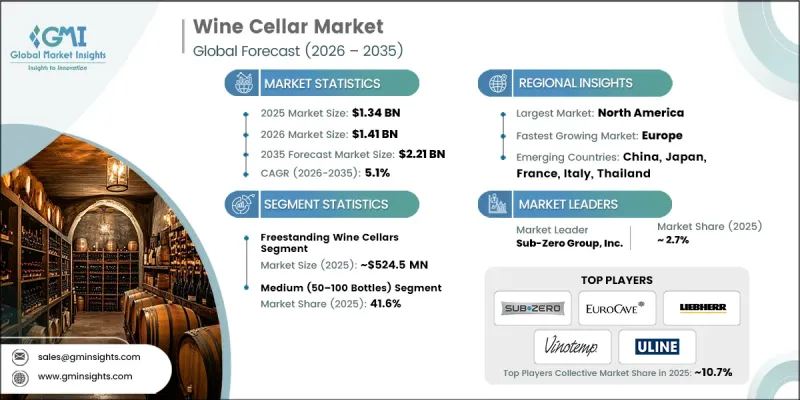
The increasing popularity of wine across the globe has created a rising demand for dedicated wine storage solutions that maintain optimal temperature, humidity, and overall storage conditions. Consumers and businesses are seeking specialized cellars to preserve luxury and aged wines for long-term use. Hotels, restaurants, and private residences are increasingly investing in wine storage spaces for both commercial and personal purposes. Greater availability of premium wines through e-commerce and direct-to-consumer channels has heightened awareness of proper storage practices. Advancements in climate-controlled cellars, energy-efficient cooling systems, and modular designs are encouraging new buyers. Rising disposable incomes and the growing culture of wine appreciation are driving both residential and luxury wine cellar adoption, making proper storage a key consideration for enthusiasts and hospitality operators alike.
| Market Scope | |
|---|---|
| Start Year | 2025 |
| Forecast Year | 2026-2035 |
| Start Value | $1.34 Billion |
| Forecast Value | $2.21 Billion |
| CAGR | 5.1% |
The freestanding wine cellar segment accounted for USD 524.5 million in 2025 and is expected to grow at a CAGR of 5.5% through 2035. Freestanding units are favored for their versatility and ease of installation, requiring only proper ventilation and electricity. They can be deployed in homes, apartments, or small businesses and offer features like adjustable shelving, temperature and humidity control, and energy-efficient cooling. Their adaptability, combined with growing trends in home entertaining, wine collecting, and boutique lodging, positions freestanding wine cellars as a substantial contributor to global market growth.
The commercial wine storage systems held the largest market share in 2025. These solutions are essential for restaurants, hotels, bars, wineries, and specialty wine retailers that require precise climate management for large collections. Commercial venues invest in advanced storage units with high capacity, organized racking systems, and long-term preservation capabilities to maintain wine quality and enhance customer experiences. The demand for larger, technologically sophisticated wine cellars is rising as businesses aim to offer premium beverage services while safeguarding valuable collections.
U.S. Wine Cellar Market reached USD 465.3 million in 2025 and is expected to grow at a CAGR of 5.1% through 2035. Market expansion is supported by growing interest in premium wine collections and home entertainment culture. Affluent households and wine enthusiasts are investing in modular and custom solutions to ensure optimal temperature, humidity, and lighting conditions. Residential remodeling and construction trends are driving demand for integrated wine rooms, basements, and kitchen wine storage. Specialty retailers and luxury home solution providers contribute to product accessibility with both prebuilt and customized offerings. High-end restaurants and hospitality businesses further boost the demand for commercial wine storage units to protect extensive collections and maintain service quality.
Leading companies in the Global Wine Cellar Market include Sub-Zero Group, Inc., EuroCave, LG Electronics, Liebherr Group, Bosch Home Appliances, Samsung Electronics, Perlick Corporation, Whirlpool (KitchenAid), Haier Group, Marvel Refrigeration, Miele, TRUE Manufacturing, Smeg, Vinotemp International, and U-Line Corporation. Key players in the Global Wine Cellar Market are focusing on strategic initiatives to enhance their market presence and strengthen their competitive position. Companies are investing in R&D to develop advanced climate-controlled and energy-efficient solutions that cater to both residential and commercial needs. Collaborations with luxury home builders, hospitality businesses, and e-commerce platforms expand product reach and brand visibility. Firms offer customizable modular designs to meet varying customer requirements. Geographic expansion into emerging wine markets ensures broader penetration. Additionally, businesses emphasize after-sales services, maintenance packages, and extended warranties to improve customer satisfaction and loyalty.
Table of Contents
Chapter 1 Methodology & Scope
- 1.1 Market scope and definition
- 1.2 Research design
- 1.2.1 Research approach
- 1.2.2 Data collection methods
- 1.3 Data mining sources
- 1.3.1 Global
- 1.3.2 Regional/Country
- 1.4 Base estimates and calculations
- 1.4.1 Base year calculation
- 1.4.2 Key trends for market estimation
- 1.5 Primary research and validation
- 1.5.1 Primary sources
- 1.6 Forecast model
- 1.7 Research assumptions and limitations
Chapter 2 Executive Summary
- 2.1 Industry 360° synopsis
- 2.2 Key market trends
- 2.2.1 Regional
- 2.2.2 Product Type
- 2.2.3 Capacity
- 2.2.4 Cooling Technology
- 2.2.5 Pricing
- 2.2.6 Application
- 2.2.7 Distribution channel
Chapter 3 Industry Insights
- 3.1 Industry ecosystem analysis
- 3.1.1 Supplier landscape
- 3.1.2 Profit margin
- 3.1.3 Value addition at each stage
- 3.1.4 Factor affecting the value chain
- 3.2 Industry impact forces
- 3.2.1 Growth drivers
- 3.2.1.1 Rising wine consumption and appreciation of premium wines globally
- 3.2.1.2 Growing adoption of residential and luxury home wine storage solutions
- 3.2.1.3 Expansion of hospitality and restaurant sectors with curated wine offerings
- 3.2.2 Pitfalls & Challenges
- 3.2.2.1 High installation and maintenance costs for custom wine cellars
- 3.2.2.2 Limited space availability in urban residences
- 3.2.3 Opportunities
- 3.2.3.1 Rising demand for modular and compact wine storage units
- 3.2.3.2 Integration with smart home and IoT technologies
- 3.2.1 Growth drivers
- 3.3 Growth potential analysis
- 3.4 Future market trends
- 3.5 Technology and innovation landscape
- 3.5.1 Current technological trends
- 3.5.2 Emerging technologies
- 3.6 Price trends
- 3.6.1 By region
- 3.6.2 By product
- 3.7 Regulatory landscape
- 3.7.1 Standards and compliance requirements
- 3.7.2 Regional regulatory frameworks
- 3.7.3 Certification standards
- 3.8 Porter's analysis
- 3.9 PESTEL analysis
- 3.10 Patent Landscape (Driven by Primary Research)
- 3.10.1 Patent Filing Trends by Technology Type
- 3.10.2 Key Patent Holders & Innovation Leaders
- 3.10.3 Emerging Patent Areas (Smart Technology, Cooling Innovations)
- 3.11 Trade Data Analysis (Driven by Paid Data Base)
- 3.11.1 Import/Export Volume & Value Trends (Driven by Paid Data Base)
- 3.11.2 Key Trade Corridors & Tariff Impact (Driven by Paid Data Base)
- 3.11.3 Major Importing Countries Analysis
- 3.11.4 Major Exporting Countries Analysis
- 3.12 Distribution Infrastructure & Channel Penetration Landscape (Driven by Primary Research)
- 3.12.1 Channel Coverage by Region & Format (Modern vs Traditional Trade) (Driven by Primary Research)
- 3.12.2 Last-Mile Infrastructure Gaps & Emerging Channel Shifts (Driven by Primary Research)
Chapter 4 Competitive Landscape, 2025
- 4.1 Introduction
- 4.2 Company market share analysis
- 4.2.1 By Region
- 4.2.1.1 North America
- 4.2.1.2 Europe
- 4.2.1.3 Asia Pacific
- 4.2.1.4 Latin America
- 4.2.1.5 Middle East & Africa
- 4.2.1 By Region
- 4.3 Company matrix analysis
- 4.4 Competitive analysis of major market players
- 4.5 Competitive positioning matrix
- 4.6 Key developments
- 4.6.1 Mergers & acquisitions
- 4.6.2 Partnerships & collaborations
- 4.6.3 New product launches
- 4.6.4 Expansion plans
Chapter 5 Market Estimates & Forecast, By Product Type, 2022 - 2035, (USD Million) (Thousand Units)
- 5.1 Key trends
- 5.2 Freestanding wine cellars
- 5.3 Built-in wine cellars
- 5.4 Walk-in wine cellars
- 5.5 Wine walls
- 5.6 Wine cabinets
- 5.7 Others
Chapter 6 Market Estimates & Forecast, By Capacity, 2022 - 2035, (USD Million) (Thousand Units)
- 6.1 Key trends
- 6.2 Small (under 50 bottles)
- 6.3 Medium (50-100 bottles)
- 6.4 Large (100-200 bottles)
- 6.5 Extra-large (over 200 bottles)
Chapter 7 Market Estimates & Forecast, By Cooling Technology, 2022 - 2035, (USD Million) (Thousand Units)
- 7.1 Key trends
- 7.2 Compressor-Based Cooling
- 7.3 Thermoelectric Cooling
- 7.4 Hybrid Cooling Systems
Chapter 8 Market Estimates & Forecast, By Pricing, 2022 - 2035, (USD Million) (Thousand Units)
- 8.1 Key trends
- 8.2 Economy
- 8.3 Mass
- 8.4 Premium
Chapter 9 Market Estimates & Forecast, By Application, 2022 - 2035, (USD Million) (Thousand Units)
- 9.1 Key trends
- 9.2 Residential
- 9.3 Commercial
- 9.3.1 Restaurants and bars
- 9.3.2 Hotels and resorts
- 9.3.3 Wine shops and tasting rooms
- 9.3.4 Others
Chapter 10 Market Estimates & Forecast, By Distribution Channel, 2022 - 2035, (USD Million) (Thousand Units)
- 10.1 Key trends
- 10.2 B2B
- 10.3 B2C
- 10.3.1 Specialty stores
- 10.3.2 Home improvement stores
- 10.3.3 Online retail
- 10.3.4 Department stores
- 10.3.5 Others
Chapter 11 Market Estimates & Forecast, By Region, 2022 - 2035, (USD Million) (Thousand Units)
- 11.1 Key trends
- 11.2 North America
- 11.2.1 U.S.
- 11.2.2 Canada
- 11.3 Europe
- 11.3.1 Germany
- 11.3.2 UK
- 11.3.3 France
- 11.3.4 Italy
- 11.3.5 Spain
- 11.4 Asia Pacific
- 11.4.1 China
- 11.4.2 India
- 11.4.3 Japan
- 11.4.4 South Korea
- 11.4.5 Australia
- 11.5 Latin America
- 11.5.1 Brazil
- 11.5.2 Mexico
- 11.5.3 Argentina
- 11.6 MEA
- 11.6.1 Saudi Arabia
- 11.6.2 UAE
- 11.6.3 South Africa
Chapter 12 Company Profiles
- 12.1 Sub-Zero Group, Inc.
- 12.2 EuroCave
- 12.3 Liebherr Group
- 12.4 Vinotemp International
- 12.5 U-Line Corporation
- 12.6 Haier Group
- 12.7 Samsung Electronics
- 12.8 LG Electronics
- 12.9 Whirlpool (KitchenAid)
- 12.10 Miele
- 12.11 Bosch Home Appliances
- 12.12 Perlick Corporation
- 12.13 Smeg
- 12.14 Marvel Refrigeration
- 12.15 TRUE Manufacturing

