
PUBLISHER: Mordor Intelligence | PRODUCT CODE: 2063287

PUBLISHER: Mordor Intelligence | PRODUCT CODE: 2063287
Smart Wine Cellar - Market Share Analysis, Industry Trends & Statistics, Growth Forecasts (2026 - 2031)
According to Mordor Intelligence, the smart wine cellar market size was valued at USD 1.65 billion in 2025 and is estimated to grow from USD 1.79 billion in 2026 to reach USD 2.72 billion by 2031, at a CAGR of 8.68% during the forecast period (2026-2031).
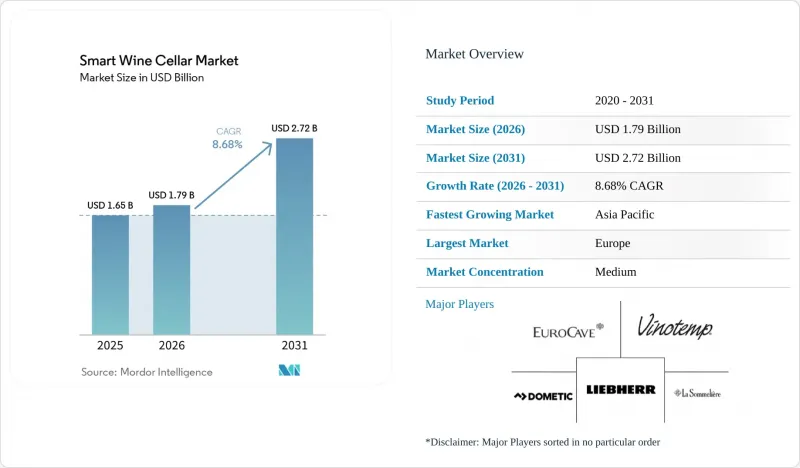
This report is Segmented by Product Type (Freestanding Smart Wine Cellars, Multi-Zone Smart Cabinets, Commercial-Grade Walk-In Smart Cellars, and More), Capacity (Up To 50 Bottles, and More), Connectivity/Technology (Wi-Fi Enabled With App Control, Cloud-Linked Cellar Management Platforms, and More), End-User (Residential, and More), and Geography. The Market Forecasts are Provided in Terms of Value (USD).
Global Smart Wine Cellar Market Trends and Insights
Connected-Home Penetration Uplifting Premium Appliance Demand
Smart-home ecosystems are shifting from individual gadgets to integrated platforms, positioning wine cellars as centerpiece appliances in open-concept kitchens. Voice-assistant compatibility, RFID tracking, and over-the-air updates raise average selling prices and shorten replacement cycles, especially as affluent homeowners seek unified dashboards across lighting, security, and refrigeration. Hospitality operators mirror this trend by embedding cellar data into property management systems, unlocking cross-sell opportunities for analytics-driven upselling.
Rising Wine Consumption in Emerging Economies
In 2024, global wine production reached a 60-year low, resulting in significant scarcity premiums across the market. Concurrently, urbanization and rising disposable incomes in countries such as China, Japan, India, Brazil, and Argentina are driving an increase in per-capita wine consumption. This growing demand for wine, coupled with limited supply, has created a challenging environment for merchants in these regions. To address these challenges, merchants are increasingly adopting advanced, climate-controlled storage solutions to preserve their scarce and valuable vintages. These systems are designed to maintain optimal storage conditions, ensuring the quality and longevity of the wine. Furthermore, the integration of cloud-managed technology in these storage solutions is enabling merchants to monitor and manage their inventory more efficiently. This trend is fueling the demand for high-capacity, technologically advanced storage systems, which are becoming essential tools in the wine supply chain.
High Upfront Cost vs. Conventional Coolers
Smart cellar prices, influenced by the inclusion of advanced features such as sensor arrays, connectivity modules, and natural-refrigerant compressors, are 40-70% higher than basic units. This significant price difference restricts their adoption in price-sensitive markets, where affordability remains a key concern. On the other hand, entry-level thermoelectric models, priced under USD 300, compete aggressively by catering to cost-conscious consumers. In contrast, premium smart versions, such as Liebherr's EWT 9275, are priced above USD 5,000, further widening the affordability gap and highlighting the stark contrast between basic and high-end offerings in the market.
Other drivers and restraints analyzed in the detailed report include:
- Residential Remodels Featuring Dedicated Wine Rooms
- Hospitality Sector Upgrades to IoT-Enabled Storage
- Limited Consumer Awareness Outside Connoisseur Niches
For complete list of drivers and restraints, kindly check the Table Of Contents.
Segment Analysis
Freestanding units commanded 60.77% of the Smart Wine Cellar market share in 2025, favored for their retrofit flexibility in established homes and small hospitality venues. Mid-tier North American brands dominate these retail channels, offering dual-zone Wi-Fi models at USD 1,500-3,500 price points. Built-in appliances entice remodelers seeking seamless cabinetry integration, while appliance giants leverage cross-category bundling to upsell undercounter solutions. Commercial-grade walk-in smart cellars are projected to grow at a 9.17% CAGR to 2031 as wineries and restaurateurs scale RFID-enabled storage, underscoring a shift toward large, serviceable footprints.
Walk-in formats enable modular expansion, redundant cooling, and centralized monitoring, meeting the needs of merchants facing vintage scarcity and direct-to-consumer fulfillment. Multi-zone cabinets remain popular in Asia-Pacific's space-constrained apartments, blending entertainment aesthetics with precise climate control. Competitive differentiation is migrating from compressor hardware to software, with cloud dashboards and predictive analytics defining the premium tier.
The 51-150 bottles band represented 46.23% of Smart Wine Cellar market size in 2025, matching typical collector inventories and standard kitchen footprints. Units below 50 bottles struggle to justify the cost of advanced electronics, as thermoelectric coolers commoditize the market. Demand is tilting toward above-150-bottle systems, forecast to grow at a 9.76% CAGR, as merchants, hotels, and high-net-worth collectors seek scalable storage with dual sensors and cloud alerts.
Vintage volatility, underscored by a 13% drop versus the ten-year production average in 2024, drives merchants to bank inventory and monetize cellar services such as paid aging. Large-capacity models facilitate upsized racking, vibration isolation, and multi-temperature zoning, differentiating premium cellars from conventional refrigerators. This trend reflects a growing demand for advanced storage solutions in the wine industry.
Geography Analysis
North America held 36.43% share in 2025. U.S. per-capita consumption dipped, sharpening focus on quality preservation over volume and driving demand for multi-zone smart solutions. State-level HFC bans mirror European regulation, nudging suppliers toward propane and isobutane refrigerants. Canada and Mexico add incremental growth through wine tourism investments in British Columbia and Baja California. Europe remains a significant market thanks to entrenched wine culture and stringent environmental mandates.
Regulation (EU) 2024/573 enforces the use of low-GWP refrigerants, and WEEE obligations raise recycling costs, rewarding manufacturers with design-for-recycling expertise. Premium built-in categories flourish under brands such as EuroCave and Climadiff, while replacement demand accelerates ahead of 2027 GWP caps. Asia-Pacific is the fastest-growing region, with an 8.86% CAGR, driven by urban affluence and import growth. Consumers in Tokyo, Seoul, Shanghai, and Mumbai gravitate toward compact multi-zone cabinets that blend with limited living spaces.
Awareness campaigns and direct-to-consumer channels are gradually closing knowledge gaps, while wineries in Australia and India are adopting IoT-enabled cellars to differentiate tasting-room experiences. South America and the Middle East and Africa contribute smaller bases but exhibit rising hospitality investments. Argentina's double-digit production rebound in 2024 and Brazil's urban middle-class expansion propel demand for scalable walk-in storage, whereas Gulf hospitality megaprojects integrate presentation-grade cellars into luxury dining concepts.
- EuroCave SAS
- Vinotemp International Corporation
- La Sommeliere International SAS
- Climadiff Development SAS
- Avintage (Frio Entreprise SAS)
- Artevino SAS
- Wine Enthusiast Companies Inc.
- Allavino LLC
- EdgeStar (Living Direct Inc.)
- Kalamera LLC
- Smith & Hanks Inc.
- Bodega Appliance Inc.
- Wine Guardian (Air Innovations Inc.)
- WhisperKOOL (Vinotheque Wine Cellars, Inc.)
- Summit Appliance - Felix Storch, Inc.
- Liebherr-Hausgerate Ochsenhausen GmbH
- Dometic Group AB (publ)
- Vintec Australia Pty Ltd
- mQuvee AB
- NewAir LLC
Additional Benefits:
- The market estimate (ME) sheet in Excel format
- 3 months of analyst support
TABLE OF CONTENTS
1 INTRODUCTION
- 1.1 Study Assumptions and Market Definition
- 1.2 Scope of the Study
2 RESEARCH METHODOLOGY
3 EXECUTIVE SUMMARY
4 MARKET LANDSCAPE
- 4.1 Market Overview
- 4.2 Market Drivers
- 4.2.1 Connected-Home Penetration Uplifting Premium Appliance Demand
- 4.2.2 Rising Wine Consumption in Emerging Economies
- 4.2.3 Residential Remodels Featuring Dedicated Wine Rooms
- 4.2.4 Hospitality Sector Upgrades to IoT-Enabled Storage
- 4.2.5 AI-Driven Flavor-Profiling Cellars for Collectors
- 4.2.6 Carbon-Neutral Refrigeration Mandates Spurring Replacements
- 4.3 Market Restraints
- 4.3.1 High Upfront Cost vs. Conventional Coolers
- 4.3.2 Limited Consumer Awareness Outside Connoisseur Niches
- 4.3.3 Semiconductor Supply-Chain Volatility Hitting Smart Controllers
- 4.3.4 E-Waste Regulations Increasing End-of-Life Compliance Costs
- 4.4 Industry Value-Chain Analysis
- 4.5 Regulatory Landscape
- 4.6 Technological Outlook
- 4.7 Impact of Macroeconomic Factors on the Market
- 4.8 Porter's Five Forces Analysis
- 4.8.1 Threat of New Entrants
- 4.8.2 Bargaining Power of Suppliers
- 4.8.3 Bargaining Power of Buyers
- 4.8.4 Threat of Substitutes
- 4.8.5 Competitive Rivalry
5 MARKET SIZE AND GROWTH FORECASTS (VALUE)
- 5.1 Product Type
- 5.1.1 Freestanding Smart Wine Cellars
- 5.1.2 Built-In / Integrated Smart Wine Cellars
- 5.1.3 Commercial-Grade Walk-In Smart Cellars
- 5.1.4 Multi-Zone Smart Cabinets
- 5.2 Capacity
- 5.2.1 Up to 50 Bottles
- 5.2.2 51-150 Bottles
- 5.2.3 Above 150 Bottles
- 5.3 Connectivity / Technology
- 5.3.1 Wi-Fi Enabled with App Control
- 5.3.2 Stand-Alone Smart Sensors and Controllers
- 5.3.3 Cloud-Linked Cellar Management Platforms
- 5.4 End-User
- 5.4.1 Residential
- 5.4.2 Commercial, Restaurants and Hospitality
- 5.4.3 Wineries and Wine Merchants
- 5.5 Geography
- 5.5.1 North America
- 5.5.1.1 United States
- 5.5.1.2 Canada
- 5.5.1.3 Mexico
- 5.5.2 Europe
- 5.5.2.1 Germany
- 5.5.2.2 United Kingdom
- 5.5.2.3 France
- 5.5.2.4 Russia
- 5.5.2.5 Rest of Europe
- 5.5.3 Asia-Pacific
- 5.5.3.1 China
- 5.5.3.2 Japan
- 5.5.3.3 India
- 5.5.3.4 South Korea
- 5.5.3.5 Australia
- 5.5.3.6 Rest of Asia-Pacific
- 5.5.4 Middle East and Africa
- 5.5.4.1 Middle East
- 5.5.4.1.1 Saudi Arabia
- 5.5.4.1.2 United Arab Emirates
- 5.5.4.1.3 Rest of Middle East
- 5.5.4.2 Africa
- 5.5.4.2.1 South Africa
- 5.5.4.2.2 Egypt
- 5.5.4.2.3 Rest of Africa
- 5.5.4.1 Middle East
- 5.5.5 South America
- 5.5.5.1 Brazil
- 5.5.5.2 Argentina
- 5.5.5.3 Rest of South America
- 5.5.1 North America
6 COMPETITIVE LANDSCAPE
- 6.1 Market Concentration
- 6.2 Strategic Moves
- 6.3 Market Share Analysis
- 6.4 Company Profiles (includes Global Level Overview, Market Level Overview, Core Segments, Financials as available, Strategic Information, Market Rank/Share, Products and Services, Recent Developments)
- 6.4.1 EuroCave SAS
- 6.4.2 Vinotemp International Corporation
- 6.4.3 La Sommeliere International SAS
- 6.4.4 Climadiff Development SAS
- 6.4.5 Avintage (Frio Entreprise SAS)
- 6.4.6 Artevino SAS
- 6.4.7 Wine Enthusiast Companies Inc.
- 6.4.8 Allavino LLC
- 6.4.9 EdgeStar (Living Direct Inc.)
- 6.4.10 Kalamera LLC
- 6.4.11 Smith & Hanks Inc.
- 6.4.12 Bodega Appliance Inc.
- 6.4.13 Wine Guardian (Air Innovations Inc.)
- 6.4.14 WhisperKOOL (Vinotheque Wine Cellars, Inc.)
- 6.4.15 Summit Appliance - Felix Storch, Inc.
- 6.4.16 Liebherr-Hausgerate Ochsenhausen GmbH
- 6.4.17 Dometic Group AB (publ)
- 6.4.18 Vintec Australia Pty Ltd
- 6.4.19 mQuvee AB
- 6.4.20 NewAir LLC
7 MARKET OPPORTUNITIES AND FUTURE OUTLOOK
- 7.1 White-Space and Unmet-Need Assessment

