PUBLISHER: Global Market Insights Inc. | PRODUCT CODE: 1998744

PUBLISHER: Global Market Insights Inc. | PRODUCT CODE: 1998744
Biodiesel Market Opportunity, Growth Drivers, Industry Trend Analysis, and Forecast 2026 - 2035
The Global Biodiesel Market was valued at USD 70.5 billion in 2025 and is estimated to grow at a CAGR of 9.9% to reach USD 182 billion by 2035.
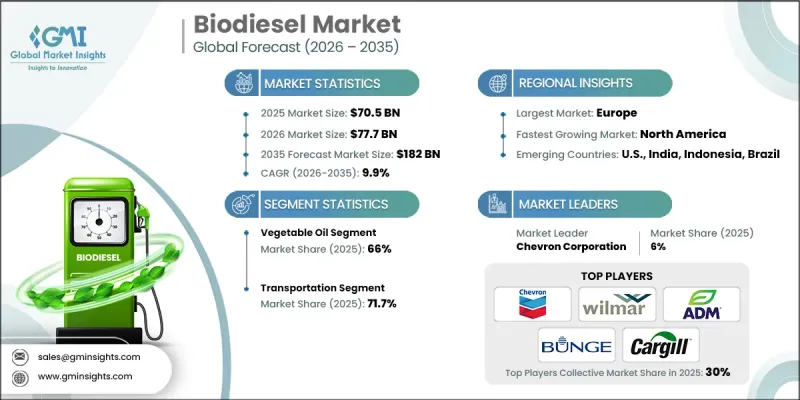
Expansion across the biodiesel market is supported by strengthening national fuel blending mandates targeting the transportation sector, along with regulatory frameworks encouraging the use of cleaner fuel alternatives. Governments across several diesel-dependent economies are steadily raising required biodiesel blend ratios as part of broader decarbonization strategies for heavy transport operations. As equipment manufacturers broaden warranty coverage for engines operating on higher biodiesel blends, the financial and operational barriers to adoption continue to decline. This dynamic allows fleet operators to integrate biodiesel into existing systems without requiring significant capital investment in new vehicles. In effect, biodiesel is increasingly shifting from a market driven by optional price advantages to one shaped by regulatory obligations with long-term demand visibility. These mandates are also stimulating upgrades across fuel storage, blending infrastructure, and supply chain systems while encouraging continued research aimed at improving fuel performance in demanding industrial environments. Clear regulatory frameworks are providing signals for future investments in production capacity, feedstock processing facilities, and supply network expansion.
| Market Scope | |
|---|---|
| Start Year | 2025 |
| Forecast Year | 2026-2035 |
| Start Value | $70.5 Billion |
| Forecast Value | $182 Billion |
| CAGR | 9.9% |
The used cooking oil segment is projected to grow at a CAGR of 11.4% through 2035. Used cooking oil has rapidly emerged as a highly strategic feedstock within biodiesel production due to its ability to deliver lower lifecycle carbon intensity compared with many traditional oil sources. The increasing regulatory focus on reducing greenhouse gas emissions is encouraging the use of waste-derived feedstocks that can improve sustainability metrics within fuel supply chains. As transparency standards continue to strengthen, traceability and monitoring systems for feedstock sourcing have become increasingly important. Improved regulatory oversight and verification mechanisms are helping create stronger confidence in international supply networks for recycled oil feedstocks, further supporting the role of used cooking oil in future biodiesel production.
The transportation application segment accounted for 71.7% share in 2025 and is projected to grow at a CAGR of 9% through 2035. Transportation remains the largest area of biodiesel consumption due to the growing number of regulatory policies that mandate renewable fuel blending in diesel supplies. Policymakers increasingly view biodiesel as a practical solution for reducing emissions from transportation sectors that remain heavily dependent on conventional diesel engines. Since biodiesel can be integrated directly into existing diesel infrastructure, it enables energy transition goals without requiring large-scale modifications to vehicles or fuel distribution systems. This compatibility supports faster adoption across commercial fleets and large transportation networks while maintaining operational efficiency.
U.S. Biodiesel Market held 93% share in 2025 and generated USD 21.9 billion. Market development in the United States is supported by a robust regulatory environment that promotes renewable fuel usage through structured policy mechanisms and compliance markets focused on reducing carbon intensity. The regional industry is also undergoing a gradual shift away from traditional crop-based feedstocks toward waste-based and residue-derived raw materials to meet evolving sustainability expectations. In addition, strong export activity from the United States toward international biodiesel markets continues to strengthen domestic production stability and supports the long-term resilience of the sector.
Major companies operating across the Global Biodiesel Market include Wilmar International, Archer Daniels Midland, Cargill, Bunge, Chevron, Total Energies, Clariant, FutureFuel, Greenergy, Grupo Potencial, Manuelita, Universal Biofuels, Renewable Biofuels, Washwell Biodiesel, TerraVia, Ag Processing, Abellon Clean Energy, Altret Greenfuels, Anellotech, and G-Energetic Biofuels. Companies participating in the Global Biodiesel Market are strengthening their competitive position through a combination of capacity expansion, feedstock diversification, and strategic partnerships across the fuel value chain. Many producers are investing in advanced processing technologies to improve production efficiency while enabling the use of alternative feedstocks derived from waste oils and agricultural residues. Strategic collaborations with feedstock suppliers, logistics providers, and energy distributors are helping companies secure reliable supply networks and expand market access. Several firms are also focusing on developing integrated biofuel platforms that combine refining, storage, and distribution capabilities.
Table of Contents
Chapter 1 Methodology & Scope
- 1.1 Research approach
- 1.2 Quality commitment
- 1.2.1 GMI AI policy & data integrity commitment
- 1.2.1.1 Source consistency protocol
- 1.2.1 GMI AI policy & data integrity commitment
- 1.3 Research Trail & Confidence Scoring
- 1.3.1 Research Trail Components
- 1.3.2 Scoring Components
- 1.4 Data Collection
- 1.4.1 Partial list of primary sources
- 1.5 Data mining sources
- 1.5.1 Paid sources
- 1.5.1.1 Sources, by region
- 1.5.1 Paid sources
- 1.6 Base estimates and calculations
- 1.6.1 Base year calculation for any one approach
- 1.7 Forecast model
- 1.8 Research transparency addendum
- 1.8.1 Source attribution framework
- 1.8.2 Quality assurance metrics
- 1.8.3 Our commitment to trust
- 1.9 Market definitions
Chapter 2 Executive Summary
- 2.1 Industry synopsis, 2022 - 2035
- 2.1.1 Business trends
- 2.1.2 Feedstock trends
- 2.1.3 Application trends
- 2.1.4 Regional trends
Chapter 3 Industry Insights
- 3.1 Industry ecosystem analysis
- 3.2 Regulatory landscape
- 3.3 Industry impact forces
- 3.3.1 Growth drivers
- 3.3.2 Industry pitfalls & challenges
- 3.4 Growth potential analysis
- 3.5 Porter's analysis
- 3.5.1 Bargaining power of suppliers
- 3.5.2 Bargaining power of buyers
- 3.5.3 Threat of new entrants
- 3.5.4 Threat of substitutes
- 3.6 PESTEL analysis
- 3.6.1 Political factors
- 3.6.2 Economic factors
- 3.6.3 Social factors
- 3.6.4 Technology factors
- 3.6.5 environmental factors
- 3.6.6 Legal factors
- 3.7 Emerging opportunities & trends
- 3.7.1 Digitalization and IoT integration
- 3.7.2 Emerging market penetration
Chapter 4 Competitive landscape, 2025
- 4.1 Introduction
- 4.2 Company market share analysis, 2025
- 4.2.1 North America
- 4.2.2 Europe
- 4.2.3 Asia Pacific
- 4.2.4 Middle East & Africa
- 4.2.5 Latin America
- 4.3 Strategic initiatives
- 4.4 Competitive benchmarking
- 4.5 Strategic dashboard
- 4.6 Innovation & technology landscape
Chapter 5 Market Size and Forecast, By Feedstock, 2022 - 2035 (USD Million, Mtoe)
- 5.1 Key trends
- 5.2 Vegetable oils
- 5.3 Used cooking oil (UCO)
- 5.4 Animal fats
- 5.5 Others
Chapter 6 Market Size and Forecast, By Application, 2022 - 2035 (USD Million, Mtoe)
- 6.1 Key trends
- 6.2 Transportation
- 6.3 Power generation
- 6.4 Others
Chapter 7 Market Size and Forecast, By Region, 2022 - 2035 (USD Million, Mtoe)
- 7.1 Key trends
- 7.2 North America
- 7.2.1 U.S.
- 7.2.2 Canada
- 7.2.3 Mexico
- 7.3 Europe
- 7.3.1 Germany
- 7.3.2 France
- 7.3.3 UK
- 7.3.4 Spain
- 7.3.5 Italy
- 7.4 Asia Pacific
- 7.4.1 China
- 7.4.2 India
- 7.4.3 Indonesia
- 7.4.4 Australia
- 7.4.5 South Korea
- 7.5 Middle East & Africa
- 7.5.1 Saudi Arabia
- 7.5.2 South Africa
- 7.6 Latin America
- 7.6.1 Brazil
- 7.6.2 Argentina
Chapter 8 Company Profiles
- 8.1 Abellon Clean Energy
- 8.2 Ag Processing
- 8.3 Altret Greenfuels
- 8.4 Anellotech
- 8.5 Archer Daniels Midland
- 8.6 Bunge
- 8.7 Cargill
- 8.8 Chevron Corporation
- 8.9 Clariant
- 8.10 FutureFuel
- 8.11 G-Energetic Biofuels
- 8.12 Greenergy
- 8.13 Grupo Potencial
- 8.14 Manuelita
- 8.15 Renewable Biofuels
- 8.16 TerraVia
- 8.17 Total Energies
- 8.18 Universal Biofuels
- 8.19 Washwell Biodiesel
- 8.20 Wilmar International

