
PUBLISHER: Global Market Insights Inc. | PRODUCT CODE: 1998750

PUBLISHER: Global Market Insights Inc. | PRODUCT CODE: 1998750
Marine Onboard Communication and Control Systems Market Opportunity, Growth Drivers, Industry Trend Analysis, and Forecast 2026 - 2035
The Global Marine Onboard Communication and Control Systems Market was valued at USD 10 billion in 2025 and is estimated to grow at a CAGR of 8.1% to reach USD 21.3 billion by 2035.
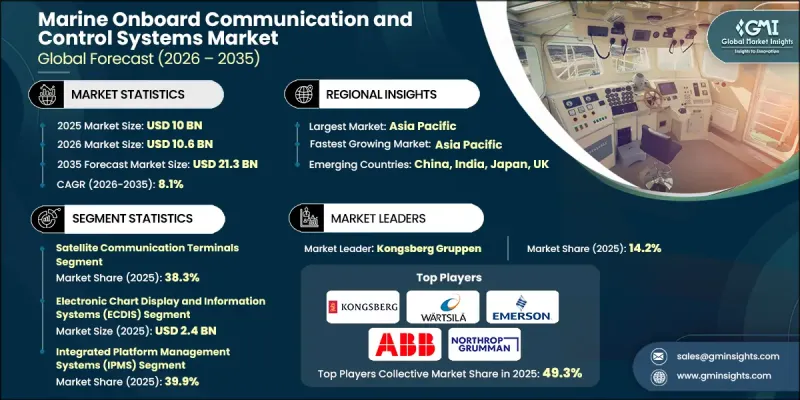
The market expansion is driven by the increasing adoption of smart vessel automation platforms, rising demand for reliable maritime satellite connectivity, and the continuous growth of global commercial shipping fleets. The integration of real-time vessel monitoring and fleet management systems, alongside the advancement of digital navigation and maritime safety frameworks, is further supporting market growth. Shipping companies are increasingly relying on connected onboard systems that integrate navigation, propulsion, and operational control, enhancing efficiency, operational safety, and regulatory compliance. Government investments in digital maritime infrastructure and initiatives aimed at improving fleet monitoring, maritime domain awareness, and operational safety are also contributing to the widespread adoption of advanced onboard communication and control solutions.
| Market Scope | |
|---|---|
| Start Year | 2025 |
| Forecast Year | 2026-2035 |
| Start Value | $10 Billion |
| Forecast Value | $21.3 Billion |
| CAGR | 8.1% |
The satellite communication terminals segment held 38.3% share in 2025, owing to their capability to provide uninterrupted long-range communication between ships and shore-based operations. These systems support real-time route updates, operational management, and seamless crew communication across vast maritime distances, driving sustained demand.
The electronic chart display and information systems (ECDIS) segment was valued at USD 2.4 billion in 2025 and dominated the market due to its crucial role in digital navigation and maritime safety. ECDIS replaces traditional paper charts by providing real-time navigational data, enhancing situational awareness, and complying with regulatory mandates. The integration of ECDIS with radar, AIS, and GNSS systems further strengthens its relevance and adoption across commercial fleets.
North America Marine Onboard Communication and Control Systems Market accounted for 28.3% share in 2025. The region's growth is supported by substantial investment in naval modernization, offshore maritime operations, and the deployment of digital vessel technologies. Commercial shipping companies and naval authorities are increasingly implementing onboard automation, integrated bridge systems, and satellite communication solutions to enhance operational safety and efficiency. Government initiatives focused on maritime domain awareness, naval communications, and fleet monitoring continue to encourage the adoption of advanced onboard systems.
Prominent players in the Global Marine Onboard Communication and Control Systems Market include L3Harris Technologies, Inc., Raymarine, Viasat, Inc., Northrop Grumman Corporation, Furuno Electric Co., Ltd., Kongsberg, ABB Group, ST Engineering, Wartsila, Honeywell International Inc., Navico Group, Emerson Electric Co., Saab Ab, and Japan Radio Co., Ltd. Companies in the Global Marine Onboard Communication and Control Systems Market are adopting multiple strategies to solidify their presence and expand market share. They are investing in research and development to deliver advanced, integrated communication, navigation, and control solutions. Strategic collaborations with shipbuilders, naval authorities, and fleet operators enhance technology adoption and service reach. Firms are diversifying product portfolios to include satellite communication terminals, ECDIS, integrated bridge systems, and fleet management solutions, enabling comprehensive offerings. Expanding regional operations, enhancing after-sales support, and ensuring regulatory compliance are also key strategies for strengthening market footholds and building long-term client relationships.
Table of Contents
Chapter 1 Methodology and Scope
- 1.1 Market scope and definition
- 1.2 Research design
- 1.2.1 Research approach
- 1.2.2 Data collection methods
- 1.3 Data mining sources
- 1.3.1 Global
- 1.3.2 Regional/Country
- 1.4 Base estimates and calculations
- 1.4.1 Base year calculation
- 1.4.2 Key trends for market estimation
- 1.5 Primary research and validation
- 1.5.1 Primary sources
- 1.6 Forecast model
- 1.7 Research assumptions and limitations
Chapter 2 Executive Summary
- 2.1 Industry 360° synopsis, 2022 - 2035
- 2.2 Key market trends
- 2.2.1 Communication systems trends
- 2.2.2 Navigation & positioning systems trends
- 2.2.3 Control & automation systems trends
- 2.2.4 Monitoring & surveillance systems trends
- 2.2.5 Platform trends
- 2.2.6 End-User trends
- 2.2.7 Regional trends
- 2.3 TAM Analysis, 2026-2035
- 2.4 CXO perspectives: Strategic imperatives
Chapter 3 Industry Insights
- 3.1 Industry ecosystem analysis
- 3.1.1 Supplier Landscape
- 3.1.2 Profit Margin
- 3.1.3 Cost structure
- 3.1.4 Value addition at each stage
- 3.1.5 Factor affecting the value chain
- 3.1.6 Disruptions
- 3.2 Industry impact forces
- 3.2.1 Growth drivers
- 3.2.1.1 Increasing adoption of smart and connected vessels
- 3.2.1.2 Growing maritime satellite communication demand
- 3.2.1.3 Expansion of global seaborne trade and fleet size
- 3.2.1.4 Rising need for real-time vessel monitoring systems
- 3.2.1.5 IMO regulations driving digital navigation systems adoption
- 3.2.2 Industry pitfalls and challenges
- 3.2.2.1 High installation and retrofitting costs for legacy fleets
- 3.2.2.2 Cybersecurity risks in connected shipboard networks
- 3.2.3 Market opportunities
- 3.2.3.1 Autonomous and remotely operated vessel development
- 3.2.3.2 Expansion of satellite broadband for offshore vessels
- 3.2.1 Growth drivers
- 3.3 Growth potential analysis
- 3.4 Regulatory landscape
- 3.4.1 North America
- 3.4.2 Europe
- 3.4.3 Asia Pacific
- 3.4.4 Latin America
- 3.4.5 Middle East & Africa
- 3.5 Porter's analysis
- 3.6 PESTEL analysis
- 3.7 Technology and Innovation landscape
- 3.7.1 Current technological trends
- 3.7.2 Emerging technologies
- 3.8 Price trends
- 3.8.1 By region
- 3.8.2 By product
- 3.9 Pricing Strategies
- 3.10 Emerging Business Models
- 3.11 Compliance Requirements
- 3.12 Patent and IP analysis
Chapter 4 Competitive Landscape, 2025
- 4.1 Introduction
- 4.2 Company market share analysis
- 4.2.1 By region
- 4.2.1.1 North America
- 4.2.1.2 Europe
- 4.2.1.3 Asia Pacific
- 4.2.1.4 Latin America
- 4.2.1.5 Middle East & Africa
- 4.2.2 Market concentration analysis
- 4.2.1 By region
- 4.3 Competitive benchmarking of key players
- 4.3.1 Financial performance comparison
- 4.3.1.1 Revenue
- 4.3.1.2 Profit margin
- 4.3.1.3 R&D
- 4.3.2 Product portfolio comparison
- 4.3.2.1 Product range breadth
- 4.3.2.2 Technology
- 4.3.2.3 Innovation
- 4.3.3 Geographic presence comparison
- 4.3.3.1 Global footprint analysis
- 4.3.3.2 Service network coverage
- 4.3.3.3 Market penetration by region
- 4.3.4 Competitive positioning matrix
- 4.3.4.1 Leaders
- 4.3.4.2 Challengers
- 4.3.4.3 Followers
- 4.3.4.4 Niche players
- 4.3.5 Strategic outlook matrix
- 4.3.1 Financial performance comparison
- 4.4 Key developments
- 4.4.1 Mergers and acquisitions
- 4.4.2 Partnerships and collaborations
- 4.4.3 Technological advancements
- 4.4.4 Expansion and investment strategies
- 4.4.5 Digital transformation initiatives
- 4.5 Emerging/ startup competitors landscape
Chapter 5 Market Estimates and Forecast, By Communication Systems, 2022 - 2035 (USD Million)
- 5.1 Key trends
- 5.2 Satellite communication terminals
- 5.2.1 VSAT terminals
- 5.2.2 L-band terminals
- 5.3 Marine Radio Systems
- 5.3.1 VHF radio systems
- 5.3.2 MF/HF radio systems
- 5.3.3 GMDSS equipment
- 5.4 Onboard network infrastructure
- 5.4.1 Routers & switches
- 5.4.2 Onboard broadband backbone systems
- 5.5 Internal communication systems
- 5.5.1 Public address / general alarm (PA/GA) systems
- 5.5.2 Intercom systems
Chapter 6 Market Estimates and Forecast, By Navigation & Positioning Systems, 2022 - 2035 (USD Million)
- 6.1 Key trends
- 6.2 Electronic chart display & information systems (ECDIS)
- 6.3 Radar systems
- 6.3.1 X-Band radar
- 6.3.2 S-Band radar
- 6.4 Automatic identification systems (AIS)
- 6.5 Global navigation satellite systems (GNSS/GPS)
- 6.6 Voyage data recorders (VDR)
- 6.7 Dynamic positioning systems
Chapter 7 Market Estimates and Forecast, By Control & Automation Systems, 2022 - 2035 (USD Million)
- 7.1 Key trends
- 7.2 Propulsion control systems
- 7.3 Engine automation systems
- 7.4 Thruster control systems
- 7.5 Power management systems
- 7.6 Integrated platform management systems (IPMS)
Chapter 8 Market Estimates and Forecast, By Monitoring & Surveillance Systems Application, 2022 - 2035 (USD Million)
- 8.1 Key trends
- 8.2 Fire detection systems
- 8.3 Gas detection systems
- 8.4 CCTV & onboard security systems
- 8.5 Hull stress monitoring systems
- 8.6 Condition-based monitoring systems
Chapter 9 Market Estimates and Forecast, By Platform, 2022 - 2035 (USD Million)
- 9.1 Key trends
- 9.2 Commercial vessels
- 9.2.1 Passenger vessels
- 9.2.2 Cargo vessels
- 9.2.3 Offshore & specialized vessels
- 9.3 Defense vessels
- 9.3.1 Aircraft carriers
- 9.3.2 Destroyers
- 9.3.3 Frigates
- 9.3.4 Corvettes
- 9.3.5 Submarines
- 9.3.6 Amphibious assault ships
Chapter 10 Market Estimates and Forecast, By End-User, 2022 - 2035 (USD Million)
- 10.1 Key trends
- 10.2 OEM
- 10.3 Aftermarket
Chapter 11 Market Estimates and Forecast, By Region, 2022 - 2035 (USD Million)
- 11.1 Key trends
- 11.2 North America
- 11.2.1 U.S.
- 11.2.2 Canada
- 11.3 Europe
- 11.3.1 Germany
- 11.3.2 UK
- 11.3.3 France
- 11.3.4 Spain
- 11.3.5 Italy
- 11.3.6 Russia
- 11.4 Asia Pacific
- 11.4.1 China
- 11.4.2 India
- 11.4.3 Japan
- 11.4.4 Australia
- 11.4.5 South Korea
- 11.5 Latin America
- 11.5.1 Brazil
- 11.5.2 Mexico
- 11.5.3 Argentina
- 11.6 Middle East and Africa
- 11.6.1 South Africa
- 11.6.2 Saudi Arabia
- 11.6.3 UAE
Chapter 12 Company Profiles
- 12.1 Global Key Players
- 12.1.1 ABB Group
- 12.1.2 Kongsberg
- 12.1.3 Wartsila
- 12.1.4 Northrop Grumman Corporation
- 12.1.5 Honeywell International Inc.
- 12.2 Regional key players
- 12.2.1 North America
- 12.2.1.1 Emerson Electric Co.
- 12.2.1.2 L3Harris Technologies, Inc.
- 12.2.1.3 Viasat, Inc.
- 12.2.2 Asia Pacific
- 12.2.2.1 Furuno Electric Co., Ltd.
- 12.2.2.2 Japan Radio Co., Ltd.
- 12.2.2.3 Raymarine
- 12.2.3 Europe
- 12.2.3.1 Saab AB
- 12.2.3.2 ST Engineering
- 12.2.1 North America
- 12.3 Niche Players/Disruptors
- 12.3.1 Navico Group

