PUBLISHER: Global Market Insights Inc. | PRODUCT CODE: 1998841

PUBLISHER: Global Market Insights Inc. | PRODUCT CODE: 1998841
Industrial Laser Systems Market Opportunity, Growth Drivers, Industry Trend Analysis, and Forecast 2026 - 2035
The Global Industrial Laser Systems Market was valued at USD 6.2 billion in 2025 and is estimated to grow at a CAGR of 5.5% to reach USD 10.5 billion in 2035.
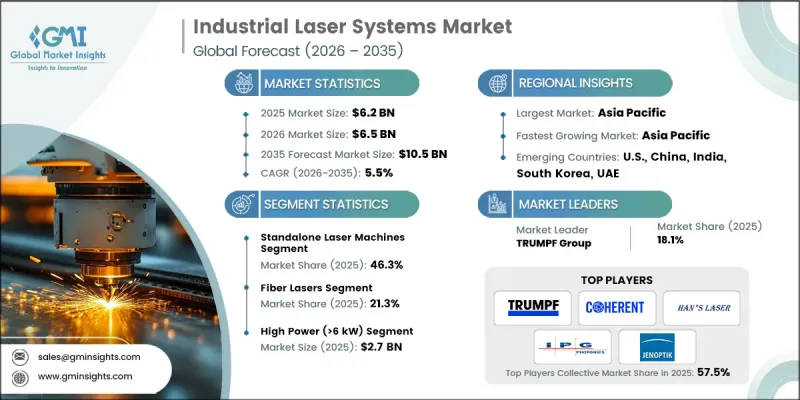
The market is propelled by the growing adoption of laser-based technologies in precision manufacturing, particularly for high-value applications that require accuracy and efficiency. Increasing demand for laser welding in electric vehicle battery production, laser marking in electronics manufacturing, ultrafast laser micromachining for semiconductor miniaturization, and laser-assisted additive manufacturing for aerospace and industrial components is driving industry expansion. Technological advances in fiber lasers, ultrafast lasers, and robotic integration allow manufacturers to reduce production times while improving quality, reliability, and energy efficiency. These factors, combined with ongoing investments in automation and Industry 4.0 processes, are creating strong growth opportunities across multiple industrial sectors.
| Market Scope | |
|---|---|
| Start Year | 2025 |
| Forecast Year | 2026-2035 |
| Start Value | $6.2 Billion |
| Forecast Value | $10.5 Billion |
| CAGR | 5.5% |
The industrial laser systems market is particularly fueled by the rising need for precision laser welding in battery and electronics manufacturing. Laser welding enables high-speed joining of conductive materials with minimal thermal distortion, ensuring strong structural integrity and improved electrical performance. Simultaneously, ultrafast laser micromachining is gaining traction in semiconductor manufacturing, enabling highly precise wafer cutting, micro-via drilling, and thin-film structuring without causing heat damage. Laser-based additive manufacturing is also increasingly adopted for producing complex aerospace components and industrial parts with high structural requirements, creating broader applications for high-performance lasers. The convergence of precision, speed, and automation in laser systems is pushing manufacturers to integrate advanced laser solutions across production lines, supporting improved yield, repeatability, and operational efficiency.
The robotic laser processing systems segment is expected to grow at a CAGR of 6.6% during 2026-2035. These systems are highly sought after in sectors like automotive, aerospace, and heavy manufacturing that increasingly rely on automation to enhance productivity and precision. Robotic laser systems reduce manual labor, improve production consistency, and integrate seamlessly into Industry 4.0 environments. The ability to operate continuously while delivering accurate and repeatable results has made robotic laser processing an attractive investment for manufacturers aiming to scale production while maintaining quality standards.
The high-power (>6 kW) segment reached USD 2.7 billion in 2025, driven by heavy-duty material processing applications. High-power lasers are widely deployed in thick metal cutting, automotive chassis manufacturing, shipbuilding, and steel fabrication. Their ability to cut large and reflective metal surfaces with high speed and efficiency makes them indispensable in industries requiring robust metal processing solutions. The growing adoption of these high-output lasers ensures uninterrupted production in large-scale fabrication operations, contributing significantly to the market's revenue share.
North America Industrial Laser Systems Market accounted for 27.7% share in 2025. The region's growth is largely driven by strong demand from automotive, aerospace, and electronics manufacturers, which require high-precision laser welding, cutting, and micromachining solutions. The expanding electric vehicle industry, semiconductor production, and advanced metal fabrication facilities are further accelerating the adoption of fiber and ultrafast laser systems. Investments in smart manufacturing infrastructure, robotics, and Industry 4.0-enabled production lines are enhancing the deployment of advanced laser-based technologies across multiple sectors.
Key companies operating in the Global Industrial Laser Systems Market include Coherent Corp., Han's Laser Technology Industry Group Co., Ltd., IPG Photonics Corporation, Jenoptik AG, Lumentum Holdings Inc., Raycus Fiber Laser Technologies Co., Ltd., Amada Miyachi America, Inc., TRUMPF Group, Toptica Photonics AG, nLIGHT, Inc., LPKF Laser & Electronics AG, Bystronic Laser AG, Sahajanand Laser Technology Limited, Maxphotonics Co., Ltd., and MKS Instruments, Inc. Companies in the Global Industrial Laser Systems Market are implementing strategies to strengthen their market presence and competitive position. Key initiatives include investing heavily in R&D to improve laser power, precision, and efficiency while developing new fiber, ultrafast, and robotic laser solutions tailored to high-demand sectors. Expanding product portfolios to cater to emerging applications in electric vehicles, semiconductors, aerospace, and industrial manufacturing is a critical growth strategy. Firms are also pursuing strategic collaborations with system integrators, OEMs, and automation technology providers to create integrated manufacturing solutions. Increasing global manufacturing footprints and after-sales service networks allow companies to enhance accessibility and reliability for end users.
Table of Contents
Chapter 1 Methodology and Scope
- 1.1 Market scope and definition
- 1.2 Research design
- 1.2.1 Research approach
- 1.2.2 Data collection methods
- 1.3 Data mining sources
- 1.3.1 Global
- 1.3.2 Regional/Country
- 1.4 Base estimates and calculations
- 1.4.1 Base year calculation
- 1.4.2 Key trends for market estimation
- 1.5 Primary research and validation
- 1.5.1 Primary sources
- 1.6 Forecast model
- 1.7 Research assumptions and limitations
Chapter 2 Executive Summary
- 2.1 Industry 360° synopsis, 2022 - 2035
- 2.2 Key market trends
- 2.2.1 Laser type trends
- 2.2.2 Power range trends
- 2.2.3 System configuration trends
- 2.2.4 Application trends
- 2.2.5 End-user trends
- 2.2.6 Regional trends
- 2.3 TAM Analysis, 2026-2035
- 2.4 CXO perspectives: Strategic imperatives
Chapter 3 Industry Insights
- 3.1 Industry ecosystem analysis
- 3.1.1 Supplier Landscape
- 3.1.2 Profit Margin
- 3.1.3 Cost structure
- 3.1.4 Value addition at each stage
- 3.1.5 Factor affecting the value chain
- 3.1.6 Disruptions
- 3.2 Industry impact forces
- 3.2.1 Growth drivers
- 3.2.1.1 EV battery manufacturing demanding precision laser welding
- 3.2.1.2 Consumer electronics production demanding high-precision laser marking
- 3.2.1.3 Semiconductor miniaturization requiring ultrafast laser micromachining
- 3.2.1.4 Medical device manufacturing requiring micro-scale laser processing
- 3.2.1.5 Automated smart factories integrating laser processing equipment
- 3.2.2 Industry pitfalls and challenges
- 3.2.2.1 Skilled operator shortage for complex laser machining processes
- 3.2.2.2 Maintenance complexity in high-power industrial laser sources
- 3.2.3 Market opportunities
- 3.2.3.1 Ultrafast lasers adoption in semiconductor wafer processing
- 3.2.3.2 Laser additive manufacturing expansion in aerospace components
- 3.2.1 Growth drivers
- 3.3 Growth potential analysis
- 3.4 Regulatory landscape
- 3.4.1 North America
- 3.4.2 Europe
- 3.4.3 Asia Pacific
- 3.4.4 Latin America
- 3.4.5 Middle East & Africa
- 3.5 Porter's analysis
- 3.6 PESTEL analysis
- 3.7 Technology and Innovation landscape
- 3.7.1 Current technological trends
- 3.7.2 Emerging technologies
- 3.8 Price trends
- 3.8.1 By region
- 3.8.2 By product
- 3.9 Pricing Strategies
- 3.10 Emerging Business Models
- 3.11 Compliance Requirements
- 3.12 Patent and IP analysis
Chapter 4 Competitive Landscape, 2025
- 4.1 Introduction
- 4.2 Company market share analysis
- 4.2.1 By region
- 4.2.1.1 North America
- 4.2.1.2 Europe
- 4.2.1.3 Asia Pacific
- 4.2.1.4 Latin America
- 4.2.1.5 Middle East & Africa
- 4.2.2 Market concentration analysis
- 4.2.1 By region
- 4.3 Competitive benchmarking of key players
- 4.3.1 Financial performance comparison
- 4.3.1.1 Revenue
- 4.3.1.2 Profit margin
- 4.3.1.3 R&D
- 4.3.2 Product portfolio comparison
- 4.3.2.1 Product range breadth
- 4.3.2.2 Technology
- 4.3.2.3 Innovation
- 4.3.3 Geographic presence comparison
- 4.3.3.1 Global footprint analysis
- 4.3.3.2 Service network coverage
- 4.3.3.3 Market penetration by region
- 4.3.4 Competitive positioning matrix
- 4.3.4.1 Leaders
- 4.3.4.2 Challengers
- 4.3.4.3 Followers
- 4.3.4.4 Niche players
- 4.3.5 Strategic outlook matrix
- 4.3.1 Financial performance comparison
- 4.4 Key developments
- 4.4.1 Mergers and acquisitions
- 4.4.2 Partnerships and collaborations
- 4.4.3 Technological advancements
- 4.4.4 Expansion and investment strategies
- 4.4.5 Digital transformation initiatives
- 4.5 Emerging/ startup competitors landscape
Chapter 5 Market Estimates and Forecast, By Laser Type, 2022 - 2035 (USD Million)
- 5.1 Key trends
- 5.2 Fiber lasers
- 5.3 Co2 lasers
- 5.4 Solid-state lasers
- 5.5 Diode lasers
- 5.6 Ultrafast lasers
- 5.7 Excimer lasers
- 5.8 Others
Chapter 6 Market Estimates and Forecast, By Material Type, 2022 - 2035 (USD Million)
- 6.1 Key trends
- 6.2 Low power (<1 kW)
- 6.3 Medium power (1-6 kW)
- 6.4 High power (>6 kW)
Chapter 7 Market Estimates and Forecast, By System Configuration, 2022 - 2035 (USD Million)
- 7.1 Key trends
- 7.2 Standalone laser machines
- 7.3 Robotic laser processing systems
- 7.4 Integrated production line systems
Chapter 8 Market Estimates and Forecast, By Application, 2022 - 2035 (USD Million)
- 8.1 Key trends
- 8.2 Cutting
- 8.3 Welding
- 8.4 Marking & engraving
- 8.5 Drilling
- 8.6 Others
Chapter 9 Market Estimates and Forecast, By End-User, 2022 - 2035 (USD Million)
- 9.1 Key trends
- 9.2 Automotive
- 9.3 Electronics manufacturing
- 9.4 Semiconductor fabrication
- 9.5 Aerospace & defense
- 9.6 Metal fabrication & industrial manufacturing
- 9.7 Medical devices
- 9.8 Others
Chapter 10 Market Estimates and Forecast, By Region, 2022 - 2035 (USD Million)
- 10.1 Key trends
- 10.2 North America
- 10.2.1 U.S.
- 10.2.2 Canada
- 10.3 Europe
- 10.3.1 Germany
- 10.3.2 UK
- 10.3.3 France
- 10.3.4 Spain
- 10.3.5 Italy
- 10.4 Asia Pacific
- 10.4.1 China
- 10.4.2 India
- 10.4.3 Japan
- 10.4.4 Australia
- 10.4.5 South Korea
- 10.5 Latin America
- 10.5.1 Brazil
- 10.5.2 Mexico
- 10.5.3 Argentina
- 10.6 Middle East and Africa
- 10.6.1 South Africa
- 10.6.2 Saudi Arabia
- 10.6.3 UAE
Chapter 11 Company Profiles
- 11.1 Global Key Players
- 11.1.1 TRUMPF Group
- 11.1.2 IPG Photonics Corporation
- 11.1.3 Coherent Corp.
- 11.2 Regional key players
- 11.2.1 North America
- 11.2.1.1 Lumentum Holdings Inc.
- 11.2.1.2 nLIGHT, Inc.
- 11.2.1.3 Amada Miyachi America, Inc.
- 11.2.1.4 MKS Instruments, Inc.
- 11.2.2 Asia Pacific
- 11.2.2.1 Han's Laser Technology Industry Group Co., Ltd.
- 11.2.2.2 Raycus Fiber Laser Technologies Co., Ltd.
- 11.2.2.3 Maxphotonics Co., Ltd.
- 11.2.2.4 Sahajanand Laser Technology Limited
- 11.2.3 Europe
- 11.2.3.1 Bystronic Laser AG
- 11.2.3.2 Jenoptik AG
- 11.2.3.3 LPKF Laser & Electronics AG
- 11.2.3.4 Toptica Photonics AG
- 11.2.1 North America

