PUBLISHER: Mordor Intelligence | PRODUCT CODE: 2124558

PUBLISHER: Mordor Intelligence | PRODUCT CODE: 2124558
Industrial Laser System - Market Share Analysis, Industry Trends & Statistics, Growth Forecasts (2026 - 2031)
According to Mordor Intelligence, the industrial laser system market size is expected to grow from USD 6.37 billion in 2025 to USD 6.71 billion in 2026 and is forecast to reach USD 8.72 billion by 2031 at 5.38% CAGR over 2026-2031.
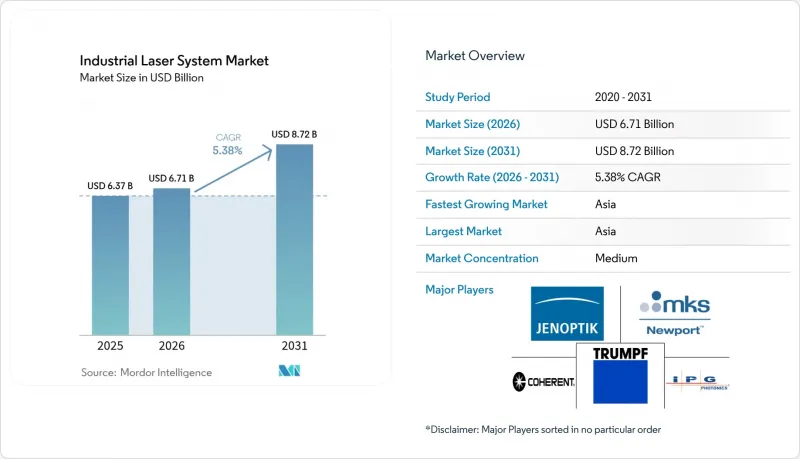
This report is Segmented by Laser Type (Fiber Lasers, Solid-State Lasers, and More), Power Range (Low Power (Less Than 1 KW), Medium Power (1-6 KW), and More), Application (Cutting, Welding and Brazing, Marking and Engraving, and More), End-User Industry (Semiconductor and Electronics, Automotive, Medical Devices, and More), and Geography. The Market Forecasts are Provided in Terms of Value (USD).
Global Industrial Laser System Market Trends and Insights
Rapid transition from mechanical to laser-based metal cutting in automotive manufacturing
Automakers are standardizing fiber laser lines to shorten chassis and battery-enclosure cycles, boost edge quality, and minimize scrap. German plants report 40% shorter processing time when swapping plasma cutters for 6 kW fiber units. Asian EV producers follow with multi-kilowatt installations that keep pace with rising vehicle output while supporting aluminum-steel hybrid designs prized for lightweighting. The same trend reaches suppliers preparing for Europe's 2035 internal-combustion phase-out, cementing long-term demand across the industrial laser system market.
Proliferation of 5G/AI chip fabrication demanding sub-micron via-hole lasers
Advanced nodes at 3 nm and 2 nm require femtosecond drilling to preserve signal integrity in multilayer substrates. Taiwan, South Korea, and the United States are installing high-precision platforms whose 100-fs pulses avoid heat-affected zones. Delivery lead times have stretched past one year because optical-component makers struggle to expand capacity, yet chip foundries continue signing multi-tool contracts that widen the industrial laser system market.
Capital-intensive >6 kW systems limit penetration into tier-2 job shops
High-power units now cost upward of USD 500,000, and the infrastructure-chillers, three-phase wiring, Class 1 enclosures-can double that outlay. Smaller fabricators in Southeast Asia, Latin America, and Eastern Europe face currency swings and scarce leasing options, slowing adoption even as OEMs push for thicker-plate cutting. As a result, segments of the industrial laser system market remain under-served despite clear productivity gains
Other drivers and restraints analyzed in the detailed report include:
- Battery-pack welding needs in e-mobility gigafactories-Europe-led
- Growing adoption of ultrafast lasers for OLED and micro-LED processing-Asia
- Stringent IEC/EN 60825-1 safety re-certification costs for retrofitted lines
For complete list of drivers and restraints, kindly check the Table Of Contents.
Segment Analysis
Fiber sources accounted for 51.25% of revenue in 2025, reflecting their rugged build, high wall-plug efficiency, and easy integration with motion platforms. Their dominance is visible in automotive and semiconductor fabs that depend on hour-by-hour uptime. The industrial laser system market size for fiber systems is expected to expand at 5.25% CAGR, supported by ongoing price drops in ytterbium diodes. Ultrafast lasers, despite a smaller base, add 6.05% CAGR as electronics, medical, and display customers adopt pulse widths under 200 fs. Cooling innovations and OPCPA pumping architectures raise average power, enabling mass-production throughput that once favored continuous-wave tools.
Solid-state and disc architectures serve niche wavelengths that suit exotic alloys or thick copper cutting, whereas CO2 units retreat to thick acrylic or wood applications because their long wavelength lacks efficiency in metals. Direct-diode arrays address cladding, hardening, and polymer welding tasks where beam quality tolerance is higher and 50% electrical efficiency lowers operating cost. Excimer systems persist in semiconductor lithography and catheter hole drilling, while quantum cascade designs sit in R&D but could unlock mid-IR ablation markets later in the decade. Collectively, these dynamics keep technology diversity high within the industrial laser system market.
Systems rated 1-6 kW generated almost half of 2025 revenue as they balance capital cost against sheet-metal speed. Automotive sub-contractors favor 4 kW cutters that process 2 mm steel at 30 m/min while remaining affordable. The industrial laser system market share for this band is projected to remain stable even as high-power units gain ground. Platforms above 6 kW grow 5.85% CAGR thanks to shipyards, bridge yards, and heavy-equipment makers that need 100 mm-thick steel processing in single passes. Early adopters report labor savings that compensate for higher capex within two years.
Below 1 kW, nanosecond and continuous-wave tools process printed circuit boards, sensor housings, and stents where heat control trumps speed. OEMs pair these low-power heads with galvanometer scanners to achieve 500 mm/s engraving while holding 10 µm positional accuracy. Together, the tiers ensure every material thickness and productivity target has a matching laser, maintaining a broad power-range spectrum across the industrial laser system market.
Complete Report Scope:
- By Laser Type
- Fiber Lasers
- Solid-State Lasers
- Nd:YAG
- Disc Lasers
- CO2 Lasers
- Excimer Lasers
- Direct Diode Lasers
- Other Lasers (Ultrafast, QCW, QCL)
- By Power Range
- Low Power (Less than 1 kW)
- Medium Power (1-6 kW)
- High Power (Above 6 kW)
- By Application
- Cutting
- 2D Cutting
- 3D Cutting
- Welding and Brazing
- Marking and Engraving
- Drilling and Micro-Processing
- Surface Treatment (Cladding, Hardening, Texturing)
- Additive Manufacturing
- Cutting
- By End-user Industry
- Automotive
- Semiconductor and Electronics
- Aerospace and Defense
- Medical Devices
- Energy (Battery, Solar)
- Heavy Machinery and Tools
- Jewelry and Artisanal
- Others (Packaging, General Mfg.)
- By Geography
- North America
- United States
- Canada
- Mexico
- Europe
- Germany
- United Kingdom
- France
- Nordics
- Rest of Europe
- South America
- Brazil
- Rest of South America
- Asia-Pacific
- China
- Japan
- India
- South-East Asia
- Rest of Asia-Pacific
- Middle East and Africa
- Middle East
- Gulf Cooperation Council Countries
- Turkey
- Rest of Middle East
- Africa
- South Africa
- Rest of Africa
- Middle East
- North America
Geography Analysis
Asia-Pacific commanded 45.70% of 2025 revenue and is projected at a 6.35% CAGR through 2031. China's "Made-in-China 2025" policy funds semiconductor mega-fabs, EV lines, and photovoltaic plants that turn to high-brightness fiber systems for cutting and welding. South Korean and Japanese display makers order femtosecond platforms to advance OLED and micro-LED projects. Southeast Asian contract manufacturers embrace 1-3 kW cutters for appliance chassis, aided by government import-duty relief. Local service networks, surplus engineering talent, and extensive supply chains keep capital efficiency high, reinforcing leadership in the industrial laser system market
Europe follows with strong installation momentum anchored in Germany, Italy, and Sweden. Automotive laser content per vehicle rises as premium brands shift toward aluminum body-in-white and battery enclosures. EU "Fit-for-55" rules require turbine blade texturing and hydrogen-ready pipeline welding; both favor high-power lasers. Battery gigafactory build-outs in Sweden and France adopt laser welding lines synced with inline X-ray inspection, while aerospace hubs in Toulouse and Hamburg invest in laser powder bed fusion for structural brackets. Overall, policy, sustainability targets, and engineering heritage combine to keep Europe central to the industrial laser system market.
North America shows steady expansion propelled by defense, aerospace, and domestic semiconductor reshoring efforts. The CHIPS and Science Act frees capital incentives for via-hole drilling tools, and the Pentagon funds megawatt fiber laser demonstrators. Tier-1 automotive suppliers in Mexico transition to 4 kW units to meet OEM traceability standards, while Canadian mining-equipment builders install 20 kW machines to process quenched-and-tempered plate. Latin America and the Middle East & Africa remain emerging opportunities: Brazilian agri-machinery, Saudi desalination plants, and South African railcar factories pilot mid-power lasers, yet penetration stays low due to financing gaps and limited field service. Nonetheless, growth potential is recognized across the wider industrial laser system market.
- TRUMPF GmbH + Co. KG
- Coherent Corp.
- IPG Photonics Corporation
- Han's Laser Technology Industry Group Co., Ltd.
- Jenoptik AG
- nLIGHT, Inc.
- II-VI Incorporated
- Newport Corporation (MKS Instruments)
- Lumentum Holdings Inc.
- Fanuc Corporation
- Prima Industrie S.p.A.
- Bystronic Laser AG
- Amada Co., Ltd.
- Miyachi Unitek (Amada Weld Tech)
- Rofin-Sinar Technologies
- GWEIKE Laser
- Trotec Laser GmbH
- Epilog Laser
- ACSYS Lasertechnik GmbH
- Alpha Laser GmbH
- Lasea S.A.
- LaserStar Technologies Corp.
Additional Benefits:
- The market estimate (ME) sheet in Excel format
- 3 months of analyst support
TABLE OF CONTENTS
1 INTRODUCTION
- 1.1 Study Assumptions and Market Definition
- 1.2 Scope of the Study
2 RESEARCH METHODOLOGY
3 EXECUTIVE SUMMARY
4 MARKET LANDSCAPE
- 4.1 Market Overview
- 4.2 Market Drivers
- 4.2.1 Rapid Transition from Mechanical to Laser?Based Metal Cutting in Automotive Manufacturing
- 4.2.2 Proliferation of 5G/AI Chip Fabrication Demanding Sub-Micron Via-Hole Lasers
- 4.2.3 Battery-Pack Welding Needs in e-Mobility Gigafactories-Europe-Led
- 4.2.4 Growing Adoption of Ultrafast Lasers for OLED and Micro-LED Processing-Asia
- 4.2.5 Laser-Based Additive Manufacturing in Aerospace Lightweighting-U.S.-Centric
- 4.2.6 EU "Fit-for-55" Drives Laser Surface-Texturing for Energy-Efficient Turbines
- 4.3 Market Restraints
- 4.3.1 Capital-Intensive Above 6 kW Systems Limit Penetration into Tier-2 Job-Shops
- 4.3.2 Stringent IEC/EN 60825-1 Safety Re-Certification Costs for Retrofitted Lines
- 4.3.3 Heat-Affected Zone (HAZ) Micro-Cracking in Next-Gen Battery Foils
- 4.3.4 Volatile Rare-Earth (Yb, Nd) Supply Chain from China Elevates Laser BOM Cost
- 4.4 Industry Ecosystem Analysis
- 4.5 Regulatory Outlook
- 4.6 Technological Outlook
- 4.7 Porter's Five Forces Analysis
- 4.7.1 Bargaining Power of Suppliers
- 4.7.2 Bargaining Power of Buyers
- 4.7.3 Threat of New Entrants
- 4.7.4 Threat of Substitutes
- 4.7.5 Intensity of Rivalry
5 MARKET SIZE AND GROWTH FORECASTS (VALUES)
- 5.1 By Laser Type
- 5.1.1 Fiber Lasers
- 5.1.2 Solid-State Lasers
- 5.1.2.1 Nd:YAG
- 5.1.2.2 Disc Lasers
- 5.1.3 CO2 Lasers
- 5.1.4 Excimer Lasers
- 5.1.5 Direct Diode Lasers
- 5.1.6 Other Lasers (Ultrafast, QCW, QCL)
- 5.2 By Power Range
- 5.2.1 Low Power (Less than 1 kW)
- 5.2.2 Medium Power (1-6 kW)
- 5.2.3 High Power (Above 6 kW)
- 5.3 By Application
- 5.3.1 Cutting
- 5.3.1.1 2D Cutting
- 5.3.1.2 3D Cutting
- 5.3.2 Welding and Brazing
- 5.3.3 Marking and Engraving
- 5.3.4 Drilling and Micro-Processing
- 5.3.5 Surface Treatment (Cladding, Hardening, Texturing)
- 5.3.6 Additive Manufacturing
- 5.3.1 Cutting
- 5.4 By End-user Industry
- 5.4.1 Automotive
- 5.4.2 Semiconductor and Electronics
- 5.4.3 Aerospace and Defense
- 5.4.4 Medical Devices
- 5.4.5 Energy (Battery, Solar)
- 5.4.6 Heavy Machinery and Tools
- 5.4.7 Jewelry and Artisanal
- 5.4.8 Others (Packaging, General Mfg.)
- 5.5 By Geography
- 5.5.1 North America
- 5.5.1.1 United States
- 5.5.1.2 Canada
- 5.5.1.3 Mexico
- 5.5.2 Europe
- 5.5.2.1 Germany
- 5.5.2.2 United Kingdom
- 5.5.2.3 France
- 5.5.2.4 Nordics
- 5.5.2.5 Rest of Europe
- 5.5.3 South America
- 5.5.3.1 Brazil
- 5.5.3.2 Rest of South America
- 5.5.4 Asia-Pacific
- 5.5.4.1 China
- 5.5.4.2 Japan
- 5.5.4.3 India
- 5.5.4.4 South-East Asia
- 5.5.4.5 Rest of Asia-Pacific
- 5.5.5 Middle East and Africa
- 5.5.5.1 Middle East
- 5.5.5.1.1 Gulf Cooperation Council Countries
- 5.5.5.1.2 Turkey
- 5.5.5.1.3 Rest of Middle East
- 5.5.5.2 Africa
- 5.5.5.2.1 South Africa
- 5.5.5.2.2 Rest of Africa
- 5.5.5.1 Middle East
- 5.5.1 North America
6 COMPETITIVE LANDSCAPE
- 6.1 Market Concentration
- 6.2 Strategic Moves
- 6.3 Market Share Analysis
- 6.4 Company Profiles {(includes Global level Overview, Market level overview, Core Segments, Financials as available, Strategic Information, Market Rank/Share for key companies, Products and Services, and Recent Developments)}
- 6.4.1 TRUMPF GmbH + Co. KG
- 6.4.2 Coherent Corp.
- 6.4.3 IPG Photonics Corporation
- 6.4.4 Han's Laser Technology Industry Group Co., Ltd.
- 6.4.5 Jenoptik AG
- 6.4.6 nLIGHT, Inc.
- 6.4.7 II-VI Incorporated
- 6.4.8 Newport Corporation (MKS Instruments)
- 6.4.9 Lumentum Holdings Inc.
- 6.4.10 Fanuc Corporation
- 6.4.11 Prima Industrie S.p.A.
- 6.4.12 Bystronic Laser AG
- 6.4.13 Amada Co., Ltd.
- 6.4.14 Miyachi Unitek (Amada Weld Tech)
- 6.4.15 Rofin-Sinar Technologies
- 6.4.16 GWEIKE Laser
- 6.4.17 Trotec Laser GmbH
- 6.4.18 Epilog Laser
- 6.4.19 ACSYS Lasertechnik GmbH
- 6.4.20 Alpha Laser GmbH
- 6.4.21 Lasea S.A.
- 6.4.22 LaserStar Technologies Corp.
7 MARKET OPPORTUNITIES AND FUTURE OUTLOOK
- 7.1 White-Space and Unmet-Need Assessment

