PUBLISHER: Global Market Insights Inc. | PRODUCT CODE: 2019020

PUBLISHER: Global Market Insights Inc. | PRODUCT CODE: 2019020
U.S. Secondhand Camera and Lens Market Opportunity, Growth Drivers, Industry Trend Analysis, and Forecast 2026 - 2035
U.S. Secondhand Camera and Lens Market was valued at USD 2.6 billion in 2025 and is estimated to grow at a CAGR of 4.7% to reach USD 4.2 billion by 2035.
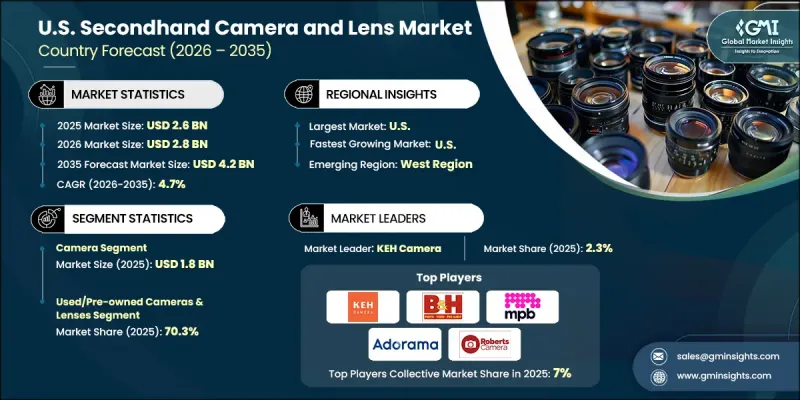
Market growth is driven by increasing demand for affordable photography equipment, the rapid growth of content creation, and the expanding recommerce ecosystem. The market has gained significant traction as consumers seek cost-effective alternatives to new camera gear, particularly amid slowing upgrade cycles and high prices of advanced imaging equipment. The proliferation of online resale platforms, coupled with improved grading systems, warranties, and return policies, has enhanced buyer confidence and transparency in the secondhand market. Additionally, the growing popularity of photography as both a hobby and profession, along with the rise of social media platforms such as YouTube and Instagram, is fueling demand for high-quality yet budget-friendly equipment. Sustainability considerations and circular economy trends are further encouraging consumers to opt for pre-owned cameras and lenses, thereby extending product lifecycles and reducing electronic waste.
| Market Scope | |
|---|---|
| Start Year | 2025 |
| Forecast Year | 2026-2035 |
| Start Value | $2.6 Billion |
| Forecast Value | $4.2 Billion |
| CAGR | 4.7% |
Based on type, the camera segment generated USD 1.8 billion in 2025. This segment benefits from the continuous influx of used camera bodies as consumers upgrade from DSLR to mirrorless systems, creating a steady supply of high-quality pre-owned devices. Cameras remain a primary purchase for beginners, hobbyists, and semi-professional photographers seeking reliable performance at a lower cost. Within this segment, mirrorless cameras are gaining strong traction due to their advanced features, such as superior autofocus, compact design, and enhanced video capabilities, making them highly desirable in the resale market. The availability of a wide range of models across different price points further supports adoption, allowing users to access professional-grade equipment without significant financial investment. The camera segment continues to play a crucial role in attracting first-time buyers and expanding the overall customer base.
The used/pre-owned cameras and lenses segment held a 70.3% share in 2025, offering an ideal balance of affordability, quality, and reliability. Camera equipment is typically built for durability and long-term use, allowing most pre-owned cameras and lenses to maintain strong performance even after years of operation. This longevity, combined with transparent grading standards, comprehensive refurbishment processes, and flexible return policies, helps build strong consumer trust in used gear. Moreover, frequent upgrade cycles among photographers ensure a continuous supply of well-maintained, high-quality products in the resale market. A wide selection of models across different brands, formats, and price ranges further strengthens the segment's appeal. This variety enables both hobbyists and professional photographers to find equipment that suits their needs, while avoiding the higher costs associated with buying new gear.
U.S. Secondhand Camera and Lens Market is highly competitive and fragmented, with key players including KEH Camera, B&H Photo Used Department, MPB, Adorama Used, eBay Certified Refurbished, Central Camera Company, Competitive Camera, Nikon Inc., Canon U.S.A., Inc., Precision Camera, Roberts Camera, and Samy's Camera. Companies in the U.S. Secondhand Camera and Lens Market are focusing on strengthening digital capabilities, enhancing trust, and expanding inventory to maintain a competitive edge. Leading players are investing in advanced e-commerce platforms with real-time inventory updates, detailed grading systems, and high-resolution product listings to improve customer experience. Trade-in and buyback programs are widely adopted to ensure a consistent supply of quality used equipment. Firms are also offering warranties, certification processes, and return policies to build consumer confidence and reduce perceived risks associated with secondhand purchases. Strategic partnerships with logistics providers enable faster nationwide delivery.
Table of Contents
Chapter 1 Methodology and Scope
- 1.1 Market scope and definition
- 1.2 Research design
- 1.2.1 Research approach
- 1.2.2 Data collection methods
- 1.3 Data mining sources
- 1.3.1 Global
- 1.3.2 Regional/Country
- 1.4 Base estimates and calculations
- 1.4.1 Base year calculation
- 1.4.2 Key trends for market estimation
- 1.5 Primary research and validation
- 1.5.1 Primary sources
- 1.6 Forecast model
- 1.7 Research assumptions and limitations
Chapter 2 Executive Summary
- 2.1 Industry 360° synopsis
- 2.2 Key market trends
- 2.2.1 Regional
- 2.2.2 Type
- 2.2.3 Product condition
- 2.2.4 Price range
- 2.2.5 End use
- 2.2.6 Distribution channel
Chapter 3 Industry Insights
- 3.1 Industry ecosystem analysis
- 3.1.1 Supplier landscape
- 3.1.2 Profit margin
- 3.1.3 Value addition at each stage
- 3.1.4 Factor affecting the value chain
- 3.2 Industry impact forces
- 3.2.1 Growth drivers
- 3.2.1.1 Affordability & Cost Savings
- 3.2.1.2 Upgrade cycles & increased supply from DSLR mirrorless shift
- 3.2.1.3 Rising popularity of photography & content creation
- 3.2.2 Industry pitfalls & challenges
- 3.2.2.1 Quality variability and lack of warranty
- 3.2.2.2 Fraud risks and trust issues on peer-to-peer platforms
- 3.2.3 Opportunities
- 3.2.3.1 Rising demand for affordable, high-quality gear
- 3.2.3.2 Increased supply from the shift to mirrorless systems
- 3.2.1 Growth drivers
- 3.3 Growth potential analysis
- 3.4 Regulatory landscape
- 3.4.1 Consumer protection laws (FTC Used Merchandise Rules)
- 3.4.2 Warranty & return requirements by state
- 3.4.3 Sales Tax Implications for C2C Transactions
- 3.4.4 Product Liability Standards for Refurbished Equipment
- 3.4.5 Gray Market Import Regulations
- 3.5 Major market trends and disruptions
- 3.6 Technological and innovation landscape
- 3.6.1 Current technological trends
- 3.6.2 Emerging technologies
- 3.7 Pricing Analysis (2025)
- 3.8 Future Market Trends
- 3.9 Porter's Analysis
- 3.10 PESTEL Analysis
- 3.11 Consumer Buying Behaviour
- 3.11.1 Purchasing patterns
- 3.11.2 Preference analysis
- 3.11.3 Regional variations in consumer behaviour
- 3.11.4 Impact of e-commerce on buying decisions
- 3.12 Technology / innovation landscape
- 3.12.1 AI-powered condition assessment & pricing tools
- 3.12.2 Blockchain for provenance verification
- 3.12.3 Computer vision for authenticity detection
- 3.12.4 Automated grading & quality scoring systems
- 3.12.5 Digital inspection platforms & remote assessment
- 3.13 Trade data analysis
- 3.13.1 Import / export volume & value trends
- 3.13.2 Key trade corridors & tariff impact
- 3.14 Impact of AI & generative AI on the market
- 3.14.1 AI-driven disruption of existing business models
- 3.14.2 Generative AI use cases & adoption roadmap by segment
- 3.14.3 Risks, limitations & regulatory considerations
- 3.15 Patent & innovation landscape
- 3.15.1 Patent filing trends by technology area (2022-2025)
- 3.15.2 Key patent assignees & IP concentration
- 3.15.3 Emerging technology clusters & whitespace mapping
- 3.15.4 Geographic patent activity
- 3.16 Distribution infrastructure & channel penetration landscape
- 3.16.1 Channel coverage by region & format
- 3.16.2 Last-mile infrastructure gaps & emerging channel shifts
- 3.17 Future outlook
Chapter 4 Competitive Landscape, 2025
- 4.1 Introduction
- 4.2 Company market share analysis
- 4.3 Company matrix analysis
- 4.4 Competitive analysis of major market players
- 4.5 Competitive positioning matrix
- 4.6 Key developments
- 4.6.1 Mergers & acquisitions
- 4.6.2 Partnerships & collaborations
- 4.6.3 New product launches
- 4.6.4 Expansion plans
Chapter 5 Market Estimates and Forecast, By Type, 2022 - 2035 (USD Billion) (Thousand Units)
- 5.1 Key trends
- 5.2 Camera
- 5.2.1 DSLR cameras
- 5.2.2 Mirrorless cameras
- 5.2.3 Point-and-shoot cameras
- 5.2.4 Film cameras
- 5.2.5 Others (medium format camera, etc.)
- 5.3 Lens
- 5.3.1 Standard lens
- 5.3.2 Wide angle lens
- 5.3.3 Telephoto lens
- 5.3.4 Others (fisheye, etc.)
Chapter 6 Market Estimates and Forecast, By Product Condition, 2022 - 2035 (USD Billion) (Thousand Units)
- 6.1 Key trends
- 6.2 Used/pre-owned cameras & lenses
- 6.3 Refurbished cameras & lenses
Chapter 7 Market Estimates and Forecast, By Price Range, 2022 - 2035 (USD Billion) (Thousand Units)
- 7.1 Key trends
- 7.2 Entry-level
- 7.3 Mid-range
- 7.4 Professional
- 7.5 Premium
Chapter 8 Market Estimates and Forecast, By End Use, 2022 - 2035 (USD Billion) (Thousand Units)
- 8.1 Key trends
- 8.2 Amateur/hobbyist photographers
- 8.3 Semi-professional photographers
- 8.4 Content creators/vloggers
- 8.5 Institutional/educational
- 8.6 Others (collectors, rental companies, travel enthusiasts)
Chapter 9 Market Estimates and Forecast, By Distribution Channel, 2022 - 2035 (USD Billion) (Thousand Units)
- 9.1 Key trends
- 9.2 Online channels
- 9.3 Offline channels
Chapter 10 Market Estimates and Forecast, By Region, 2022 - 2035 (USD Billion) (Thousand Units)
- 10.1 Key trends
- 10.2 Northeast
- 10.3 Midwest
- 10.4 South
- 10.5 West
- 10.6 Southwest
Chapter 11 Company Profiles
- 11.1 Adorama Used
- 11.2 B&H Photo Used Department
- 11.3 Canon U.S.A., Inc.
- 11.4 Central Camera Company
- 11.5 Competitive Camera
- 11.6 eBay Certified Refurbished
- 11.7 KEH Camera
- 11.8 Lens Rentals
- 11.9 Mike's Camera
- 11.10 MPB
- 11.11 National Camera Exchange
- 11.12 Nikon Inc.
- 11.13 Precision Camera
- 11.14 Roberts Camera
- 11.15 Samy's Camera

