PUBLISHER: Global Market Insights Inc. | PRODUCT CODE: 2019109

PUBLISHER: Global Market Insights Inc. | PRODUCT CODE: 2019109
Bakery Products Market Opportunity, Growth Drivers, Industry Trend Analysis, and Forecast 2026 - 2035
The Global Bakery Products Market was valued at USD 625.5 billion in 2025 and is estimated to grow at a CAGR of 4.5% to reach USD 963.7 billion by 2035.
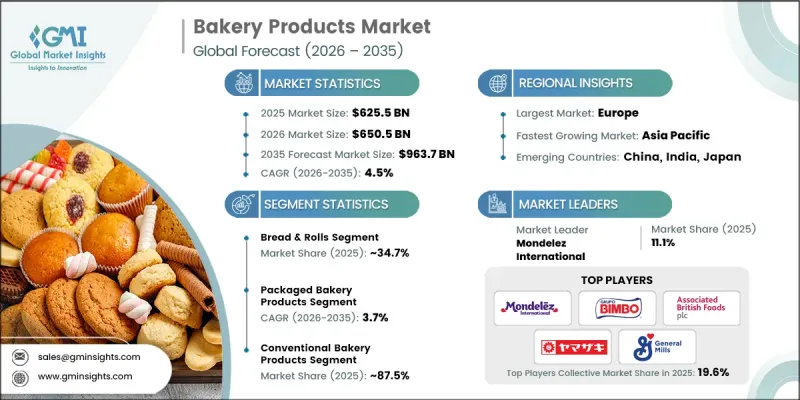
The market is evolving around changing consumer preferences that emphasize freshness, authenticity, and indulgence in daily consumption. Bakery products are increasingly presented in visually appealing packaging with clean-label designs, enabling consumers to easily access ingredient information while experiencing a multisensory connection with the product. Health-conscious trends are driving the development of functional bakery items, prompting brands to leverage research, flexible production, and smaller batch customization. The industry is also being shaped by demand for convenience, supported by multiple distribution channels including e-commerce, direct-to-consumer platforms, and collaborations with quick-service restaurants. Sustainability is now a core business objective, with companies focusing on responsibly sourced ingredients, waste reduction, and recyclable packaging solutions to align with consumer expectations and global environmental standards.
| Market Scope | |
|---|---|
| Start Year | 2025 |
| Forecast Year | 2026-2035 |
| Start Value | $625.5 Billion |
| Forecast Value | $963.7 Billion |
| CAGR | 4.5% |
The bread and rolls segment held a share of 34.7% in 2025 and is expected to grow at a CAGR of 3.4% through 2035. These staples dominate due to their daily consumption in households and foodservice outlets. The segment thrives on clean-label formulations, alternative grains, fermentation-based quality markers, and flexible serving sizes that match evolving dietary trends. Improvements in packaging and shelf life maintain freshness and drive repeat consumption.
The packaged bakery products segment held a 58.8% share in 2025 and is expected to grow at a CAGR of 3.7% through 2035. Packaged items remain popular due to their convenience, extended shelf life, and integration into daily eating routines. Continuous product innovations, such as texture improvements, functional packaging, premium sub-ranges, and portion-controlled formats, sustain segment stability while boosting competition. Retailers and convenience stores play a critical role in maintaining consistent demand for bread, cakes, cookies, and related bakery products.
North America Bakery Products Market held 27.8% share in 2025. The region is among the most developed and expansive due to strong consumer interest in diverse, accessible, and innovative bakery products. North America benefits from a well-established bakery ecosystem with prominent brands and extensive retail networks. Rising demand for gluten-free, organic, and low-calorie options drives product innovation, while the preference for artisanal and specialty bakery items shapes the development of new product lines and expansions.
Prominent players in the Global Bakery Products Industry include General Mills, Inc., ARYZTA AG, Grupo Bimbo, Associated British Foods plc, Flowers Foods, Nestle S.A., Mondelez International, Yamazaki Baking Co., Ltd, Hostess Brands, LLC, Crown Bakeries, Finsbury Food Group Limited, and Britannia Industries. Companies in the Global Bakery Products Market strengthen their presence through strategic approaches such as expanding product portfolios with functional, clean-label, and premium offerings, investing in R&D to enhance taste, texture, and shelf life, and leveraging flexible manufacturing to support small-batch customization. They prioritize partnerships with retail and e-commerce channels to increase product visibility and accessibility, while sustainability initiatives like recyclable packaging and responsibly sourced ingredients improve brand credibility. Marketing campaigns highlighting health, indulgence, and artisan qualities help boost consumer engagement, while mergers and acquisitions allow companies to enter new geographies, consolidate market share, and diversify product lines to maintain long-term competitiveness.
Table of Contents
Chapter 1 Methodology & Scope
- 1.1 Market scope and definition
- 1.2 Research design
- 1.2.1 Research approach
- 1.2.2 Data collection methods
- 1.3 Data mining sources
- 1.3.1 Global
- 1.3.2 Regional/Country
- 1.4 Base estimates and calculations
- 1.4.1 Base year calculation
- 1.4.2 Key trends for market estimation
- 1.5 Primary research and validation
- 1.5.1 Primary sources
- 1.6 Forecast model
- 1.7 Research assumptions and limitations
Chapter 2 Executive Summary
- 2.1 Industry 360° synopsis
- 2.2 Key market trends
- 2.2.1 Regional
- 2.2.2 Product type
- 2.2.3 Category
- 2.2.4 Specialty type
- 2.2.5 Distribution channel
- 2.3 TAM Analysis, 2026-2035
- 2.4 CXO perspectives: Strategic imperatives
- 2.4.1 Executive decision points
Chapter 3 Industry Insights
- 3.1 Industry ecosystem analysis
- 3.1.1 Supplier landscape
- 3.1.2 Profit margin
- 3.1.3 Value addition at each stage
- 3.1.4 Factor affecting the value chain
- 3.1.5 Disruptions
- 3.2 Industry impact forces
- 3.2.1 Growth drivers
- 3.2.2 Industry pitfalls and challenges
- 3.2.3 Market opportunities
- 3.3 Growth potential analysis
- 3.4 Regulatory landscape
- 3.4.1 North America
- 3.4.2 Europe
- 3.4.3 Asia Pacific
- 3.4.4 Latin America
- 3.4.5 Middle East & Africa
- 3.5 Porter's analysis
- 3.6 PESTEL analysis
- 3.7 Price trends
- 3.7.1 By region
- 3.7.2 By type
- 3.8 Future market trends
- 3.9 Technology and Innovation landscape
- 3.9.1 Current technological trends
- 3.9.2 Emerging technologies
- 3.10 Patent Landscape
- 3.11 Trade statistics (HS code)
- 3.11.1 Major importing countries
- 3.11.2 Major exporting countries
- 3.12 Sustainability and environmental aspects
- 3.12.1 Sustainable practices
- 3.12.2 Waste reduction strategies
- 3.12.3 Energy efficiency in production
- 3.12.4 Eco-friendly initiatives
- 3.13 Carbon footprint consideration
Chapter 4 Competitive Landscape, 2025
- 4.1 Introduction
- 4.2 Company market share analysis
- 4.2.1 By region
- 4.2.1.1 North America
- 4.2.1.2 Europe
- 4.2.1.3 Asia Pacific
- 4.2.1.4 LATAM
- 4.2.1.5 MEA
- 4.2.1 By region
- 4.3 Company matrix analysis
- 4.4 Competitive analysis of major market players
- 4.5 Competitive positioning matrix
- 4.6 Key developments
- 4.6.1 Mergers & acquisitions
- 4.6.2 Partnerships & collaborations
- 4.6.3 New Product Launches
- 4.6.4 Expansion Plans
Chapter 5 Market Estimates and Forecast, By Product Type, 2022-2035 (USD Billion) (Kilo Tons)
- 5.1 Key trends
- 5.2 Bread & rolls
- 5.2.1 White bread
- 5.2.2 Whole grain/multigrain bread
- 5.2.3 Specialty bread (gluten-free, organic, sourdough)
- 5.3 Cakes & pastries
- 5.3.1 Cakes (layer cakes, cupcakes, muffins)
- 5.3.2 Pastries (croissants, danish, tarts)
- 5.4 Biscuits & cookies
- 5.4.1 Sweet cookies
- 5.4.2 Crackers & savory biscuits
- 5.4.3 Nut cookies
- 5.5 Pizza crusts
- 5.6 Other bakery products
- 5.6.1 Rusks, breadsticks, pretzels, bagels
- 5.6.2 Emerging product categories (protein bars or hybrid baked snacks)
Chapter 6 Market Estimates and Forecast, By Category, 2022-2035 (USD Billion) (Kilo Tons)
- 6.1 Key trends
- 6.2 Packaged bakery products
- 6.2.1 Mass-market packaged bakery
- 6.2.2 Premium packaged bakery
- 6.3 Artisanal bakery products
- 6.3.1 European artisanal bakery products
- 6.3.2 North American artisanal bakery products
- 6.3.3 Latin American artisanal bakery products
- 6.3.4 Middle Eastern artisanal bakery products
- 6.3.5 Asian artisanal bakery products
- 6.3.6 Oceanian artisanal bakery products
- 6.4 In-store bakery
Chapter 7 Market Estimates and Forecast, By Specialty Type, 2022-2035 (USD Billion) (Kilo Tons)
- 7.1 Key trends
- 7.2 Gluten-free bakery products
- 7.3 Organic bakery products
- 7.4 Fortified bakery products
- 7.5 Low-calorie/sugar-free bakery
- 7.6 Vegan bakery products
- 7.7 Conventional bakery products
Chapter 8 Market Estimates and Forecast, By Distribution Channel, 2022-2035 (USD Billion) (Kilo Tons)
- 8.1 Key trends
- 8.2 Hypermarkets & supermarkets
- 8.3 Convenience stores
- 8.4 Specialty bakery stores
- 8.5 Online retail
- 8.6 Food service
- 8.7 Direct sales
Chapter 9 Market Estimates and Forecast, By Region, 2022-2035 (USD Billion) (Kilo Tons)
- 9.1 Key trends
- 9.2 North America
- 9.2.1 U.S.
- 9.2.2 Canada
- 9.3 Europe
- 9.3.1 Germany
- 9.3.2 UK
- 9.3.3 France
- 9.3.4 Spain
- 9.3.5 Italy
- 9.3.6 Rest of Europe
- 9.4 Asia Pacific
- 9.4.1 China
- 9.4.2 India
- 9.4.3 Japan
- 9.4.4 Australia
- 9.4.5 South Korea
- 9.4.6 Rest of Asia Pacific
- 9.5 Latin America
- 9.5.1 Brazil
- 9.5.2 Mexico
- 9.5.3 Argentina
- 9.5.4 Rest of Latin America
- 9.6 Middle East and Africa
- 9.6.1 Saudi Arabia
- 9.6.2 South Africa
- 9.6.3 UAE
- 9.6.4 Rest of Middle East and Africa
Chapter 10 Company Profiles
- 10.1 ARYZTA AG
- 10.2 Associated British Foods plc
- 10.3 Britannia Industries
- 10.4 Crown Bakeries
- 10.5 Finsbury Food Group Limited
- 10.6 Flowers Foods
- 10.7 General Mills, Inc.
- 10.8 Grupo Bimbo
- 10.9 HOSTESS BRANDS, LLC
- 10.10 Mondelez International
- 10.11 Nestle S.A.
- 10.12 Yamazaki Baking Co., Ltd.

