
PUBLISHER: Mordor Intelligence | PRODUCT CODE: 1939134

PUBLISHER: Mordor Intelligence | PRODUCT CODE: 1939134
Bakery Products - Market Share Analysis, Industry Trends & Statistics, Growth Forecasts (2026 - 2031)
The global bakery products market size in 2026 is estimated at USD 524.99 billion, growing from 2025 value of USD 503.4 billion with 2031 projections showing USD 647.58 billion, growing at 4.29% CAGR over 2026-2031.
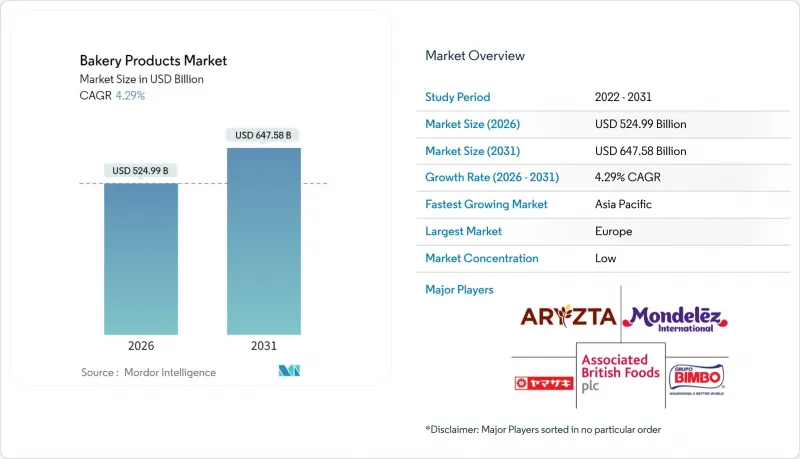
Sustained growth stems from steady demand for staple bread, fast-rising appetite for health-forward snacks, and wider access to convenient retail channels that match modern lifestyles. Upcycled ingredients certified by the Upcycled Food Association have moved from experimental trials to mainstream lines, signaling a shift toward circular-economy sourcing that resonates with eco-conscious shoppers. Automation is also reshaping production: robotic micro-bakeries embedded in stores deliver artisan-style freshness while easing chronic labor shortages, a pain point flagged by 73% of commercial bakers in 2024 workforce surveys.
Global Bakery Products Market Trends and Insights
Gluten-free & Allergen-free Formulations Gain Mass-Market Traction
Regulators tightening label rules and consumers demanding inclusive diets are propelling gluten-free and allergen-free items from niche shelves into core bakery aisles. The 2024 FDA recall of mislabeled gluten-free loaves spotlighted the cost of compliance lapses and accelerated investment in dedicated production lines. Commercial Bakeries' 2024 buyout of Imagine Baking added specialized R&D and separate allergen-controlled facilities, giving the acquirer a faster path into premium free-from segments. In the European Union, mandatory allergen statements became more conspicuous under updated regulations, nudging retailers to expand shelf space for certified products that simplify consumer choice. As ingredient suppliers unlock volume pricing for rice-, oat-, and sorghum-based flours, unit costs are declining, allowing mainstream brands to offer free-from variants with minimal price uplift. Retailers in North America and Europe now dedicate full bays to these lines, a practice mirrored by leading chains in Japan and Australia, signaling a lasting shift toward inclusive bakery offerings.
On-the-Go, Portion-Controlled Bakery Snacks
Urban commuters juggling tight schedules gravitate to single-serve muffins, filled croissants, and protein-enriched cookies that can be eaten in transit. The American Bakers Association's 2024 roadmap placed special emphasis on merchandising smaller pack sizes to curb food waste and resonate with calorie-conscious buyers. Pack-tech innovators have responded with high-barrier films that retain softness for seven days without preservatives, supporting wider distribution windows. Asia-Pacific convenience stores report double-digit sales growth for heat-and-eat buns targeting office workers, while social-media campaigns pairing portion guidance with QR-code nutrition panels reinforce healthy indulgence cues. Premium pricing on multipacks offsets higher material costs, boosting margins even as volume per pack shrinks.
Sugar, Fat & Additive Health Concerns
Public policy is hardening around sugar limits as obesity rates climb. The EU's 2024 decision to block isomaltulose health claims reinforced a trend of evidence-based approvals, forcing marketers to vet functional statements rigorously. Simultaneously, the FDA's final rule redefining "healthy" labelling caps added sugars at strict thresholds, pressuring bakers to reformulate while preserving taste. Retailers in Canada have begun color-coding bakery SKUs by nutrient density, and items exceeding voluntary sugar ceilings face shelf-space downgrades. Reformulation raises costs: replacing sugar with specialty fibers can inflate recipe spending by 6-8%, a hurdle particularly for small bakeries lacking scale.
Other drivers and restraints analyzed in the detailed report include:
- Rising Disposable Incomes in Emerging Economies
- In-Store Automated Micro-Bakeries Lift Freshness Perception
- Wheat & Other Cereal Price Volatility
For complete list of drivers and restraints, kindly check the Table Of Contents.
Segment Analysis
Bread generated the largest slice of the bakery products market size, accounting for 44.98% revenue in 2025. Population-wide familiarity, affordable pricing, and mealtime versatility anchor its lead, while continuous recipe tweaks-whole-grain, low-GI, or protein-fortified-align with evolving dietary ideals without alienating core consumers. Regulators allow tartaric acid derivatives up to 15,000 mg/kg, helping bakers manage texture during shelf life. Major players also explore sourdough fermentation to lend natural preservatives and artisan flavor cues.
Morning goods, though smaller, are the bakery products market's fastest-moving niche with a 5.52% CAGR outlook. Grab-and-go culture underpins mini-croissants and muffins, while better-for-you twists-chia, flax, or reduced sugar-let brands capture indulgence and wellness in one pack. Suppliers such as Farinart launched customizable clean-label mixes to cut R&D time for smaller factories, fostering product diversity. The interplay of premiumization and convenience makes morning goods a magnet for both local craft bakers and global snack giants chasing incremental growth.
The Bakery Products Market is Segmented by Product Type (Bread, Cakes & Pastries, Biscuits/Cookies, Morning Goods, Other Product Types), Distribution Channel (Supermarkets/Hypermarkets, Convenience & Grocery Stores, Specialty Bakery Stores, Online Retail & D2C, Other Channels), Form (Fresh, Frozen), and Geography (North America, Europe, Asia-Pacific, and More). The Market Forecasts are Provided in Terms of Value (USD).
Geography Analysis
In 2025, Europe held the largest market share at 32.84%, driven by its strong bakery culture, advanced retail systems, and regulations that encourage innovation despite being stringent. The introduction of new EU additive limits and the 2025 deforestation-free sourcing rule is pushing suppliers toward verifiable supply chains, increasing compliance costs but enhancing consumer trust. Merger and acquisition discussions, such as Kingsmill-Hovis talks, indicate market rationalization to address cost inflation and sustainability investments. Additionally, nonprofit WRAP's goal of cutting greenhouse gas emissions by 50% is steering the industry toward eco-friendly packaging and renewable energy adoption in production facilities. Asia-Pacific, with a 5.62% CAGR, is the fastest-growing region, supported by a rising urban middle class and trade facilitation under the APEC Food Safety Modernisation Framework. Governments are revising nutrition policies, such as Singapore's 2025 expansion of Nutri-Grade to bakery beverages, which is driving reduced-sugar reformulations. Halal certification rollouts in Indonesia and Malaysia, while adding paperwork, are unlocking access to broader Muslim consumer markets. The region is also blending local and Western flavors, as seen in innovations like pandan-flavored swiss rolls and kimchi-stuffed buns.
North America remains influential due to strong brand presence and advanced automation, though growth is modest due to market saturation. The American Bakers Association's "destination workplace" initiative aims to address skilled labor shortages, while state government grants help offset capital expenditures on energy-efficient ovens. South America, the Middle East, and Africa, though smaller in market share, are experiencing mid-single-digit growth driven by urban population increases and improved cold chain logistics. In Oman, the planned merger of Salalah Mills and Atyab Food highlights regional ambitions to scale up and establish a diversified bakery hub. These developments across regions reflect a dynamic global bakery market adapting to regulatory, sustainability, and consumer trends.
- Grupo Bimbo SAB de CV
- Yamazaki Baking Co. Ltd
- Mondelez International Inc.
- Associated British Foods plc
- Aryzta AG
- Kellogg Company
- General Mills Inc.
- Flower Foods Inc.
- Lantmennen Unibake
- Warburtons Ltd
- Britannia Industries Ltd
- Finsbury Food Group plc
- Hostess Brands Inc.
- McKee Foods Corporation
- Yildiz Holding
- Premier Foods plc
- Barilla Group (Mulino Bianco)
- Parle Products Pvt Ltd
- Subulah Group
- Walker's Shortbread Ltd
Additional Benefits:
- The market estimate (ME) sheet in Excel format
- 3 months of analyst support
TABLE OF CONTENTS
1 Introduction
- 1.1 Study Assumptions and Market Definition
- 1.2 Scope of the Study
2 Research Methodology
3 Executive Summary
4 Market Landscape
- 4.1 Market Overview
- 4.2 Market Drivers
- 4.2.1 Gluten-free & Allergen-free Formulations Gain Mass-Market Traction
- 4.2.2 On-the-Go, Portion-Controlled Bakery Snacks
- 4.2.3 Rising Disposable Incomes in Emerging Economies
- 4.2.4 Direct-to-Consumer Subscription Bakeries
- 4.2.5 Upcycled Ingredients for Cost & Sustainability Edge
- 4.2.6 In-store Automated Micro-Bakeries Lift Freshness Perception
- 4.3 Market Restraints
- 4.3.1 Sugar, Fat & Additive Health Concerns
- 4.3.2 Wheat & Other Cereal Price Volatility
- 4.3.3 Carbon-Footprint Scrutiny of Global Supply Chains (Under-reported)
- 4.3.4 Skilled Artisan-Baker Labor Shortages (Under-reported)
- 4.4 Value / Supply-Chain Analysis
- 4.5 Regulatory Landscape
- 4.6 Technological Outlook
- 4.7 Porter's Five Forces Analysis
- 4.7.1 Threat of New Entrants
- 4.7.1.1 Bargaining Power of Buyers / Consumers
- 4.7.1.2 Bargaining Power of Suppliers
- 4.7.1.3 Threat of Substitute Products
- 4.7.1.4 Intensity of Competitive Rivalry
- 4.7.1 Threat of New Entrants
5 Market Size & Growth Forecasts (Value)
- 5.1 By Product Type
- 5.1.1 Bread
- 5.1.2 Cakes & Pastries
- 5.1.3 Biscuits / Cookies
- 5.1.4 Morning Goods (Donuts, Muffins, Croissants)
- 5.1.5 Other Product Types
- 5.2 By Distribution Channel
- 5.2.1 Supermarkets / Hypermarkets
- 5.2.2 Convenience & Grocery Stores
- 5.2.3 Specialty Bakery Stores
- 5.2.4 Online Retail & D2C
- 5.2.5 Other Channels
- 5.3 Form
- 5.3.1 Fresh
- 5.3.2 Frozen
- 5.4 By Geography
- 5.4.1 North America
- 5.4.1.1 United States
- 5.4.1.2 Canada
- 5.4.1.3 Mexico
- 5.4.1.4 Rest of North America
- 5.4.2 Europe
- 5.4.2.1 Germany
- 5.4.2.2 United Kingdom
- 5.4.2.3 Italy
- 5.4.2.4 France
- 5.4.2.5 Spain
- 5.4.2.6 Netherlands
- 5.4.2.7 Poland
- 5.4.2.8 Belgium
- 5.4.2.9 Sweden
- 5.4.2.10 Rest of Europe
- 5.4.3 Asia-Pacific
- 5.4.3.1 China
- 5.4.3.2 India
- 5.4.3.3 Japan
- 5.4.3.4 Australia
- 5.4.3.5 Indonesia
- 5.4.3.6 South Korea
- 5.4.3.7 Thailand
- 5.4.3.8 Singapore
- 5.4.3.9 Rest of Asia-Pacific
- 5.4.4 South America
- 5.4.4.1 Brazil
- 5.4.4.2 Argentina
- 5.4.4.3 Colombia
- 5.4.4.4 Chile
- 5.4.4.5 Peru
- 5.4.4.6 Rest of South America
- 5.4.5 Middle East and Africa
- 5.4.5.1 South Africa
- 5.4.5.2 Saudi Arabia
- 5.4.5.3 United Arab Emirates
- 5.4.5.4 Nigeria
- 5.4.5.5 Egypt
- 5.4.5.6 Morocco
- 5.4.5.7 Turkey
- 5.4.5.8 Rest of Middle East and Africa
- 5.4.1 North America
6 Competitive Landscape
- 6.1 Market Concentration
- 6.2 Strategic Moves
- 6.3 Market Share Analysis
- 6.4 Company Profiles (includes Global level Overview, Market level overview, Core Segments, Financials as available, Strategic Information, Market Rank/Share for key companies, Products & Services, and Recent Developments)
- 6.4.1 Grupo Bimbo SAB de CV
- 6.4.2 Yamazaki Baking Co. Ltd
- 6.4.3 Mondelez International Inc.
- 6.4.4 Associated British Foods plc
- 6.4.5 Aryzta AG
- 6.4.6 Kellogg Company
- 6.4.7 General Mills Inc.
- 6.4.8 Flower Foods Inc.
- 6.4.9 Lantmennen Unibake
- 6.4.10 Warburtons Ltd
- 6.4.11 Britannia Industries Ltd
- 6.4.12 Finsbury Food Group plc
- 6.4.13 Hostess Brands Inc.
- 6.4.14 McKee Foods Corporation
- 6.4.15 Yildiz Holding
- 6.4.16 Premier Foods plc
- 6.4.17 Barilla Group (Mulino Bianco)
- 6.4.18 Parle Products Pvt Ltd
- 6.4.19 Subulah Group
- 6.4.20 Walker's Shortbread Ltd
7 Market Opportunities & Future Outlook

