PUBLISHER: Global Market Insights Inc. | PRODUCT CODE: 2071318

PUBLISHER: Global Market Insights Inc. | PRODUCT CODE: 2071318
Open Loop Current Transducer Market Opportunity, Growth Drivers, Industry Trend Analysis, and Forecast 2026 - 2035
The Global Open Loop Current Transducer Market was valued at USD 252.8 million in 2025 and is estimated to grow at a CAGR of 5.2% to reach USD 418 million by 2035. Market growth is supported by the increasing deployment of electrically controlled systems across industrial, automotive, and energy applications, where accurate and efficient current monitoring is essential for safe and optimized performance. These transducers play a critical role in ensuring operational stability across power systems used in energy management platforms, industrial automation environments, and electric vehicle ecosystems. The rising integration of renewable energy sources is further strengthening demand, as modern energy networks require reliable current measurement solutions to maintain efficiency and grid stability. Technological advancements are also reshaping the market landscape, with newer transducer designs becoming more compact, cost-efficient, and highly accurate. Improvements in sensing technologies, combined with the integration of wireless communication systems and IoT-enabled platforms, are enhancing real-time data acquisition and analytics capabilities. This is increasing the adoption of open loop current transducers in remote monitoring systems and smart energy applications. Growing emphasis on reducing carbon emissions and improving energy efficiency is further reinforcing the need for precise current monitoring solutions across multiple sectors.
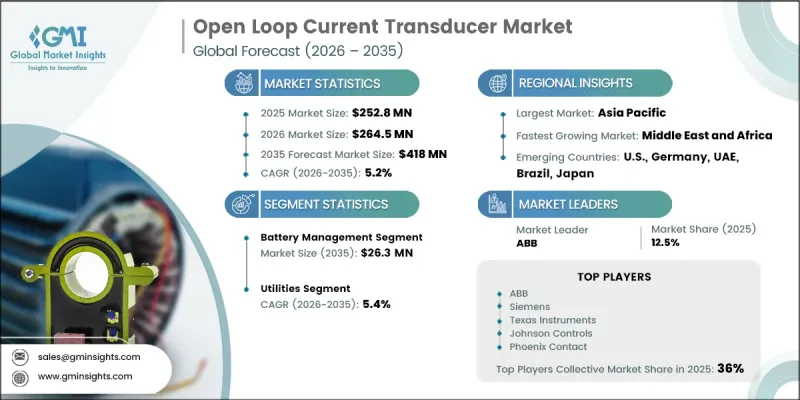
The battery management application segment is expected to reach USD 26.3 million by 2035, driven by increasing deployment of energy storage systems in electric mobility and renewable energy integration. Rising demand for improved battery performance, extended lifecycle management, and enhanced safety monitoring is accelerating the use of current sensing technologies in battery systems. These transducers are becoming essential components in optimizing energy efficiency and ensuring stable battery operations across advanced storage applications.
| Market Scope | |
|---|---|
| Start Year | 2025 |
| Forecast Year | 2026-2035 |
| Start Value | $252.8 Million |
| Forecast Value | $418 Million |
| CAGR | 5.2% |
The utilities segment is projected to grow at a CAGR of 5.4% between 2026 and 2035, supported by the increasing need for efficient power management and improved grid connectivity. Utility-scale applications such as renewable energy plants, substations, and transmission and distribution networks are increasingly relying on precise current measurement technologies. The non-invasive design and high accuracy of open loop current transducers make them suitable for monitoring high-current environments, supporting stable and efficient power distribution systems.
U.S. Open Loop Current Transducer Market is expected to reach USD 63 million by 2035, driven by rising investments in energy efficiency, smart grid infrastructure, and renewable energy expansion. The growing adoption of solar and wind power is increasing the need for advanced current monitoring systems across generation, transmission, and distribution networks. Industrial applications are also contributing to demand as industries increasingly prioritize real-time energy monitoring and operational efficiency improvements.
Major companies operating in the global open loop current transducer market include Siemens, ABB, Texas Instruments, LEM International, Phoenix Contact, Johnson Controls, Danisense, Vacuumschmelze, NK Technologies, HBK, Cheemi Technology, Chenyang Technologies, Luksens, PowerUC, Howard Butler, Sensor Electronic Technology, Senis, and Topstek. Companies operating in the open loop current transducer market are focusing on strengthening their competitive position through continuous technological advancement and product optimization. A key strategy involves the development of high-precision, compact, and cost-efficient sensing solutions tailored for industrial, automotive, and energy applications. Market players are increasingly integrating IoT connectivity and wireless communication features into transducer systems to enable real-time monitoring and predictive analytics. Strategic collaborations with energy utilities, EV manufacturers, and industrial automation providers are helping expand application reach. Companies are also investing in research and development to improve measurement accuracy, thermal stability, and energy efficiency.
Table of Contents
Chapter 1 Methodology & Scope
- 1.1 Research approach
- 1.2 Quality commitments
- 1.2.1 GMI AI policy & data integrity commitment
- 1.2.1.1 Source consistency protocol
- 1.2.1 GMI AI policy & data integrity commitment
- 1.3 Research trail & confidence scoring
- 1.3.1 Research trail components
- 1.3.2 Scoring components
- 1.4 Data collection
- 1.4.1 Partial list of primary sources
- 1.5 Data mining sources
- 1.5.1 Paid sources
- 1.5.1.1 Sources, by region
- 1.5.1 Paid sources
- 1.6 Base estimates and calculations
- 1.6.1 Base year calculation for any one approach
- 1.7 Market estimates & forecasts parameters
- 1.8 Forecast model
- 1.8.1 Quantified market impact analysis
- 1.8.1.1 Mathematical impact of growth parameters on forecast
- 1.8.1 Quantified market impact analysis
- 1.9 Research transparency addendum
- 1.9.1 Source attribution framework
- 1.9.2 Quality assurance metrics
- 1.9.3 Our commitment to trust
- 1.10 Market definitions
Chapter 2 Executive Summary
- 2.1 Industry synopsis, 2022 - 2035
- 2.1.1 Business trends
- 2.1.2 Application trends
- 2.1.3 End use trends
- 2.1.4 Regional trends
Chapter 3 Industry Insights
- 3.1 Industry ecosystem analysis
- 3.1.1 Raw material availability & sourcing analysis
- 3.1.2 Manufacturing capacity assessment
- 3.1.3 Supply chain resilience & risk factors
- 3.1.4 Distribution network analysis
- 3.2 Regulatory landscape
- 3.3 Industry impact forces
- 3.3.1 Growth drivers
- 3.3.2 Industry pitfalls & challenges
- 3.4 Growth potential analysis
- 3.5 Porter's analysis
- 3.5.1 Bargaining power of suppliers
- 3.5.2 Bargaining power of buyers
- 3.5.3 Threat of new entrants
- 3.5.4 Threat of substitutes
- 3.6 PESTEL analysis
- 3.6.1 Political factors
- 3.6.2 Economic factors
- 3.6.3 Social factors
- 3.6.4 Technological factors
- 3.6.5 Legal factors
- 3.6.6 Environmental factors
- 3.7 Capacity & production landscape (Driven by Primary Research)
- 3.7.1 Capacity by key producer (Driven by Primary Research)
- 3.7.2 Capacity utilization rates & expansion pipelines (Driven by Primary Research)
- 3.8 Impact of AI & Generative AI on the market (Core Solution)
- 3.8.1 AI-Driven production optimization (Core Solution)
- 3.8.2 Predictive maintenance & fault detection (Core Solution)
- 3.9 Emerging opportunities & trends
- 3.10 Investment analysis & future prospects
- 3.11 Sustainability initiatives & industry 4.0 integration
Chapter 4 Competitive Landscape, 2026
- 4.1 Introduction
- 4.2 Company market share analysis, by region, 2025
- 4.2.1 North America
- 4.2.2 Europe
- 4.2.3 Asia Pacific
- 4.2.4 Middle East & Africa
- 4.2.5 Latin America
- 4.3 Key developments
- 4.3.1 Key partnerships & collaborations
- 4.3.2 Major M&A activities
- 4.3.3 Product innovations & launches
- 4.3.4 Market expansion strategies
- 4.4 Competitive positioning matrix
Chapter 5 Market Size and Forecast, By Application, 2022 - 2035 (USD Million)
- 5.1 Key trends
- 5.2 Motor drive
- 5.3 Converter & inverter
- 5.4 Battery management
- 5.5 UPS & SMPS
- 5.6 Others
Chapter 6 Market Size and Forecast, By End Use, 2022 - 2035 (USD Million)
- 6.1 Key trends
- 6.2 Industrial
- 6.3 Utility
- 6.4 Automotive
- 6.5 Others
Chapter 7 Market Size and Forecast, By Region, 2022 - 2035 (USD Million)
- 7.1 Key trends
- 7.2 North America
- 7.2.1 U.S.
- 7.2.2 Canada
- 7.2.3 Mexico
- 7.3 Europe
- 7.3.1 UK
- 7.3.2 France
- 7.3.3 Germany
- 7.3.4 Italy
- 7.3.5 Russia
- 7.3.6 Spain
- 7.4 Asia Pacific
- 7.4.1 China
- 7.4.2 Australia
- 7.4.3 India
- 7.4.4 Japan
- 7.4.5 South Korea
- 7.5 Middle East & Africa
- 7.5.1 Saudi Arabia
- 7.5.2 UAE
- 7.5.3 South Africa
- 7.6 Latin America
- 7.6.1 Brazil
- 7.6.2 Argentina
Chapter 8 Company Profiles
- 8.1 ABB
- 8.2 Cheemi Technology
- 8.3 Chenyang Technologies
- 8.4 Danisense
- 8.5 HBK
- 8.6 Howard Butler
- 8.7 Johnson Controls
- 8.8 LEM International
- 8.9 Luksens
- 8.10 NK Technologies
- 8.11 Phoenix Contact
- 8.12 PowerUC
- 8.13 Senis
- 8.14 Sensor Electronic Technology
- 8.15 Siemens
- 8.16 Texas Instruments
- 8.17 Topstek
- 8.18 Vacuumschmelze

