PUBLISHER: Global Market Insights Inc. | PRODUCT CODE: 2019168

PUBLISHER: Global Market Insights Inc. | PRODUCT CODE: 2019168
Bromine Flame Retardant Market Opportunity, Growth Drivers, Industry Trend Analysis, and Forecast 2026 - 2035
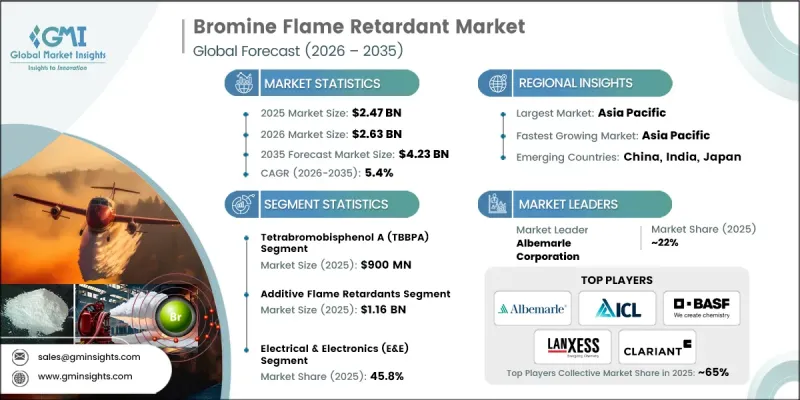
The Global Bromine Flame Retardant Market was valued at USD 2.47 billion in 2025 and is estimated to grow at a CAGR of 5.4% to reach USD 4.23 billion by 2035.
The industry continues to gain momentum as fire safety awareness rises and regulatory frameworks become more stringent across key sectors. Increasing adoption in construction and automotive manufacturing, particularly in rapidly developing economies, is reinforcing demand growth. At the same time, evolving formulation technologies are shaping product innovation, with manufacturers focusing on improving efficiency while addressing environmental and health concerns. Market dynamics are also influenced by growing scrutiny over toxicity and long-term environmental persistence, prompting companies to invest in safer and more sustainable alternatives. Continuous advancements in material science are enabling the development of improved bromine-based solutions that deliver effective fire resistance with reduced ecological impact. The industry is steadily transitioning toward next-generation flame retardants that balance compliance, safety, and performance. Strong regulatory alignment, combined with the need for high-performance fire protection materials, is expected to sustain long-term growth across multiple application areas.
| Market Scope | |
|---|---|
| Start Year | 2025 |
| Forecast Year | 2026-2035 |
| Start Value | $2.47 Billion |
| Forecast Value | $4.23 Billion |
| CAGR | 5.4% |
The tetrabromobisphenol A segment generated USD 900 million in 2025 and is anticipated to grow at a CAGR of 5.6% between 2026 and 2035. This segment remains closely associated with advanced polymer systems used in electrical and engineered material applications. Its ability to maintain thermal stability and deliver consistent performance under high-temperature conditions makes it a preferred option for fire-resistant formulations. Growth in this segment is shaped by evolving regulatory standards and the need for compatibility with modern material systems. Manufacturers are actively refining formulations to ensure compliance while maintaining performance efficiency in increasingly complex product environments.
The powder and granules segment accounted for USD 1.58 billion in 2025, capturing 63.7% share, and is forecast to grow at a CAGR of 5.3% through 2035. This segment continues to dominate due to its ease of processing, storage stability, and suitability for large-scale polymer production. Its compatibility with a wide range of industrial applications supports consistent usage across multiple sectors requiring reliable fire resistance. Ongoing improvements in dispersion, thermal characteristics, and handling efficiency are further enhancing its market position. Producers are focusing on optimizing formulations to align with evolving manufacturing requirements and advanced polymer integration techniques.
North America Bromine Flame Retardant Market captured USD 624 million in 2025. Demand across the region is driven by widespread application in electronics, construction materials, transportation systems, and industrial equipment. Regulatory frameworks continue to push manufacturers toward developing formulations that deliver high fire resistance while minimizing environmental impact. Increasing investments in infrastructure upgrades, coupled with advancements in polymer technologies and automation systems, are strengthening market demand. The region also benefits from strong research capabilities, enabling the development of tailored solutions for high-performance and specialized applications.
Key players operating in the Global Bromine Flame Retardant Market include Albemarle Corporation, ICL (Israel Chemicals Ltd), BASF SE, Lanxess AG, Clariant AG, Eastman Chemical Company, Tosoh Corporation, Akzo Nobel N.V., Jordan Bromine Company (JBC), and Shandong Brother Sci. & Tech. Co., Ltd., Oceanchem Group Limited, and Shandong Tianyi Chemical Co., Ltd. Companies operating in the Bromine Flame Retardant Market are strengthening their market position by prioritizing innovation, regulatory compliance, and sustainability. Manufacturers are investing heavily in research and development to create advanced formulations with lower toxicity and improved environmental profiles while maintaining high fire resistance performance. Strategic collaborations and partnerships with end-use industries are helping companies expand application areas and enhance product integration. Firms are also focusing on capacity expansion and supply chain optimization to meet growing global demand efficiently. In addition, the adoption of eco-friendly production processes and transparent communication regarding product safety is improving brand trust and market acceptance. Digitalization and process automation are further supporting operational efficiency and product consistency.
Table of Contents
Chapter 1 Methodology
- 1.1 Market scope and definition
- 1.2 Research design
- 1.2.1 Research approach
- 1.2.2 Data collection methods
- 1.3 Data mining sources
- 1.3.1 Global
- 1.3.2 Regional/Country
- 1.4 Base estimates and calculations
- 1.4.1 Base year calculation
- 1.4.2 Key trends for market estimation
- 1.5 Primary research and validation
- 1.5.1 Primary sources
- 1.6 Forecast model
- 1.7 Research assumptions and limitations
Chapter 2 Executive Summary
- 2.1 Industry 360° synopsis
- 2.2 Key market trends
- 2.2.1 Regional
- 2.2.2 Type
- 2.2.3 Technology
- 2.2.4 Form
- 2.2.5 End-Use Industry
- 2.3 TAM Analysis, 2026-2035
- 2.4 CXO perspectives: Strategic imperatives
Chapter 3 Industry Insights
- 3.1 Industry ecosystem analysis
- 3.1.1 Supplier Landscape
- 3.1.2 Profit Margin
- 3.1.3 Value addition at each stage
- 3.1.4 Factor affecting the value chain
- 3.1.5 Disruptions
- 3.2 Industry impact forces
- 3.2.1 Growth drivers
- 3.2.2 Industry pitfalls and challenges
- 3.2.3 Market opportunities
- 3.3 Growth potential analysis
- 3.4 Regulatory landscape
- 3.4.1 North America
- 3.4.2 Europe
- 3.4.3 Asia Pacific
- 3.4.4 Latin America
- 3.4.5 Middle East & Africa
- 3.5 Porter's analysis
- 3.6 PESTEL analysis
- 3.7 Price trends
- 3.7.1 By region
- 3.7.2 By product
- 3.8 Future market trends
- 3.9 Technology and Innovation landscape
- 3.9.1 Current technological trends
- 3.9.2 Emerging technologies
- 3.10 Patent Landscape
- 3.11 Trade statistics
- 3.11.1 Major importing countries
- 3.11.2 Major exporting countries
- 3.12 Sustainability and Environmental Aspects
- 3.12.1 Sustainable Practices
- 3.12.2 Waste Reduction Strategies
- 3.12.3 Energy Efficiency in Production
- 3.12.4 Eco-friendly Initiatives
- 3.13 Carbon Footprint Considerations
Chapter 4 Competitive Landscape, 2025
- 4.1 Introduction
- 4.2 Company market share analysis
- 4.2.1 By region
- 4.2.1.1 North America
- 4.2.1.2 Europe
- 4.2.1.3 Asia Pacific
- 4.2.1.4 LATAM
- 4.2.1.5 MEA
- 4.2.1 By region
- 4.3 Company matrix analysis
- 4.4 Competitive analysis of major market players
- 4.5 Competitive positioning matrix
- 4.6 Key developments
- 4.6.1 Mergers & acquisitions
- 4.6.2 Partnerships & collaborations
- 4.6.3 New Product Launches
- 4.6.4 Expansion Plans
Chapter 5 Market Estimates and Forecast, By Type, 2022- 2035 (USD Billion, Kilo Tons)
- 5.1 Key trends
- 5.2 Tetrabromobisphenol A (TBBPA)
- 5.3 Hexabromocyclododecane (HBCD)
- 5.4 Polybrominated Diphenyl Ethers (PBDEs)
- 5.5 Decabromodiphenyl Ethane (DBDPE)
- 5.6 Brominated Polystyrene (BPS)
- 5.7 Others
Chapter 6 Market Estimates and Forecast, By Technology, 2022- 2035 (USD Billion, Kilo Tons)
- 6.1 Key trends
- 6.2 Reactive Flame Retardants
- 6.3 Additive Flame Retardants
- 6.4 Polymeric Flame Retardants
Chapter 7 Market Estimates and Forecast, By Form, 2022 - 2035 (USD Billion, Kilo Tons)
- 7.1 Key trends
- 7.2 Powder/Granules
- 7.3 Liquid
- 7.4 Masterbatch/Dispersion
- 7.5 Solid Crystals
Chapter 8 Market Estimates and Forecast, By End-Use Industry, 2022 - 2035 (USD Billion, Kilo Tons)
- 8.1 Key trends
- 8.2 Electrical & Electronics (E&E)
- 8.3 Building & Construction
- 8.4 Transportation
- 8.5 Textiles & Furniture
- 8.6 Wire & Cable
- 8.7 Others
Chapter 9 Market Estimates and Forecast, By Region, 2022 - 2035 (USD Billion, Kilo Tons)
- 9.1 Key trends
- 9.2 North America
- 9.2.1 U.S.
- 9.2.2 Canada
- 9.3 Europe
- 9.3.1 Germany
- 9.3.2 UK
- 9.3.3 France
- 9.3.4 Italy
- 9.3.5 Spain
- 9.3.6 Rest of Europe
- 9.4 Asia Pacific
- 9.4.1 China
- 9.4.2 India
- 9.4.3 Japan
- 9.4.4 Australia
- 9.4.5 South Korea
- 9.4.6 Rest of Asia Pacific
- 9.5 Latin America
- 9.5.1 Brazil
- 9.5.2 Mexico
- 9.5.3 Argentina
- 9.5.4 Rest of Latin America
- 9.6 Middle East & Africa
- 9.6.1 Saudi Arabia
- 9.6.2 South Africa
- 9.6.3 UAE
- 9.6.4 Rest of Middle East & Africa
Chapter 10 Company Profiles
- 10.1 Albemarle Corporation
- 10.2 ICL (Israel Chemicals Ltd)
- 10.3 BASF SE
- 10.4 Lanxess AG
- 10.5 Clariant AG
- 10.6 Eastman Chemical Company
- 10.7 Tosoh Corporation
- 10.8 Akzo Nobel N.V.
- 10.9 Jordan Bromine Company (JBC)
- 10.10 Shandong Brother Sci. & Tech. Co., Ltd.
- 10.11 Oceanchem Group Limited
- 10.12 Shandong Tianyi Chemical Co., Ltd.

