PUBLISHER: Global Market Insights Inc. | PRODUCT CODE: 2019210

PUBLISHER: Global Market Insights Inc. | PRODUCT CODE: 2019210
Industrial Dryers Market Opportunity, Growth Drivers, Industry Trend Analysis, and Forecast 2026 - 2035
The Global Industrial Dryers Market was valued at USD 8.2 billion in 2025 and is estimated to grow at a CAGR of 5.1% to reach USD 13.4 billion by 2035.
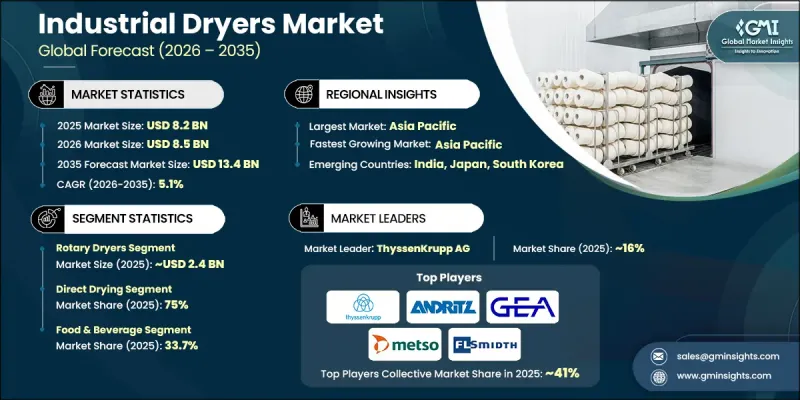
Growth in the market is being fueled by the rising production of packaged and processed foods, as manufacturers increasingly require advanced drying systems to remove moisture, preserve product quality, and extend shelf life. Industrial dryers are critical for ensuring consistent moisture content across products, maintaining texture, and stabilizing ingredients in snack foods, dairy powders, and instant food items. Food processors and manufacturers are investing in energy-efficient, reliable drying solutions that can handle high-volume continuous production while ensuring sanitation and uniform output. The rising demand for packaged and processed foods is creating a parallel need for moisture removal technologies that optimize efficiency, minimize downtime, and deliver consistent results. Manufacturers prioritize systems that maintain product safety standards and streamline operations, driving the adoption of modern industrial dryers globally.
| Market Scope | |
|---|---|
| Start Year | 2025 |
| Forecast Year | 2026-2035 |
| Start Value | $8.2 Billion |
| Forecast Value | $13.4 Billion |
| CAGR | 5.1% |
The rotary dryers segment generated USD 2.4 billion in 2025 and is expected to grow at a CAGR of 6% through 2035. Rotary dryers lead the market due to their versatility, efficiency, and ability to process bulk and granular materials across sectors, including food, chemicals, minerals, and biomass. Their rotating drum design, combined with controlled hot air or gas, ensures uniform drying, enabling continuous operation and high-volume capacity under harsh industrial conditions. The reliability and robust performance of rotary dryers make them a preferred choice for large-scale operations.
The direct drying technology segment held a 75% share in 2025 and is projected to grow at a CAGR of 5% through 2035. Its simplicity, operational efficiency, and cost-effectiveness drive its adoption across multiple industries. Direct dryers use hot air or gas in direct contact with materials, enabling rapid moisture removal with high thermal efficiency. They are favored for lower energy consumption, ease of operation, and reduced equipment complexity compared to indirect drying systems, supporting their strong market presence.
China Industrial Dryers Market captured USD 1.03 billion in 2025 and is expected to grow at a CAGR of 6.3% through 2035. The market is driven by expanding chemical, food processing, pharmaceutical, and textile industries. High demand for efficient drying solutions in large-scale manufacturing facilities is boosting the adoption of rotary, fluidized bed, spray, and vacuum dryers. Chinese manufacturers emphasize energy-efficient, high-capacity designs to lower operational costs and maintain consistent product quality. Technological innovations, including precise temperature controls, automated monitoring, and advanced moisture removal, enhance productivity and reduce material waste, particularly in the sensitive pharmaceutical sector.
Key players in the Global Industrial Dryers Market include ANDRITZ AG, Akona Process Solutions, ANIVI Ingenieria SA, Buhler Holding AG, Carrier Vibrating Equipment, Inc., Durr CTS Inc., FLSmidth & Co. A/S, GEA Group, Lanly Company, METSO, Mitchell Dryers, SPX Flow, Ventilex B.V., Wuxi Modern Spray Drying Equipment Co., Ltd., and YAMATO SANKO MFG. CO. LTD. Companies in the Global Industrial Dryers Market are strengthening their foothold by investing in energy-efficient and high-capacity drying technologies that minimize operational costs while maximizing throughput. They focus on developing automation-enabled and smart monitoring systems for precise moisture control, improving reliability and process consistency. Strategic partnerships with food, pharmaceutical, and chemical manufacturers expand market reach, while after-sales services and maintenance support enhance customer retention. Manufacturers are also prioritizing R&D to introduce flexible, modular, and scalable solutions that address diverse industry requirements, improving competitiveness and fostering long-term growth across global markets.
Table of Contents
Chapter 1 Methodology & Scope
- 1.1 Market scope and definition
- 1.2 Research design
- 1.2.1 Research approach
- 1.2.2 Data collection methods
- 1.3 Data mining sources
- 1.3.1 Global
- 1.3.2 Regional/Country
- 1.4 Base estimates and calculations
- 1.4.1 Base year calculation
- 1.4.2 Key trends for market estimation
- 1.5 Primary research and validation
- 1.5.1 Primary sources
- 1.6 Forecast model
- 1.7 Research assumptions and limitations
Chapter 2 Executive Summary
- 2.1 Industry 360° synopsis
- 2.2 Key market trends
- 2.2.1 Regional
- 2.2.2 Type
- 2.2.3 Technology
- 2.2.4 End use industry
- 2.2.5 Distribution channel
- 2.3 Future outlook and strategic recommendations
Chapter 3 Industry Insights
- 3.1 Industry ecosystem analysis
- 3.1.1 Supplier landscape
- 3.1.2 Profit margin
- 3.1.3 Value addition at each stage
- 3.1.4 Factor affecting the value chain
- 3.2 Industry impact forces
- 3.2.1 Growth drivers
- 3.2.1.1 Expansion of food processing and packaged food production
- 3.2.1.2 Growing pharmaceutical and chemical manufacturing activities
- 3.2.1.3 Technological advancements in drying systems and process automation
- 3.2.2 Pitfalls & Challenges
- 3.2.2.1 High energy consumption associated with industrial drying operations
- 3.2.2.2 High capital investment required for advanced drying equipment
- 3.2.3 Opportunities
- 3.2.3.1 Growing demand for energy-efficient and heat recovery drying technologies
- 3.2.3.2 Integration of digital monitoring and automated process control systems
- 3.2.1 Growth drivers
- 3.3 Growth potential analysis
- 3.4 Future market trends
- 3.5 Technology and innovation landscape
- 3.5.1 Current technological trends
- 3.5.2 Emerging technologies
- 3.6 Regulatory landscape
- 3.6.1 Standards and compliance requirements
- 3.6.2 Regional regulatory frameworks
- 3.6.3 Certification standards
- 3.7 Porter's analysis
- 3.8 PESTEL analysis
- 3.9 Pricing analysis (driven by primary research)
- 3.9.1 Historical price trend analysis (driven by primary research)
- 3.9.2 Pricing strategy by player type (premium / value / cost-plus) (driven by primary research)
- 3.9.3 Regional price variation factors
- 3.9.4 Price sensitivity by end-use industry
- 3.9.5 Total cost of ownership analysis
- 3.10 Trade data analysis (driven by paid data base)
- 3.10.1 Import/export volume & value trends (driven by paid data base)
- 3.10.2 Key trade corridors & tariff impact (driven by paid data base)
- 3.10.3 Trade flow by dryer type
- 3.10.4 Regional import dependency analysis
- 3.11 Capacity & production landscape (driven by primary research)
- 3.11.1 Installed capacity by region & key producer (driven by primary research)
- 3.11.2 Capacity utilization rates & expansion pipelines (driven by primary research)
Chapter 4 Competitive Landscape, 2025
- 4.1 Introduction
- 4.2 Company market share analysis
- 4.2.1 By Region
- 4.2.1.1 North America
- 4.2.1.2 Europe
- 4.2.1.3 Asia Pacific
- 4.2.1.4 Latin America
- 4.2.1.5 Middle East & Africa
- 4.2.1 By Region
- 4.3 Company matrix analysis
- 4.4 Competitive analysis of major market players
- 4.5 Competitive positioning matrix
- 4.6 Key developments
- 4.6.1 Mergers & acquisitions
- 4.6.2 Partnerships & collaborations
- 4.6.3 New product launches
- 4.6.4 Expansion plans
Chapter 5 Market Estimates & Forecast, By Type, 2022 - 2035, (USD Billion) (Thousand Units)
- 5.1 Key trends
- 5.2 Rotary Dryers
- 5.3 Fluidized Bed Dryers
- 5.4 Spray Dryers
- 5.5 Drum Dryers
- 5.6 Freeze Dryers
- 5.7 Others
Chapter 6 Market Estimates & Forecast, By Technology, 2022 - 2035, (USD Billion) (Thousand Units)
- 6.1 Key trends
- 6.2 Direct Drying
- 6.3 Indirect Drying
Chapter 7 Market Estimates & Forecast, By End Use Industry, 2022 - 2035, (USD Billion) (Thousand Units)
- 7.1 Key trends
- 7.2 Food & Beverage
- 7.3 Chemical
- 7.4 Pharmaceutical
- 7.5 Paper & Pulp
- 7.6 Textile
- 7.7 Construction
- 7.8 Others
Chapter 8 Market Estimates & Forecast, By Distribution Channel, 2022 - 2035, (USD Billion) (Thousand Units)
- 8.1 Key trends
- 8.2 Direct sales
- 8.3 Indirect sales
Chapter 9 Market Estimates & Forecast, By Region, 2022 - 2035, (USD Billion) (Thousand Units)
- 9.1 Key trends
- 9.2 North America
- 9.2.1 U.S.
- 9.2.2 Canada
- 9.3 Europe
- 9.3.1 Germany
- 9.3.2 UK
- 9.3.3 France
- 9.3.4 Italy
- 9.3.5 Spain
- 9.4 Asia Pacific
- 9.4.1 China
- 9.4.2 India
- 9.4.3 Japan
- 9.4.4 South Korea
- 9.4.5 Australia
- 9.5 Latin America
- 9.5.1 Brazil
- 9.5.2 Mexico
- 9.5.3 Argentina
- 9.6 MEA
- 9.6.1 Saudi Arabia
- 9.6.2 UAE
- 9.6.3 South Africa
Chapter 10 Company Profiles
- 10.1 Akona Process Solutions
- 10.2 ANDRITZ AG
- 10.3 ANIVI Ingenieria SA
- 10.4 Buhler Holding AG
- 10.5 Carrier Vibrating Equipment, Inc.
- 10.6 Durr CTS Inc.
- 10.7 FLSmidth & Co. A/S
- 10.8 GEA Group
- 10.9 Lanly Company
- 10.10 METSO
- 10.11 Mitchell Dryers
- 10.12 SPX Flow
- 10.13 Ventilex B.V.
- 10.14 Wuxi Modern Spray Drying Equipment Co., Ltd.
- 10.15 YAMATO SANKO MFG. CO. LTD.

