PUBLISHER: Global Market Insights Inc. | PRODUCT CODE: 2019218

PUBLISHER: Global Market Insights Inc. | PRODUCT CODE: 2019218
Tumble Dryer Market Opportunity, Growth Drivers, Industry Trend Analysis, and Forecast 2026 - 2035
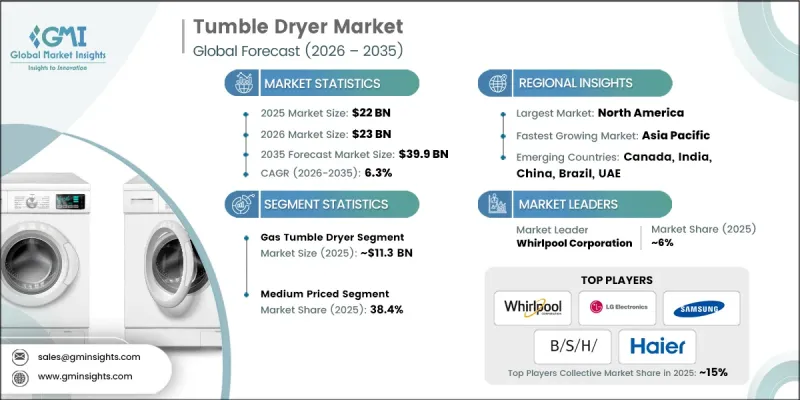
The Global Tumble Dryer Market was valued at USD 22 billion in 2025 and is estimated to grow at a CAGR of 6.3% to reach USD 39.9 billion by 2035.
Tumble dryers have shifted from being considered luxury appliances to essential household items in developed markets, with replacement cycles now firmly established. Growth in these regions is primarily driven by consumers replacing older units with advanced models that deliver higher performance, improved fabric care, and compliance with stringent energy efficiency standards. Product variety, including ventless and compact models, also supports market stability by catering to diverse household needs. In emerging economies, rising disposable incomes and urbanization are increasing demand for convenience-oriented appliances. Dual-income households are prioritizing time-saving solutions, and tumble dryers offer fast, reliable drying regardless of weather, which is particularly valuable in urban areas with limited outdoor drying space. Compact and portable dryers further reflect the preference for space-efficient, user-friendly appliances.
| Market Scope | |
|---|---|
| Start Year | 2025 |
| Forecast Year | 2026-2035 |
| Start Value | $22 Billion |
| Forecast Value | $39.9 Billion |
| CAGR | 6.3% |
The gas tumble dryer segment generated USD 11.3 billion in 2025 and is expected to grow at a CAGR of 6% through 2035. Gas models provide shorter drying cycles and lower operational costs, making them appealing for large households and light commercial users where energy efficiency and throughput are critical. In regions with existing gas infrastructure, replacement demand and upgrades from older electric models contribute to ongoing adoption, positioning gas dryers as a cost-effective, long-term solution.
Medium-priced tumble dryers held 38.4% share in 2025 and are projected to grow at a CAGR of 6.5% from 2026 to 2035. These models combine energy-efficient programs, moisture sensors, fabric care options, larger capacities, and basic smart features without the premium price tag. Middle-income households form the largest consumer base for this segment, particularly in replacement markets, while rising incomes in emerging economies are shifting consumers toward mid-range models over entry-level options, favoring durability and modern design.
U.S. Tumble Dryer Market reached USD 4.1 billion in 2025, and is expected to grow at a CAGR of 7.3% through 2035. High household penetration of dedicated laundry spaces and access to both electric and gas infrastructure support widespread adoption. Replacement demand drives sales as consumers seek larger capacities, enhanced fabric care, and improved energy efficiency. Gas tumble dryers remain popular due to lower operating costs and faster drying cycles, while energy-efficient and smart models are increasingly adopted amid growing awareness of energy consumption and smart home integration.
Key players in the Global Tumble Dryer Market include LG, Miele, Haier, Electrolux, Samsung, Maytag, ASKO Appliances, American Dryer, Dexter Laundry, Little Swan, Pellerin Milnor, GIRBAU, Danube, Renzacci, and Schulthess. Companies in the Global Tumble Dryer Market employ various strategies to strengthen their presence. They focus on expanding production capacity and optimizing manufacturing processes to meet rising global demand. Strategic collaborations with retailers, distributors, and e-commerce platforms enhance accessibility and regional reach. Investment in R&D drives innovation in energy-efficient, smart, and compact designs, allowing differentiation from competitors. Firms emphasize marketing campaigns highlighting time-saving features, durability, and energy savings to influence purchase decisions. Warranty programs, after-sales service, and customer support reinforce brand reliability. Additionally, companies leverage sustainability initiatives and compliance with regulatory standards to gain consumer trust and boost market credibility across both developed and emerging regions.
Table of Contents
Chapter 1 Methodology & Scope
- 1.1 Market scope and definition
- 1.2 Research design
- 1.2.1 Research approach
- 1.2.2 Data collection methods
- 1.3 Data mining sources
- 1.3.1 Global
- 1.3.2 Regional/Country
- 1.4 Base estimates and calculations
- 1.4.1 Base year calculation
- 1.4.2 Key trends for market estimation
- 1.5 Primary research and validation
- 1.5.1 Primary sources
- 1.6 Forecast model
- 1.7 Research assumptions and limitations
Chapter 2 Executive Summary
- 2.1 Industry 360° synopsis
- 2.2 Key market trends
- 2.2.1 Regional
- 2.2.2 Type
- 2.2.3 Technology type
- 2.2.4 Capacity
- 2.2.5 Price
- 2.2.6 Application
- 2.2.7 Distribution channel
Chapter 3 Industry Insights
- 3.1 Industry ecosystem analysis
- 3.1.1 Supplier landscape
- 3.1.2 Profit margin
- 3.1.3 Value addition at each stage
- 3.1.4 Factor affecting the value chain
- 3.2 Industry impact forces
- 3.2.1 Growth drivers
- 3.2.1.1 Replacement cycles are firmly established in mature markets
- 3.2.1.2 Rising disposable incomes fuel a growing demand for convenience
- 3.2.1.3 Advancements in energy efficiency and smart technology are on the rise
- 3.2.2 Industry pitfalls & challenges
- 3.2.2.1 Energy consumption and running costs remain high
- 3.2.2.2 Efficient models come with a steep initial purchase price
- 3.2.1 Growth drivers
- 3.3 Growth potential analysis
- 3.4 Future market trends
- 3.5 Regulatory landscape
- 3.5.1 Standards and compliance requirements
- 3.5.2 Regional regulatory frameworks
- 3.5.3 Certification standards
- 3.6 Impact of ai & generative ai on the market
- 3.6.1 AI-driven disruption of existing business models
- 3.6.2 Genai use cases & adoption roadmap by segment
- 3.6.3 Risks, limitations & regulatory considerations
- 3.7 Technology & innovation landscape
- 3.7.1 Current technological trends
- 3.7.2 Heat pump technology evolution
- 3.7.3 Smart dryer features & IoT integration
- 3.7.4 Energy efficiency innovations
- 3.7.5 Emerging technologies (AI sensors, auto-dosing)
- 3.8 Pricing analysis
- 3.8.1 Historical price trend analysis
- 3.8.2 Pricing strategy by player type (premium / value / cost-plus)
- 3.8.3 Regional price variations
- 3.8.4 Price-performance benchmarking
- 3.9 Trade data analysis
- 3.9.1 Import/export volume & value trends
- 3.9.2 Key trade corridors & tariff impact
- 3.9.3 Cross-border market dynamics
- 3.10 Porter's analysis
- 3.11 PESTEL analysis
- 3.12 Consumer behavior analysis
- 3.12.1 Purchasing patterns
- 3.12.2 Preference analysis
- 3.12.3 Regional variations in consumer behavior
- 3.12.4 Impact of e-commerce on buying decisions
Chapter 4 Competitive Landscape, 2025
- 4.1 Introduction
- 4.2 Company market share analysis
- 4.2.1 By Region
- 4.2.1.1 North America
- 4.2.1.2 Europe
- 4.2.1.3 Asia Pacific
- 4.2.1.4 Latin America
- 4.2.1.5 Middle East & Africa
- 4.2.1 By Region
- 4.3 Company matrix analysis
- 4.4 Competitive analysis of major market players
- 4.5 Competitive positioning matrix
- 4.6 Key developments
- 4.6.1 Mergers & acquisitions
- 4.6.2 Partnerships & collaborations
- 4.6.3 New product launches
- 4.6.4 Expansion plans
Chapter 5 Market Estimates & Forecast, By Type, 2022 - 2035, (USD Billion) (Thousand Units)
- 5.1 Key trends
- 5.2 Electric tumble dryer
- 5.3 Gas tumble dryer
Chapter 6 Market Estimates & Forecast, By Technology Type, 2022 - 2035, (USD Billion) (Thousand Units)
- 6.1 Key trends
- 6.2 Vented tumble dryers
- 6.3 Condenser tumble dryers
- 6.4 Heat pump tumble dryers
Chapter 7 Market Estimates & Forecast, By Capacity, 2022 - 2035, (USD Billion) (Thousand Units)
- 7.1 Key trends
- 7.2 Small capacity (<7 kg)
- 7.3 Medium capacity (7-9 kg)
- 7.4 Large capacity (>9 kg)
Chapter 8 Market Estimates & Forecast, By Price, 2022 - 2035, (USD Billion) (Thousand Units)
- 8.1 Key trends
- 8.2 Low
- 8.3 Medium
- 8.4 High
Chapter 9 Market Estimates & Forecast, By Application, 2022 - 2035, (USD Billion) (Thousand Units)
- 9.1 Key trends
- 9.2 Household
- 9.3 Textile industry
- 9.4 clothing or laundry industry
- 9.5 Hospitality industry
- 9.6 Others (spa, Healthcare, etc.)
Chapter 10 Market Estimates & Forecast, By Distribution Channel, 2022 - 2035, (USD Billion) (Thousand Units)
- 10.1 Key trends
- 10.2 Online
- 10.2.1 E-commerce
- 10.2.2 Company website
- 10.3 Offline
- 10.3.1 Mega retail stores
- 10.3.2 Specialty stores
- 10.3.3 Others (individual stores, departmental stores, etc.)
Chapter 11 Market Estimates & Forecast, By Region, 2022 - 2035, (USD Billion) (Million Units)
- 11.1 Key trends
- 11.2 North America
- 11.2.1 U.S.
- 11.2.2 Canada
- 11.3 Europe
- 11.3.1 Germany
- 11.3.2 UK
- 11.3.3 France
- 11.3.4 Italy
- 11.3.5 Spain
- 11.4 Asia Pacific
- 11.4.1 China
- 11.4.2 India
- 11.4.3 Japan
- 11.4.4 South Korea
- 11.4.5 Australia
- 11.4.6 Indonesia
- 11.4.7 Malaysia
- 11.5 Latin America
- 11.5.1 Brazil
- 11.5.2 Mexico
- 11.5.3 Argentina
- 11.6 MEA
- 11.6.1 Saudi Arabia
- 11.6.2 UAE
- 11.6.3 South Africa
Chapter 12 Company Profiles
- 12.1 American Dryer
- 12.2 ASKO Appliances
- 12.3 Danube
- 12.4 Dexter Laundry
- 12.5 Electrolux
- 12.6 GIRBAU
- 12.7 Haier
- 12.8 LG
- 12.9 Little Swan
- 12.10 Maytag
- 12.11 Miele
- 12.12 Pellerin Milnor
- 12.13 Renzacci
- 12.14 Samsung
- 12.15 Schulthess

