PUBLISHER: Global Market Insights Inc. | PRODUCT CODE: 2019231

PUBLISHER: Global Market Insights Inc. | PRODUCT CODE: 2019231
Trailer and Cargo Container Tracking Market Opportunity, Growth Drivers, Industry Trend Analysis, and Forecast 2026 - 2035
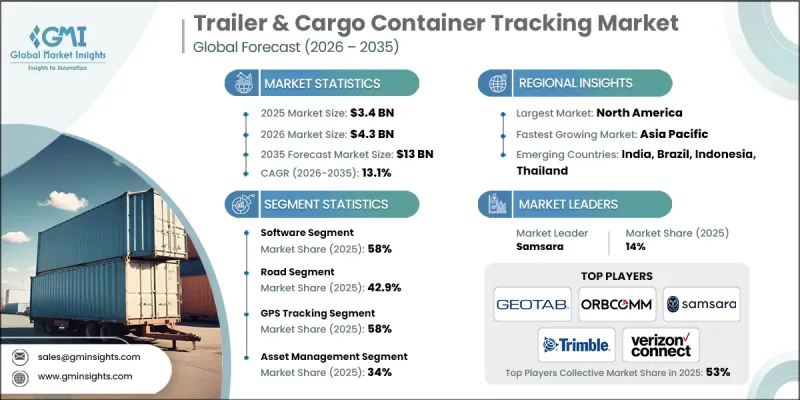
The Global Trailer & Cargo Container Tracking Market was valued at USD 3.4 billion in 2025 and is estimated to grow at a CAGR of 13.1% to reach USD 13 billion by 2035.
Growing regulatory requirements and the increasing need for supply chain transparency are driving market expansion. Government authorities and industry bodies are pushing for electronic trip records and comprehensive asset tracking to ensure compliance. The rise of satellite-based tracking devices is addressing connectivity gaps in remote and maritime logistics routes. Additionally, the demand for cold chain monitoring is creating opportunities for sensor-enabled tracking solutions. Logistics operations are increasingly leveraging artificial intelligence and advanced analytics to optimize routes and asset management. Studies suggest that analytics-driven logistics can reduce operational costs by up to 15% while improving delivery accuracy and efficiency. The adoption of digital freight platforms is also accelerating the integration of end-to-end visibility systems, further boosting market growth.
| Market Scope | |
|---|---|
| Start Year | 2025 |
| Forecast Year | 2026-2035 |
| Start Value | $3.4 Billion |
| Forecast Value | $13 Billion |
| CAGR | 13.1% |
The software segment held a 58% share in 2025 and is expected to grow at a CAGR of 14.8% through 2035. Proprietary software platforms provide centralized solutions for tracking, fleet management, and analytics, allowing companies to optimize routes, predict operational needs, and integrate seamlessly with enterprise systems.
The road transport segment accounted for 42.9% share in 2025 and is projected to grow at a CAGR of 10.5% through 2035. Road freight dominates due to the extensive use of trailers for transporting bulk goods, frequent shipments, and customer demand for real-time visibility. Tracking technologies help monitor vehicle location, driver behavior, and cargo integrity while improving asset utilization and reducing delays.
U.S. Trailer & Cargo Container Tracking Market held an 87% share, generating USD 1.1 billion in 2025. Growth is fueled by the volume of domestic freight, advanced logistics infrastructure, and the rising adoption of e-commerce. Companies are investing in real-time tracking systems to enhance shipment visibility, improve delivery times, and streamline complex supply chains.
Major players in the Global Trailer & Cargo Container Tracking Market include Geotab, ORBCOMM, Nexxiot, Samsara, Sensitech, CalAmp, Spireon, Trimble Transportation, Verizon Connect, and Motive. Key strategies adopted by companies to strengthen their market presence include developing advanced IoT-enabled tracking devices with real-time monitoring and analytics. Firms are forming strategic partnerships with logistics providers and fleet operators to expand reach and integrate solutions into existing supply chains. Investment in cloud-based platforms, predictive analytics, and AI-driven route optimization enhances operational efficiency and customer satisfaction. Companies are also focusing on global expansion, satellite connectivity, and cold chain capabilities to address remote logistics challenges. Continuous R&D, software customization, and regulatory compliance initiatives further strengthen competitive positioning and capture emerging market opportunities.
Table of Contents
Chapter 1 Methodology
- 1.1 Research approach
- 1.2 Quality Commitments
- 1.2.1 GMI AI policy & data integrity commitment
- 1.2.1.1 Source consistency protocol
- 1.2.1 GMI AI policy & data integrity commitment
- 1.3 Research Trail & Confidence Scoring
- 1.3.1 Research Trail Components
- 1.3.2 Scoring Components
- 1.4 Data Collection
- 1.4.1 Partial list of primary sources
- 1.5 Data mining sources
- 1.5.1 Paid sources
- 1.5.1.1 Sources, by region
- 1.5.1 Paid sources
- 1.6 Base estimates and calculations
- 1.6.1 Base year calculation for any one approach
- 1.7 Forecast model
- 1.7.1 Quantified market impact analysis
- 1.7.1.1 Mathematical impact of growth parameters on forecast
- 1.7.1 Quantified market impact analysis
- 1.8 Research transparency addendum
- 1.8.1 Source attribution framework
- 1.8.2 Quality assurance metrics
- 1.8.3 Our commitment to trust
Chapter 2 Executive Summary
- 2.1 Industry 360° synopsis, 2022 - 2035
- 2.2 Key market trends
- 2.2.1 Regional
- 2.2.2 Offering
- 2.2.3 Transportation
- 2.2.4 Technology
- 2.2.5 Application
- 2.2.6 End-Use
- 2.3 TAM Analysis, 2026-2035
- 2.4 CXO perspectives: Strategic imperatives
Chapter 3 Industry Insights
- 3.1 Industry ecosystem analysis
- 3.1.1 Supplier landscape
- 3.1.2 Profit margin analysis
- 3.1.3 Cost structure
- 3.1.4 Value addition at each stage
- 3.1.5 Factor affecting the value chain
- 3.1.6 Disruptions
- 3.2 Industry impact forces
- 3.2.1 Growth drivers
- 3.2.1.1 Growing demand for flexible short-term transportation
- 3.2.1.2 Expansion of tourism and leisure activities
- 3.2.1.3 Corporate and employee leasing programs
- 3.2.1.4 Digital booking and fleet management systems
- 3.2.2 Industry pitfalls and challenges
- 3.2.2.1 High maintenance and fleet management costs
- 3.2.2.2 Seasonal demand fluctuations
- 3.2.3 Market opportunities
- 3.2.3.1 Expansion in corporate leasing segment
- 3.2.3.2 Growth in tourism driven rentals
- 3.2.3.3 Development of subscription based rental plans
- 3.2.1 Growth drivers
- 3.3 Growth potential analysis
- 3.4 Regulatory landscape
- 3.4.1 North America
- 3.4.1.1 United States electronic logging device requirements and fleet compliance regulations
- 3.4.1.2 Cargo security standards and freight monitoring guidelines
- 3.4.1.3 Data privacy and telematics usage regulations
- 3.4.1.4 Canada transportation safety regulations and electronic tracking guidelines
- 3.4.2 Europe
- 3.4.2.1 EU digital transport and logistics regulations
- 3.4.2.2 Data protection and GDPR compliance in telematics systems
- 3.4.2.3 Cross border freight monitoring and customs tracking requirements
- 3.4.2.4 Environmental and smart logistics policy frameworks
- 3.4.3 Asia Pacific
- 3.4.3.1 China smart logistics and digital freight regulations
- 3.4.3.2 India transport digitization and fleet tracking guidelines
- 3.4.3.3 Japan logistics efficiency and cargo monitoring standards
- 3.4.3.4 Australia freight safety and telematics compliance regulations
- 3.4.3.5 ASEAN regional logistics and digital transport frameworks
- 3.4.4 Latin America
- 3.4.4.1 Brazil cargo security and transport monitoring regulations
- 3.4.4.2 Mexico freight transport and telematics guidelines
- 3.4.4.3 Argentina logistics monitoring and compliance policies
- 3.4.4.4 Regional trade and transport regulatory frameworks
- 3.4.5 Middle East & Africa
- 3.4.5.1 UAE smart logistics and cargo tracking regulations
- 3.4.5.2 Saudi Arabia transport monitoring and safety regulations
- 3.4.5.3 South Africa freight security and telematics frameworks
- 3.4.1 North America
- 3.5 Porter's analysis
- 3.6 PESTEL analysis
- 3.7 Technology and innovation landscape
- 3.7.1 Current technological trends
- 3.7.2 Emerging technologies
- 3.8 Pricing Analysis (Driven by primary research)
- 3.8.1 Historical Price Trend Analysis
- 3.8.2 Pricing Strategy by Player Type
- 3.9 Cost breakdown analysis
- 3.10 Patent analysis (Driven by primary research)
- 3.11 Sustainability and environmental aspects
- 3.11.1 Sustainable practices
- 3.11.2 Waste reduction strategies
- 3.11.3 Energy efficiency in production
- 3.11.4 Eco-friendly Initiatives
- 3.11.5 Carbon footprint considerations
- 3.12 Impact of AI and Generative AI on the Market
- 3.12.1 AI Driven Disruption of Existing Business Models
- 3.12.2 GenAI Use Cases and Adoption Roadmap by Segment
- 3.12.3 Risks Limitations and Regulatory Considerations
- 3.13 Forecast assumptions & scenario analysis (Driven by primary research)
- 3.13.1 Base Case- Key Macro & Industry Variables Driving CAGR
- 3.13.2 Optimistic Scenarios- Favorable macro and industry tailwinds
- 3.13.3 Pessimistic Scenario - Macroeconomic slowdown or industry headwinds
Chapter 4 Competitive Landscape, 2025
- 4.1 Introduction
- 4.2 Company market share analysis
- 4.2.1 North America
- 4.2.2 Europe
- 4.2.3 Asia Pacific
- 4.2.4 LATAM
- 4.2.5 MEA
- 4.3 Competitive analysis of major market players
- 4.4 Competitive positioning matrix
- 4.5 Key developments
- 4.5.1 Mergers & acquisitions
- 4.5.2 Partnerships & collaborations
- 4.5.3 New Product Launches
- 4.5.4 Expansion Plans and funding
Chapter 5 Market Estimates & Forecast, By Offering, 2022 - 2035 (USD Mn, Units)
- 5.1 Key trends
- 5.2 Hardware
- 5.2.1 GPS Tracking Devices
- 5.2.2 Communication Modules
- 5.2.3 Antennas & Embedded Chipsets
- 5.3 Software
- 5.3.1 Tracking Platforms
- 5.3.2 Fleet Management Software
- 5.3.3 Visualization & Reporting Tools
- 5.4 Services
- 5.4.1 Managed Services
- 5.4.2 Integration & Deployment
- 5.4.3 Maintenance & Support
Chapter 6 Market Estimates & Forecast, By Transportation, 2022 - 2035 (USD Mn, Units)
- 6.1 Key trends
- 6.2 Road
- 6.3 Rail
- 6.4 Air
- 6.5 Maritime
Chapter 7 Market Estimates & Forecast, By Technology, 2022 - 2035 (USD Mn, Units)
- 7.1 Key trends
- 7.2 GPS tracking
- 7.3 RFID tracking
- 7.4 Cellular tracking
- 7.5 Satellite tracking
Chapter 8 Market Estimates & Forecast, By Application, 2022 - 2035 (USD Mn, Units)
- 8.1 Key trends
- 8.2 Asset management
- 8.3 Fleet management
- 8.4 Security & surveillance
- 8.5 Supply chain optimization
Chapter 9 Market Estimates & Forecast, By End-Use, 2022 - 2035 (USD Mn, Units)
- 9.1 Key trends
- 9.2 Logistics and Transportation
- 9.3 Retail & E-commerce
- 9.4 Manufacturing
- 9.5 Oil & Gas
- 9.6 Food & Beverages
- 9.7 Pharmaceuticals
Chapter 10 Market Estimates & Forecast, By Region, 2022 - 2035 (USD Mn, Units)
- 10.1 Key trends
- 10.2 North America
- 10.2.1 US
- 10.2.2 Canada
- 10.3 Europe
- 10.3.1 Germany
- 10.3.2 UK
- 10.3.3 France
- 10.3.4 Italy
- 10.3.5 Spain
- 10.3.6 Russia
- 10.3.7 Norway
- 10.3.8 Netherlands
- 10.3.9 Sweden
- 10.4 Asia Pacific
- 10.4.1 China
- 10.4.2 India
- 10.4.3 Japan
- 10.4.4 Australia
- 10.4.5 South Korea
- 10.4.6 Singapore
- 10.4.7 Thailand
- 10.4.8 Indonesia
- 10.4.9 Vietnam
- 10.5 Latin America
- 10.5.1 Brazil
- 10.5.2 Mexico
- 10.5.3 Argentina
- 10.6 MEA
- 10.6.1 South Africa
- 10.6.2 Saudi Arabia
- 10.6.3 UAE
- 10.6.4 Turkey
Chapter 11 Company Profiles
- 11.1 Global Players
- 11.1.1 Samsara
- 11.1.2 ORBCOMM
- 11.1.3 Geotab
- 11.1.4 Trimble
- 11.1.5 Verizon Connect
- 11.1.6 Sensitech
- 11.1.7 Nexxiot
- 11.1.8 Roambee
- 11.2 Regional Players
- 11.2.1 Spireon
- 11.2.2 G7 Connect
- 11.2.3 Cartrack
- 11.2.4 Ituran
- 11.2.5 Transics
- 11.2.6 EROAD
- 11.3 Emerging Players / Disruptors
- 11.3.1 Tive
- 11.3.2 Hoopo
- 11.3.3 Globe Tracker
- 11.3.4 Arviem
- 11.3.5 BlackBerry Radar
- 11.3.6 Amsted Digital Solutions

