PUBLISHER: Global Market Insights Inc. | PRODUCT CODE: 2027456

PUBLISHER: Global Market Insights Inc. | PRODUCT CODE: 2027456
Asia-Pacific Carpet and Rug Market Opportunity, Growth Drivers, Industry Trend Analysis, and Forecast 2026 - 2035
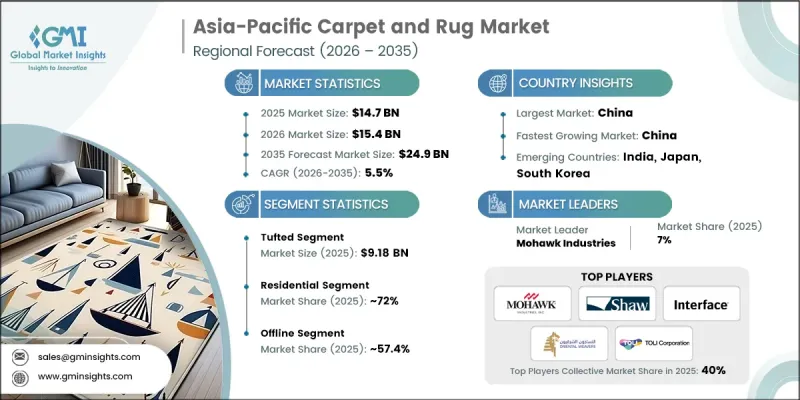
Asia Pacific Carpet and Rug Market was valued at USD 14.7 billion in 2025 and is estimated to grow at a CAGR of 5.5% to reach USD 24.9 billion by 2035.
Market expansion is supported by the rapid development of residential and commercial infrastructure across the region. Rising urbanization levels are reshaping living standards and driving demand for improved interior solutions that enhance both comfort and visual appeal. Consumers are increasingly investing in home decor products that contribute to better living environments, which is strengthening demand for carpets and rugs. In addition, the expansion of urban populations is encouraging higher spending on interior furnishings. Shifting consumer preferences toward premium-quality products are also influencing market trends, as buyers seek durability, aesthetics, and enhanced functionality. The industry is evolving with changing lifestyle patterns, where comfort and design play a crucial role in purchasing decisions. As a result, manufacturers are focusing on delivering innovative and high-performance solutions that align with modern interior requirements, making the Asia Pacific carpet and rug market more dynamic and competitive.
| Market Scope | |
|---|---|
| Start Year | 2025 |
| Forecast Year | 2026-2035 |
| Start Value | $14.7 Billion |
| Forecast Value | $24.9 Billion |
| CAGR | 5.5% |
The growth of the middle-income population and the rising preference for contemporary interior design are significantly influencing purchasing behavior across the Asia Pacific carpet and rug market. Conventional products are gradually being replaced by more advanced alternatives that better meet evolving consumer expectations. Traditional materials and production techniques are no longer sufficient to satisfy the demand for higher quality and improved performance. Manufacturers are increasingly adopting modern materials and technologies, including environmentally responsible inputs and enhanced product features such as stain resistance and antimicrobial properties. These advancements are helping to elevate product standards while aligning with changing consumer priorities.
The tufted carpet segment accounted for USD 9.18 billion in 2025 and is anticipated to reach USD 15.41 billion by 2035, maintaining its leading position in the market. This segment continues to dominate due to its cost efficiency, design flexibility, and relatively faster production methods compared to conventional manufacturing processes. The ability to create a wide range of textures, patterns, and surface finishes makes tufted carpets highly suitable for diverse applications, supporting their sustained demand across both residential and commercial sectors.
The residential segment held a 72% share in 2025 and is expected to retain its dominance through 2035. Strong growth in housing development across the region is a major factor driving demand in this segment. Increasing home ownership rates, along with rising investments in home improvement and interior decoration, are encouraging the adoption of carpets and rugs in residential spaces. Consumers are prioritizing comfort, aesthetics, and functionality, which continues to support consistent demand within this segment.
China Carpet and Rug Market held a 22.4% share in 2025, growing at a CAGR of 6% through 2035. The country's strong position is supported by ongoing infrastructure development, expanding urban populations, and robust manufacturing capabilities. These factors collectively contribute to both high production capacity and strong domestic consumption, reinforcing its leadership within the regional market.
Key companies operating in the Asia Pacific Carpet and Rug Market include Axminster Carpets Group, Brintons Carpets, Carpet Overseas, Godfrey Hirst, Interface, Inc., Jaipur Rugs Company, Jiangsu Kaile Carpet, Mohawk Industries, Obeetee Carpets, Oriental Weavers, Sangetsu Corporation, Shanhua Carpet Group, Shaw Industries Group, Toli Corporation, and Zhejiang Meron Carpet. Companies in the Asia Pacific Carpet and Rug Market are enhancing their competitive position through product innovation, material advancements, and strategic expansion initiatives. Manufacturers are investing in research and development to introduce durable, sustainable, and high-performance products that align with modern consumer expectations. Expanding distribution networks and strengthening partnerships help companies improve market reach across diverse regions. Firms are also focusing on design differentiation and premium product offerings to attract a broader customer base while maintaining affordability. In addition, the integration of eco-friendly practices and efficient production methods supports long-term growth, reinforcing brand value in a competitive marketplace.
Table of Contents
Chapter 1 Methodology and Scope
- 1.1 Market scope and definition
- 1.2 Research design
- 1.2.1 Research approach
- 1.2.2 Data collection methods
- 1.3 Data mining sources
- 1.3.1 Country
- 1.4 Base estimates and calculations
- 1.4.1 Base year calculation
- 1.4.2 Key trends for market estimation
- 1.5 Primary research and validation
- 1.5.1 Primary sources
- 1.6 Forecast model
- 1.7 Research assumptions and limitations
Chapter 2 Executive Summary
- 2.1 Industry 360° synopsis
- 2.2 Key market trends
- 2.2.1 Regional
- 2.2.2 Product type
- 2.2.3 Material
- 2.2.4 Application
- 2.2.5 Distribution channel
Chapter 3 Industry Insights
- 3.1 Industry ecosystem analysis
- 3.1.1 Supplier landscape
- 3.1.2 Profit margin
- 3.1.3 Value addition at each stage
- 3.1.4 Factor affecting the value chain
- 3.2 Industry impact forces
- 3.2.1 Growth drivers
- 3.2.1.1 Rapid urbanization & real estate boom
- 3.2.1.2 Rising disposable incomes & lifestyle upgrades
- 3.2.2 Industry pitfalls & challenges
- 3.2.2.1 Price sensitivity in emerging markets
- 3.2.2.2 Sustainability concerns & raw material costs
- 3.2.3 Opportunities
- 3.2.3.1 E-commerce expansion & digital transformation
- 3.2.3.2 Sustainable & smart carpet solutions
- 3.2.1 Growth drivers
- 3.3 Growth potential analysis
- 3.4 Future market trends
- 3.5 Technology and innovation landscape
- 3.5.1 Current technological trends
- 3.5.2 Emerging technologies
- 3.6 Pricing analysis (driven by primary research)
- 3.6.1 Historical price trend analysis (2020-2025) (driven by primary research)
- 3.6.2 Pricing strategy by player type (premium/value/cost-plus) (driven by primary research)
- 3.7 Regulatory landscape
- 3.7.1 Standards and compliance requirements
- 3.7.2 Regional regulatory frameworks
- 3.7.3 Certification standards
- 3.8 Porter's analysis
- 3.9 PESTEL analysis
- 3.10 Trade data analysis (driven by paid database)
- 3.10.1 Import/export volume & value trends (2020-2025)
- 3.10.1.1 Major exporting countries (China, India, Turkey to APAC)
- 3.10.1.2 Major importing countries within APAC
- 3.10.1.3 HS code-level trade flows (HS 5701-5705)
- 3.10.2 Key trade corridors & tariff impact (Driven by Primary Research)
- 3.10.2.1 China-Australia trade dynamics
- 3.10.2.2 India-Middle East-APAC corridor
- 3.10.2.3 Intra-APAC trade (ASEAN, RCEP Impact)
- 3.10.2.4 Tariff structures & anti-dumping measures
- 3.10.1 Import/export volume & value trends (2020-2025)
- 3.11 Impact of AI & generative AI on the market
- 3.11.1 AI-driven disruption of existing business models
- 3.11.1.1 Mass customization via AI design tools
- 3.11.1.2 Predictive demand planning
- 3.11.1.3 Automated quality control
- 3.11.2 GenAI use cases & adoption roadmap by segment
- 3.11.2.1 Custom design generation for residential customers
- 3.11.2.2 Virtual room visualization (AR/VR Integration)
- 3.11.2.3 Supply chain optimization
- 3.11.3 Risks, limitations & regulatory considerations
- 3.11.1 AI-driven disruption of existing business models
Chapter 4 Competitive Landscape, 2025
- 4.1 Introduction
- 4.2 Company market share analysis
- 4.2.1 By Country
- 4.2.1.1 China
- 4.2.1.2 Japan
- 4.2.1.3 India
- 4.2.1.4 Australia
- 4.2.1.5 South Korea
- 4.2.1 By Country
- 4.3 Company matrix analysis
- 4.4 Competitive analysis of major market players
- 4.5 Competitive positioning matrix
- 4.6 Key developments
- 4.6.1 Mergers & acquisitions
- 4.6.2 Partnerships & collaborations
- 4.6.3 New product launches
- 4.6.4 Expansion plans
Chapter 5 Market Estimates & Forecast, By Product Type, 2022 - 2035, (USD Billion) (Million Square Meters)
- 5.1 Key trends
- 5.2 Woven
- 5.3 Tufted
- 5.4 Knotted
- 5.5 Needle-Punched
- 5.6 Flat-Weave
- 5.7 Others
Chapter 6 Market Estimates & Forecast, By Material, 2022 - 2035, (USD Billion) (Million Square Meters)
- 6.1 Key trends
- 6.2 Nylon
- 6.3 Wool
- 6.4 Silk
- 6.5 Polyester
- 6.6 Acrylic
- 6.7 Others
Chapter 7 Market Estimates & Forecast, By Application, 2022 - 2035, (USD Billion) (Million Square Meters)
- 7.1 Key trends
- 7.2 Residential
- 7.3 Commercial
Chapter 8 Market Estimates & Forecast, By Distribution Channel, 2022 - 2035, (USD Million) (Million Square Meters)
- 8.1 Key trends
- 8.2 Online
- 8.3 Offline
Chapter 9 Market Estimates and Forecast, By Country, 2022 - 2035 (USD Billion) (Million Square Meters)
- 9.1 China
- 9.2 Japan
- 9.3 India
- 9.4 Australia
- 9.5 South Korea
Chapter 10 Company Profiles
- 10.1 Axminster Carpets Group
- 10.2 Brintons Carpets
- 10.3 Carpet Overseas
- 10.4 Godfrey Hirst
- 10.5 Interface, Inc.
- 10.6 Jaipur Rugs Company
- 10.7 Jiangsu Kaile Carpet
- 10.8 Mohawk Industries
- 10.9 Obeetee Carpets
- 10.10 Oriental Weavers
- 10.11 Sangetsu Corporation
- 10.12 Shanhua Carpet Group
- 10.13 Shaw Industries Group
- 10.14 Toli Corporation
- 10.15 Zhejiang Meron Carpet

