PUBLISHER: Global Market Insights Inc. | PRODUCT CODE: 2027511

PUBLISHER: Global Market Insights Inc. | PRODUCT CODE: 2027511
Glycerol Market Opportunity, Growth Drivers, Industry Trend Analysis, and Forecast 2026 - 2035
The Global Glycerol Market was valued at USD 5.5 billion in 2025 and is estimated to grow at a CAGR of 4.9% to reach USD 8.9 billion by 2035.
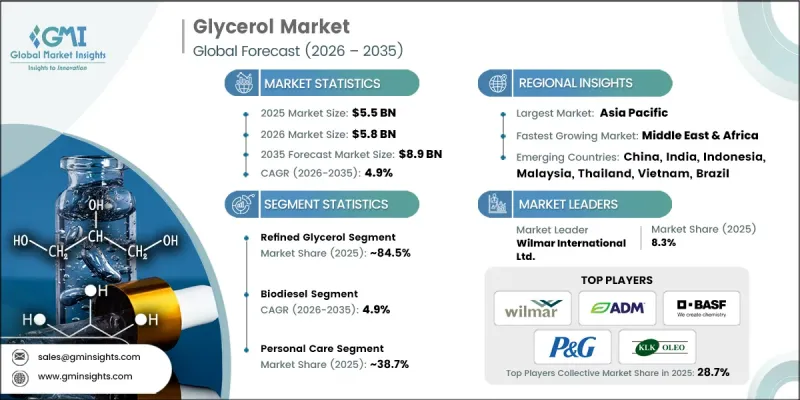
The market is witnessing steady expansion, driven by strong demand across sectors such as personal care, pharmaceuticals, food & beverages, and industrial applications. Glycerol, also known as glycerine or glycerin, is a colorless, odorless, and sweet-tasting polyol primarily obtained as a by-product of biodiesel production and fatty acid/alcohol manufacturing. The market trend is shifting toward bio-based glycerol production in line with sustainability initiatives, as biodiesel expansion generates ample crude glycerol supply, which is refined for high-value applications. Consumer preference for natural, non-toxic ingredients in personal care and food products, along with glycerol's humectant and moisturizing properties, continues to propel market growth, positioning glycerol as a versatile and essential ingredient across multiple industries.
| Market Scope | |
|---|---|
| Start Year | 2025 |
| Forecast Year | 2026-2035 |
| Start Value | $5.5 Billion |
| Forecast Value | $8.9 Billion |
| CAGR | 4.9% |
In the personal care and cosmetics sector, glycerol is a critical ingredient due to its moisture-retention capabilities, skin-softening properties, and compatibility with various formulations. Refined glycerol functions as a humectant in skincare, hair care, soaps, shaving creams, and other cosmetic products, providing smooth texture, hydration, and improved sensory qualities. In pharmaceuticals, glycerol is valued for its therapeutic and nutritive properties in cough syrups, elixirs, suppositories, and other medicinal formulations. In food & beverages, it serves as a humectant, sweetener, thickener, and preservative in baked goods, processed foods, beverages, and confectionery, appreciated for its non-toxic nature and nutritional value.
The refined glycerol segment held 84.5% share in 2025 and is expected to grow at a CAGR of 5% by 2035. The refined segment represents high-purity glycerol (99.5-99.7%), achieved through distillation, ion exchange, activated carbon treatment, and membrane filtration. It caters to stringent quality requirements in pharmaceuticals, food & beverages, and personal care, where impurities such as methanol, fatty acid methyl esters, ash, and chlorides must be minimized. Pharmaceutical-grade glycerol meeting USP/EP standards commands premium pricing for injectable formulations, oral medications, suppositories, and medical devices. Food-grade glycerol adhering to FCC and FDA GRAS standards is essential for baked goods, beverages, and confectionery, functioning as a humectant, sweetener, and texture enhancer.
The biodiesel production segment accounted for 69.7% share in 2025 and is expected to grow at a CAGR of 4.9% by 2035. Glycerol is generated as a by-product during the transesterification of vegetable oils, animal fats, or waste cooking oils with methanol or ethanol, typically comprising 10% of biodiesel output. Expanding renewable fuel mandates, carbon reduction policies, and energy security concerns have driven biodiesel production globally, increasing glycerol availability. Regions such as the European Union, United States, Brazil, Indonesia, and Argentina produce significant crude glycerol volumes. Quality varies based on feedstock purity, catalyst, and process conditions, generally ranging from 50-85% purity and requiring refining for premium applications.
North America Glycerol Market accounted for 22% share in 2025. The region benefits from expanding biodiesel capacity, high-quality standards favoring refined glycerol, and strong demand from personal care, pharmaceutical, and food industries. Regulatory frameworks such as FDA GRAS and USP standards ensure consistent quality, facilitating market access. The U.S. biodiesel industry relies on soybean and corn feedstock, while Canada contributes with canola-based biodiesel. Growing consumer awareness of natural ingredients in personal care and clean-label foods further drives demand. Advanced refining technologies and sustainable chemical development establish North America as an innovation hub for glycerol and its derivatives.
Key players operating in the Global Glycerol Market include COCOCHEM, ADM, Wilmar International Ltd., Oleon NV, Emery Oleochemicals, KLK OLEO, BASF SE, Procter & Gamble, Aemetis, Inc., Monarch Chemicals Ltd, Dow, Kao Corporation, and Godrej Industries Limited. Companies in the Global Glycerol Market strengthen their position by investing in advanced refining technologies to improve purity, yield, and operational efficiency. Firms collaborate with pharmaceutical, personal care, and food manufacturers to expand application portfolios. Strategic acquisitions and partnerships secure feedstock supply chains and enhance distribution networks. Innovation in bio-based glycerol production, including waste-to-value technologies, improves sustainability credentials. Marketing initiatives focus on highlighting glycerol's non-toxic, natural properties to align with consumer preferences for clean-label products. Companies also prioritize regulatory compliance and product certification to access premium applications, while R&D efforts target derivative products and high-margin formulations to expand market share.
Table of Contents
Chapter 1 Methodology & Scope
- 1.1 Market scope and definition
- 1.2 Research design
- 1.2.1 Research approach
- 1.2.2 Data collection methods
- 1.3 Data mining sources
- 1.3.1 Global
- 1.3.2 Regional/Country
- 1.4 Base estimates and calculations
- 1.4.1 Base year calculation
- 1.4.2 Key trends for market estimation
- 1.5 Primary research and validation
- 1.5.1 Primary sources
- 1.6 Forecast model
- 1.7 Research assumptions and limitations
Chapter 2 Executive Summary
- 2.1 Industry 360° synopsis
- 2.2 Key market trends
- 2.2.1 Type
- 2.2.2 Source
- 2.2.3 Application
- 2.2.4 Regional
- 2.3 TAM Analysis, 2026-2035
- 2.4 CXO perspectives: Strategic imperatives
Chapter 3 Industry Insights
- 3.1 Industry ecosystem analysis
- 3.1.1 Supplier landscape
- 3.1.2 Profit margin
- 3.1.3 Value addition at each stage
- 3.1.4 Factor affecting the value chain
- 3.1.5 Disruptions
- 3.2 Industry impact forces
- 3.2.1 Growth drivers
- 3.2.2 Industry pitfalls and challenges
- 3.2.3 Market opportunities
- 3.3 Growth potential analysis
- 3.4 Regulatory landscape
- 3.4.1 North America
- 3.4.2 Europe
- 3.4.3 Asia Pacific
- 3.4.4 Latin America
- 3.4.5 Middle East & Africa
- 3.5 Porter’s analysis
- 3.6 PESTEL analysis
- 3.7 Price trends
- 3.7.1 By region
- 3.7.2 By type
- 3.8 Future market trends
- 3.9 Technology and Innovation landscape
- 3.9.1 Current technological trends
- 3.9.2 Emerging technologies
- 3.10 Patent Landscape
- 3.11 Trade statistics (HS code)
- 3.11.1 Major importing countries
- 3.11.2 Major exporting countries
- 3.12 Sustainability and environmental aspects
- 3.12.1 Sustainable practices
- 3.12.2 Waste reduction strategies
- 3.12.3 Energy efficiency in production
- 3.12.4 Eco-friendly initiatives
- 3.13 Carbon footprint consideration
Chapter 4 Competitive Landscape, 2025
- 4.1 Introduction
- 4.2 Company market share analysis
- 4.2.1 By region
- 4.2.1.1 North America
- 4.2.1.2 Europe
- 4.2.1.3 Asia Pacific
- 4.2.1.4 LATAM
- 4.2.1.5 MEA
- 4.2.1 By region
- 4.3 Competitive analysis of major market players
- 4.4 Competitive positioning matrix
- 4.5 Key developments
- 4.5.1 Mergers & acquisitions
- 4.5.2 Partnerships & collaborations
- 4.5.3 New Product Launches
- 4.5.4 Expansion Plans
Chapter 5 Market Estimates and Forecast, By Type, 2022-2035 (USD Billion) (Kilo Tons)
- 5.1 Key trends
- 5.2 Crude
- 5.3 Refined
Chapter 6 Market Estimates and Forecast, By Source, 2022-2035 (USD Billion) (Kilo Tons)
- 6.1 Key trends
- 6.2 Biodiesel
- 6.3 Fatty Acids
- 6.4 Fatty Alcohols
- 6.5 Soap Industry
Chapter 7 Market Estimates and Forecast, By Application, 2022-2035 (USD Billion) (Kilo Tons)
- 7.1 Key trends
- 7.2 Personal Care
- 7.3 Pharmaceutical
- 7.4 Alkyd Resins
- 7.5 Foods & Beverages
- 7.6 Polyether Polyols
- 7.7 Tobacco Humectants
- 7.8 Other
Chapter 8 Market Estimates and Forecast, By Region, 2022-2035 (USD Billion) (Kilo Tons)
- 8.1 Key trends
- 8.2 North America
- 8.2.1 U.S.
- 8.2.2 Canada
- 8.3 Europe
- 8.3.1 Germany
- 8.3.2 UK
- 8.3.3 France
- 8.3.4 Spain
- 8.3.5 Italy
- 8.3.6 Rest of Europe
- 8.4 Asia Pacific
- 8.4.1 China
- 8.4.2 India
- 8.4.3 Japan
- 8.4.4 Australia
- 8.4.5 South Korea
- 8.4.6 Rest of Asia Pacific
- 8.5 Latin America
- 8.5.1 Brazil
- 8.5.2 Mexico
- 8.5.3 Argentina
- 8.5.4 Rest of Latin America
- 8.6 Middle East and Africa
- 8.6.1 Saudi Arabia
- 8.6.2 South Africa
- 8.6.3 UAE
- 8.6.4 Rest of Middle East and Africa
Chapter 9 Company Profiles
- 9.1 ADM
- 9.2 BASF SE
- 9.3 COCOCHEM
- 9.4 Dow
- 9.5 Emery Oleochemicals
- 9.6 Godrej Industries Limited
- 9.7 Kao Corporation
- 9.8 KLK OLEO
- 9.9 Monarch Chemicals Ltd
- 9.10 Oleon NV
- 9.11 Procter & Gamble
- 9.12 Wilmar International Ltd.
- 9.13 Aemetis, Inc.

