
PUBLISHER: Global Market Insights Inc. | PRODUCT CODE: 2027520

PUBLISHER: Global Market Insights Inc. | PRODUCT CODE: 2027520
Home Gym Equipment Market Opportunity, Growth Drivers, Industry Trend Analysis, and Forecast 2026 - 2035
The Global Home Gym Equipment Market was valued at USD 12.4 billion in 2025 and is estimated to grow at a CAGR of 5.4% to reach USD 19.8 billion by 2035.
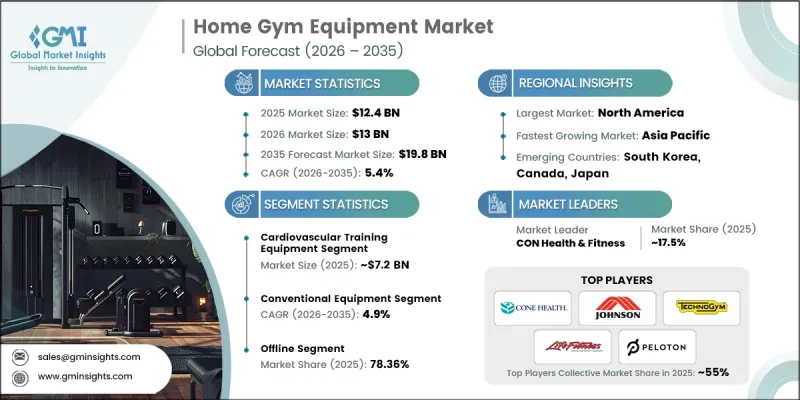
The market is expanding steadily as consumers increasingly prioritize convenience and flexibility in their fitness routines. Many individuals are shifting away from traditional fitness centers and investing in personalized workout solutions within their homes. Compact and multifunctional equipment is gaining strong traction, especially among urban households with limited space, as it enables effective workouts without requiring large setups. Changing work patterns, including remote and hybrid arrangements, have further accelerated the demand for at-home fitness solutions. Rising health awareness is also playing a crucial role, with consumers focusing on regular physical activity to manage weight and reduce the risk of lifestyle-related conditions. The ease of purchasing through retail stores and e-commerce platforms, combined with a wide range of products across price points, continues to support strong adoption across diverse consumer segments.
| Market Scope | |
|---|---|
| Start Year | 2025 |
| Forecast Year | 2026-2035 |
| Start Value | $12.4 Billion |
| Forecast Value | $19.8 Billion |
| CAGR | 5.4% |
The cardiovascular training equipment segment generated USD 7.2 billion in 2025 and is expected to grow at a CAGR of 5.5% from 2026 to 2035. This segment dominates due to its effectiveness in improving endurance, heart health, and overall fitness levels. Equipment designed for cardiovascular workouts is widely adopted in home settings because it accommodates varying fitness levels and supports flexible routines. Growing awareness of lifestyle-related health concerns has further strengthened demand, while advancements in compact design and performance tracking features enhance usability in residential environments.
The conventional equipment segment accounted for 73.3% share in 2025 and is projected to grow at a CAGR of 4.9% through 2035. Its strong market position is driven by affordability, simplicity, and ease of use. These products deliver reliable performance for basic workouts without requiring advanced technology or connectivity, making them accessible to a broad consumer base. Their durability, low maintenance requirements, and cost-effectiveness continue to attract users seeking practical and efficient fitness solutions at home.
United States Home Gym Equipment Market captured USD 3.5 billion in 2025 and is expected to grow at a CAGR of 5.1% from 2026 to 2035. Market growth is supported by rising health consciousness, increasing interest in fitness, and the convenience of home-based workouts. Consumers are showing a strong preference for space-efficient and multifunctional equipment suited for smaller living spaces. The growing influence of flexible work lifestyles has further accelerated adoption. Manufacturers are focusing on durable designs, intuitive interfaces, and integration with digital fitness platforms to enhance user experience, while expanding retail and e-commerce channels to improve accessibility and product availability.
Key players operating in the Global Home Gym Equipment Market include Assault Fitness, Body-Solid, Echelon Fitness, Hydrow, ICON Health & Fitness, Johnson Health Tech, Life Fitness, Nautilus, Inc., NOHrD, Peloton Interactive, Precor (Amer Sports), Speediance, Technogym, Tonal Systems, and TRUE Fitness. Companies in the Home Gym Equipment Market strengthen their position by investing in product innovation, focusing on compact, multifunctional, and space-saving designs tailored for modern households. Integration of digital technologies, including connected fitness platforms and performance tracking, enhances user engagement and differentiation. Strategic partnerships with fitness platforms and subscription-based services help expand recurring revenue streams. Brands also emphasize omnichannel distribution, leveraging both online and offline retail networks to maximize reach. Marketing initiatives, influencer collaborations, and personalized fitness experiences further improve brand visibility. Additionally, companies prioritize durability, affordability, and customization options to cater to diverse consumer needs, ensuring sustained growth and competitive advantage in the evolving market.
Table of Contents
Chapter 1 Methodology & Scope
- 1.1 Market scope and definition
- 1.2 Research design
- 1.2.1 Research approach
- 1.2.2 Data collection methods
- 1.3 Data mining sources
- 1.3.1 Global
- 1.3.2 Regional/Country
- 1.4 Base estimates and calculations
- 1.4.1 Base year calculation
- 1.4.2 Key trends for market estimation
- 1.5 Primary research and validation
- 1.5.1 Primary sources
- 1.6 Forecast model
- 1.7 Research assumptions and limitations
Chapter 2 Executive Summary
- 2.1 Industry 360° synopsis
- 2.2 Key market trends
- 2.2.1 Regional
- 2.2.2 Equipment Type
- 2.2.3 Category
- 2.2.4 Price Range
- 2.2.5 Distribution channel
Chapter 3 Industry Insights
- 3.1 Industry ecosystem analysis
- 3.1.1 Supplier landscape
- 3.1.2 Profit margin
- 3.1.3 Value addition at each stage
- 3.1.4 Factor affecting the value chain
- 3.2 Industry impact forces
- 3.2.1 Growth drivers
- 3.2.1.1 Growing preference for convenient and flexible workout solutions at home
- 3.2.1.2 Rising health awareness and focus on fitness and wellness
- 3.2.1.3 Expansion of remote work and hybrid lifestyles
- 3.2.2 Pitfalls & Challenges
- 3.2.2.1 High upfront cost of advanced home gym equipment
- 3.2.2.2 Limited space availability in urban households
- 3.2.3 Opportunities
- 3.2.3.1 Growing demand for subscription-based virtual fitness platforms
- 3.2.3.2 Rising adoption of foldable and modular equipment designs
- 3.2.1 Growth drivers
- 3.3 Growth potential analysis
- 3.4 Future market trends
- 3.5 Technology and innovation landscape
- 3.5.1 Current technological trends
- 3.5.2 Emerging technologies
- 3.6 Regulatory landscape
- 3.6.1 Standards and compliance requirements
- 3.6.2 Regional regulatory frameworks
- 3.6.3 Certification standards
- 3.7 Porter's analysis
- 3.8 PESTEL analysis
- 3.9 Pricing analysis (driven by primary research)
- 3.9.1 Historical price trend analysis (driven by primary research)
- 3.9.2 Pricing strategy by player type (premium / value / cost-plus) (driven by primary research)
- 3.9.3 Smart equipment price premium analysis
- 3.9.4 Regional price variations & purchasing power parity
- 3.9.5 Discounting & promotional strategies
- 3.10 Trade data analysis (HS code 9506.9) (driven by paid database)
- 3.10.1 Import/export volume & value trends (driven by paid database)
- 3.10.2 Key trade corridors & tariff impact (driven by primary research)
- 3.10.3 Top exporting countries (China, Taiwan, Vietnam)
- 3.10.4 Top importing countries (U.S., Germany, UK)
- 3.10.5 HS code classification & trade flow dynamics
- 3.11 Distribution infrastructure & channel penetration landscape (driven by primary research)
- 3.11.1 Channel coverage by region & format (modern vs. traditional trade) (driven by primary research)
- 3.11.2 Last-mile infrastructure gaps & emerging channel shifts (driven by primary research)
- 3.11.3 E-commerce fulfillment capacity & delivery challenges
- 3.11.4 Retail store density & geographic coverage analysis
Chapter 4 Competitive Landscape, 2025
- 4.1 Introduction
- 4.2 Company market share analysis
- 4.2.1 By Region
- 4.2.1.1 North America
- 4.2.1.2 Europe
- 4.2.1.3 Asia Pacific
- 4.2.1.4 Latin America
- 4.2.1.5 Middle East & Africa
- 4.2.1 By Region
- 4.3 Company matrix analysis
- 4.4 Competitive analysis of major market players
- 4.5 Competitive positioning matrix
- 4.6 Key developments
- 4.6.1 Mergers & acquisitions
- 4.6.2 Partnerships & collaborations
- 4.6.3 New product launches
- 4.6.4 Expansion plans
Chapter 5 Market Estimates & Forecast, By Equipment Type, 2022 - 2035, (USD Billion) (Thousand Units)
- 5.1 Key trends
- 5.2 Cardiovascular Training Equipment
- 5.2.1 Treadmills
- 5.2.2 Exercise Bikes
- 5.2.3 Rowing Machines
- 5.2.4 Elliptical and others
- 5.2.5 Stair Climber/Step mill
- 5.2.6 Others
- 5.3 Strength Training Equipment
- 5.3.1 Dumbbells
- 5.3.2 Barbells
- 5.3.3 Body Bars
- 5.3.4 Kettlebells
- 5.3.5 Resistance Band
- 5.3.6 Others
Chapter 6 Market Estimates & Forecast, By Category, 2022 - 2035, (USD Billion) (Thousand Units)
- 6.1 Key trends
- 6.2 Conventional Equipment
- 6.3 Smart Equipment
Chapter 7 Market Estimates & Forecast, By Price Range, 2022 - 2035, (USD Billion) (Thousand Units)
- 7.1 Key trends
- 7.2 Low
- 7.3 Medium
- 7.4 High/Premium
Chapter 8 Market Estimates & Forecast, By Distribution Channel, 2022 - 2035, (USD Billion) (Thousand Units)
- 8.1 Key trends
- 8.2 Online
- 8.2.1 E-commerce
- 8.2.2 Third Party Website/Company Website
- 8.3 Offline
- 8.3.1 Supermarkets/Hypermarkets
- 8.3.2 Multi-Brand Stores
- 8.3.3 Sport Stores/ Independent Departmental Stores
- 8.3.4 Specialty Stores/Sports Chain Outlets
Chapter 9 Market Estimates & Forecast, By Region, 2022 - 2035, (USD Billion) (Thousand Units)
- 9.1 Key trends
- 9.2 North America
- 9.2.1 U.S.
- 9.2.2 Canada
- 9.3 Europe
- 9.3.1 Germany
- 9.3.2 UK
- 9.3.3 France
- 9.3.4 Italy
- 9.3.5 Spain
- 9.4 Asia Pacific
- 9.4.1 China
- 9.4.2 India
- 9.4.3 Japan
- 9.4.4 South Korea
- 9.4.5 Australia
- 9.5 Latin America
- 9.5.1 Brazil
- 9.5.2 Mexico
- 9.5.3 Argentina
- 9.6 MEA
- 9.6.1 Saudi Arabia
- 9.6.2 UAE
- 9.6.3 South Africa
Chapter 10 Company Profiles
- 10.1 Assault Fitness
- 10.2 Body-Solid
- 10.3 Echelon Fitness
- 10.4 Hydrow
- 10.5 ICON Health & Fitness
- 10.6 Johnson Health Tech
- 10.7 Life Fitness
- 10.8 Nautilus, Inc.
- 10.9 NOHrD
- 10.10 Peloton Interactive
- 10.11 Precor (Amer Sports)
- 10.12 Speediance
- 10.13 Technogym
- 10.14 Tonal Systems
- 10.15 TRUE Fitness

