
PUBLISHER: Global Market Insights Inc. | PRODUCT CODE: 2038280

PUBLISHER: Global Market Insights Inc. | PRODUCT CODE: 2038280
North America Coffee Beauty Products Market Opportunity, Growth Drivers, Industry Trend Analysis, and Forecast 2026 - 2035
North America Coffee Beauty Products Market was valued at USD 207.1 million in 2025 and is estimated to grow at a CAGR of 4.5% to reach USD 320 million by 2035.
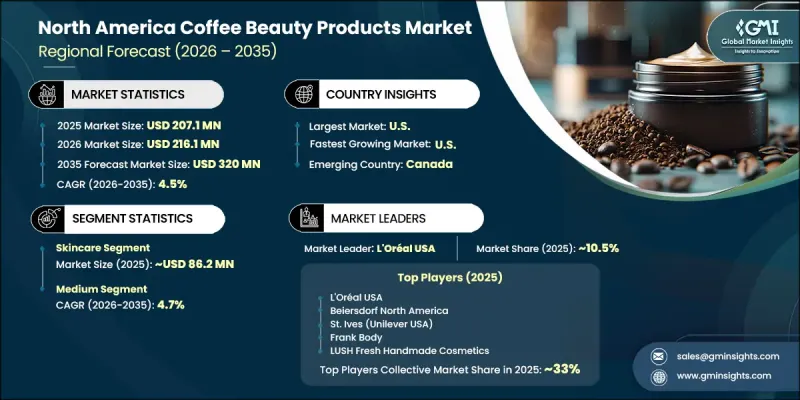
Growth is influenced by rising demand for plant-based formulations that emphasize minimal processing and ingredient transparency. Coffee-derived ingredients are increasingly incorporated into beauty products due to their antioxidant and skin-enhancing properties, aligning with consumer preferences for safer and more skin-compatible alternatives. The market is also benefiting from the broader shift toward wellness-oriented lifestyles, where personal care routines are closely linked to overall well-being. Products infused with coffee are gaining popularity as they support both functional and sensory benefits, reinforcing their appeal across diverse consumer groups. In addition, heightened awareness through digital platforms is amplifying product visibility, while brands continue to innovate with cleaner formulations and improved product positioning, further strengthening the growth outlook for the North America coffee beauty products market.
| Market Scope | |
|---|---|
| Start Year | 2025 |
| Forecast Year | 2026-2035 |
| Start Value | $207.1 Million |
| Forecast Value | $320 Million |
| CAGR | 4.5% |
The skincare segment generated USD 86.2 million in 2025 and is expected to grow at a CAGR of 4.2% between 2026 and 2035. This segment leads the North America coffee beauty products market, driven by strong demand for natural and sustainably sourced formulations. Coffee-based skincare products are widely recognized for their beneficial properties, including antioxidant and soothing effects that contribute to improved skin appearance. Increasing consumer focus on wellness-driven beauty routines and preference for clean-label products continue to support widespread adoption across various demographic groups.
The offline distribution segment held the largest share in 2025 and is anticipated to witness notable growth through 2035. Physical retail channels remain dominant as consumers prefer to evaluate products directly before purchasing. Access to a wide assortment of products, along with the ability to assess quality attributes in person, strengthens consumer confidence. Additionally, personalized assistance and immediate product availability contribute to sustained demand through offline channels. Despite the rise of digital commerce, established retail networks continue to maintain a strong presence due to high engagement and brand visibility.
U.S. Coffee Beauty Products Market accounted for USD 170.4 million in 2025 and is expected to grow at a CAGR of 4.3% from 2026 to 2035. Market growth in the country is driven by rising demand for functional and natural skincare solutions enriched with coffee-based ingredients. Consumer preferences are strongly aligned with clean beauty trends, where transparency and formulation quality are key considerations. Distribution is supported by both online and offline channels, while marketing strategies increasingly leverage digital platforms to enhance product awareness. Premium product positioning, sustainable sourcing practices, and focus on multi-functional benefits continue to shape the competitive landscape.
Key companies operating in the North America Coffee Beauty Products Market include L'Oreal USA, The Procter & Gamble Co., Beiersdorf North America, The Body Shop, Kiehl's Since 1851, LUSH Fresh Handmade Cosmetics, Caudalie USA, Frank Body, Tree Hut, Bean Body, BodyBlendz, 100% PURE, Soap & Glory, St. Ives (Unilever USA), and JAVA Skin Care LLC. Companies in the North America Coffee Beauty Products Market are strengthening their market presence by focusing on product innovation and clean-label formulations. They are incorporating sustainably sourced coffee extracts and emphasizing transparency to align with evolving consumer expectations. Brands are expanding their portfolios with multifunctional products that address various skincare needs while maintaining natural positioning. Strategic use of digital marketing, including influencer collaborations and social media campaigns, is enhancing brand visibility and consumer engagement. Companies are also improving distribution by strengthening both retail partnerships and e-commerce platforms.
Table of Contents
Chapter 1 Methodology & Scope
- 1.1 Market scope and definition
- 1.2 Research design
- 1.2.1 Research approach
- 1.2.2 Data collection methods
- 1.3 Data mining sources
- 1.3.1 Global
- 1.3.2 Country
- 1.4 Base estimates and calculations
- 1.4.1 Base year calculation
- 1.4.2 Key trends for market estimation
- 1.5 Primary research and validation
- 1.5.1 Primary sources
- 1.6 Forecast model
- 1.7 Research assumptions and limitations
Chapter 2 Executive Summary
- 2.1 Industry 360° synopsis
- 2.2 Key market trends
- 2.2.1 Regional
- 2.2.2 Product
- 2.2.3 Price range
- 2.2.4 End user
- 2.2.5 Distribution channel
Chapter 3 Industry Insights
- 3.1 Industry ecosystem analysis
- 3.1.1 Supplier landscape
- 3.1.2 Profit margin
- 3.1.3 Value addition at each stage
- 3.1.4 Factor affecting the value chain
- 3.2 Industry impact forces
- 3.2.1 Growth drivers
- 3.2.1.1 High consumer demand for natural and clean-label skincare products
- 3.2.1.2 Strong influence of wellness and self-care lifestyle trends
- 3.2.1.3 Expansion of premium personal care and organic beauty brands in North America
- 3.2.2 Pitfalls & Challenges
- 3.2.2.1 High product pricing compared to conventional skincare alternatives
- 3.2.2.2 Concerns regarding product efficacy and scientific validation
- 3.2.3 Opportunities
- 3.2.3.1 Rising demand for sustainable and ethically sourced coffee ingredients
- 3.2.3.2 Expansion into multifunctional beauty categories such as hair and body care
- 3.2.1 Growth drivers
- 3.3 Growth potential analysis
- 3.4 Future market trends
- 3.5 Technology and innovation landscape
- 3.5.1 Current technological trends
- 3.5.2 Emerging technologies
- 3.6 Regulatory landscape
- 3.6.1 Standards and compliance requirements
- 3.6.2 Regional regulatory frameworks
- 3.6.3 Certification standards
- 3.7 Porter's analysis
- 3.8 PESTEL analysis
- 3.9 Pricing analysis (driven by primary research)
- 3.9.1 Historical price trend analysis (driven by primary research)
- 3.9.2 Pricing strategy by player type (premium / value / cost-plus) (driven by primary research)
- 3.9.3 Regional price variations
- 3.9.4 Impact of raw material costs on product pricing
- 3.10 Trade data analysis (HS code 3304) (driven by paid database)
- 3.10.1 Import/export volume and value trends (driven by paid database)
- 3.10.2 Key trade corridors and tariff impact (driven by paid database)
- 3.10.3 Cross-border e-commerce dynamics
- 3.11 Distribution infrastructure and channel penetration landscape (driven by primary research)
- 3.11.1 Channel coverage by region and format (modern vs. traditional trade) (driven by primary research)
- 3.11.2 Last-mile infrastructure gaps and emerging channel shifts (driven by primary research)
- 3.11.3 E-commerce platform penetration and digital maturity by market
Chapter 4 Competitive Landscape, 2025
- 4.1 Introduction
- 4.2 Company market share analysis
- 4.2.1 By Country
- 4.2.1.1 U.S.
- 4.2.1.2 Canada
- 4.2.1 By Country
- 4.3 Company matrix analysis
- 4.4 Competitive analysis of major market players
- 4.5 Competitive positioning matrix
- 4.6 Key developments
- 4.6.1 Mergers & acquisitions
- 4.6.2 Partnerships & collaborations
- 4.6.3 New product launches
- 4.6.4 Expansion plans
Chapter 5 Market Estimates & Forecast, By Product, 2022 - 2035, (USD Million) (Thousand Units)
- 5.1 Key trends
- 5.2 Skincare Products
- 5.2.1 Face and lips scrubs
- 5.2.2 Face masks
- 5.2.3 Moisturizers
- 5.2.4 Serums
- 5.2.5 Others (eye creams, etc.)
- 5.3 Haircare Products
- 5.3.1 Shampoos
- 5.3.2 Conditioners
- 5.3.3 Hair masks
- 5.3.4 Others (scalp treatments, etc.)
- 5.4 Body Care Products
- 5.4.1 Body scrubs
- 5.4.2 Body lotions
- 5.4.3 Body wash
- 5.4.4 Others (bath salts, cellulite creams, etc.)
- 5.5 Perfume & fragrances
- 5.6 Color cosmetics
Chapter 6 Market Estimates & Forecast, By Price Range, 2022 - 2035, (USD Million) (Thousand Units)
- 6.1 Key trends
- 6.2 Low
- 6.3 Medium
- 6.4 High
Chapter 7 Market Estimates & Forecast, By End User, 2022 - 2035, (USD Million) (Thousand Units)
- 7.1 Key trends
- 7.2 Household
- 7.3 Professional
Chapter 8 Market Estimates & Forecast, By Distribution Channel, 2022 - 2035, (USD Million) (Thousand Units)
- 8.1 Key trends
- 8.2 Offline
- 8.3 Online
Chapter 9 Market Estimates & Forecast, By Region, 2022 - 2035, (USD Million) (Thousand Units)
- 9.1 Key trends
- 9.2 North America
- 9.2.1 U.S.
- 9.2.2 Canada
Chapter 10 Company Profiles
- 10.1 100% PURE
- 10.2 Bean Body
- 10.3 Beiersdorf North America
- 10.4 BodyBlendz
- 10.5 Caudalie USA
- 10.6 Frank Body
- 10.7 JAVA Skin Care LLC
- 10.8 Kiehl's Since 1851
- 10.9 L'Oreal USA
- 10.10 LUSH Fresh Handmade Cosmetics
- 10.11 Soap & Glory
- 10.12 St. Ives (Unilever USA)
- 10.13 The Body Shop
- 10.14 The Procter & Gamble Co.
- 10.15 Tree Hut

