PUBLISHER: Global Market Insights Inc. | PRODUCT CODE: 2038333

PUBLISHER: Global Market Insights Inc. | PRODUCT CODE: 2038333
High Heels Footwear Market Opportunity, Growth Drivers, Industry Trend Analysis, and Forecast 2026 - 2035
The Global High Heels Footwear Market was valued at USD 39.1 billion in 2025 and is estimated to grow at a CAGR of 4.3% to reach USD 60 billion by 2035.
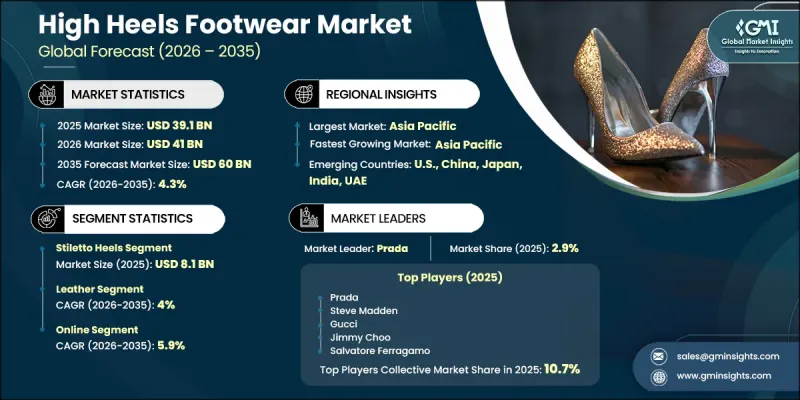
Increasing urbanization and heightened fashion awareness are encouraging consumers to invest in footwear that enhances style and overall appearance. High heels continue to hold strong appeal as a fashion-forward choice, particularly among consumers seeking sophisticated and trend-driven designs. The growing influence of global fashion trends, combined with increased exposure through digital platforms, is further strengthening demand. In addition, continuous product innovation and improvements in manufacturing techniques are enhancing comfort, durability, and design variety. While concerns around comfort and long-term wearability persist, manufacturers are actively addressing these issues through ergonomic designs and improved materials. As a result, the market is balancing style with functionality, ensuring sustained consumer interest and long-term growth potential across diverse customer segments.
| Market Scope | |
|---|---|
| Start Year | 2025 |
| Forecast Year | 2026-2035 |
| Start Value | $39.1 Billion |
| Forecast Value | $60 Billion |
| CAGR | 4.3% |
The expansion of digital retail channels has significantly influenced the growth of the high heels footwear market, providing consumers with easy access to a wide variety of products and price ranges. Online platforms enable convenient purchasing experiences and broaden product availability across regions. At the same time, increasing workforce participation among women is supporting demand, as professional attire continues to include fashion-oriented footwear. High heels are often associated with a polished and confident appearance, which contributes to their continued relevance in professional and semi-formal settings. Advancements in production processes are also enhancing product quality and variety, although ongoing concerns related to comfort and health considerations continue to shape product development strategies.
The stiletto heels segment generated USD 8.1 billion in 2025 and is expected to grow at a CAGR of 3.9% during 2026-2035. This segment maintains a strong presence due to its association with elegance and formal fashion preferences. Continued demand is supported by rising disposable income levels and increasing visibility of fashion trends, which influence consumer purchasing behavior and sustain interest in this category.
The leather segment accounted for 40% share in 2025 and is projected to grow at a CAGR of 4% from 2026 to 2035. This segment benefits from strong consumer preference for durable and high-quality materials, positioning leather as a premium choice in the high heels footwear market. The growing demand for luxury products and emphasis on craftsmanship continue to support the adoption of leather-based footwear across various consumer groups.
U.S. High Heels Footwear Market held 80% share in 2025, generating USD 4.4 billion. Market growth in the country is driven by evolving consumer preferences and increasing disposable income levels. Demand remains strong in urban areas, where fashion awareness and access to premium products are high. A well-established retail environment, combined with a large working population, continues to support consistent demand for high heels footwear across multiple occasions and style preferences.
Key companies operating in the Global High Heels Footwear Market include Gucci (Kering), Prada Group, Jimmy Choo, Manolo Blahnik, Salvatore Ferragamo, Steve Madden, Stella International, Giuseppe Zanotti, Casadei, Rene Caovilla, Kangnai Group, Vulcabras, Calcados Beira Rio, Diana Corporation, Sergio Rossi, M.Gemi, Badgley Mischka, Betsey Johnson, Shoedazzle, Suecomma Bonnie, and Tamara Mellon. Companies in the Global High Heels Footwear Market are strengthening their market position by focusing on design innovation, premium branding, and enhanced customer engagement. They are investing in new materials and ergonomic designs to improve comfort without compromising style. Expanding digital presence through e-commerce platforms and direct-to-consumer channels is a key strategy to reach a wider audience. Collaborations with fashion influencers and designers are being used to boost brand visibility and appeal. Companies are also diversifying product portfolios across price segments to cater to varying consumer preferences.
Table of Contents
Chapter 1 Methodology and scope
- 1.1 Research approach
- 1.2 Quality Commitments
- 1.2.1 GMI AI policy & data integrity commitment
- 1.2.1.1 Source consistency protocol
- 1.2.1 GMI AI policy & data integrity commitment
- 1.3 Research Trail & Confidence Scoring
- 1.3.1 Research Trail Components
- 1.3.2 Scoring Components
- 1.4 Data Collection
- 1.4.1 Partial list of primary sources
- 1.5 Data mining sources
- 1.5.1 Paid sources
- 1.5.1.1 Sources, by region
- 1.5.1 Paid sources
- 1.6 Base estimates and calculations
- 1.6.1 Base year calculation for any one approach
- 1.7 Forecast model
- 1.7.1 Quantified market impact analysis
- 1.7.1.1 Mathematical impact of growth parameters on forecast
- 1.7.1 Quantified market impact analysis
- 1.8 Research transparency addendum
- 1.8.1 Source attribution framework
- 1.8.2 Quality assurance metrics
- 1.8.3 Our commitment to trust
Chapter 2 Executive summary
- 2.1 Industry 360° synopsis
- 2.2 Key market trends
- 2.2.1 Regional
- 2.2.2 Product Type
- 2.2.3 Material
- 2.2.4 Heel Height
- 2.2.5 Application
- 2.2.6 End User
- 2.2.7 Distribution Channel
Chapter 3 Industry insights
- 3.1 Industry ecosystem analysis
- 3.1.1 Supplier landscape
- 3.1.2 Profit margin
- 3.1.3 Value addition at each stage
- 3.1.4 Factor affecting the value chain
- 3.1.5 Disruptions
- 3.2 Industry impact forces
- 3.2.1 Growth drivers
- 3.2.2 Industry pitfalls & challenges
- 3.2.3 Opportunities
- 3.3 Growth potential analysis
- 3.4 Pricing analysis, 2025 (driven by primary research)
- 3.4.1 Historical price trend analysis
- 3.4.2 Pricing strategy by player type (premium / value / cost-plus)
- 3.4.3 Price variation by product type & technology generation
- 3.4.4 Consumer price sensitivity analysis
- 3.5 Regulatory landscape
- 3.5.1 Key regulations by region
- 3.5.1.1 EU: REACH compliance, leather sourcing, labor standards
- 3.5.1.2 US: Consumer Product Safety Commission (CPSC) standards
- 3.5.1.3 China: GB standards for footwear safety and labeling
- 3.5.1.4 India: Bureau of Indian Standards (BIS) quality marks
- 3.5.2 Compliance requirements
- 3.5.2.1 Material safety and chemical restrictions
- 3.5.2.2 Labor and ethical sourcing certifications
- 3.5.1 Key regulations by region
- 3.6 Porter's analysis
- 3.7 PESTEL analysis
- 3.8 Technological and innovation landscape
- 3.8.1 Current technological trends
- 3.8.2 Emerging technologies
- 3.9 Future market trends
- 3.10 Trade data analysis (driven by paid database) (HS Code: 640299)
- 3.10.1 Import/export volume & value trends
- 3.10.2 Key trade corridors & tariff impact
- 3.10.3 Trade flow by technology type & product category
- 3.11 Impact of AI & generative ai on the market
- 3.11.1 AI-driven disruption of existing business models
- 3.11.2 GenAI use cases & adoption roadmap by segment
- 3.11.3 Risks, limitations & regulatory considerations
- 3.12 Distribution infrastructure & channel penetration landscape (driven by primary research)
- 3.12.1 Channel coverage by region & format (modern vs. traditional trade)
- 3.12.2 Last-mile infrastructure gaps & emerging channel shifts
- 3.13 Consumer buying behaviour
- 3.13.1 Purchasing patterns
- 3.13.2 Preference analysis
- 3.13.3 Regional variations in consumer behaviour
- 3.13.4 Impact of e-commerce on buying decisions
Chapter 4 Competitive landscape, 2025
- 4.1 Introduction
- 4.2 Company market share analysis
- 4.2.1 North America
- 4.2.2 Europe
- 4.2.3 Asia Pacific
- 4.2.4 Latin America
- 4.2.5 MEA
- 4.3 Company matrix analysis
- 4.4 Competitive analysis of major market players
- 4.5 Competitive positioning matrix
- 4.6 Key developments
- 4.6.1 Mergers & acquisitions
- 4.6.2 Partnerships & collaborations
- 4.6.3 New product launches
- 4.6.4 Expansion plans
Chapter 5 Market Estimates & Forecast, By Product Type, 2022 - 2035 ($Billion, Thousand Units)
- 5.1 Key trends
- 5.2 Platform heels
- 5.3 Stiletto heels
- 5.4 Heeled boots
- 5.5 Wedge heels
- 5.6 Pump heels
- 5.7 Others (cuban heels, slingbacks etc.)
Chapter 6 Market Estimates & Forecast, By Material, 2022 - 2035 ($Billion, Thousand Units)
- 6.1 Key trends
- 6.2 Leather
- 6.3 Synthetic
- 6.4 Fabric
- 6.5 Suede
Chapter 7 Market Estimates & Forecast, By Heel Height, 2022 - 2035 ($Billion, Thousand Units)
- 7.1 Key trends
- 7.2 Low heels (under 2 inches)
- 7.3 Mid heels (2-3 inches)
- 7.4 High heels (above 3 inches)
Chapter 8 Market Estimates & Forecast, By Application, 2022 - 2035 ($Billion, Thousand Units)
- 8.1 Key trends
- 8.2 Formal/office wear
- 8.3 Party/evening wear
- 8.4 Bridal
- 8.5 Casual/daily wear
- 8.6 Others (sports & performance etc.)
Chapter 9 Market Estimates & Forecast, By End User, 2022 - 2035 ($Billion, Thousand Units)
- 9.1 Key trends
- 9.2 Men
- 9.3 Women
Chapter 10 Market Estimates & Forecast, By Distribution Channel, 2022 - 2035 ($Billion, Thousand Units)
- 10.1 Key trends
- 10.2 Online
- 10.2.1 E-commerce
- 10.2.2 Company websites
- 10.3 Offline
- 10.3.1 Supermarkets/hypermarket
- 10.3.2 Specialty retail stores
- 10.3.3 Others (independent retailer etc.)
Chapter 11 Market Estimates & Forecast, By Region, 2022 - 2035 ($Billion, Thousand Units)
- 11.1 Key trends
- 11.2 North America
- 11.2.1 U.S.
- 11.2.2 Canada
- 11.3 Europe
- 11.3.1 Germany
- 11.3.2 UK
- 11.3.3 France
- 11.3.4 Spain
- 11.3.5 Italy
- 11.3.6 Netherlands
- 11.4 Asia Pacific
- 11.4.1 China
- 11.4.2 Japan
- 11.4.3 India
- 11.4.4 Australia
- 11.4.5 South Korea
- 11.5 Latin America
- 11.5.1 Brazil
- 11.5.2 Mexico
- 11.5.3 Argentina
- 11.6 MEA
- 11.6.1 South Africa
- 11.6.2 Saudi Arabia
- 11.6.3 UAE
Chapter 12 Company Profiles
- 12.1 Top Global Players
- 12.1.1 Gucci (Kering)
- 12.1.2 Jimmy Choo
- 12.1.3 Manolo Blahnik
- 12.1.4 Prada Group
- 12.1.5 Salvatore Ferragamo
- 12.1.6 Stella International
- 12.1.7 Steve Madden
- 12.2 Regional Key Players
- 12.2.1 Calcados Beira Rio
- 12.2.2 Casadei
- 12.2.3 Diana Corporation
- 12.2.4 Giuseppe Zanotti
- 12.2.5 Kangnai Group
- 12.2.6 Rene Caovilla
- 12.2.7 Vulcabras
- 12.3 Emerging And Specialized Players
- 12.3.1 Badgley Mischka
- 12.3.2 Betsey Johnson
- 12.3.3 M.Gemi
- 12.3.4 Sergio Rossi
- 12.3.5 Shoedazzle
- 12.3.6 Suecomma Bonnie
- 12.3.7 Tamara Mellon

