
PUBLISHER: Global Market Insights Inc. | PRODUCT CODE: 2038338

PUBLISHER: Global Market Insights Inc. | PRODUCT CODE: 2038338
Men's Intimate Hygiene Products Market Opportunity, Growth Drivers, Industry Trend Analysis, and Forecast 2026 - 2035
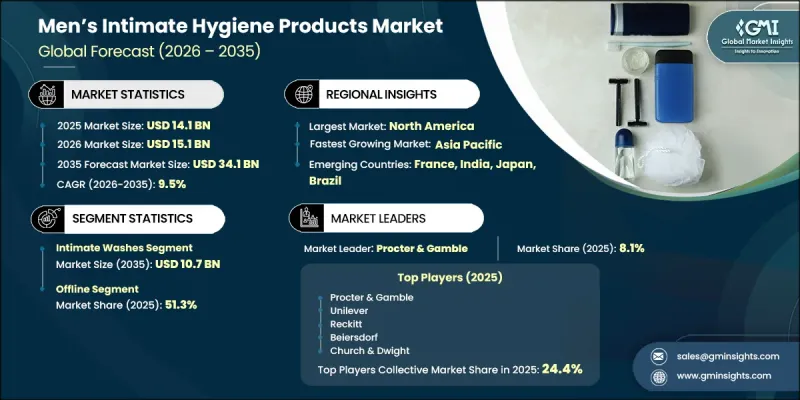
The Global Men's Intimate Hygiene Products Market was valued at USD 14.1 billion in 2025 and is estimated to grow at a CAGR of 9.5% to reach USD 34.1 billion by 2035.
The market is witnessing strong and sustained expansion as awareness surrounding male personal care and hygiene practices continues to grow globally. Changing social perceptions around grooming and self-care have significantly influenced consumer behavior, encouraging men to adopt specialized hygiene products as part of their daily routines. Increased exposure to digital platforms, along with structured awareness initiatives by healthcare organizations and public institutions, has played a crucial role in normalizing conversations around intimate hygiene. The entry of established personal care brands and emerging niche players has further accelerated product availability and category expansion. Rising confidence levels, improved product accessibility, and targeted marketing efforts have collectively contributed to shaping a more mature consumer base. The overall market environment reflects a clear shift toward preventive hygiene care, supported by evolving lifestyle habits and growing emphasis on personal wellness.
| Market Scope | |
|---|---|
| Start Year | 2025 |
| Forecast Year | 2026-2035 |
| Start Value | $14.1 Billion |
| Forecast Value | $34.1 Billion |
| CAGR | 9.5% |
Over the past decade, the industry has evolved from a largely underrepresented segment to a rapidly expanding category within the broader personal care market. Growing advocacy around hygiene awareness has encouraged both public and private entities to promote better personal care practices among men. Global health organizations have consistently emphasized hygiene as a key component of preventive healthcare, reinforcing the importance of integrating personal care products into daily routines. In several regions, government bodies have also undertaken initiatives aimed at improving awareness about hygiene standards among men, contributing to increased product adoption. Additionally, the rise of social media platforms has transformed consumer education, with digital campaigns and influencer-driven content significantly shaping purchasing behavior and product perception. These combined efforts have led to a stronger cultural acceptance of male intimate hygiene products, supporting long-term market expansion.
The offline distribution channel accounted for 51.3% share in 2025, reflecting its continued importance in consumer engagement and product accessibility. Physical retail environments remain a critical touchpoint for consumers, offering direct product exposure and the opportunity to evaluate personal care items before purchase. Retail networks, including pharmacies and specialty stores, play a key role in building trust through in-person interaction and product education. Awareness initiatives conducted in collaboration with retailers further support category growth by encouraging trial usage and improving consumer understanding of product benefits. This channel continues to maintain its dominance due to its ability to combine accessibility with personalized shopping experiences.
United States Men's Intimate Hygiene Products Market held a 74.3% share in 2025. Market growth in the country is supported by high awareness levels regarding personal hygiene and dermatological care, along with strong retail infrastructure and widespread product availability. Consumer acceptance of premium personal care solutions continues to grow, driven by increasing emphasis on grooming and wellness. The presence of established brands and consistent product innovation has further strengthened market penetration. Additionally, aggressive marketing strategies and expanded distribution networks have contributed to sustained category growth across both urban and suburban populations.
Key companies operating in the Global Men's Intimate Hygiene Products Market include Procter & Gamble, Unilever, Beiersdorf, Kenvue, Reckitt, Henkel, Church & Dwight, Kimberly-Clark, Kao Corporation, Lion Corporation, LG H&H, Mandom, Godrej, Amorepacific, Burt's Bees, and Chattem/Sanofi. Companies in the Global Men's Intimate Hygiene Products Market are focusing on product innovation, targeted marketing, and portfolio expansion to strengthen their competitive position. Market participants are investing in research and development to create safer, dermatologist-tested, and skin-friendly formulations tailored to evolving consumer needs. Brands are also expanding their product lines to address specific hygiene concerns and enhance category relevance. Strategic marketing campaigns, particularly through digital and influencer channels, are being used to improve awareness and normalize product usage. Strengthening retail partnerships and expanding distribution networks across offline and online channels are further enhancing market reach.
Table of Contents
Chapter 1 Methodology & Scope
- 1.1 Research approach
- 1.2 Quality Commitments
- 1.3 GMI AI policy & data integrity commitment
- 1.3.1 Source consistency protocol
- 1.4 Research Trail & Confidence Scoring
- 1.4.1 Research Trail Components
- 1.4.2 Scoring Components
- 1.5 Data Collection
- 1.5.1 Partial list of primary sources
- 1.6 Data mining sources
- 1.7 Paid sources
- 1.7.1 Sources, by region
- 1.8 Base estimates and calculations
- 1.8.1 Base year calculation for any one approach
- 1.9 Forecast model
- 1.9.1 Quantified market impact analysis
- 1.9.1.1 Mathematical impact of growth parameters on forecast
- 1.9.1 Quantified market impact analysis
- 1.10 Research transparency addendum
- 1.10.1 Source attribution framework
- 1.10.2 Quality assurance metrics
- 1.10.3 Our commitment to trust
Chapter 2 Executive Summary
- 2.1 Industry 360° synopsis
- 2.2 Key market trends
- 2.2.1 Regional
- 2.2.2 Product type
- 2.2.3 Material type
- 2.2.4 Price
- 2.2.5 Form
- 2.2.6 Age group
- 2.2.7 Application
- 2.2.8 Distribution Channel
Chapter 3 Industry Insights
- 3.1 Industry ecosystem analysis
- 3.1.1 Supplier landscape
- 3.1.2 Profit margin
- 3.1.3 Value addition at each stage
- 3.1.4 Factor affecting the value chain
- 3.2 Industry impact forces
- 3.2.1 Growth drivers
- 3.2.1.1 Increasing awareness of personal hygiene and grooming among men
- 3.2.1.2 Development of innovative and specialized intimate hygiene products
- 3.2.1.3 Increase in skin sensitivity and dermatological concerns
- 3.2.2 Industry pitfalls & challenges
- 3.2.2.1 Cultural taboos and stigma associated with the use of mens intimate hygiene products
- 3.2.2.2 Lack of education around the importance of intimate hygiene
- 3.2.3 Opportunities
- 3.2.3.1 Untapped product innovation space
- 3.2.3.2 E-commerce and direct-to-consumer growth
- 3.2.1 Growth drivers
- 3.3 Growth potential analysis
- 3.4 Future market trends
- 3.5 Technology and innovation landscape
- 3.5.1 Current technological trends
- 3.5.2 Emerging technologies
- 3.6 Regulatory landscape
- 3.6.1 Standards and compliance requirements
- 3.6.2 Regional regulatory frameworks
- 3.6.3 Certification standards
- 3.7 Pricing analysis (driven by primary research)
- 3.7.1 Historical price trend analysis (driven by primary research)
- 3.7.2 Pricing strategy by player type (premium / value / cost-plus) (driven by primary research)
- 3.7.3 Regional price variations
- 3.7.4 Impact of raw material costs on pricing
- 3.8 Porter's analysis
- 3.9 PESTEL analysis
- 3.10 Consumer behaviour analysis
- 3.10.1 Purchasing patterns
- 3.10.2 Preference analysis
- 3.10.3 Regional variations in consumer behaviour
- 3.10.4 Impact of e-commerce on buying decisions
- 3.11 Trade data analysis
- 3.11.1 Import/export volume & value trends
- 3.11.2 Key trade corridors & tariff impact
- 3.12 Impact of AI & generative AI on the market
- 3.12.1 AI-driven disruption of existing business models
- 3.12.2 Gen AI use cases & adoption roadmap by segment
- 3.12.3 Risks, limitations & regulatory considerations
Chapter 4 Competitive Landscape, 2025
- 4.1 Introduction
- 4.2 Company market share analysis
- 4.2.1 By region
- 4.2.1.1 North America
- 4.2.1.2 Europe
- 4.2.1.3 Asia Pacific
- 4.2.1.4 Latin America
- 4.2.1.5 Middle East and Africa
- 4.2.1 By region
- 4.3 Company matrix analysis
- 4.4 Competitive analysis of major market players
- 4.5 Competitive positioning matrix
- 4.6 Key developments
- 4.6.1 Mergers & acquisitions
- 4.6.2 Partnerships & collaborations
- 4.6.3 New product launches
- 4.6.4 Expansion plans
Chapter 5 Market Estimates & Forecast, By Product, 2022-2035 (USD Billion) (Million Units)
- 5.1 Key trends
- 5.2 Intimate washes
- 5.2.1 pH-balanced formulations
- 5.2.2 Antibacterial/antimicrobial washes
- 5.2.3 Natural & organic variants
- 5.3 Wipes
- 5.3.1 Pre-moistened cleansing wipes
- 5.3.2 Post-activity freshening wipes
- 5.3.3 Travel-size & on-the-go packs
- 5.4 Deodorants & antiperspirants
- 5.4.1 Spray deodorants
- 5.4.2 Roll-on deodorants
- 5.4.3 Stick deodorants
- 5.4.4 Cream deodorants
- 5.5 Moisturizers
- 5.5.1 Daily moisturizing creams
- 5.5.2 Anti-chafing balms
- 5.5.3 Soothing & healing lotions
- 5.6 Shaving care
- 5.6.1 Intimate shaving gels & creams
- 5.6.2 Pre-shave oils & preparations
- 5.6.3 Post-shave balms & treatments
- 5.7 Others
- 5.7.1 Anti-chafing gels
- 5.7.2 Intimate powders
- 5.7.3 Specialized treatment products
Chapter 6 Market Estimates & Forecast, By Type, 2022-2035 (USD Billion) (Million Units)
- 6.1 Key trends
- 6.2 Organic
- 6.2.1 Plant-based formulations
- 6.2.2 Essential oils & herbal extracts
- 6.2.3 Certified organic products
- 6.3 Conventional/synthetic
- 6.3.1 Standard chemical formulations
- 6.3.2 Hybrid (Natural-Synthetic Blend)
Chapter 7 Market Estimates & Forecast, By Price, 2022-2035 (USD Billion) (Million Units)
- 7.1 Key trends
- 7.2 Low
- 7.3 Medium
- 7.4 High
Chapter 8 Market Estimates & Forecast, By Form, 2022-2035 (USD Billion) (Million Units)
- 8.1 Key trends
- 8.2 Liquid
- 8.3 Cream
- 8.4 Gel
- 8.5 Powder
- 8.6 Others
Chapter 9 Market Estimates & Forecast, By Age Group, 2022-2035 (USD Billion) (Million Units)
- 9.1 Key trends
- 9.2 Teenagers (13-19 years)
- 9.3 Adults (20-40 years)
- 9.4 Middle-aged & Older Adults (40+ years)
Chapter 10 Market Estimates & Forecast, By Application, 2022-2035 (USD Billion) (Million Units)
- 10.1 Key trends
- 10.2 Sweat control and freshness
- 10.3 Post-sexual care
- 10.4 Post-activity cleansing
- 10.5 Skin condition management
- 10.6 Others
Chapter 11 Market Estimates & Forecast, By Distribution Channel, 2022-2035 (USD Billion) (Million Units)
- 11.1 Key trends
- 11.2 Online
- 11.2.1 E-commerce
- 11.2.2 Company website
- 11.3 Offline
- 11.3.1 Supermarkets/Hypermarkets
- 11.3.2 Specialty stores
- 11.3.3 Others (individual stores, departmental stores, etc.)
Chapter 12 Market Estimates & Forecast, By Region, 2022-2035 (USD Billion) (Million Units)
- 12.1 Key trends
- 12.2 North America
- 12.2.1 U.S.
- 12.2.2 Canada
- 12.3 Europe
- 12.3.1 Germany
- 12.3.2 France
- 12.3.3 UK
- 12.3.4 Italy
- 12.3.5 Spain
- 12.4 Asia Pacific
- 12.4.1 China
- 12.4.2 India
- 12.4.3 Japan
- 12.4.4 South Korea
- 12.4.5 Australia
- 12.5 Latin America
- 12.5.1 Brazil
- 12.5.2 Mexico
- 12.5.3 Argentina
- 12.6 MEA
- 12.6.1 South Africa
- 12.6.2 Saudi Arabia
- 12.6.3 UAE
Chapter 13 Company Profiles
- 13.1 Amorepacific
- 13.2 Beiersdorf
- 13.3 Burt's Bees
- 13.4 Chattem/Sanofi
- 13.5 Church & Dwight
- 13.6 Godrej
- 13.7 Henkel
- 13.8 Kao Corporation
- 13.9 Kenvue
- 13.10 Kimberly-Clark
- 13.11 LG H&H
- 13.12 Lion Corporation
- 13.13 Mandom
- 13.14 Procter & Gamble
- 13.15 Reckitt
- 13.16 Unilever

