PUBLISHER: Global Market Insights Inc. | PRODUCT CODE: 2038351

PUBLISHER: Global Market Insights Inc. | PRODUCT CODE: 2038351
Body Armor Market Opportunity, Growth Drivers, Industry Trend Analysis, and Forecast 2026 - 2035
The Global Body Armor Market was valued at USD 2.2 billion in 2025 and is estimated to grow at a CAGR of 6.2% to reach USD 3.9 billion by 2035.
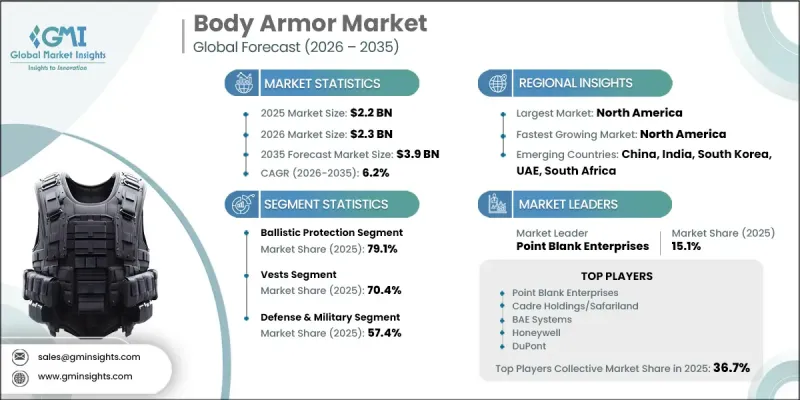
The market is experiencing expansion driven by increasing emphasis on personnel safety and operational effectiveness across defense and security forces worldwide. Growing modernization initiatives within military organizations are encouraging the adoption of advanced protective gear that delivers higher ballistic resistance while maintaining reduced weight for improved mobility and endurance. Rising global security concerns, including terrorism risks and increasing criminal activities, are further intensifying demand for personal protection equipment. Law enforcement agencies are increasingly equipping personnel with advanced protective solutions to safeguard against firearm and edged-weapon threats. At the same time, awareness among civilians regarding personal safety has contributed to growing adoption in high-risk environments. The rising frequency of violent incidents and security threats has reinforced the importance of reliable protective systems. Continuous innovation in materials science has enabled the development of lighter, stronger, and more comfortable protective solutions, improving usability and adoption rates. Proper fit, ergonomic design, and full-body coverage remain critical factors influencing product effectiveness and market acceptance, prompting manufacturers to focus on customization and improved user comfort across applications.
| Market Scope | |
|---|---|
| Start Year | 2025 |
| Forecast Year | 2026-2035 |
| Start Value | $2.2 Billion |
| Forecast Value | $3.9 Billion |
| CAGR | 6.2% |
The ballistic protection segment accounted for 79.1% share in 2025. This segment maintains strong demand due to its essential role in protecting against bullets and high-impact projectiles. It is widely deployed across military and law enforcement applications where high-risk exposure is common. Growth in this segment is supported by advancements in lightweight composites, improved structural strength, and enhanced wearer comfort that allow extended use without compromising mobility.
The vest segment represented 70.4% share in 2025, attributed to widespread use in protecting critical upper-body regions and its adaptability across multiple operational environments. These protective systems are extensively utilized by defense and security personnel. Continuous improvements in modular configurations, ergonomic design, and advanced ballistic materials are enhancing performance, comfort, and overall usability, supporting sustained demand across end-user groups.
North America Body Armor Market accounted for 35% share in 2025 supported by substantial defense spending, advanced manufacturing capabilities, and ongoing integration of next-generation protective technologies. Continuous investments in improving soldier and law enforcement safety, along with technological advancements in protective equipment, are expected to further strengthen regional market expansion.
Key companies operating in the Global Body Armor Industry include DuPont de Nemours Inc., Safariland LLC, BAE Systems, Teijin Limited, Honeywell International Inc., 3M Company, and Point Blank Enterprises. Companies in the Body Armor Market are focusing on advanced material innovation to improve protection levels while reducing weight and enhancing flexibility. Strong investments in research and development are enabling the creation of next-generation composites with superior ballistic resistance and durability. Manufacturers are increasingly forming strategic partnerships with defense agencies and law enforcement organizations to ensure product customization and long-term supply contracts. Expansion of production capacities and adoption of automated manufacturing processes are helping improve efficiency and scalability. Firms are also prioritizing ergonomic improvements and modular armor designs to enhance user comfort and adaptability.
Table of Contents
Chapter 1 Methodology and Scope
- 1.1 Market scope and definition
- 1.2 Research design
- 1.2.1 Research approach
- 1.2.2 Data collection methods
- 1.3 Data mining sources
- 1.3.1 Global
- 1.3.2 Regional/Country
- 1.4 Base estimates and calculations
- 1.4.1 Base year calculation
- 1.4.2 Key trends for market estimation
- 1.5 Primary research and validation
- 1.5.1 Primary sources
- 1.6 Forecast model
- 1.7 Research assumptions and limitations
Chapter 2 Executive Summary
- 2.1 Industry 360° synopsis, 2022 - 2035
- 2.2 Key market trends
- 2.2.1 Protection level trends
- 2.2.2 Product type trends
- 2.2.3 End-user trends
- 2.2.4 Regional trends
- 2.3 TAM Analysis, 2026-2035
- 2.4 CXO perspectives: Strategic imperatives
Chapter 3 Industry Insights
- 3.1 Industry ecosystem analysis
- 3.1.1 Supplier Landscape
- 3.1.2 Profit Margin
- 3.1.3 Cost structure
- 3.1.4 Value addition at each stage
- 3.1.5 Factor affecting the value chain
- 3.1.6 Disruptions
- 3.2 Industry impact forces
- 3.2.1 Growth drivers
- 3.2.1.1 Increasing global military expenditure
- 3.2.1.2 Rising threats of terrorism and criminal activities
- 3.2.1.3 Technological advancements in material science
- 3.2.1.4 Increased demand for customized and gender-specific armor
- 3.2.1.5 Expansion of the civilian market for personal protection
- 3.2.2 Industry pitfalls and challenges
- 3.2.2.1 High production costs and affordability issues
- 3.2.2.2 Body coverage issues
- 3.2.3 Market opportunities
- 3.2.3.1 Development of next-generation lightweight armor materials
- 3.2.3.2 Increasing adoption by law enforcement and homeland security agencies
- 3.2.1 Growth drivers
- 3.3 Growth potential analysis
- 3.4 Regulatory landscape
- 3.4.1 North America
- 3.4.2 Europe
- 3.4.3 Asia Pacific
- 3.4.4 Latin America
- 3.4.5 Middle East & Africa
- 3.5 Porter's analysis
- 3.6 PESTEL analysis
- 3.7 Technology and Innovation landscape
- 3.7.1 Current technological trends
- 3.7.2 Emerging technologies
- 3.8 Defense budget analysis
- 3.9 Global defense spending trends
- 3.10 Regional defense budget allocation
- 3.10.1 North America
- 3.10.2 Europe
- 3.10.3 Asia Pacific
- 3.10.4 Middle East and Africa
- 3.10.5 Latin America
- 3.11 Pricing Analysis (Driven by Primary Research)
- 3.11.1 Historical Price Trend Analysis
- 3.11.2 Pricing Strategy by Player Type (Premium / Value / Cost-plus)
- 3.12 Trade Data Analysis (Based on Paid Database)
- 3.12.1 Import/Export Volume & Value Trends
- 3.12.2 Key Trade Corridors & Tariff Impact
- 3.13 Impact of AI & Generative AI on the Market (Driven by Primary Research)
- 3.13.1 AI-Driven Disruption of Existing Business Models
- 3.13.2 GenAI Use Cases & Adoption Roadmap by Segment
- 3.13.3 Risks, Limitations & Regulatory Considerations
- 3.14 Capacity & Production Landscape (Driven by Primary Research)
- 3.14.1 Production Capacity by Region & Key Producer
- 3.14.2 Capacity Utilization Rates & Expansion Pipelines
Chapter 4 Competitive Landscape, 2025
- 4.1 Introduction
- 4.2 Company market share analysis
- 4.2.1 By Region
- 4.2.1.1 North America
- 4.2.1.2 Europe
- 4.2.1.3 Asia-Pacific
- 4.2.1.4 Latin America
- 4.2.1.5 Middle East and Africa
- 4.2.2 Market Concentration Analysis
- 4.2.1 By Region
- 4.3 Competitive analysis of major market players
- 4.4 Competitive positioning matrix
- 4.5 Key developments
- 4.5.1 Mergers & acquisitions
- 4.5.2 Partnerships & collaborations
- 4.5.3 New product launches
- 4.5.4 Expansion plans and funding
- 4.6 Company tier benchmarking
- 4.6.1 Tier classification criteria & qualifying thresholds
- 4.6.2 Tier positioning matrix by revenue, geography & innovation
Chapter 5 Market Estimates and Forecast, By Protection Level, 2022 - 2035 (USD Million)
- 5.1 Key trends
- 5.2 Ballistic protection
- 5.2.1 Level IIA
- 5.2.2 Level II
- 5.2.3 Level IIIA
- 5.2.4 Level III
- 5.2.5 Level IV
- 5.3 Stab & spike protection
- 5.3.1 Stab-resistant armor
- 5.3.2 Spike-resistant armor
- 5.3.3 Multi-threat protection (combined ballistic/stab/spike)
Chapter 6 Market Estimates and Forecast, By Product Type, 2022 - 2035 (USD Million)
- 6.1 Key trends
- 6.2 Vests
- 6.2.1 Covert/concealable vests
- 6.2.2 Overt/tactical vests
- 6.2.3 Plate carriers
- 6.2.4 Modular armor systems
- 6.3 Helmets
- 6.3.1 Combat helmets
- 6.3.2 Riot helmets
- 6.3.3 Ballistic face shields
- 6.4 Shields
- 6.4.1 Handheld ballistic shields
- 6.4.2 Breaching shields
- 6.5 Accessories & attachments
- 6.5.1 Groin protectors
- 6.5.2 Neck guards
- 6.5.3 Shoulder & deltoid protection
- 6.5.4 Ballistic inserts & soft armor panels
Chapter 7 Market Estimates and Forecast, By End-User, 2022 - 2035 (USD Million)
- 7.1 Key trends
- 7.2 Defense & military
- 7.2.1 Army
- 7.2.2 Navy
- 7.2.3 Air force
- 7.2.4 Marines
- 7.2.5 Special operations forces
- 7.3 Law enforcement & security
- 7.3.1 Police departments
- 7.3.2 Correctional officers
- 7.3.3 Private security firms
- 7.3.4 Border patrol & customs
- 7.4 Civilian
- 7.4.1 Personal protection
- 7.4.2 Shooting sports & training
- 7.4.3 Journalists & NGO workers
- 7.4.4 High-risk professionals
Chapter 8 Market Estimates and Forecast, By Region, 2022 - 2035 (USD Million)
- 8.1 Key trends
- 8.2 North America
- 8.2.1 U.S.
- 8.2.2 Canada
- 8.3 Europe
- 8.3.1 Germany
- 8.3.2 UK
- 8.3.3 France
- 8.3.4 Spain
- 8.3.5 Italy
- 8.3.6 Netherlands
- 8.3.7 Rest of Europe
- 8.4 Asia Pacific
- 8.4.1 China
- 8.4.2 India
- 8.4.3 Japan
- 8.4.4 Australia
- 8.4.5 South Korea
- 8.4.6 Rest of Asia Pacific
- 8.5 Latin America
- 8.5.1 Brazil
- 8.5.2 Mexico
- 8.5.3 Argentina
- 8.5.4 Rest of Latin America
- 8.6 Middle East and Africa
- 8.6.1 South Africa
- 8.6.2 Saudi Arabia
- 8.6.3 UAE
- 8.6.4 Rest of MEA
Chapter 9 Company Profiles
- 9.1 Global Players
- 9.1.1 Point Blank Enterprises
- 9.1.2 BAE Systems
- 9.1.3 Safariland LLC
- 9.1.4 Honeywell International Inc.
- 9.1.5 DuPont de Nemours Inc.
- 9.1.6 3M Company
- 9.1.7 Teijin Limited
- 9.2 Regional Champions
- 9.2.1 U.S. Armor Corporation
- 9.2.2 Armor Express
- 9.2.3 AR500 Armor
- 9.2.4 Vestguard (UK)
- 9.2.5 Protection Group Danmark (Europe)
- 9.2.6 Indian Armour Systems
- 9.3 Emerging Players
- 9.3.1 Safe Life Defense
- 9.3.2 BulletSafe
- 9.3.3 Spartan Armor Systems
- 9.3.4 Hoplite Armor
- 9.3.5 RMA Armament
- 9.3.6 DFNDR Armor

