PUBLISHER: Global Market Insights Inc. | PRODUCT CODE: 2045711

PUBLISHER: Global Market Insights Inc. | PRODUCT CODE: 2045711
Vehicle Armor Market Opportunity, Growth Drivers, Industry Trend Analysis, and Forecast 2026 - 2035
The Global Vehicle Armor Market was valued at USD 10 billion in 2025 and is estimated to grow at a CAGR of 4.8% to reach USD 16 billion by 2035.
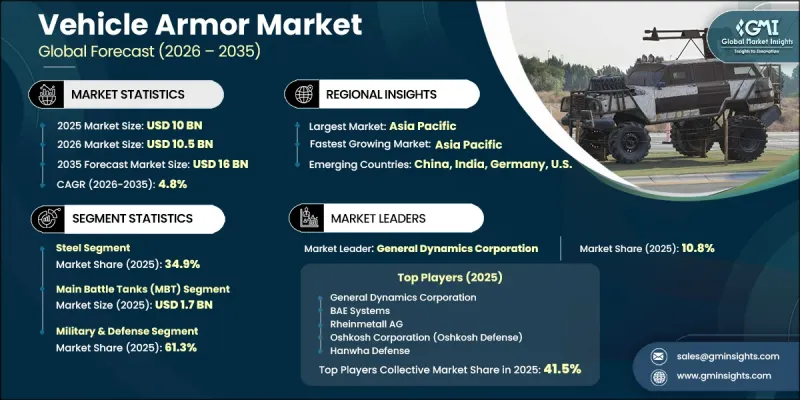
The vehicle armor industry is experiencing steady momentum driven by increasing investments aimed at reinforcing military vehicle fleets, along with rising demand for enhanced internal security capabilities. Growing emphasis on protected mobility across defense and security organizations is strengthening market expansion. The adoption of advanced lightweight armor technologies is also contributing to improved vehicle performance, supporting deployment across a wider range of operational scenarios. In addition, the expanding application of armored vehicles beyond defense into security-sensitive civilian use cases is broadening the customer base. Rising focus on operational safety, mission efficiency, and adaptable mobility platforms continues to accelerate demand for advanced vehicle armor solutions across global markets.
| Market Scope | |
|---|---|
| Start Year | 2025 |
| Forecast Year | 2026-2035 |
| Start Value | $10 Billion |
| Forecast Value | $16 Billion |
| CAGR | 4.8% |
The vehicle armor market is further supported by ongoing modernization initiatives across defense sectors, where governments are allocating higher budgets to upgrade protection systems and enhance troop mobility. Increasing concerns related to global security challenges are also contributing to the growing need for advanced protective systems. Law enforcement agencies and rapid response units are strengthening their operational readiness by integrating armored mobility solutions, which continues to support overall market growth.
The ceramics segment is projected to grow at a CAGR of 7.5% during 2026-2035. This growth is driven by the development of advanced ceramic-based materials that offer strong impact resistance while maintaining reduced weight. These characteristics are enabling improved mobility and operational efficiency, making ceramic armor a preferred choice in modern vehicle protection systems.
The law enforcement and civilian vehicles segment is expected to register a CAGR of 8.3% during 2026-2035. Increasing focus on security and protection solutions for non-military applications is encouraging the adoption of armored vehicles across various end users. The need for enhanced safety and mobility in high-risk environments is contributing to the rising demand for integrated armor systems in these segments.
North America Vehicle Armor Market accounted for 34.9% share in 2025. Regional growth is supported by continued investments in defense capabilities and the procurement of advanced armored platforms. Increasing emphasis on security infrastructure and tactical mobility solutions is further driving adoption. Expanding initiatives to strengthen domestic manufacturing capabilities and improve maintenance and upgrade systems are also reinforcing market development across the region.
Key players operating in the Global Vehicle Armor Market include BAE Systems, General Dynamics Corporation, Rheinmetall AG, Oshkosh Corporation, Hanwha Defense, Hyundai Rotem, Uralvagonzavod, NORINCO Group, Krauss-Maffei Wegmann, Nexter Systems, Iveco Defense Vehicles, Plasan Sasa, Hardwire LLC, ArmorWorks, BMI Defense Systems, Automotive Armor Manufacturing, Bulldog Direct Protective Systems, Protective Group, Design Armor, LLC, and Safeco Industries. Companies in the vehicle armor market are prioritizing innovation in lightweight materials and advanced protection technologies to enhance performance and mobility. Strategic collaborations with defense agencies and long-term supply contracts are helping companies secure stable revenue streams. Many players are investing in research and development to improve ballistic resistance while reducing weight and cost. Expanding production capabilities and strengthening regional presence through partnerships and facility expansion are also key approaches. In addition, companies are focusing on customization and modular armor solutions to meet diverse operational requirements, while aligning with evolving safety standards and regulatory frameworks to maintain competitiveness and long-term market positioning.
Table of Contents
Chapter 1 Methodology and Scope
- 1.1 Market scope and definition
- 1.2 Research design
- 1.2.1 Research approach
- 1.2.2 Data collection methods
- 1.3 Data mining sources
- 1.3.1 Global
- 1.3.2 Regional/Country
- 1.4 Base estimates and calculations
- 1.4.1 Base year calculation
- 1.4.2 Key trends for market estimation
- 1.5 Primary research and validation
- 1.5.1 Primary sources
- 1.6 Forecast model
- 1.7 Research assumptions and limitations
Chapter 2 Executive Summary
- 2.1 Industry 360° synopsis, 2022 - 2035
- 2.2 Key market trends
- 2.2.1 Material type trends
- 2.2.2 Vehicle type trends
- 2.2.3 Application trends
- 2.2.4 Point of sale trends
- 2.2.5 Regional trends
- 2.3 TAM Analysis, 2026-2035
- 2.4 CXO perspectives: Strategic imperatives
Chapter 3 Industry Insights
- 3.1 Industry ecosystem analysis
- 3.1.1 Supplier Landscape
- 3.1.2 Profit Margin
- 3.1.3 Cost structure
- 3.1.4 Value addition at each stage
- 3.1.5 Factor affecting the value chain
- 3.1.6 Disruptions
- 3.2 Industry impact forces
- 3.2.1 Growth drivers
- 3.2.1.1 Rising defense modernization and procurement programs
- 3.2.1.2 Increasing internal security and counter-terrorism requirements
- 3.2.1.3 Advancements in lightweight and high-performance armor materials
- 3.2.1.4 Growing demand for expeditionary mobility and peacekeeping missions
- 3.2.1.5 Expansion of civilian armored vehicle demand (VIP transport and cash logistics)
- 3.2.2 Industry pitfalls and challenges
- 3.2.2.1 High cost of advanced armor materials
- 3.2.2.2 Complexity of integrating armor without compromising mobility
- 3.2.3 Market opportunities
- 3.2.3.1 Growing demand for lightweight composite armor solutions
- 3.2.3.2 Adoption of active protection and smart armor technologies
- 3.2.1 Growth drivers
- 3.3 Growth potential analysis
- 3.4 Regulatory landscape
- 3.4.1 North America
- 3.4.2 Europe
- 3.4.3 Asia Pacific
- 3.4.4 Latin America
- 3.4.5 Middle East & Africa
- 3.5 Porter's analysis
- 3.6 PESTEL analysis
- 3.7 Technology and Innovation landscape
- 3.7.1 Current technological trends
- 3.7.2 Emerging technologies
- 3.8 Price trends
- 3.8.1 By region
- 3.8.2 By product
- 3.9 Pricing Strategies
- 3.10 Emerging Business Models
- 3.11 Compliance Requirements
- 3.12 Patent and IP analysis
Chapter 4 Competitive Landscape, 2025
- 4.1 Introduction
- 4.2 Company market share analysis
- 4.2.1 By region
- 4.2.1.1 North America
- 4.2.1.2 Europe
- 4.2.1.3 Asia Pacific
- 4.2.1.4 Latin America
- 4.2.1.5 Middle East & Africa
- 4.2.2 Market concentration analysis
- 4.2.1 By region
- 4.3 Competitive benchmarking of key players
- 4.3.1 Financial performance comparison
- 4.3.1.1 Revenue
- 4.3.1.2 Profit margin
- 4.3.1.3 R&D
- 4.3.2 Product portfolio comparison
- 4.3.2.1 Product range breadth
- 4.3.2.2 Technology
- 4.3.2.3 Innovation
- 4.3.3 Geographic presence comparison
- 4.3.3.1 Global footprint analysis
- 4.3.3.2 Service network coverage
- 4.3.3.3 Market penetration by region
- 4.3.4 Competitive positioning matrix
- 4.3.4.1 Leaders
- 4.3.4.2 Challengers
- 4.3.4.3 Followers
- 4.3.4.4 Niche players
- 4.3.5 Strategic outlook matrix
- 4.3.1 Financial performance comparison
- 4.4 Key developments
- 4.4.1 Mergers and acquisitions
- 4.4.2 Partnerships and collaborations
- 4.4.3 Technological advancements
- 4.4.4 Expansion and investment strategies
- 4.4.5 Digital transformation initiatives
- 4.5 Emerging/ startup competitors landscape
Chapter 5 Market Estimates and Forecast, By Material Type, 2022 - 2035 (USD Million)
- 5.1 Key trends
- 5.2 Steel
- 5.3 Ceramics
- 5.4 Composites
- 5.5 Aluminum alloys
- 5.6 Transparent armor
- 5.7 Others
Chapter 6 Market Estimates and Forecast, By Vehicle Type, 2022 - 2035 (USD Million)
- 6.1 Key trends
- 6.2 Main battle tanks (MBT)
- 6.3 Armored personnel carriers (APC)
- 6.4 Infantry Fighting Vehicles (IFV)
- 6.5 Mine-resistant ambush protected (MRAP) vehicles
- 6.6 Light protected vehicles (LPV)
- 6.7 Tactical vehicles
- 6.8 Law enforcement & civilian vehicles
- 6.9 Others
Chapter 7 Market Estimates and Forecast, By Application, 2022 - 2035 (USD Million)
- 7.1 Key trends
- 7.2 Military & defense
- 7.3 Homeland security
- 7.4 Law enforcement
- 7.5 Commercial
- 7.6 Others
Chapter 8 Market Estimates and Forecast, By Point of Sale, 2022 - 2035 (USD Million)
- 8.1 Key trends
- 8.2 OEM
- 8.3 Retrofit/Aftermarket
Chapter 9 Market Estimates and Forecast, By Region, 2022 - 2035 (USD Million)
- 9.1 Key trends
- 9.2 North America
- 9.2.1 U.S.
- 9.2.2 Canada
- 9.3 Europe
- 9.3.1 Germany
- 9.3.2 UK
- 9.3.3 France
- 9.3.4 Spain
- 9.3.5 Italy
- 9.3.6 Russia
- 9.4 Asia Pacific
- 9.4.1 China
- 9.4.2 India
- 9.4.3 Japan
- 9.4.4 Australia
- 9.4.5 South Korea
- 9.5 Latin America
- 9.5.1 Brazil
- 9.5.2 Mexico
- 9.5.3 Argentina
- 9.6 Middle East and Africa
- 9.6.1 South Africa
- 9.6.2 Saudi Arabia
- 9.6.3 UAE
Chapter 10 Company Profiles
- 10.1 Global Key Players
- 10.1.1 General Dynamics Corporation
- 10.1.2 BAE Systems
- 10.1.3 Rheinmetall AG
- 10.1.4 Oshkosh Corporation (Oshkosh Defense)
- 10.1.5 Hanwha Defense
- 10.2 Regional key players
- 10.2.1 North America
- 10.2.1.1 Hardwire LLC
- 10.2.1.2 ArmorWorks
- 10.2.1.3 BMI Defense Systems
- 10.2.1.4 Automotive Armor Manufacturing
- 10.2.1.5 Bulldog Direct Protective Systems
- 10.2.1.6 Protective Group
- 10.2.1.7 Design Armor, LLC
- 10.2.1.8 Safeco Industries
- 10.2.2 Asia Pacific
- 10.2.2.1 NORINCO Group
- 10.2.2.2 Hyundai Rotem
- 10.2.3 Europe
- 10.2.3.1 Krauss-Maffei Wegmann
- 10.2.3.2 Nexter Systems
- 10.2.3.3 Iveco Defense Vehicles
- 10.2.4 Middle East & Africa
- 10.2.4.1 Plasan Sasa
- 10.2.1 North America
- 10.3 Niche Players/Disruptors
- 10.3.1 Uralvagonzavod

