PUBLISHER: Global Market Insights Inc. | PRODUCT CODE: 2038404

PUBLISHER: Global Market Insights Inc. | PRODUCT CODE: 2038404
Wide Bandgap Semiconductors Market Opportunity, Growth Drivers, Industry Trend Analysis, and Forecast 2026 - 2035
The Global Wide Bandgap Semiconductors Market was valued at USD 2.4 billion in 2025 and is estimated to grow at a CAGR of 10.8% to reach USD 6.8 billion by 2035.
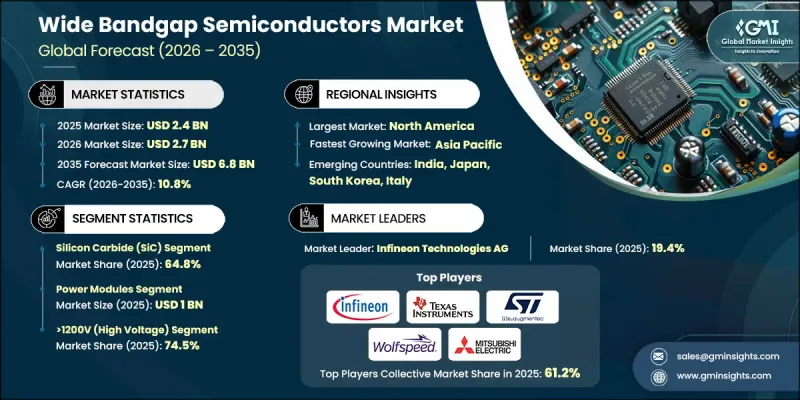
Growth is fueled by the rising adoption of electric mobility solutions, expanding high-power charging infrastructure, and the growing need for energy-efficient computing environments. In addition, the rapid rollout of next-generation communication networks is increasing the demand for advanced semiconductor materials capable of delivering superior performance. The industry is witnessing a transition toward materials that offer higher efficiency, improved thermal management, and better power handling capabilities. Manufacturers are also moving toward vertically integrated production models to ensure better control over quality and supply continuity. Continuous technological advancements and increasing investments in semiconductor manufacturing are further strengthening the market outlook, positioning wide bandgap semiconductors as a key enabler of next-generation electronic systems.
| Market Scope | |
|---|---|
| Start Year | 2025 |
| Forecast Year | 2026-2035 |
| Start Value | $2.4 Billion |
| Forecast Value | $6.8 Billion |
| CAGR | 10.8% |
The wide bandgap semiconductors market is being driven by the increasing demand for advanced power devices that support efficient energy conversion and high-performance applications. The shift toward more efficient powertrain systems in electric mobility is accelerating the adoption of silicon carbide-based components. At the same time, the expansion of high-capacity charging infrastructure is creating additional demand for semiconductors that can handle higher power levels while minimizing energy losses. Manufacturers are increasingly focusing on improving performance and reliability while addressing supply chain challenges through enhanced production strategies.
The gallium nitride segment is expected to grow at a CAGR of 12.4% during 2026-2035. This growth is supported by rising demand for compact and high-frequency power solutions across various applications. These devices offer faster switching capabilities, improved efficiency, and reduced system size, making them suitable for applications that require optimized performance and energy savings.
The discrete devices segment is projected to grow at a CAGR of 12.8% over the forecast period. Increasing demand for compact and efficient electronic components is driving the adoption of these devices. Their scalability and adaptability make them suitable for a wide range of applications, supporting high-volume production and efficient system design.
North America Wide Bandgap Semiconductors Market accounted for 38.8% share in 2025. The region is experiencing strong growth due to increasing demand from advanced manufacturing sectors and ongoing investments in semiconductor production capabilities. Expanding infrastructure for energy-efficient technologies and continued advancements in high-performance computing are further supporting market development. Strong investment activity aimed at strengthening domestic semiconductor production is also contributing to increased adoption of advanced materials.
Key companies operating in the Global Wide Bandgap Semiconductors Market include Infineon Technologies AG, STMicroelectronics N.V., Texas Instruments Inc., Mitsubishi Electric Corporation, Toshiba Electronic Devices & Storage Corporation, Renesas Electronics Corporation, ROHM Semiconductor, Wolfspeed, Inc., Navitas Semiconductor (GeneSiC Semiconductor), Diodes Incorporated, Vishay Intertechnology Inc., Littelfuse, Inc., Fuji Electric Co., Ltd., Nexperia, Microsemi Corporation, SEMIKRON, and CISSOID. Companies in the Wide Bandgap Semiconductors Market are strengthening their competitive position through innovation, vertical integration, and strategic expansion. They are investing in advanced material technologies to enhance efficiency, thermal performance, and reliability. Many players are developing end-to-end manufacturing capabilities to improve supply chain control and ensure product quality. Strategic collaborations and long-term agreements are helping companies expand their customer base and accelerate product adoption. Additionally, firms are increasing production capacity and focusing on cost optimization to meet growing demand.
Table of Contents
Chapter 1 Methodology and Scope
- 1.1 Market scope and definition
- 1.2 Research design
- 1.2.1 Research approach
- 1.2.2 Data collection methods
- 1.3 Data mining sources
- 1.3.1 Global
- 1.3.2 Regional/Country
- 1.4 Base estimates and calculations
- 1.4.1 Base year calculation
- 1.4.2 Key trends for market estimation
- 1.5 Primary research and validation
- 1.5.1 Primary sources
- 1.6 Forecast model
- 1.7 Research assumptions and limitations
Chapter 2 Executive Summary
- 2.1 Industry 360° synopsis, 2022 - 2035
- 2.2 Key market trends
- 2.2.1 Material type trends
- 2.2.2 Product type trends
- 2.2.3 Voltage range trends
- 2.2.4 Wafer size trends
- 2.2.5 Application trends
- 2.2.6 End-user industry trends
- 2.2.7 Regional trends
- 2.3 TAM Analysis, 2026-2035
- 2.4 CXO perspectives: Strategic imperatives
Chapter 3 Industry Insights
- 3.1 Industry ecosystem analysis
- 3.1.1 Supplier Landscape
- 3.1.2 Profit Margin
- 3.1.3 Cost structure
- 3.1.4 Value addition at each stage
- 3.1.5 Factor affecting the value chain
- 3.1.6 Disruptions
- 3.2 Industry impact forces
- 3.2.1 Growth drivers
- 3.2.1.1 Rapid EV adoption increasing SiC power device demand
- 3.2.1.2 Fast-charging infrastructure expansion requiring high-efficiency semiconductors
- 3.2.1.3 Data center energy efficiency mandates boosting GaN adoption
- 3.2.1.4 5G infrastructure rollout accelerating RF GaN deployment
- 3.2.1.5 Renewable energy integration driving high-voltage power electronics
- 3.2.2 Industry pitfalls and challenges
- 3.2.2.1 High SiC wafer and substrate production costs
- 3.2.2.2 Complex manufacturing yields impacting scalability
- 3.2.3 Market opportunities
- 3.2.3.1 800V EV architectures enabling higher SiC penetration
- 3.2.3.2 Aerospace and defense demand for radiation-hardened devices
- 3.2.1 Growth drivers
- 3.3 Growth potential analysis
- 3.4 Regulatory landscape
- 3.4.1 North America
- 3.4.2 Europe
- 3.4.3 Asia Pacific
- 3.4.4 Latin America
- 3.4.5 Middle East & Africa
- 3.5 Porter's analysis
- 3.6 PESTEL analysis
- 3.7 Technology and Innovation landscape
- 3.7.1 Current technological trends
- 3.7.2 Emerging technologies
- 3.8 Price trends
- 3.8.1 By region
- 3.8.2 By product
- 3.9 Pricing Strategies
- 3.10 Emerging Business Models
- 3.11 Compliance Requirements
- 3.12 Patent and IP analysis
Chapter 4 Competitive Landscape, 2025
- 4.1 Introduction
- 4.2 Company market share analysis
- 4.2.1 By region
- 4.2.1.1 North America
- 4.2.1.2 Europe
- 4.2.1.3 Asia Pacific
- 4.2.1.4 Latin America
- 4.2.1.5 Middle East & Africa
- 4.2.2 Market concentration analysis
- 4.2.1 By region
- 4.3 Competitive benchmarking of key players
- 4.3.1 Financial performance comparison
- 4.3.1.1 Revenue
- 4.3.1.2 Profit margin
- 4.3.1.3 R&D
- 4.3.2 Product portfolio comparison
- 4.3.2.1 Product range breadth
- 4.3.2.2 Technology
- 4.3.2.3 Innovation
- 4.3.3 Geographic presence comparison
- 4.3.3.1 Global footprint analysis
- 4.3.3.2 Service network coverage
- 4.3.3.3 Market penetration by region
- 4.3.4 Competitive positioning matrix
- 4.3.4.1 Leaders
- 4.3.4.2 Challengers
- 4.3.4.3 Followers
- 4.3.4.4 Niche players
- 4.3.5 Strategic outlook matrix
- 4.3.1 Financial performance comparison
- 4.4 Key developments
- 4.4.1 Mergers and acquisitions
- 4.4.2 Partnerships and collaborations
- 4.4.3 Technological advancements
- 4.4.4 Expansion and investment strategies
- 4.4.5 Digital transformation initiatives
- 4.5 Emerging/ startup competitors landscape
Chapter 5 Market Estimates and Forecast, By Material Type, 2022 - 2035 (USD Million)
- 5.1 Key trends
- 5.2 Silicon carbide (SiC)
- 5.2.1 SiC substrates & epitaxial wafers
- 5.2.2 SiC discrete devices
- 5.2.3 SiC power modules
- 5.3 Gallium nitride (GaN)
- 5.3.1 GaN epitaxial wafers
- 5.3.2 GaN discrete devices
- 5.3.3 GaN power modules
Chapter 6 Market Estimates and Forecast, By Product Type, 2022 - 2035 (USD Million)
- 6.1 Key trends
- 6.2 Substrates & epitaxial wafers
- 6.2.1 SiC substrates
- 6.2.2 SiC epitaxial wafers
- 6.2.3 GaN epitaxial wafers
- 6.3 Discrete devices
- 6.3.1 Power devices
- 6.3.2 RF devices
- 6.4 Power modules
- 6.4.1 Pure WBG modules
- 6.4.2 Hybrid modules
Chapter 7 Market Estimates and Forecast, By Voltage Range, 2022 - 2035 (USD Million)
- 7.1 Key trends
- 7.2 <650V (low voltage)
- 7.3 650V-1200V (mid voltage)
- 7.4 1200V (high voltage)
Chapter 8 Market Estimates and Forecast, By Wafer Size, 2022 - 2035 (USD Million)
- 8.1 Key trends
- 8.2 4-inch wafers
- 8.3 6-inch wafers
- 8.4 8-inch wafers
Chapter 9 Market Estimates and Forecast, By Application, 2022 - 2035 (USD Million)
- 9.1 Key trends
- 9.2 Power electronics
- 9.2.1 Electric vehicle powertrain
- 9.2.2 Charging infrastructure
- 9.2.3 Renewable energy systems
- 9.2.4 Industrial power & motor drives
- 9.2.5 IT & data center infrastructure
- 9.2.6 Consumer power adapters
- 9.3 RF & microwave
- 9.3.1 5G infrastructure
- 9.3.2 Satellite communications
- 9.3.3 Radar systems
Chapter 10 Market Estimates and Forecast, By End-User Industry, 2022 - 2035 (USD Million)
- 10.1 Key trends
- 10.2 Automotive
- 10.3 Energy & utilities
- 10.4 Industrial & manufacturing
- 10.5 Telecommunications
- 10.6 Aerospace & defense
- 10.7 IT & data center infrastructure
- 10.8 Consumer electronics
Chapter 11 Market Estimates and Forecast, By Region, 2022 - 2035 (USD Million)
- 11.1 Key trends
- 11.2 North America
- 11.2.1 U.S.
- 11.2.2 Canada
- 11.3 Europe
- 11.3.1 Germany
- 11.3.2 UK
- 11.3.3 France
- 11.3.4 Spain
- 11.3.5 Italy
- 11.4 Asia Pacific
- 11.4.1 China
- 11.4.2 India
- 11.4.3 Japan
- 11.4.4 Australia
- 11.4.5 South Korea
- 11.5 Latin America
- 11.5.1 Brazil
- 11.5.2 Mexico
- 11.5.3 Argentina
- 11.6 Middle East and Africa
- 11.6.1 South Africa
- 11.6.2 Saudi Arabia
- 11.6.3 UAE
Chapter 12 Company Profiles
- 12.1 Global Key Players
- 12.1.1 Infineon Technologies AG
- 12.1.2 STMicroelectronics N.V.
- 12.1.3 Mitsubishi Electric Corporation
- 12.1.4 Toshiba Electronic Devices & Storage Corporation
- 12.2 Regional key players
- 12.2.1 North America
- 12.2.1.1 Texas Instruments Inc.
- 12.2.1.2 Wolfspeed, Inc.
- 12.2.1.3 Littelfuse, Inc.
- 12.2.1.4 Microsemi Corporation
- 12.2.2 Asia Pacific
- 12.2.2.1 ROHM Semiconductor
- 12.2.2.2 Renesas Electronics Corporation
- 12.2.2.3 Fuji Electric Co., Ltd.
- 12.2.2.4 Nexperia
- 12.2.3 Europe
- 12.2.3.1 SEMIKRON
- 12.2.3.2 CISSOID
- 12.2.1 North America
- 12.3 Niche Players/Disruptors
- 12.3.1 Navitas Semiconductor (GeneSiC Semiconductor)
- 12.3.2 Diodes Incorporated
- 12.3.3 Vishay Intertechnology Inc.

