PUBLISHER: Global Market Insights Inc. | PRODUCT CODE: 2038428

PUBLISHER: Global Market Insights Inc. | PRODUCT CODE: 2038428
North America Air to Water Heat Pump Market Opportunity, Growth Drivers, Industry Trend Analysis, and Forecast 2026 - 2035
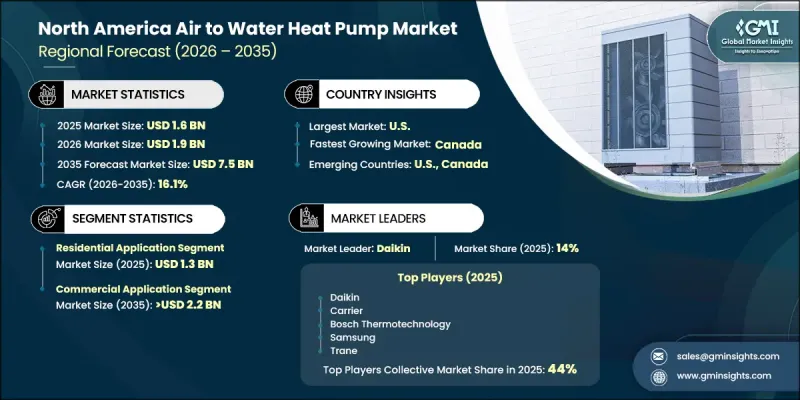
North America Air to Water Heat Pump Market was valued at USD 1.6 billion in 2025 and is estimated to grow at a CAGR of 16.1% to reach USD 7.5 billion by 2035.
The market growth is influenced by increasing awareness of energy conservation and sustainability, which is encouraging the adoption of solutions designed to reduce operational emissions while maintaining indoor comfort. Improvements in system performance, particularly in cold climate operation, are strengthening end-user trust and accelerating adoption across residential and commercial applications. Demand from building owners and policymakers for energy-efficient alternatives to conventional heating systems is further supporting the shift toward integrated solutions capable of delivering heating and hot water from a single unit. This transition aligns with broader regional trends focused on electrification and reduced reliance on fossil fuels. Air to water heat pump systems are increasingly used for space heating, underfloor heating, and domestic hot water applications in both new constructions and retrofit projects, particularly when integrated with radiant heating systems. Additionally, the expansion of renewable energy adoption, stricter emission standards, and ongoing technological advancements aimed at lowering environmental impact are reinforcing long-term market expansion.
| Market Scope | |
|---|---|
| Start Year | 2025 |
| Forecast Year | 2026-2035 |
| Start Value | $1.6 Billion |
| Forecast Value | $7.5 Billion |
| CAGR | 16.1% |
The residential segment is projected to grow at a CAGR of 16.2% through 2035. Rising consumer preference for energy-efficient and environmentally responsible heating technologies is significantly contributing to segment growth. Supportive government incentives, combined with continuous technological improvements, are further accelerating adoption. Increasing regulatory pressure related to energy efficiency standards, along with heightened concerns about climate change, is also expected to drive widespread installation of air to water heat pump systems across residential properties.
U.S. Air to Water Heat Pump Market was valued at USD 1.6 billion in 2025. Market performance is being shaped by the growing shift toward sustainable heating and cooling solutions aligned with energy efficiency regulations and environmental initiatives. Rising investment in building renovation and retrofitting projects, aimed at meeting updated energy codes, is further supporting demand across the country.
Key companies operating in the North America Air to Water Heat Pump Industry include LG Electronics, Bosch Thermotechnology, Carrier, Daikin Comfort Technologies North America, Johnson Controls, Trane, Samsung, Arctic Heat Pumps, Swegon North America, Lochinvar, Raypak, U.S. Boiler Company, Chiltrix, Nordic Heat Pumps, Jetson, Gree Canada, SpacePak, Hydro Solar Innovative Energy, General, and Blue Star. Companies in the North America Air to Water Heat Pump Market are actively focusing on improving system efficiency, expanding cold-climate performance capabilities, and integrating advanced control technologies to strengthen their competitive position. Continuous investment in research and development is enabling the launch of high-efficiency, low-emission products that align with evolving regulatory standards. Market players are also strengthening partnerships with construction firms, HVAC contractors, and energy solution providers to expand distribution networks and improve installation reach. Product innovation centered on smart connectivity and system automation is being prioritized to enhance user convenience and energy management. In addition, companies are expanding service infrastructure and after-sales support capabilities to improve customer retention.
Table of Contents
Chapter 1 Methodology & Scope
- 1.1 Research approach
- 1.2 Quality commitments
- 1.2.1 GMI AI policy & data integrity commitment
- 1.2.1.1 Source consistency protocol
- 1.2.1 GMI AI policy & data integrity commitment
- 1.3 Research trail & confidence scoring
- 1.3.1 Research trail components
- 1.3.2 Scoring components
- 1.4 Data collection
- 1.4.1 Partial list of primary sources
- 1.5 Data mining sources
- 1.5.1 Paid sources
- 1.5.1.1 Sources, by country
- 1.5.1 Paid sources
- 1.6 Base estimates and calculations
- 1.6.1 Base year calculation for any one approach
- 1.7 Market estimates & forecasts parameters
- 1.8 Forecast model
- 1.8.1 Quantified market impact analysis
- 1.8.1.1 Mathematical impact of growth parameters on forecast
- 1.8.1 Quantified market impact analysis
- 1.9 Research transparency addendum
- 1.9.1 Source attribution framework
- 1.9.2 Quality assurance metrics
- 1.9.3 Our commitment to trust
- 1.10 Market definitions
Chapter 2 Executive Summary
- 2.1 Industry synopsis, 2022 - 2035
- 2.2 Business trends
- 2.3 Application trends
- 2.4 Country trends
Chapter 3 Industry Insights
- 3.1 Industry ecosystem analysis
- 3.1.1 Raw material availability & sourcing analysis
- 3.1.2 Key factors affecting the value chain
- 3.1.3 Disruptions
- 3.2 Industry impact forces
- 3.2.1 Growth drivers
- 3.2.2 Industry pitfalls & challenges
- 3.3 Growth potential analysis
- 3.4 Regulatory landscape
- 3.5 Porter's analysis
- 3.5.1 Bargaining power of suppliers
- 3.5.2 Bargaining power of buyers
- 3.5.3 Threat of new entrants
- 3.5.4 Threat of substitutes
- 3.6 PESTEL analysis
- 3.6.1 Political factors
- 3.6.2 Economic factors
- 3.6.3 Social factors
- 3.6.4 Technological factors
- 3.6.5 Legal factors
- 3.6.6 Environmental factors
- 3.7 Cost structure analysis of heat pumps
- 3.8 Emerging opportunities & trends
- 3.9 Digital transformation with IoT technologies
- 3.9.1 Emerging market penetration
- 3.10 Investment analysis & future prospects
- 3.11 Price trend analysis, 2022-2035 (USD/Unit) (Driven by Primary Research)
- 3.11.1 By application (Driven by Primary Research)
- 3.11.2 By country (Driven by Primary Research)
- 3.12 Impact of AI & Generative AI on the market (Solution Core)
- 3.12.1 AI-Driven production optimization (Solution Core)
- 3.12.2 Predictive maintenance & fault detection (Solution Core)
- 3.13 Capacity & production landscape (Driven by Primary Research)
- 3.13.1 Capacity by country & key producer (Driven by Primary Research)
- 3.13.2 Capacity utilization rates & expansion pipelines (Driven by Primary Research)
Chapter 4 Competitive Landscape, 2026
- 4.1 Introduction
- 4.2 Company market share analysis, by country, 2025
- 4.2.1 U.S.
- 4.2.2 Canada
- 4.3 Competitive positioning matrix
- 4.4 Key developments
- 4.4.1 Mergers & acquisitions
- 4.4.2 Partnerships & collaborations
- 4.4.3 New product launches
- 4.4.4 Expansion plans and funding
Chapter 5 Market Size and Forecast, By Application, 2022 - 2035 (USD Million, '000 Units)
- 5.1 Key trends
- 5.2 Residential
- 5.2.1 Single family
- 5.2.2 Multi family
- 5.2.3 By product
- 5.2.3.1 Domestic hot water
- 5.2.3.2 Room heat pump
- 5.3 Commercial
- 5.3.1 Education
- 5.3.2 Healthcare
- 5.3.3 Retail
- 5.3.4 Logistics & Transportation
- 5.3.5 Offices
- 5.3.6 Hospitality
- 5.3.7 Others
Chapter 6 Market Size and Forecast, By Country, 2022 - 2035 (USD Million, '000 Units)
- 6.1 Key trends
- 6.2 U.S.
- 6.3 Canada
Chapter 7 Company Profiles
- 7.1 Arctic Heat Pumps
- 7.2 Blue Star
- 7.3 Bosch Thermotechnology
- 7.4 Carrier
- 7.5 Chiltrix
- 7.6 Daikin Comfort Technologies North America
- 7.7 General
- 7.8 Gree Canada
- 7.9 Hydro Solar Innovative Energy
- 7.10 Jetson
- 7.11 Johnson Controls
- 7.12 LG Electronics
- 7.13 Lochinvar
- 7.14 Nordic Heat Pumps
- 7.15 Raypak
- 7.16 Samsung
- 7.17 SpacePak
- 7.18 Swegon North America
- 7.19 Trane
- 7.20 U.S. Boiler Company

