PUBLISHER: Global Market Insights Inc. | PRODUCT CODE: 2038478

PUBLISHER: Global Market Insights Inc. | PRODUCT CODE: 2038478
Eco-friendly Backpack Market Opportunity, Growth Drivers, Industry Trend Analysis, and Forecast 2026 - 2035
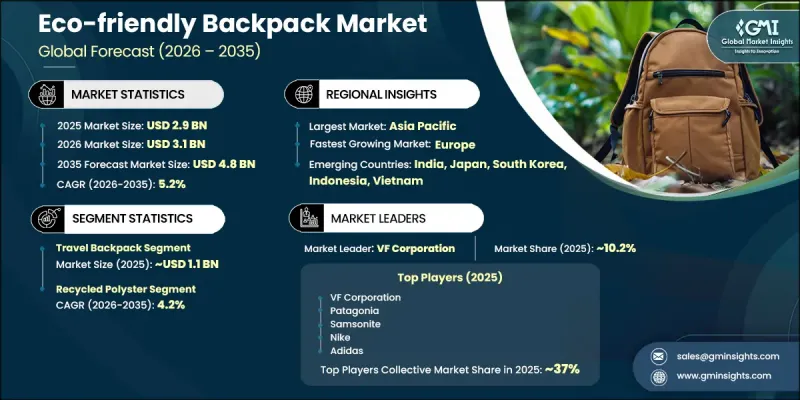
The Global Eco-Friendly Backpack Market was valued at USD 2.9 billion in 2025 and is estimated to grow at a CAGR of 5.2% to reach USD 4.8 billion by 2035.
Market expansion is driven by a rising global shift toward sustainable consumption and increased demand for environmentally responsible lifestyle products. Consumers are increasingly choosing backpacks manufactured using recycled, biodegradable, and natural materials as part of their sustainability-focused purchasing behavior. Manufacturers are responding by integrating materials such as recycled plastics, organic fibers, and plant-derived fabrics into product development, helping reduce environmental impact while maintaining durability and functionality. Growing environmental awareness among consumers has significantly influenced purchasing decisions, with sustainability becoming a key factor in product selection. Brands strengthen credibility through eco-certifications and sustainable production practices. Retailers are expanding their green product assortments to align with evolving consumer expectations, while institutional and corporate buyers are increasingly sourcing eco-friendly backpacks for functional and promotional applications. Additionally, rising participation in outdoor activities, travel, and urban commuting is driving demand for durable, ergonomic, and lightweight backpacks. Increased engagement in hiking, camping, and daily commuting has further strengthened the need for functional yet sustainable backpack solutions, reinforcing long-term market growth.
| Market Scope | |
|---|---|
| Start Year | 2025 |
| Forecast Year | 2026-2035 |
| Start Value | $2.9 Billion |
| Forecast Value | $4.8 Billion |
| CAGR | 5.2% |
The travel backpack segment accounted for USD 1.1 billion in 2025 and is expected to grow at a CAGR of 5.2% from 2026 to 2035. This segment holds a leading position in the eco-friendly backpack market due to strong demand from travelers, commuters, and outdoor enthusiasts. Travel backpacks are designed with a focus on durability, storage efficiency, and comfort, making them suitable for both short-distance travel and everyday use. Rising consumer preference for multifunctional and environmentally responsible travel gear is significantly contributing to segment growth. The increasing need for practical, spacious, and sustainable backpack solutions continues to reinforce the dominance of this category. Enhanced design features such as ergonomic support, compartmentalized storage, and lightweight construction further strengthen consumer adoption across diverse usage scenarios.
The recycled polyester segment held a 40.4% share in 2025 and is projected to grow at a CAGR of 4.2% from 2026 to 2035. This material category dominates the eco-friendly backpack industry due to its strong environmental benefits and reliable performance characteristics. Recycled polyester is produced from post-consumer plastic waste, offering a sustainable alternative while maintaining durability, water resistance, and lightweight properties. Its ability to reduce environmental impact while supporting high-performance product design has made it a preferred material among manufacturers. Increasing emphasis on sustainability targets and regulatory compliance is further supporting its adoption. Growing consumer preference for eco-conscious products continues to reinforce demand. The combination of cost efficiency, durability, and environmental responsibility ensures the continued leadership of recycled polyester in the global market.
China Eco-Friendly Backpack Market was valued at USD 369.3 billion in 2025. Growth in the country is being driven by increasing environmental awareness, rapid urbanization, and a strong shift toward sustainable consumer goods. Younger demographics and working professionals are increasingly opting for backpacks made from recycled polyester, organic fibers, and biodegradable materials. Domestic manufacturers benefit from large-scale production capabilities and cost-efficient supply chains, enabling wider accessibility of eco-friendly products. Digital retail channels and e-commerce platforms are playing a major role in expanding market reach and accelerating product adoption. Continuous innovation in lightweight designs, water-resistant features, and multifunctional storage solutions is further supporting market expansion across commuting and travel applications.
Major players operating in the Global Eco-Friendly Backpack Industry include Adidas, Dakine, Ecoalf, Fjallraven, Nike, Patagonia, Pinqponq, Samsonite, Sandqvist, Solgaard, Ucon Acrobatics, Under Armour, VF Corporation, VIP Industries, and Wildcraft India. Companies in the Global Eco-Friendly Backpack Market are focusing on strengthening sustainability integration across product development by increasing the use of recycled and biodegradable materials. They are investing in advanced manufacturing technologies to improve durability while reducing environmental impact. Strategic collaborations with suppliers of sustainable raw materials are helping ensure consistent supply chains. Brands are also enhancing their market presence through eco-certifications and transparent sustainability reporting to build consumer trust. Expansion of direct-to-consumer channels and digital retail platforms is improving global reach and brand visibility. Product differentiation through innovative designs, multifunctional features, and ergonomic improvements is further supporting competitiveness. Companies are also increasing participation in outdoor and lifestyle events to strengthen brand positioning. In addition, aggressive marketing campaigns centered on environmental responsibility are helping reinforce brand identity and drive long-term consumer loyalty across global markets.
Table of Contents
Chapter 1 Methodology & Scope
- 1.1 Market scope and definition
- 1.2 Research design
- 1.2.1 Research approach
- 1.2.2 Data collection methods
- 1.3 Data mining sources
- 1.3.1 Global
- 1.3.2 Regional/Country
- 1.4 Base estimates and calculations
- 1.4.1 Base year calculation
- 1.4.2 Key trends for market estimation
- 1.5 Primary research and validation
- 1.5.1 Primary sources
- 1.6 Forecast model
- 1.7 Research assumptions and limitations
Chapter 2 Executive Summary
- 2.1 Industry 360° synopsis
- 2.2 Key market trends
- 2.2.1 Regional
- 2.2.2 Product type
- 2.2.3 Material
- 2.2.4 Closure type
- 2.2.5 Price
- 2.2.6 Capacity
- 2.2.7 Distribution channel
Chapter 3 Industry Insights
- 3.1 Industry ecosystem analysis
- 3.1.1 Supplier landscape
- 3.1.2 Profit margin
- 3.1.3 Value addition at each stage
- 3.1.4 Factor affecting the value chain
- 3.2 Industry impact forces
- 3.2.1 Growth drivers
- 3.2.1.1 Growing adoption of recycled and biodegradable materials in manufacturing
- 3.2.1.2 Expansion of outdoor activities, travel, and urban commuting lifestyles
- 3.2.1.3 Strong influence of sustainability-focused brands and ethical marketing
- 3.2.2 Pitfalls & Challenges
- 3.2.2.1 Higher production costs associated with sustainable materials
- 3.2.2.2 Limited availability and scalability of eco-friendly raw materials
- 3.2.3 Opportunities
- 3.2.3.1 Growing demand for certified and transparent sustainable products
- 3.2.3.2 Innovation in durable, lightweight, and multifunctional eco materials
- 3.2.1 Growth drivers
- 3.3 Growth potential analysis
- 3.4 Future market trends
- 3.5 Technology and innovation landscape
- 3.5.1 Current technological trends
- 3.5.2 Emerging technologies
- 3.6 Regulatory landscape
- 3.6.1 Standards and compliance requirements
- 3.6.2 Regional regulatory frameworks
- 3.6.3 Certification standards
- 3.7 Porter's analysis
- 3.8 PESTEL analysis
- 3.9 Pricing analysis (driven by primary research)
- 3.9.1 Historical price trend analysis (driven by primary research)
- 3.9.2 Pricing strategy by player type (premium / value / cost-plus) (driven by primary research)
- 3.9.3 Price variation by type & speed classification
- 3.9.4 Regional price benchmarking
- 3.9.5 Total cost of ownership (TCO) analysis
- 3.10 Trade data analysis (driven by paid data base)
- 3.10.1 Import/export volume & value trends (driven by paid database)
- 3.10.2 Key trade corridors & tariff impact (driven by paid database)
- 3.10.3 Leading exporting & importing countries
- 3.10.4 Trade policy impact on market dynamics
- 3.11 Capacity & production landscape (driven by paid database)
- 3.11.1 Installed capacity by region & key producer (driven by primary research)
- 3.11.2 Capacity utilization rates & expansion pipelines (driven by primary research)
Chapter 4 Competitive Landscape, 2025
- 4.1 Introduction
- 4.2 Company market share analysis
- 4.2.1 By Region
- 4.2.1.1 North America
- 4.2.1.2 Europe
- 4.2.1.3 Asia Pacific
- 4.2.1.4 Latin America
- 4.2.1.5 Middle East & Africa
- 4.2.1 By Region
- 4.3 Company matrix analysis
- 4.4 Competitive analysis of major market players
- 4.5 Competitive positioning matrix
- 4.6 Key developments
- 4.6.1 Mergers & acquisitions
- 4.6.2 Partnerships & collaborations
- 4.6.3 New product launches
- 4.6.4 Expansion plans
Chapter 5 Market Estimates & Forecast, By Product Type, 2022 - 2035, (USD Billion) (Thousand Units)
- 5.1 Key trends
- 5.2 Travel backpack
- 5.3 Laptop backpack
- 5.4 Hiking/Outdoor
- 5.5 Others
Chapter 6 Market Estimates & Forecast, By Material, 2022 - 2035, (USD Billion) (Thousand Units)
- 6.1 Key trends
- 6.2 Cotton
- 6.3 Hemp
- 6.4 Recycled polyester
- 6.5 Others
Chapter 7 Market Estimates & Forecast, By Closure Type, 2022 - 2035, (USD Billion) (Thousand Units)
- 7.1 Key trends
- 7.2 Zipper
- 7.3 Drawstring
- 7.4 Others
Chapter 8 Market Estimates & Forecast, By Price, 2022 - 2035, (USD Billion) (Thousand Units)
- 8.1 Key trends
- 8.2 Low range
- 8.3 Medium range
- 8.4 Premium range
Chapter 9 Market Estimates & Forecast, By Capacity, 2022 - 2035, (USD Billion) (Thousand Units)
- 9.1 Key trends
- 9.2 Up to 10 litres
- 9.3 10-15 litres
- 9.4 15-20 litres
- 9.5 20-25 litres
- 9.6 above 25 litres
Chapter 10 Market Estimates & Forecast, By Distribution Channel, 2022 - 2035, (USD Billion) (Thousand Units)
- 10.1 Key trends
- 10.2 Online
- 10.2.1 E-commerce websites
- 10.2.2 company websites
- 10.3 Offline
- 10.3.1 Specialty stores
- 10.3.2 Mega stores
- 10.3.3 Others
Chapter 11 Market Estimates & Forecast, By Region, 2022 - 2035, (USD Billion) (Thousand Units)
- 11.1 Key trends
- 11.2 North America
- 11.2.1 U.S.
- 11.2.2 Canada
- 11.3 Europe
- 11.3.1 Germany
- 11.3.2 UK
- 11.3.3 France
- 11.3.4 Italy
- 11.3.5 Spain
- 11.4 Asia Pacific
- 11.4.1 China
- 11.4.2 India
- 11.4.3 Japan
- 11.4.4 South Korea
- 11.4.5 Australia
- 11.5 Latin America
- 11.5.1 Brazil
- 11.5.2 Mexico
- 11.5.3 Argentina
- 11.6 MEA
- 11.6.1 Saudi Arabia
- 11.6.2 UAE
- 11.6.3 South Africa
Chapter 12 Company Profiles
- 12.1 Adidas
- 12.2 Dakine
- 12.3 Ecoalf
- 12.4 Fjallraven
- 12.5 Nike
- 12.6 Patagonia
- 12.7 Pinqponq
- 12.8 Samsonite
- 12.9 Sandqvist
- 12.10 Solgaard
- 12.11 Ucon Acrobatics
- 12.12 Under Armour
- 12.13 VF Corporation
- 12.14 VIP Industries
- 12.15 Wildcraft India

