PUBLISHER: Global Market Insights Inc. | PRODUCT CODE: 2071292

PUBLISHER: Global Market Insights Inc. | PRODUCT CODE: 2071292
Smart Backpack Market Opportunity, Growth Drivers, Industry Trend Analysis, and Forecast 2026 - 2035
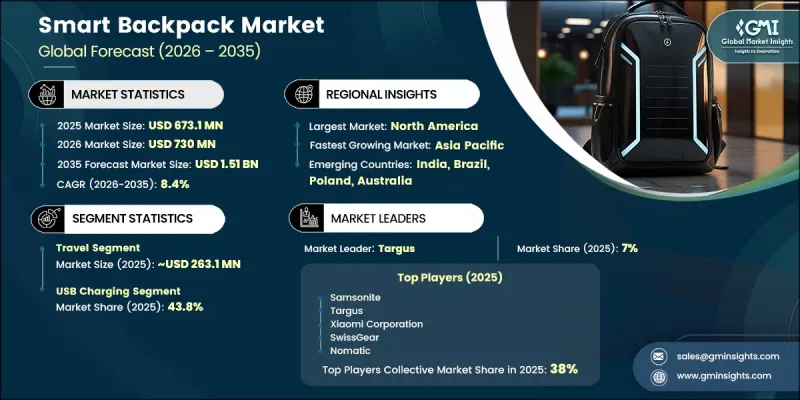
The Global Smart Backpack Market was valued at USD 673.1 million in 2025 and is estimated to grow at a CAGR of 8.4% to reach USD 1.51 billion by 2035.
Market growth is driven by structural lifestyle shifts, including the normalization of hybrid working models, the recovery of global travel activity, and rapid advancements in smart textile integration and embedded electronic systems. The category is transitioning from a standard utility product into a technology-enabled lifestyle accessory, supported by continuous innovation in lightweight materials, modular design architecture, and embedded electronic components. Rising emphasis on durability and sustainability is further reshaping product development strategies, particularly as manufacturers integrate recycled fabrics with reinforced structural components such as rigid panels and protective framing systems. Increasing regulatory focus on material transparency and sustainability compliance is also influencing competitive dynamics, with brands increasingly required to demonstrate traceable sourcing and environmentally responsible production. As consumer expectations evolve toward multifunctional, tech-integrated lifestyle goods, smart backpacks are becoming a key segment within the broader wearable and portable electronics ecosystem.
| Market Scope | |
|---|---|
| Start Year | 2025 |
| Forecast Year | 2026-2035 |
| Start Value | $673.1 Million |
| Forecast Value | $1.51 Billion |
| CAGR | 8.4% |
The travel application segment held a 39.1% share, valued at USD 263.1 million in 2025. Demand in this category is being driven by increased mobility trends and rising consumer expectations for advanced functionality in travel accessories. Users are increasingly prioritizing integrated charging solutions, organized storage for electronic devices, anti-theft protection features, and improved ergonomic design. As travel behavior continues to recover globally, the demand for technologically enhanced carry solutions is expected to remain strong, particularly among frequent travelers and digital professionals who require reliable device support on the move.
The smart locks segment accounted for 17.9% share in 2025 and is projected to grow at a CAGR of 9.1% through 2035. This segment occupies a growing mid-tier position within product innovation, driven by increasing consumer preference for enhanced personal security features. Adoption is being supported by rising concerns around device safety and theft prevention during travel and daily commuting. Smart lock-enabled backpacks integrate digital locking mechanisms and security reinforcement technologies that improve user confidence and product appeal. Continued advancements in embedded security systems are expected to further strengthen demand for this segment across both premium and mid-range product categories.
North America Smart Backpack Market generated USD 250.1 million in 2025 accounting for 37.1% share. The region is expected to maintain steady growth throughout the forecast period, supported by strong consumer spending on premium lifestyle accessories and high adoption of technology-integrated products. The United States continues to lead regional demand due to its well-established digital retail infrastructure, strong penetration of consumer electronics, and high purchasing power among urban populations. Growing preference for multifunctional carry solutions among professionals, students, and frequent travelers continues to reinforce the region's dominant position in the global market.
Major companies operating in the Global Smart Backpack Market include Peak Design, Nomatic, Samsonite, Targus, Osprey, Herschel Supply Co., XD Design, Pacsafe, Xiaomi Corporation, Incase, Timbuk2, SwissGear, Voltaic Systems, Nordace, Bagsmart, Kopack, Korin Design, Bopai, Mancro, Matein, and Modoker. Companies in the smart backpack market are focusing on innovation-driven strategies to strengthen their competitive position and expand global reach. Product differentiation through integrated technology features such as charging systems, GPS tracking, and advanced security mechanisms is a key priority. Manufacturers are also investing in lightweight, durable, and sustainable materials to align with evolving consumer expectations and regulatory requirements. Expansion of direct-to-consumer sales channels and digital retail platforms is enabling brands to improve accessibility and strengthen customer engagement. Strategic collaborations with technology providers are supporting the integration of smarter electronic components and enhancing product functionality.
Table of Contents
Chapter 1 Research Methodology
- 1.1 Research approach
- 1.2 Quality Commitments
- 1.2.1 GMI AI policy & data integrity commitment
- 1.2.1.1 Source consistency protocol
- 1.2.1 GMI AI policy & data integrity commitment
- 1.3 Research Trail & Confidence Scoring
- 1.3.1 Research Trail Components
- 1.3.2 Scoring Components
- 1.4 Data Collection
- 1.4.1 Partial list of primary sources
- 1.5 Data mining sources
- 1.5.1 Paid sources
- 1.5.1.1 Sources, by region
- 1.5.1 Paid sources
- 1.6 Base estimates and calculations
- 1.6.1 Base year calculation for any one approach
- 1.7 Forecast model
- 1.7.1 Quantified market impact analysis
- 1.7.1.1 Mathematical impact of growth parameters on forecast
- 1.7.1 Quantified market impact analysis
- 1.8 Research transparency addendum
- 1.8.1 Source attribution framework
- 1.8.2 Quality assurance metrics
- 1.8.3 Our commitment to trust
Chapter 2 Executive Summary
- 2.1 Industry 360° synopsis, 2022 - 2035
- 2.2 Key market trends
- 2.2.1 Regional
- 2.2.2 Type
- 2.2.3 Technology
- 2.2.4 Capacity
- 2.2.5 Shell Type
- 2.2.6 Material
- 2.2.7 Price
- 2.2.8 Product
- 2.2.9 Distribution Channel
Chapter 3 Industry Insights
- 3.1 Industry ecosystem analysis
- 3.1.1 Factor affecting the value chain
- 3.1.2 Profit margin analysis
- 3.1.3 Disruptions
- 3.1.4 Future outlook
- 3.1.5 Manufacturers
- 3.1.6 Distributors
- 3.2 Supplier landscape
- 3.3 Key news & initiatives
- 3.4 Technology & Innovation Landscape
- 3.5 Regulatory landscape
- 3.6 Impact on forces
- 3.6.1 Growth drivers
- 3.6.2 Industry pitfalls & challenges
- 3.6.3 Opportunities
- 3.7 Pricing analysis, 2025 (driven by primary research)
- 3.7.1 Historical price trend analysis (2022-2025)
- 3.7.2 Pricing strategy by player type (premium/value/cost-plus)
- 3.7.3 Regional price variation analysis
- 3.8 Growth potential analysis
- 3.9 Porter's analysis
- 3.10 PESTEL analysis
- 3.11 Trade data analysis (driven by paid database)
- 3.11.1 Import/export volume & value trends (Driven by Primary Research)
- 3.11.2 Key trade corridors & tariff impact (Driven by Primary Research)
- 3.12 Impact of AI & generative AI on the market
- 3.12.1 AI-driven disruption of existing business models
- 3.12.2 GenAI use cases & adoption roadmap by segment
- 3.12.3 Risks, limitations & regulatory considerations
- 3.13 Capacity & Production Landscape (Driven by Primary Research)
- 3.13.1 Installed Capacity by Region & Key Producer (Driven by Primary Research)
- 3.13.2 Capacity Utilization Rates & Expansion Pipelines (Driven by Primary Research)
Chapter 4 Competitive Landscape, 2025
- 4.1 Introduction
- 4.2 Company market share analysis
- 4.3 Competitive positioning matrix
- 4.4 Strategic outlook matrix
- 4.5 Competitive analysis of major market players
- 4.6 Key developments
- 4.6.1 Mergers & acquisitions
- 4.6.2 Partnerships & collaborations
- 4.6.3 New product launches
- 4.6.4 Expansion plans
Chapter 5 Market Estimates & Forecast, By Type, 2022-2035 (USD Million) (Million Units)
- 5.1 Key trends
- 5.2 Travel backpack
- 5.3 Casual backpack
- 5.4 Laptop backpack
- 5.5 Others
Chapter 6 Market Estimates & Forecast, By Technology, 2022-2035 (USD Million) (Million Units)
- 6.1 Key trends
- 6.2 USB charging
- 6.3 Solar-powered
- 6.4 IoT-enabled
- 6.5 Smart locking systems
- 6.6 Sensors
- 6.7 Others
Chapter 7 Market Estimates & Forecast, By Capacity, 2022-2035 (USD Million) (Million Units)
- 7.1 Key trends
- 7.2 Below 30 Liters
- 7.3 30-40 Liters
- 7.4 Above 40 Liters
Chapter 8 Market Estimates & Forecast, By Material, 2022-2035 (USD Million) (Million Units)
- 8.1 Key trends
- 8.2 Polyester
- 8.3 Nylon
- 8.4 Leather
- 8.5 Others
Chapter 9 Market Estimates & Forecast, By Shell Type, 2022-2035 (USD Million) (Million Units)
- 9.1 Key trends
- 9.2 Hard shell
- 9.3 Soft shell
Chapter 10 Market Estimates & Forecast, By Price, 2022-2035 (USD Million) (Million Units)
- 10.1 Key trends
- 10.2 Low
- 10.3 Medium
- 10.4 High
Chapter 11 Market Estimates & Forecast, By Distribution Channel, 2022-2035 (USD Billion) (Million Units)
- 11.1 Key trends
- 11.2 Online
- 11.2.1 E-commerce site
- 11.2.2 Company website
- 11.3 Offline
- 11.3.1 Specialty stores
- 11.3.2 Supermarkets/Hypermarkets
- 11.3.3 Others
Chapter 12 Market Estimates & Forecast, By Region, 2022 - 2035, (USD Million) (Million Units)
- 12.1 Key trends
- 12.2 North America
- 12.2.1 U.S.
- 12.2.2 Canada
- 12.3 Europe
- 12.3.1 Germany
- 12.3.2 U.K.
- 12.3.3 France
- 12.3.4 Italy
- 12.3.5 Spain
- 12.4 Asia Pacific
- 12.4.1 China
- 12.4.2 India
- 12.4.3 Japan
- 12.4.4 South Korea
- 12.4.5 Australia
- 12.5 Latin America
- 12.5.1 Brazil
- 12.5.2 Mexico
- 12.5.3 Argentina
- 12.6 MEA
- 12.6.1 UAE
- 12.6.2 Saudi Arabia
- 12.6.3 South Africa
Chapter 13 Company Profiles (Business Overview, Financial Data, Product Landscape, Strategic Outlook, SWOT Analysis)
- 13.1 Global players
- 13.1.1 Targus
- 13.1.2 Samsonite
- 13.1.3 Xiaomi Corporation
- 13.1.4 SwissGear
- 13.1.5 Nomatic
- 13.1.6 Nordace
- 13.1.7 Osprey
- 13.2 Regional players
- 13.2.1 Timbuk2
- 13.2.2 Korin Design
- 13.2.3 XD Design
- 13.2.4 Pacsafe
- 13.2.5 Matein
- 13.2.6 Herschel Supply Co.
- 13.2.7 Peak Design
- 13.3 Emerging players
- 13.3.1 Bopai
- 13.3.2 Modoker
- 13.3.3 Kopack
- 13.3.4 Mancro
- 13.3.5 Bagsmart
- 13.3.6 Voltaic Systems
- 13.3.7 Incase

