PUBLISHER: Global Market Insights Inc. | PRODUCT CODE: 2038634

PUBLISHER: Global Market Insights Inc. | PRODUCT CODE: 2038634
Asia Pacific Dual Axis Solar Tracker Market Opportunity, Growth Drivers, Industry Trend Analysis, and Forecast 2026 - 2035
Asia Pacific Dual Axis Solar Tracker Market was valued at USD 16.1 billion in 2025 and is estimated to grow at a CAGR of 10.2% to reach USD 42.3 billion by 2035.
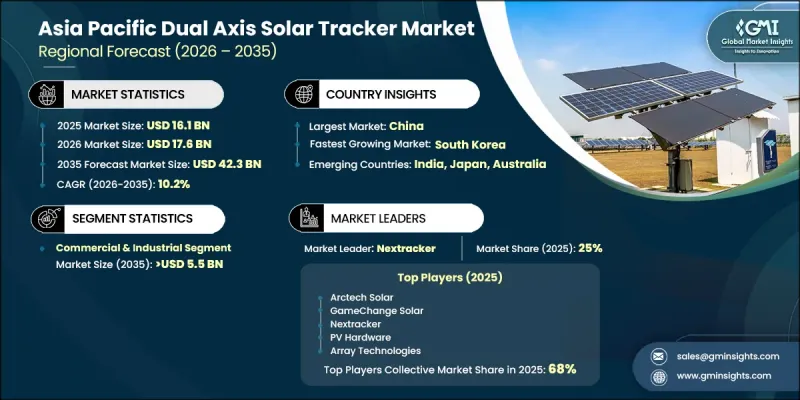
The market is gaining strong momentum due to the superior performance of dual axis tracking systems compared to single axis alternatives, resulting in higher energy generation. These systems are designed using motors, gear mechanisms, sensors, and advanced control units that continuously adjust panel positioning based on solar movement. Tracking is enabled through coordinate-based systems that determine the sun's position using time and location inputs. Enhanced features such as improved energy efficiency, precise angle alignment, and adaptability across varying seasonal conditions are driving widespread adoption. The ability of these systems to capture both direct and diffused sunlight further strengthens their operational efficiency. Additionally, flexibility in installation, long-term economic returns, and advancements in grid infrastructure are supporting market expansion. Increasing solar energy deployment, combined with favorable environmental and economic benefits, continues to strengthen the Asia Pacific Dual Axis Solar Tracker Market outlook.
| Market Scope | |
|---|---|
| Start Year | 2025 |
| Forecast Year | 2026-2035 |
| Start Value | $16.1 Billion |
| Forecast Value | $42.3 Billion |
| CAGR | 10.2% |
The commercial and industrial segment is expected to reach USD 5.5 billion by 2035, supported by an approximate 14% improvement in energy generation efficiency. Regulatory support and evolving policy frameworks are encouraging organizations to invest in advanced solar technologies. Market participants are actively engaging in partnerships and acquisitions to strengthen their capabilities and broaden their technological expertise. Rising electricity prices and the growing need for reliable and sustainable energy solutions are further contributing to the adoption of dual axis tracking systems across commercial and industrial applications.
China Dual Axis Solar Tracker Market is forecast to reach USD 37.5 billion by 2035, driven by the high efficiency of these systems. Their ability to optimize solar panel positioning across multiple directions significantly enhances energy output, making them increasingly attractive for large-scale renewable projects. Supportive government initiatives focused on clean energy development, along with financial incentives and renewable targets, are accelerating adoption. Continued investment in solar infrastructure and integration into large-scale installations aimed at maximizing output are further strengthening market growth across the region.
Key companies operating in the Asia Pacific Dual Axis Solar Tracker Market include Nextracker, Arctech Solar, Array Technologies, Soltec, SunPower Corporation, PV Hardware, Ideematec, DEGERENERGIE, AllEarth Renewables, Mecasolar, Abengoa Solar, Scorpius Trackers, Powerway Renewable Energy, Mechatron, PARU, Haosolar, Shandong Zhaori New Energy Tech, Sun Action Trackers, Versolsolar Hangzhou, and Xiamen Grace Solar New Energy Technology. Companies in the Asia Pacific Dual Axis Solar Tracker Market are focusing on strengthening their position through continuous technological advancements and product innovation improve tracking accuracy and system efficiency. Strategic collaborations and joint ventures are being used to expand market reach and enhance project capabilities. Firms are also increasing investments in research and development to optimize performance and reduce operational costs. Expanding manufacturing capacity and entering high-growth regional markets are key approaches to scaling operations. Additionally, companies are aligning their offerings with government policies and renewable energy targets to secure long-term contracts.
Table of Contents
Chapter 1 Methodology & Scope
- 1.1 Research design
- 1.2 Quality commitment
- 1.2.1 GMI AI policy & data integrity commitment
- 1.2.1.1 Source consistency protocol
- 1.2.1 GMI AI policy & data integrity commitment
- 1.3 Research trail & Confidence Scoring
- 1.3.1 Research trail components
- 1.3.2 Scoring components
- 1.4 Data Collection
- 1.4.1 Partial list of primary sources
- 1.5 Data mining sources
- 1.5.1 Paid sources
- 1.5.1.1 Sources, by region
- 1.5.1 Paid sources
- 1.6 Base estimates and calculations
- 1.6.1 Base year calculation for any one approach
- 1.7 Forecast model
- 1.8 Research transparency addendum
- 1.8.1 Source attribution framework
- 1.8.2 Quality assurance metrics
- 1.8.3 Our commitment to trust
- 1.9 Market definitions
Chapter 2 Executive Summary
- 2.1 Industry synopsis, 2022 - 2035
- 2.2 Business trends
- 2.3 Application trends
- 2.4 Country trends
Chapter 3 Industry Insights
- 3.1 Industry ecosystem
- 3.2 Regulatory landscape
- 3.3 Industry impact forces
- 3.3.1 Growth drivers
- 3.3.2 Industry pitfalls & challenges
- 3.4 Growth potential analysis
- 3.5 Porter's analysis
- 3.5.1 Bargaining power of suppliers
- 3.5.2 Bargaining power of buyers
- 3.5.3 Threat of new entrants
- 3.5.4 Threat of substitutes
- 3.6 PESTEL analysis
- 3.6.1 Political factors
- 3.6.2 Economic factors
- 3.6.3 Social factors
- 3.6.4 Technological factors
- 3.6.5 Legal factors
- 3.6.6 Environmental factors
- 3.7 Cost structure analysis
- 3.8 Price trend analysis, 2022-2035 (USD/MW)
- 3.8.1 By Application
- 3.8.2 By Country
- 3.9 Emerging opportunities & trends
- 3.9.1 Digitalization & IoT integration
- 3.9.2 Investment analysis & future outlook
Chapter 4 Competitive landscape, 2026
- 4.1 Introduction
- 4.2 Company market share analysis, by country, 2025
- 4.2.1 Japan
- 4.2.2 SK
- 4.2.3 China
- 4.2.4 India
- 4.2.5 Australia
- 4.3 Competitive positioning matrix
- 4.4 Key developments
- 4.4.1 Mergers & acquisitions
- 4.4.2 Partnerships & collaborations
- 4.4.3 New product launches
- 4.4.4 Expansion plans & funding
Chapter 5 Market Size and Forecast, By Application, 2022 - 2035 (USD Billion & MW)
- 5.1 Key trends
- 5.2 Residential
- 5.3 Commercial & Industrial
- 5.4 Utility
Chapter 6 Market Size and Forecast, By Country, 2022 - 2035 (USD Billion & MW)
- 6.1 Key trends
- 6.2 China
- 6.3 Australia
- 6.4 India
- 6.5 Japan
- 6.6 South Korea
Chapter 7 Company Profiles
- 7.1 Abengoa Solar
- 7.2 AllEarth Renewables
- 7.3 Arctech Solar
- 7.4 Array Technologies
- 7.5 DEGERENERGIE
- 7.6 Haosolar
- 7.7 Ideematec
- 7.8 Mecasolar
- 7.9 Mechatron
- 7.10 Nextracker
- 7.11 PARU
- 7.12 Powerway Renewable Energy
- 7.13 PV Hardware
- 7.14 Scorpius Trackers
- 7.15 Shandong Zhaori New Energy Tech
- 7.16 Soltec
- 7.17 Sun Action Trackers
- 7.18 SunPower Corporation
- 7.19 Versolsolar Hangzhou
- 7.20 Xiamen Grace Solar New Energy Technology

