PUBLISHER: Global Market Insights Inc. | PRODUCT CODE: 2038746

PUBLISHER: Global Market Insights Inc. | PRODUCT CODE: 2038746
AC Voltage Transducer Market Opportunity, Growth Drivers, Industry Trend Analysis, and Forecast 2026 - 2035
The Global AC Voltage Transducer Market was valued at USD 1.1 billion in 2025 and is estimated to grow at a CAGR of 7.3% to reach USD 2.2 billion by 2035.
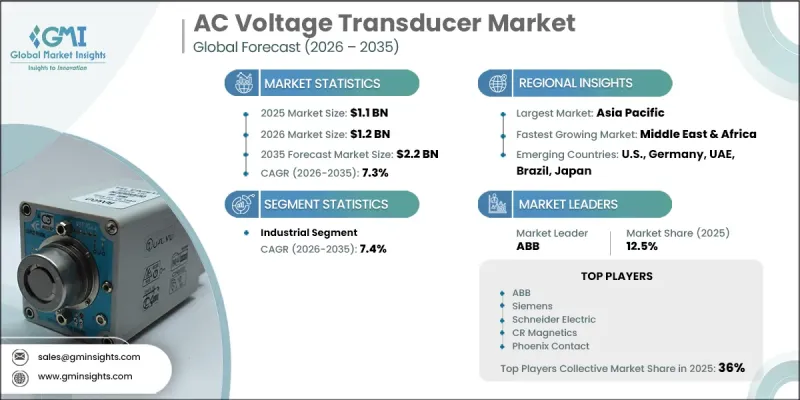
Demand for AC voltage transducers is rising as industrial automation and power monitoring systems continue to expand across sectors. Increasing focus on efficient energy management and uninterrupted operations is accelerating the adoption of advanced monitoring devices. Industries with high power requirements, including manufacturing, oil and gas, and chemical processing, are driving consistent demand due to their need for real-time voltage tracking and system reliability. These devices help reduce operational risks while improving energy utilization and supporting the transition toward smart factory ecosystems. The market is also benefiting from the growing shift toward energy-efficient technologies and digitalized industrial infrastructure, where precise voltage measurement plays a critical role in maintaining operational stability and reducing downtime.
| Market Scope | |
|---|---|
| Start Year | 2025 |
| Forecast Year | 2026-2035 |
| Start Value | $1.1 Billion |
| Forecast Value | $2.2 Billion |
| CAGR | 7.3% |
The AC voltage transducer market is evolving rapidly with advancements in miniaturization, higher measurement accuracy, and enhanced digital integration capabilities. Modern transducers are increasingly equipped with wireless connectivity and cloud-based monitoring functions, enabling remote system diagnostics and predictive maintenance strategies. Improvements in sensing technologies and material engineering have also enhanced durability and performance in harsh industrial environments. Additionally, innovations such as multi-range functionality and self-calibration features are expanding their applicability across advanced energy systems, including renewable energy integration and next-generation power distribution networks.
The industrial segment is projected to grow at a CAGR of 7.4% through 2035. Growth in this segment is supported by rising demand for precise voltage monitoring, improved energy efficiency, and enhanced operational reliability in industrial environments. AC voltage transducers play a key role in ensuring equipment protection, optimizing power consumption, and minimizing downtime across manufacturing, oil and gas, and chemical processing industries. The integration of automation systems and IoT-enabled monitoring platforms is further strengthening their adoption, enabling real-time insights and improved process control in modern industrial operations.
United States AC Voltage Transducer Market is expected to reach USD 334.9 million by 2035. Market expansion is driven by increasing emphasis on energy-efficient systems and the modernization of power infrastructure across the country. The adoption of smart manufacturing practices, automation technologies, and sustainability-focused energy management solutions is rising across industrial sectors. Rapid growth in renewable energy projects, including wind and solar installations, is also boosting demand for high-accuracy voltage monitoring solutions to ensure grid stability and efficient power distribution.
Key companies operating in the Global AC Voltage Transducer Industry include Siemens, ABB, Schneider Electric, Eaton Corporation, Honeywell International Inc., Analog Devices, Texas Instruments, OMRON Corporation, Phoenix Contact, LEM International, Yokogawa Electric Corporation, Socomec, CR Magnetics, Carlo Gavazzi, Crompton Instruments, DENT Instruments, NK Technologies, RECOM Power, Weidmuller Interface, and Mors Smitt. Companies in the AC Voltage Transducer Market are strengthening their position through continuous innovation in sensor accuracy, digital connectivity, and compact product design. Manufacturers are investing in advanced electronics and smart sensing technologies to improve real-time monitoring capabilities and system reliability. Strategic collaborations with industrial automation and energy management solution providers are expanding application reach. Firms are also focusing on cloud integration and IoT-enabled platforms to support predictive maintenance and remote diagnostics. Expansion of production facilities and regional distribution networks is improving supply chain efficiency.
Table of Contents
Chapter 1 Methodology & Scope
- 1.1 Research approach
- 1.2 Quality commitments
- 1.2.1 GMI AI policy & data integrity commitment
- 1.2.1.1 Source consistency protocol
- 1.2.1 GMI AI policy & data integrity commitment
- 1.3 Research trail & confidence scoring
- 1.3.1 Research trail components
- 1.3.2 Scoring components
- 1.4 Data collection
- 1.4.1 Partial list of primary sources
- 1.5 Data mining sources
- 1.5.1 Paid sources
- 1.5.1.1 Sources, by region
- 1.5.1 Paid sources
- 1.6 Base estimates and calculations
- 1.6.1 Base year calculation for any one approach
- 1.7 Market estimates & forecasts parameters
- 1.8 Forecast model
- 1.8.1 Quantified market impact analysis
- 1.8.1.1 Mathematical impact of growth parameters on forecast
- 1.8.1 Quantified market impact analysis
- 1.9 Research transparency addendum
- 1.9.1 Source attribution framework
- 1.9.2 Quality assurance metrics
- 1.9.3 Our commitment to trust
- 1.10 Market definitions
Chapter 2 Executive Summary
- 2.1 Industry synopsis, 2022 - 2035
- 2.1.1 Business trends
- 2.1.2 Method trends
- 2.1.3 Regional trends
Chapter 3 Industry Insights
- 3.1 Industry ecosystem analysis
- 3.1.1 Raw material availability & sourcing analysis
- 3.1.2 Manufacturing capacity assessment
- 3.1.3 Supply chain resilience & risk factors
- 3.1.4 Distribution network analysis
- 3.2 Regulatory landscape
- 3.3 Industry impact forces
- 3.3.1 Growth drivers
- 3.3.2 Industry pitfalls & challenges
- 3.4 Growth potential analysis
- 3.5 Porter's analysis
- 3.5.1 Bargaining power of suppliers
- 3.5.2 Bargaining power of buyers
- 3.5.3 Threat of new entrants
- 3.5.4 Threat of substitutes
- 3.6 PESTEL analysis
- 3.6.1 Political factors
- 3.6.2 Economic factors
- 3.6.3 Social factors
- 3.6.4 Technological factors
- 3.6.5 Legal factors
- 3.6.6 Environmental factors
- 3.7 Trade data analysis (Driven by Primary Research)
- 3.7.1 Import/export value trends (Driven by Primary Research)
- 3.7.2 Key trade corridors & tariff impact (Driven by Primary Research)
- 3.8 Capacity & production landscape (Driven by Primary Research)
- 3.8.1 Capacity by key producer (Driven by Primary Research)
- 3.8.2 Capacity utilization rates & expansion pipelines (Driven by Primary Research)
- 3.9 Impact of AI & Generative AI on the market (Core Solution)
- 3.9.1 AI-Driven production optimization (Core Solution)
- 3.9.2 Predictive maintenance & fault detection (Core Solution)
- 3.10 Emerging opportunities & trends
- 3.11 Investment analysis & future prospects
- 3.12 Sustainability initiatives & industry 4.0 integration
Chapter 4 Competitive Landscape, 2026
- 4.1 Introduction
- 4.2 Company market share analysis, by region, 2025
- 4.2.1 North America
- 4.2.2 Europe
- 4.2.3 Asia Pacific
- 4.2.4 Middle East & Africa
- 4.2.5 Latin America
- 4.3 Key developments
- 4.3.1 Key partnerships & collaborations
- 4.3.2 Major M&A activities
- 4.3.3 Product innovations & launches
- 4.3.4 Market expansion strategies
- 4.4 Competitive positioning matrix
Chapter 5 Market Size and Forecast, By Application, 2022 - 2035 (USD Million)
- 5.1 Key trends
- 5.2 Railway
- 5.3 Renewables
- 5.4 Industrial
- 5.5 Automotive
- 5.6 Others
Chapter 6 Market Size and Forecast, By Region, 2022 - 2035 (USD Million)
- 6.1 Key trends
- 6.2 North America
- 6.2.1 U.S.
- 6.2.2 Canada
- 6.2.3 Mexico
- 6.3 Europe
- 6.3.1 UK
- 6.3.2 France
- 6.3.3 Germany
- 6.3.4 Italy
- 6.3.5 Russia
- 6.3.6 Spain
- 6.4 Asia Pacific
- 6.4.1 China
- 6.4.2 Australia
- 6.4.3 India
- 6.4.4 Japan
- 6.4.5 South Korea
- 6.5 Middle East & Africa
- 6.5.1 Saudi Arabia
- 6.5.2 UAE
- 6.5.3 Turkey
- 6.5.4 South Africa
- 6.5.5 Egypt
- 6.6 Latin America
- 6.6.1 Brazil
- 6.6.2 Argentina
Chapter 7 Company Profiles
- 7.1 ABB
- 7.2 Analog Devices
- 7.3 Carlo Gavazzi
- 7.4 CR Magnetics
- 7.5 Crompton Instruments
- 7.6 DENT Instruments
- 7.7 Eaton Corporation
- 7.8 Honeywell International
- 7.9 LEM International
- 7.10 Mors Smitt
- 7.11 NK Technologies
- 7.12 OMRON Corporation
- 7.13 Phoenix Contact
- 7.14 RECOM Power
- 7.15 Schneider Electric
- 7.16 Siemens
- 7.17 Socomec
- 7.18 Texas Instruments
- 7.19 Weidmuller Interface
- 7.20 Yokogawa Electric Corporation

