PUBLISHER: Global Market Insights Inc. | PRODUCT CODE: 2038788

PUBLISHER: Global Market Insights Inc. | PRODUCT CODE: 2038788
Pet Food Antioxidants Market Opportunity, Growth Drivers, Industry Trend Analysis, and Forecast 2026 - 2035
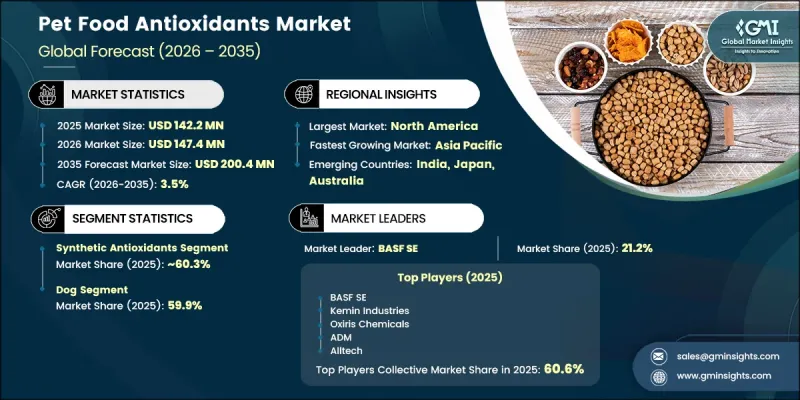
The Global Pet Food Antioxidants Market was valued at USD 142.2 million in 2025 and is estimated to grow at a CAGR of 3.5% to reach USD 200.4 million by 2035.
The market is expanding as antioxidants help in maintaining product stability by preventing oxidation while preserving nutritional integrity and freshness. Increasing consumer focus on pet wellness is influencing purchasing behavior, with a growing preference for premium formulations that support overall health and longevity. Pet owners are becoming more attentive to ingredient quality, driving demand for products that include functional additives designed to support immune health and long-term vitality. At the same time, regulatory compliance remains a key challenge, as manufacturers must meet strict standards related to ingredient safety and product effectiveness. Any concerns surrounding compliance or formulation transparency can impact consumer confidence. The market is also witnessing a shift toward naturally derived antioxidants, as demand rises for cleaner, less processed pet food options that align with evolving consumer expectations around quality and nutrition.
| Market Scope | |
|---|---|
| Start Year | 2025 |
| Forecast Year | 2026-2035 |
| Start Value | $ 142.2 Million |
| Forecast Value | $200.4 Million |
| CAGR | 3.5% |
Synthetic antioxidants accounted for 60.3% share in 2025 and is expected to grow at a CAGR of 3.4% through 2035. These ingredients continue to be widely utilized due to their cost efficiency and ability to enhance product shelf life and stability. Their consistent performance allows manufacturers to maintain quality control and ensure reliable antioxidant functionality across production processes.
The dog segment held a share of 59.9% in 2025. The market is categorized across multiple pet types, with dogs representing the leading segment due to their higher population and greater dietary requirements. Increased focus on pet health and nutrition has contributed to rising demand for antioxidant-enriched food products within this segment, supporting overall market growth.
North America Pet Food Antioxidants Market was valued at USD 49.1 million in 2025 and is expected to grow at a CAGR of 3.6% between 2026 and 2035. Regional growth is supported by increasing demand for premium pet nutrition products and a strong shift toward health-focused formulations. The expansion of online retail channels and continuous product innovation are further enhancing accessibility and market penetration.
Key players operating in the Global Pet Food Antioxidants Market include BASF SE, ADM, Kemin Industries, Alltech, Symrise Pet Food, Givaudan, Perstorp, Kaesler Nutrition GmbH, MIAVIT GmbH, Vitablend Nederland B.V., Oxiris Chemicals, FoodSafe Technologies, and Rangen Group. Companies in the Pet Food Antioxidants Market are strengthening their market position by focusing on product innovation and the development of high-quality antioxidant solutions that meet evolving consumer expectations. Investment in research and development is enabling the creation of more effective and naturally derived formulations. Strategic partnerships and distribution expansions are helping companies increase market reach and improve supply chain efficiency. Manufacturers are also emphasizing regulatory compliance and transparency to build consumer trust. Additionally, businesses are adopting advanced production technologies to enhance product consistency and shelf life. Competitive pricing strategies, combined with targeted marketing efforts that highlight health benefits, are further supporting brand positioning and long-term growth in a competitive marketplace.
Table of Contents
Chapter 1 Methodology & Scope
- 1.1 Market scope and definition
- 1.2 Research design
- 1.2.1 Research approach
- 1.2.2 Data collection methods
- 1.3 Data mining sources
- 1.3.1 Global
- 1.3.2 Regional/Country
- 1.4 Base estimates and calculations
- 1.4.1 Base year calculation
- 1.4.2 Key trends for market estimation
- 1.5 Primary research and validation
- 1.5.1 Primary sources
- 1.6 Forecast model
- 1.7 Research assumptions and limitations
Chapter 2 Executive Summary
- 2.1 Industry 360° synopsis
- 2.2 Key market trends
- 2.2.1 Regional
- 2.2.2 Grade
- 2.2.3 Form
- 2.2.4 Application
- 2.2.5 End use industry
- 2.2.6 Distribution channel
- 2.3 TAM Analysis, 2026-2035
- 2.4 CXO perspectives: Strategic imperatives
Chapter 3 Industry Insights
- 3.1 Industry ecosystem analysis
- 3.1.1 Supplier landscape
- 3.1.2 Profit margin
- 3.1.3 Value addition at each stage
- 3.1.4 Factor affecting the value chain
- 3.1.5 Disruptions
- 3.2 Industry impact forces
- 3.2.1 Growth drivers
- 3.2.1.1 Rising pet humanization & premium pet food demand
- 3.2.1.2 Consumer shift toward natural & clean label products
- 3.2.1.3 Growth in pet ownership globally
- 3.2.2 Industry pitfalls and challenges
- 3.2.2.1 Higher cost of natural antioxidants vs. Synthetic
- 3.2.2.2 Stability & shelf-life challenges with natural alternatives
- 3.2.3 Market opportunities
- 3.2.3.1 Emerging markets in Asia Pacific & Latin America
- 3.2.3.2 Customized antioxidant solutions for omega-3/6 enriched foods
- 3.2.1 Growth drivers
- 3.3 Growth potential analysis
- 3.4 Regulatory landscape
- 3.4.1 North America
- 3.4.2 Europe
- 3.4.3 Asia Pacific
- 3.4.4 Latin America
- 3.4.5 Middle East & Africa
- 3.5 Porter's analysis
- 3.6 PESTEL analysis
- 3.7 Price trends
- 3.7.1 By region
- 3.7.2 By type of antioxidants
- 3.8 Future market trends
- 3.9 Technology and innovation landscape
- 3.9.1 Current technological trends
- 3.9.2 Emerging technologies
- 3.10 Patent Landscape
- 3.11 Trade statistics (HS code)
- 3.11.1 Major importing countries
- 3.11.2 Major exporting countries
- 3.12 Sustainability and environmental aspects
- 3.12.1 Sustainable practices
- 3.12.2 Waste reduction strategies
- 3.12.3 Energy efficiency in production
- 3.12.4 Eco-friendly initiatives
- 3.13 Carbon footprint consideration
Chapter 4 Competitive Landscape, 2025
- 4.1 Introduction
- 4.2 Company market share analysis
- 4.2.1 By region
- 4.2.1.1 North America
- 4.2.1.2 Europe
- 4.2.1.3 Asia Pacific
- 4.2.1.4 LATAM
- 4.2.1.5 MEA
- 4.2.1 By region
- 4.3 Competitive analysis of major market players
- 4.4 Competitive positioning matrix
- 4.5 Key developments
- 4.5.1 Mergers & acquisitions
- 4.5.2 Partnerships & collaborations
- 4.5.3 New Product Launches
- 4.5.4 Expansion Plans
Chapter 5 Market Estimates and Forecast, By Type of Antioxidants, 2022-2035 (USD Million) (Kilo Tons)
- 5.1 Key trends
- 5.2 Natural antioxidants
- 5.2.1 Carotenoids
- 5.2.2 Tocopherols
- 5.2.3 Botanical extracts
- 5.2.4 Vitamins
- 5.2.5 Others
- 5.3 Synthetic antioxidants
- 5.3.1 BHT
- 5.3.2 BHA
- 5.3.3 Ethoxyquin
- 5.3.4 Propyl gallate
- 5.3.5 Others
Chapter 6 Market Estimates and Forecast, By Pet Type, 2022-2035 (USD Million) (Kilo Tons)
- 6.1 Key trends
- 6.2 Dog
- 6.3 Cat
- 6.4 Birds
- 6.5 Others
Chapter 7 Market Estimates and Forecast, By Formulation, 2022-2035 (USD Million) (Kilo Tons)
- 7.1 Key trends
- 7.2 Dry pet food
- 7.2.1 Extruded
- 7.2.2 Baked
- 7.2.3 Freeze-dried
- 7.3 Wet pet food
- 7.3.1 Pate style
- 7.3.2 Chunks in gravy
- 7.3.3 Stews & casseroles
- 7.4 Semi-moist pet food
- 7.4.1 Pouches
- 7.4.2 Treats & chews
Chapter 8 Market Estimates and Forecast, By Distribution Channel, 2022-2035 (USD Million) (Kilo Tons)
- 8.1 Key trends
- 8.2 Pet specialty stores
- 8.3 Supermarkets & hypermarkets
- 8.4 Online retail
- 8.5 Veterinary clinics
- 8.6 Others
Chapter 9 Market Estimates and Forecast, By Region, 2022-2035 (USD Million) (Kilo Tons)
- 9.1 Key trends
- 9.2 North America
- 9.2.1 U.S.
- 9.2.2 Canada
- 9.3 Europe
- 9.3.1 Germany
- 9.3.2 UK
- 9.3.3 France
- 9.3.4 Spain
- 9.3.5 Italy
- 9.3.6 Rest of Europe
- 9.4 Asia Pacific
- 9.4.1 China
- 9.4.2 India
- 9.4.3 Japan
- 9.4.4 Australia
- 9.4.5 South Korea
- 9.4.6 Rest of Asia Pacific
- 9.5 Latin America
- 9.5.1 Brazil
- 9.5.2 Mexico
- 9.5.3 Argentina
- 9.5.4 Rest of Latin America
- 9.6 Middle East and Africa
- 9.6.1 Saudi Arabia
- 9.6.2 South Africa
- 9.6.3 UAE
- 9.6.4 Rest of Middle East and Africa
Chapter 10 Company Profiles
- 10.1 BASF SE
- 10.2 ADM
- 10.3 Alltech
- 10.4 FoodSafe Technologies
- 10.5 Givaudan
- 10.6 Kaesler Nutrition GmbH
- 10.7 Kemin Industries
- 10.8 MIAVIT GmbH
- 10.9 Oxiris Chemicals
- 10.10 Perstorp
- 10.11 Rangen Group
- 10.12 Symrise Pet Food
- 10.13 Vitablend Nederland B.V.

