PUBLISHER: Global Market Insights Inc. | PRODUCT CODE: 2045682

PUBLISHER: Global Market Insights Inc. | PRODUCT CODE: 2045682
Asia Pacific Athletic Footwear Market Opportunity, Growth Drivers, Industry Trend Analysis, and Forecast 2026 - 2035
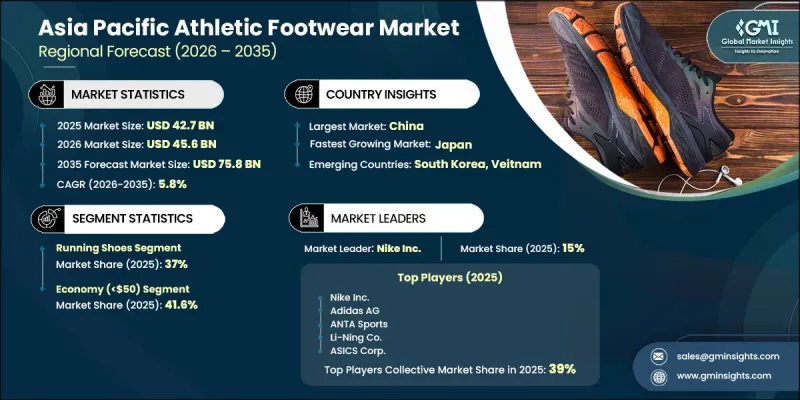
Asia Pacific Athletic Footwear Market was valued at USD 42.7 billion in 2025 and is estimated to grow at a CAGR of 5.8% to reach USD 75.8 billion by 2035.
The regional market continues to evolve due to changing lifestyle preferences, growing awareness of physical wellness, and increasing demand for comfortable everyday footwear. Athletic shoes are no longer viewed solely as sports products, as consumers across age groups are incorporating them into their daily fashion and everyday wear. Rising interest in active living, comfort-focused fashion, and multifunctional footwear is significantly influencing purchasing behavior throughout the region. Consumer preferences are also being shaped by digital trends, evolving streetwear culture, and growing exposure to sports-inspired fashion. International footwear brands maintain strong visibility across the market, while regional manufacturers are steadily strengthening their position by offering products tailored to local pricing expectations and style preferences. The expansion of e-commerce platforms has improved product accessibility across urban and semi-urban areas, although physical retail outlets continue to play a major role in customer engagement and purchasing decisions. Product durability, design appeal, and long-term comfort remain among the most important buying considerations for consumers in the Asia-Pacific athletic footwear market.
| Market Scope | |
|---|---|
| Start Year | 2025 |
| Forecast Year | 2026-2035 |
| Start Value | $42.7 Billion |
| Forecast Value | $75.8 Billion |
| CAGR | 5.8% |
The Asia Pacific athletic footwear industry is benefiting from rising consumer focus on health, fitness, and mobility, which is driving consistent demand for sports-inspired footwear categories. Increasing urbanization and changing work-life patterns have encouraged consumers to prioritize comfort-oriented shoes suitable for both casual and active use. Athletic footwear is increasingly becoming part of everyday wardrobes due to the growing preference for versatile designs that combine performance and lifestyle appeal. Social media influence, celebrity endorsements, and digital marketing campaigns continue to accelerate product visibility and trend adoption across the region. In addition, advancements in cushioning technology, lightweight materials, and breathable fabric construction are encouraging manufacturers to launch innovative footwear collections aimed at broader consumer groups. Both premium and value-oriented product categories are gaining traction as brands expand their reach through digital commerce and retail partnerships.
The running shoes segment accounted for 37% share in 2025. The category continues to witness strong growth due to the increasing popularity of running as a convenient and accessible fitness activity across the region. Consumers are increasingly choosing running footwear for everyday mobility, exercise routines, and casual wear because of the comfort and flexibility these products offer. Growing awareness regarding physical fitness and healthy lifestyles has encouraged a wider consumer base to invest in performance-oriented footwear designed for regular activity. Footwear brands are also introducing advanced sole technologies, improved shock absorption systems, and lightweight product designs to attract both experienced and first-time buyers. The segment is further supported by rising participation in recreational fitness activities and increasing consumer preference for athletic-inspired fashion trends.
In 2025, the economy segment held a 41.6% share, generating USD 17.8 billion. Demand for affordable athletic footwear remains high across the region as consumers continue to prioritize budget-friendly products that provide durability, comfort, and functional performance. The segment appeals strongly to price-sensitive buyers seeking practical footwear solutions suitable for everyday activities and regular use. Regional manufacturers play a major role in strengthening this category by offering diverse product selections at competitive price points. Online retail platforms are also contributing significantly to segment growth by enabling consumers to compare pricing, styles, and features more efficiently. Attractive discounts, expanding digital payment systems, and increased product availability through e-commerce channels are reinforcing the popularity of economy-range athletic footwear throughout the Asia Pacific market.
China Athletic Footwear Market held a 46.4% share, generating USD 19.8 billion in 2025. The country continues to lead the regional industry due to its well-established manufacturing ecosystem, advanced supply chain infrastructure, and strong consumer demand for athletic and lifestyle footwear products. China's large population base and rapidly evolving fashion preferences allow brands to introduce new product concepts and trends at a faster pace compared to other regional markets. Growing urbanization and rising interest in active lifestyles have further increased the integration of athletic footwear into everyday fashion and daily routines. The country also benefits from a highly developed retail environment supported by a strong combination of digital commerce networks and physical retail presence, enabling brands to expand their customer reach efficiently. Strong domestic production capabilities and competitive market dynamics continue to position China as a central hub for athletic footwear innovation and distribution across the Asia Pacific region.
Major companies operating in the Asia Pacific Athletic Footwear Market include Nike Inc., Adidas AG, Puma SE, ASICS Corporation, Skechers USA Inc., New Balance Athletics Inc., Under Armour Inc., Li-Ning Company Ltd., ANTA Sports Products Ltd., FILA Holdings Corp., Descente Ltd., Mizuno Corporation, 361 Degrees International Ltd., Xtep International Holdings Ltd., Peak Sport Products Co. Ltd., Joma Sport S.A.U., Prospecs / Pro-Specs, Deckers Outdoor Corp. On Holding AG, VF Corporation, and Brooks Sports Inc.. Companies operating in the Asia Pacific Athletic Footwear Market are focusing on multiple strategic initiatives to strengthen brand visibility, expand customer reach, and improve long-term competitive positioning. Leading manufacturers are investing heavily in product innovation, lightweight material technologies, and advanced cushioning systems to enhance consumer comfort and performance. Many brands are also increasing collaboration with athletes, influencers, and fashion-focused campaigns to strengthen engagement with younger consumers. Expansion of e-commerce operations, regional distribution networks, and direct-to-consumer sales channels remains a major priority across the industry. In addition, companies are introducing localized product designs and pricing strategies to better align with regional consumer preferences and purchasing power.
Table of Contents
Chapter 1 Research Methodology
- 1.1 Research approach
- 1.2 Quality Commitments
- 1.2.1 GMI AI policy & data integrity commitment
- 1.2.1.1 Source consistency protocol
- 1.2.1 GMI AI policy & data integrity commitment
- 1.3 Research Trail & Confidence Scoring
- 1.3.1 Research Trail Components
- 1.3.2 Scoring Components
- 1.4 Data Collection
- 1.4.1 Partial list of primary sources
- 1.5 Data mining sources
- 1.5.1 Paid sources
- 1.5.1.1 Sources, by region
- 1.5.1 Paid sources
- 1.6 Base estimates and calculations
- 1.6.1 Base year calculation for any one approach
- 1.7 Forecast model
- 1.7.1 Quantified market impact analysis
- 1.7.1.1 Mathematical impact of growth parameters on forecast
- 1.7.1 Quantified market impact analysis
- 1.8 Research transparency addendum
- 1.8.1 Source attribution framework
- 1.8.2 Quality assurance metrics
- 1.8.3 Our commitment to trust
Chapter 2 Executive Summary
- 2.1 Industry synopsis, 2022-2035
- 2.2 Key trends
- 2.2.1 Country
- 2.2.2 Product type
- 2.2.3 Price
- 2.2.4 Consumer group
- 2.2.5 End use
- 2.2.6 Distribution channel
Chapter 3 Industry Insights
- 3.1 Industry ecosystem analysis
- 3.1.1 Factors affecting the value chain
- 3.1.2 Profit margin analysis
- 3.1.3 Disruptions
- 3.1.4 Future outlook
- 3.1.5 Manufacturers (APAC footprint)
- 3.1.6 Distributors and its regional network
- 3.2 Impact forces
- 3.2.1 Growth drivers
- 3.2.2 Industry pitfalls & challenges
- 3.2.3 Opportunities
- 3.3 Growth potential analysis
- 3.4 Raw material analysis
- 3.4.1 Key raw materials in athletic footwear manufacturing
- 3.4.2 Regional sourcing patterns
- 3.4.3 Price volatility & impact on manufacturers
- 3.5 Future market trends
- 3.6 Technology and innovation landscape
- 3.6.1 Current technological trends
- 3.6.2 Emerging technologies
- 3.7 Price trends (driven by primary research)
- 3.7.1 Historical price trend analysis (driven by primary research)
- 3.7.2 Pricing strategy by player type (premium / value / cost-plus) (driven by primary research)
- 3.7.3 Price positioning by country (South Korea vs China vs India) (driven by primary research)
- 3.8 Regulatory landscape
- 3.8.1 APAC trade regulations & tariffs
- 3.8.2 South Korea import/export standards
- 3.8.3 Environmental & sustainability regulations
- 3.8.4 Country-specific compliance requirements
- 3.9 Supply chain analysis
- 3.9.1 Manufacturing hubs (Vietnam, China, Indonesia)
- 3.9.2 Raw material sourcing in APAC
- 3.9.3 Supply chain resilience & risk mitigation
- 3.9.4 Logistics & distribution networks
- 3.10 Porter's analysis
- 3.11 PESTEL analysis
- 3.12 Trade data analysis (driven by paid database) (HS Code: 640411)
- 3.12.1 Import/export volume & value trends (driven by primary research)
- 3.12.2 Key trade corridors & tariff impact (driven by primary research)
- 3.12.3 South Korea trade flow analysis (driven by primary research)
- 3.13 Impact of AI & generative AI on the market
- 3.13.1 AI-driven disruption of existing business models (design, manufacturing, retail)
- 3.13.2 GenAI use cases & adoption roadmap by segment (personalization, virtual try-on, design automation)
- 3.13.3 Risks, limitations & regulatory considerations
- 3.14 Distribution infrastructure & channel penetration landscape (driven by primary research)
- 3.14.1 Channel coverage by country & format (modern vs traditional trade) (driven by primary research)
- 3.14.2 Last-mile infrastructure gaps & emerging channel shifts (driven by primary research)
- 3.14.3 South Korea retail density & digital penetration (driven by primary research)
- 3.15 Consumer behavior analysis
- 3.15.1 APAC consumer preferences & purchase drivers
- 3.15.2 South Korea consumer behavior patterns
- 3.15.3 Athleisure trend impact on purchase decisions
- 3.15.4 Brand loyalty & switching behavior
- 3.15.5 Influence of celebrity endorsements & sports events
Chapter 4 Competitive Landscape, 2025
- 4.1 Introduction
- 4.2 Company market share analysis
- 4.2.1 By country
- 4.2.1.1 China
- 4.2.1.2 India
- 4.2.1.3 Japan
- 4.2.1.4 South Korea
- 4.2.1.5 Australia
- 4.2.1 By country
- 4.3 Company matrix analysis
- 4.4 Competitive analysis of major market players
- 4.5 Competitive positioning matrix
- 4.6 Key developments
- 4.6.1 Mergers & acquisitions
- 4.6.2 Partnerships & collaborations
- 4.6.3 New product launches
- 4.6.4 Expansion plans
Chapter 5 Market Estimates & Forecast, By Product Type, 2022-2035 (USD Billion) (Million Units)
- 5.1 Key trends
- 5.2 Running shoes
- 5.2.1 Trail running shoes
- 5.2.2 Road running shoes
- 5.2.3 Performance running shoes
- 5.3 Walking shoes
- 5.4 Sports shoes
- 5.4.1 Basketball shoes
- 5.4.2 Football/soccer shoes
- 5.4.3 Tennis shoes
- 5.4.4 Cricket shoes [focus: India/APAC]
- 5.4.5 Others
- 5.5 Trekking & hiking shoes
- 5.6 Others (aerobic shoes, training shoes, etc.)
Chapter 6 Market Estimates & Forecast, By Pricing, 2022-2035 (USD Billion) (Million Units)
- 6.1 Key trends
- 6.2 Economy (<$50)
- 6.3 Mid-range ($50 to $150)
- 6.4 Premium ($150)
Chapter 7 Market Estimates & Forecast, By Consumer Group, 2022-2035 (USD Billion) (Million Units)
- 7.1 Key trends
- 7.2 Men
- 7.3 Women
- 7.4 Kids
Chapter 8 Market Estimates & Forecast, By End Use, 2022-2035 (USD Billion) (Million Units)
- 8.1 Key trends
- 8.2 Professionals/Athletes
- 8.3 Fitness Enthusiasts
- 8.4 Casual/Athleisure Users
- 8.5 Beginners
Chapter 9 Market Estimates & Forecast, By Distribution Channel, 2022-2035 (USD Billion) (Million Units)
- 9.1 Key trends
- 9.2 Online
- 9.2.1 E-commerce
- 9.2.2 Company website
- 9.3 Offline
- 9.3.1 Specialty stores
- 9.3.2 Mega retail stores
- 9.3.3 Others
Chapter 10 Market Estimates & Forecast, By Region, 2022-2035 (USD Billion) (Million Units)
- 10.1 Key trends
- 10.2 China
- 10.3 India
- 10.4 Japan
- 10.5 South Korea
- 10.6 Australia
- 10.7 Philippines
- 10.8 Vietnam
- 10.9 Singapore
Chapter 11 Company Profiles
- 11.1 TIER 1: GLOBAL LEADERS
- 11.1.1 Nike Inc.
- 11.1.2 Adidas AG
- 11.1.3 Puma SE
- 11.1.4 ASICS Corporation
- 11.1.5 Skechers USA Inc.
- 11.2 TIER 2: REGIONAL CHAMPIONS
- 11.2.1 New Balance Athletics Inc.
- 11.2.2 Under Armour Inc.
- 11.2.3 Li-Ning Company Ltd.
- 11.2.4 ANTA Sports Products Ltd.
- 11.2.5 FILA Holdings Corp.
- 11.2.6 Descente Ltd.
- 11.2.7 Mizuno Corporation
- 11.2.8 361 Degrees International Ltd.
- 11.2.9 Xtep International Holdings Ltd.
- 11.2.10 Peak Sport Products Co. Ltd.
- 11.2.11 Joma Sport S.A.U.
- 11.2.12 Prospecs / Pro-Specs
- 11.3 TIER 3: NICHE / SPECIALIST PLAYERS
- 11.3.1 Deckers Outdoor Corp.
- 11.3.2 On Holding AG
- 11.3.3 VF Corporation
- 11.3.4 Brooks Sports Inc.

