PUBLISHER: Mordor Intelligence | PRODUCT CODE: 2061737

PUBLISHER: Mordor Intelligence | PRODUCT CODE: 2061737
North America Athletic Footwear - Market Share Analysis, Industry Trends & Statistics, Growth Forecasts (2026 - 2031)
According to Mordor Intelligence, north america athletic footwear market size in 2026 is estimated at USD 66.04 billion, growing from 2025 value of USD 62.65 billion with 2031 projections showing USD 85.97 billion, growing at 5.41% CAGR over 2026-2031.
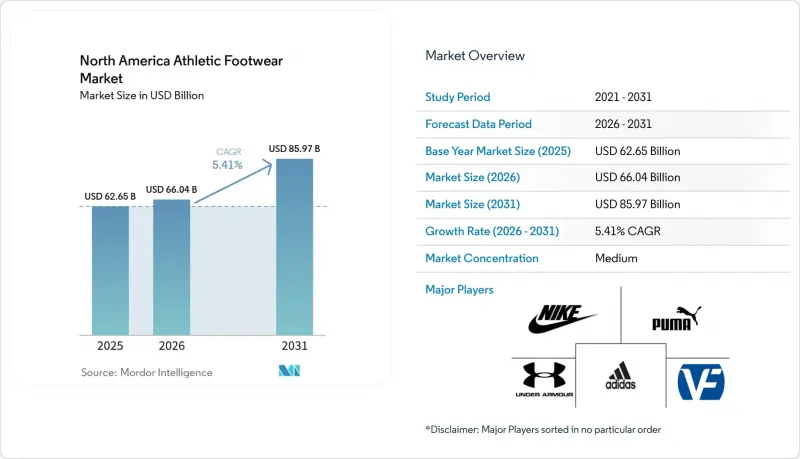
This report is Segmented by Activity (Running Shoes, Sports Shoes, and More), by Product Type (Shoes and Boots), by End User (Men, Women, and More), by Category (Premium and Mass), by Distribution Channel (Supermarkets/Hypermarkets, Online Retail Stores, and More), and by Geography (United States, Canada, Mexico, Rest of North America). The Market Forecasts are Provided in Terms of Value (USD).
North America Athletic Footwear Market Trends and Insights
Significant growth in women sports participation rate
The increasing participation of women in sports is playing a significant role in driving the North American athletic footwear market. As of 2024, nearly half of all females, around 49%, are actively involved in sports, according to Project Play . Legislative efforts, such as discussions around the Protection of Women and Girls in Sports Act, have brought female athletics into the spotlight, encouraging brands to focus on creating women-specific products. For instance, Under Armour has expanded its women's product range with launches like the UA Flow Synchronicity, designed specifically to cater to the anatomy of the female foot. The Women's Sports Foundation in 2024 reported that 67% of women credit sports participation for their leadership development, which is expected to drive higher women's participation in sports in the future . The government conducts various initiatives to encourage more women to get more active, more often, by promoting participation in physical activities. For example, the Government of Canada is committed to building and maintaining an inclusive Canadian sport system and providing opportunities for women and girls in all aspects of the sport, including coaching.
Aggressive marketing by reputed brands
Leading brands in North America are driving the growth of the athletic footwear market through impactful and relatable marketing strategies. Nike, for instance, has gained significant attention with campaigns like "You Can't Stop Us" and "Dream Crazier," which feature prominent American athletes such as Serena Williams and Colin Kaepernick. These campaigns not only promote products but also inspire consumers by delivering powerful messages of empowerment and perseverance. Similarly, Under Armour focuses on connecting with U.S. audiences through initiatives like its partnership with Stephen Curry and the launch of the Curry Flow 10. By combining athlete-driven storytelling with limited-edition releases, the brand creates excitement and exclusivity around its products. Adidas also engages North American consumers through collaborations, such as its partnership with Bad Bunny and basketball-themed product launches. These efforts are further amplified by significant investments in digital marketing and exclusive access platforms like Nike's SNKRS app and Adidas' Confirmed app. This comprehensive approach makes it challenging for smaller brands to compete with the extensive reach, visibility, and cultural influence of these major players.
Counterfeit products affecting brand reputation
The rise of counterfeit athletic footwear is becoming a serious issue for brands and consumers in North America. Fake sneakers are flooding the market, with the U.S. being a major target. For instance, U.S. Customs reported seizing nearly USD 100 million worth of counterfeit shoes in just one year, according to the Michelson Institute for Intellectual Property . This growing problem not only impacts legitimate sales but also confuses consumers who may unknowingly purchase fake products. To combat this, leading brands are stepping up their efforts by introducing advanced authentication technologies, such as QR codes and blockchain-based tracking systems, to verify product authenticity. They are also intensifying legal actions against counterfeiters and launching awareness campaigns to educate consumers on how to identify genuine products. Despite these measures, counterfeit footwear remains a persistent issue, especially with knockoffs being sold on third-party e-commerce platforms. This ongoing challenge continues to harm brand reputation and creates difficulties for both consumers and legitimate businesses in the market.
Other drivers and restraints analyzed in the detailed report include:
- Favourable government initiatives to boost sports culture
- Influence of social media platforms and celebrity endorsements
- High price points of premium footwear
For complete list of drivers and restraints, kindly check the Table Of Contents.
Segment Analysis
In 2025, sports shoes led the North America athletic footwear market, accounting for 47.12% of the total revenue. Their popularity is driven by their versatility, making them suitable for activities like team sports, gym workouts, and casual wear. Running shoes, while holding a smaller market share, have gained significant attention due to their association with marathon culture and advancements in performance-enhancing technologies. Niche categories such as Adventure Sports Shoes and hybrid lifestyle designs have found their place in the market, catering to consumers with specific needs and preferences, thereby contributing to the market's diversity.
Running shoes are projected to grow at the fastest pace, with a compound annual growth rate (CAGR) of 6.05% expected through 2031. This growth is attributed to continuous innovations, including lighter foams, carbon plates, and 3D-printed uppers, which improve performance and attract both professional athletes and fitness enthusiasts. Meanwhile, sports shoes are anticipated to maintain steady growth, supported by the ongoing athleisure trend that combines athletic functionality with casual style. Adventure Sports Shoes are also expected to see moderate growth as outdoor recreational activities continue to rise in popularity, appealing to consumers seeking active and adventurous lifestyles.
In 2025, traditional shoes dominated the market, accounting for 85.10% of total sales. Their widespread appeal lies in their reliability and versatility, making them a preferred choice for everyday activities such as school routines, casual outings, and sports like basketball or tennis. These shoes have become a staple for consumers who prioritize comfort and functionality. Although boots represented a smaller segment, they gained popularity in specific categories like winter wear and hiking, catering to consumers seeking durable and weather-resistant options. Meanwhile, sandals and other open footwear types, though holding a smaller market share, have established a loyal customer base, particularly for post-sport recovery and use in warmer climates where breathability and ease of wear are crucial.
Boots are projected to experience the fastest growth, with a compound annual growth rate (CAGR) of 5.78% expected through 2031. This growth is driven by the rising demand for multifunctional hiking footwear, innovative recovery-focused designs such as Nike's collaboration with Hyperice, and the use of climate-resilient materials that address changing weather conditions. At the same time, Traditional Shoes are anticipated to grow steadily as brands continue to focus on enhancing comfort, durability, and affordability. These improvements ensure that Traditional Shoes remain a popular choice for a wide range of consumers, offering a balance of performance, practicality, and everyday usability.
List of Companies Covered in this Report:
- Nike, Inc.
- Adidas AG
- Puma SE
- 3G Capital
- Under Armour, Inc.
- New Balance Athletics, Inc.
- ASICS Corporation
- Wolverine World Wide, Inc.
- VF Corporation
- Deckers Outdoor Corp.
- Brooks Sports, Inc.
- Columbia Sportswear Company
- Amer Sports
- Anta International Group Holdings Limited
- Misto Holdings Corp
- Yonex Co. Ltd.
- Nobull LLC
- Authentic Brands Group (ABG)
- Feel the World Inc.
- DICK's Sporting Goods'
Additional Benefits:
- The market estimate (ME) sheet in Excel format
- 3 months of analyst support
TABLE OF CONTENTS
1 INTRODUCTION
- 1.1 Study Assumptions and Market Definition
- 1.2 Scope of the Study
2 RESEARCH METHODOLOGY
3 EXECUTIVE SUMMARY
4 MARKET LANDSCAPE
- 4.1 Market Overview
- 4.2 Market Drivers
- 4.2.1 Significant Growth in Women Sports Participation Rate
- 4.2.2 Aggressive Marketing by Reputed Brands
- 4.2.3 Influence of Social Media Platforms and Celebrity Endorsements
- 4.2.4 Favourable Government Initiatives to Boost Sports Culture
- 4.2.5 Increasing Athleisure Trend
- 4.2.6 Sustainability and Ethical Consumption
- 4.3 Market Restraints
- 4.3.1 Counterfeit Products Affecting Brand Reputation
- 4.3.2 High Price Points of Premium Footwear
- 4.3.3 Regulatory and Import Barriers
- 4.3.4 Slow Pace of Penetration in Rural and Low-Income Areas
- 4.4 Consumer Behaviour Analysis
- 4.5 Regulatory Outlook
- 4.6 Porter's Five Forces Analysis
- 4.6.1 Threat of New Entrants
- 4.6.2 Bargaining Power of Buyers/Consumers
- 4.6.3 Bargaining Power of Suppliers
- 4.6.4 Threat of Substitute Products
- 4.6.5 Intensity of Competitive Rivalry
5 MARKET SIZE AND GROWTH FORECASTS (VALUE)
- 5.1 By Activity
- 5.1.1 Running Shoes
- 5.1.2 Sports Shoes
- 5.1.3 Adventure Sports Shoes
- 5.1.4 OtherProduct Types
- 5.2 By Product Type
- 5.2.1 Shoes
- 5.2.2 Boots
- 5.3 By End User
- 5.3.1 Men
- 5.3.2 Women
- 5.3.3 Kids/Children
- 5.4 By Category
- 5.4.1 Premium
- 5.4.2 Mass
- 5.5 By Distribution Channel
- 5.5.1 Sports and Athletic Goods Stores
- 5.5.2 Supermarkets/Hypermarkets
- 5.5.3 Online Retaile Stores
- 5.5.4 Other Distribution Channels
- 5.6 By Geography
- 5.6.1 United States
- 5.6.2 Canada
- 5.6.3 Mexico
- 5.6.4 Rest of North America
6 COMPETITIVE LANDSCAPE
- 6.1 Market Concentration
- 6.2 Strategic Moves
- 6.3 Market Share Analysis
- 6.4 Company Profiles (includes Global level Overview, Market level overview, Core Segments, Financials as available, Strategic Information, Market Rank/Share for key companies, Products and Services, and Recent Developments)
- 6.4.1 Nike, Inc.
- 6.4.2 Adidas AG
- 6.4.3 Puma SE
- 6.4.4 3G Capital
- 6.4.5 Under Armour, Inc.
- 6.4.6 New Balance Athletics, Inc.
- 6.4.7 ASICS Corporation
- 6.4.8 Wolverine World Wide, Inc.
- 6.4.9 VF Corporation
- 6.4.10 Deckers Outdoor Corp.
- 6.4.11 Brooks Sports, Inc.
- 6.4.12 Columbia Sportswear Company
- 6.4.13 Amer Sports
- 6.4.14 Anta International Group Holdings Limited
- 6.4.15 Misto Holdings Corp
- 6.4.16 Yonex Co. Ltd.
- 6.4.17 Nobull LLC
- 6.4.18 Authentic Brands Group (ABG)
- 6.4.19 Feel the World Inc.
- 6.4.20 DICK's Sporting Goods'
7 MARKET OPPORTUNITIES AND FUTURE OUTLOOK

