PUBLISHER: Global Market Insights Inc. | PRODUCT CODE: 2061394

PUBLISHER: Global Market Insights Inc. | PRODUCT CODE: 2061394
Athletic Footwear Market Opportunity, Growth Drivers, Industry Trend Analysis, and Forecast 2026 - 2035
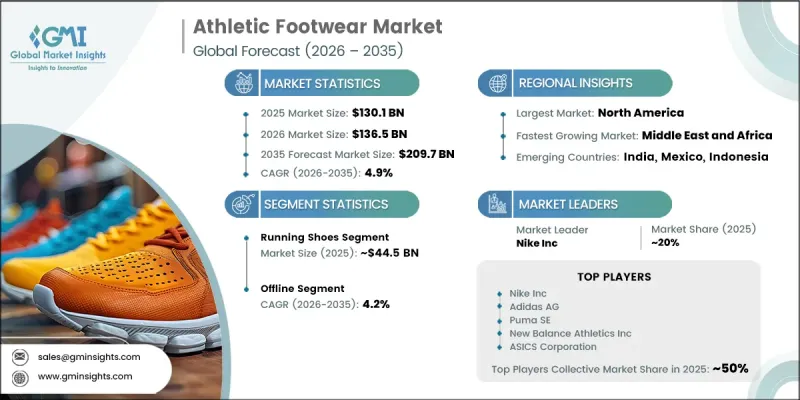
The Global Athletic Footwear Market was valued at USD 130.1 billion in 2025 and is estimated to grow at a CAGR of 4.9% to reach USD 209.7 billion in 2035.
Market growth is being driven by rising participation in sports and fitness activities, which continues to expand the global consumer base for performance and lifestyle footwear. Running and jogging represent the largest contributors to category demand, supported by tens of millions of active participants in the United States alone. In mature economies, spending on physical wellness has remained stable even during economic fluctuations, while emerging economies are seeing rapid adoption as urban populations increasingly engage in recreational sports. At the same time, continuous advancements in performance materials and footwear engineering are reshaping consumer expectations across running, training, and outdoor categories. Innovation intensity has increased significantly, particularly in performance running footwear, where material science and design integration are directly influencing purchasing behavior. Breakthroughs in midsole engineering, including carbon-fiber plate integration pioneered by major global brands, have demonstrated measurable performance gains, reinforcing consumer willingness to pay premium prices. Academic and sports performance research has also linked advanced running footwear designs to improved running efficiency, strengthening their value proposition in the premium segment.
| Market Scope | |
|---|---|
| Start Year | 2025 |
| Forecast Year | 2026-2035 |
| Start Value | $130.1 Billion |
| Forecast Value | $209.7 Billion |
| CAGR | 4.9% |
The running footwear segment generated USD 44.5 billion in 2025 and is projected to grow at a CAGR of 5.1% through 2035. This segment's expansion is supported by its dual role in both competitive athletics and everyday lifestyle usage, making it one of the most versatile categories in the broader market. Leading product lines from global brands consistently maintain high sales volumes due to their blend of performance credibility and fashion-oriented appeal.
The offline distribution segment accounted for 61.8% share in 2025 and is expected to grow at a CAGR of 4.2% through 2035. Physical retail remains a dominant channel as brands continue to invest heavily in immersive shopping environments that enhance customer engagement. These retail formats emphasize product personalization, experiential engagement, and community-driven interactions that strengthen brand loyalty and consumer connection beyond traditional purchasing.
U.S. Athletic Footwear Market reached USD 37.8 billion in 2025 and is expected to grow at a CAGR of 3.8% from 2026 to 2035. The country remains the largest contributor due to exceptionally high per-capita spending on athletic footwear. The market is strongly influenced by established global brands, with major companies shaping competitive dynamics through innovation, direct-to-consumer expansion, and advanced product differentiation strategies. A strong concentration of footwear design, innovation, and manufacturing expertise further reinforces the country's leadership position within the global landscape.
Major companies operating in the Global Athletic Footwear Industry include Nike Inc, Adidas AG, Puma SE, New Balance Athletics Inc, ASICS Corporation, Under Armour Inc, Skechers USA Inc, Decathlon S.A, Yonex Co Ltd, Mizuno Corporation, On Holding AG, VF Corporation, Deckers Outdoor Corporation, FILA Holdings Corporation, Columbia Sportswear Company, Li-Ning Company Limited, ANTA Sports Products Limited, Xtep International Holdings Limited, Lululemon Athletica Inc, Wolverine World Wide Inc, and Brooks Sports Inc. Companies in the athletic footwear market are increasingly focusing on performance-driven innovation, integrating advanced materials, lightweight construction, and energy-return technologies to enhance product differentiation. They are expanding direct-to-consumer ecosystems to improve margin control, strengthen customer engagement, and collect real-time consumer insights. Brand diversification strategies are also being deployed, with firms extending their offerings across performance, lifestyle, and hybrid segments to capture wider demographics. Strategic collaborations with athletes, designers, and sports organizations are reinforcing brand visibility and credibility. At the same time, companies are investing heavily in sustainability initiatives, including recycled materials and circular product design, to align with evolving consumer expectations and regulatory pressures.
Table of Contents
Chapter 1 Research methodology
- 1.1 Research approach
- 1.2 Quality Commitments
- 1.2.1 GMI AI policy & data integrity commitment
- 1.2.1.1 Source consistency protocol
- 1.2.1 GMI AI policy & data integrity commitment
- 1.3 Research trail & confidence scoring
- 1.3.1 Research trail components
- 1.3.2 Scoring components
- 1.4 Data Collection
- 1.4.1 Partial list of primary sources
- 1.5 Data mining sources
- 1.5.1 Paid sources
- 1.5.1.1 Sources, by region
- 1.5.1 Paid sources
- 1.6 Base estimates and calculations
- 1.6.1 Base year calculation
- 1.7 Forecast model
- 1.7.1 Quantified market impact analysis
- 1.7.1.1 Mathematical impact of growth parameters on forecast
- 1.7.1 Quantified market impact analysis
- 1.8 Research transparency addendum
- 1.8.1 Source attribution framework
- 1.8.2 Quality assurance metrics
- 1.8.3 Our commitment to trust
Chapter 2 Executive Summary
- 2.1 Industry 360° synopsis
- 2.2 Business trends
- 2.3 Regional
- 2.4 Product type
- 2.5 End user
- 2.6 Price
- 2.7 Distribution channel
Chapter 3 Industry Insights
- 3.1 Industry ecosystem analysis
- 3.1.1 Supplier landscape
- 3.1.2 Manufacturers
- 3.1.3 Distributors
- 3.1.4 Retailers
- 3.1.5 Profit margin analysis
- 3.1.6 Value addition at each stage
- 3.1.7 Factor affecting the value chain
- 3.2 Industry impact forces
- 3.2.1 Growth drivers
- 3.2.1.1 Rising health consciousness & growing sports participation
- 3.2.1.2 Innovation in footwear technology & design
- 3.2.1.3 Expansion of e-commerce & Direct-to-Consumer (DTC) channels
- 3.2.2 Industry pitfalls & challenges
- 3.2.2.1 Proliferation of counterfeit products
- 3.2.2.2 Volatile raw material prices
- 3.2.3 Opportunities
- 3.2.1 Growth drivers
- 3.3 Growth potential analysis
- 3.4 Technology and innovation landscape
- 3.4.1 Current technological trends
- 3.4.2 Emerging technologies
- 3.5 Price trends
- 3.5.1 By region
- 3.5.2 By product type
- 3.6 Trade data analysis
- 3.7 Regulatory landscape
- 3.7.1 Standards and compliance requirements
- 3.7.2 Regional regulatory frameworks
- 3.7.3 Certification standards
- 3.8 Porter's analysis
- 3.9 PESTEL analysis
- 3.10 Impact of AI & generative AI on the market
- 3.10.1 AI-driven disruption of existing business models
- 3.10.2 GenAI use cases & adoption roadmap by segment
- 3.10.3 Risks, limitations & regulatory considerations
- 3.11 Consumer behavior analysis
- 3.11.1 Demographic trends
- 3.11.2 Factors affecting buying decision
- 3.11.3 Consumer product adoption
- 3.11.4 Preferred distribution channel
- 3.11.5 Preferred price range
Chapter 4 Competitive Landscape, 2025
- 4.1 Introduction
- 4.2 Company market share analysis
- 4.2.1 By Region
- 4.2.1.1 North America
- 4.2.1.2 Europe
- 4.2.1.3 Asia Pacific
- 4.2.1.4 Latin America
- 4.2.1.5 Middle East & Africa
- 4.2.1 By Region
- 4.3 Company matrix analysis
- 4.4 Competitive analysis of major market players
- 4.5 Competitive positioning matrix
- 4.6 Key developments
- 4.6.1 Mergers & acquisitions
- 4.6.2 Partnerships & collaborations
- 4.6.3 New product launches
- 4.6.4 Expansion plans
Chapter 5 Market Estimates & Forecast, By Product Type, 2022 - 2035, (USD Billion) (Units)
- 5.1 Key trends
- 5.2 Running Shoes
- 5.3 Lifestyle/Casual Athletic
- 5.4 Training & Fitness
- 5.5 Sports Shoes
- 5.6 Outdoor & Trail
- 5.7 Others
Chapter 6 Market Estimates & Forecast, By End User, 2022 - 2035, (USD Billion) (Units)
- 6.1 Key trends
- 6.2 Men
- 6.3 Women
- 6.4 Kids
Chapter 7 Market Estimates & Forecast, By Price, 2022 - 2035, (USD Billion) (Units)
- 7.1 Key trends
- 7.2 Economy
- 7.3 Mid-range
- 7.4 Premium
Chapter 8 Market Estimates & Forecast, By Distribution Channel, 2022 - 2035, (USD Billion) (Units)
- 8.1 Key trends
- 8.2 Online
- 8.2.1 Company Websites
- 8.2.2 E-commerce Websites
- 8.3 Offline
- 8.3.1 Supermarkets and Hypermarkets
- 8.3.2 Specialty Stores
- 8.3.3 Others
Chapter 9 Market Estimates & Forecast, By Region, 2022 - 2035, (USD Billion) (Units)
- 9.1 Key trends
- 9.2 North America
- 9.2.1 U.S
- 9.2.2 Canada
- 9.3 Europe
- 9.3.1 Germany
- 9.3.2 UK
- 9.3.3 France
- 9.3.4 Italy
- 9.3.5 Spain
- 9.3.6 Sweden
- 9.3.7 Netherlands
- 9.4 Asia Pacific
- 9.4.1 China
- 9.4.2 India
- 9.4.3 Japan
- 9.4.4 South Korea
- 9.4.5 Australia
- 9.4.6 Indonesia
- 9.5 Latin America
- 9.5.1 Brazil
- 9.5.2 Mexico
- 9.5.3 Argentina
- 9.6 MEA
- 9.6.1 Saudi Arabia
- 9.6.2 UAE
- 9.6.3 South Africa
Chapter 10 Company Profiles
- 10.1 Global Players
- 10.1.1 Nike Inc
- 10.1.2 Adidas AG
- 10.1.3 Puma SE
- 10.1.4 New Balance Athletics Inc
- 10.1.5 Under Armour Inc
- 10.1.6 Skechers USA Inc
- 10.1.7 ASICS Corporation
- 10.1.8 Decathlon S.A
- 10.1.9 Yonex Co Ltd
- 10.2 Regional Players
- 10.2.1 Mizuno Corporation
- 10.2.2 On Holding AG
- 10.2.3 Deckers Outdoor Corporation
- 10.2.4 FILA Holdings Corporation
- 10.2.5 VF Corporation
- 10.2.6 Columbia Sportswear Company
- 10.2.7 Li-Ning Company Limited
- 10.3 Emerging Players & Innovators
- 10.3.1 ANTA Sports Products Limited
- 10.3.2 Xtep International Holdings Limited
- 10.3.3 Lululemon Athletica Inc
- 10.3.4 Wolverine World Wide Inc
- 10.3.5 Brooks Sports Inc

