PUBLISHER: Global Market Insights Inc. | PRODUCT CODE: 2045729

PUBLISHER: Global Market Insights Inc. | PRODUCT CODE: 2045729
Stationary Hydrogen Energy Storage Market Opportunity, Growth Drivers, Industry Trend Analysis, and Forecast 2026 - 2035
The Global Stationary Hydrogen Energy Storage Market was valued at USD 4.5 billion in 2025 and is estimated to grow at a CAGR of 10.2% to reach USD 10.8 billion by 2035.
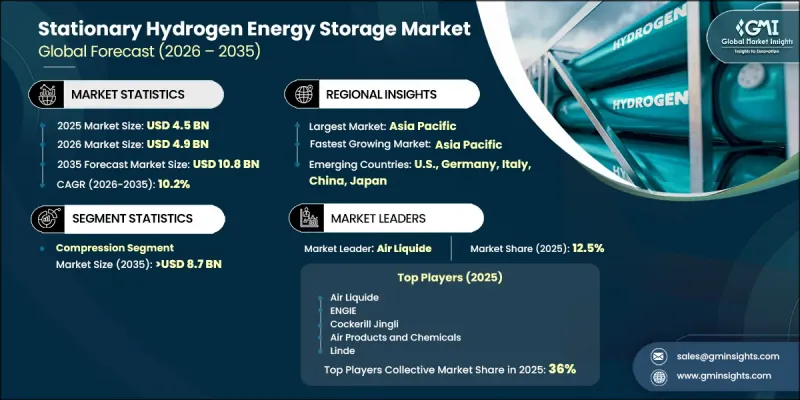
The market is gaining traction as hydrogen emerges as a key enabler of long-duration energy storage and grid stability in evolving energy systems. Ongoing advancements in hydrogen storage technologies, including solid-state and liquid-based systems, are improving efficiency while reducing overall lifecycle costs. These innovations are strengthening the economic viability of hydrogen-based storage solutions and expanding their deployment potential across large-scale energy infrastructure. The global shift toward decarbonization and increasing reliance on renewable energy sources is further accelerating demand for reliable storage systems that can balance intermittent power generation. Hydrogen plays a crucial role in integrating variable renewable energy such as wind and solar into modern grids by ensuring consistent energy supply and enhancing system resilience. Rising investments from both public and private sectors are supporting the expansion of hydrogen production, storage, and distribution infrastructure. Governments are reinforcing market development through financial incentives, policy frameworks, and regulatory support aimed at accelerating hydrogen adoption. At the same time, the growing deployment of renewable energy capacity is creating additional pressure for scalable and efficient storage technologies. Collectively, these factors are positioning stationary hydrogen energy storage as a critical component of future energy transition strategies worldwide.
| Market Scope | |
|---|---|
| Start Year | 2025 |
| Forecast Year | 2026-2035 |
| Start Value | $4.5 Billion |
| Forecast Value | $10.8 Billion |
| CAGR | 10.2% |
The compression segment is anticipated to reach USD 8.7 billion by 2035. Increasing adoption of hydrogen as an energy carrier has intensified the need for efficient and scalable storage solutions, with compression technology playing a central role in enabling practical applications. Continuous improvements in system efficiency, safety performance, and energy consumption are driving segment expansion. Advances in engineering design and material science are contributing to the development of more cost-effective and reliable compression systems. The segment is also benefiting from its operational simplicity and established technological maturity compared to alternative hydrogen storage approaches, which enhances its commercial attractiveness across multiple applications.
U.S. Stationary Hydrogen Energy Storage Market accounted for 77% share in 2025, generating USD 780.2 million. Growth in the country is driven by strong decarbonization targets, ongoing modernization of grid infrastructure, and increasing integration of renewable energy sources. Federal support programs promoting clean hydrogen production, along with incentives for electrolyzer deployment and long-duration energy storage systems, are encouraging large-scale investments. Utilities are increasingly adopting hydrogen-based storage to improve grid reliability, manage renewable energy fluctuations, and replace conventional fossil-fuel-based peaking power solutions. Expanding hydrogen hub development, defense-related microgrid applications, and backup power systems for critical infrastructure are further strengthening market demand. The presence of advanced technology providers, strong research and development capabilities, and supportive state-level clean energy policies continues to reinforce the country's leadership in this sector.
Major players operating in the Global Stationary Hydrogen Energy Storage Industry include SSE, FuelCell Energy, Inc., ENGIE, ITM Power PLC, McPhy Energy S.A., Linde plc, Air Liquide, Nel ASA, Air Products and Chemicals, Inc., Cockerill Jingli Compressed Hydrogen, GKN Hydrogen, and Gravitricity Ltd. Companies in the stationary hydrogen energy storage market are actively focusing on technological advancement to enhance storage efficiency, reduce costs, and improve system scalability. Many players are investing heavily in research and development to advance compression, liquefaction, and solid-state storage technologies. Strategic collaborations with energy utilities, industrial users, and government bodies are helping expand large-scale deployment opportunities. Firms are also strengthening their market position through investments in hydrogen infrastructure projects, including production and distribution networks. Expansion of manufacturing capacity and optimization of supply chains are enabling better cost control and improved project execution timelines.
Table of Contents
Chapter 1 Methodology & Scope
- 1.1 Research design
- 1.1.1 Research approach
- 1.1.2 Data collection methods
- 1.2 Base estimates and calculations
- 1.2.1 Base year calculation
- 1.2.2 Market estimates & forecast parameters
- 1.3 Forecast
- 1.3.1 Key trends for market estimates
- 1.3.2 Quantified market impact analysis
- 1.3.2.1 Mathematical impact of growth parameters on forecast
- 1.3.3 Scenario analysis framework
- 1.4 Primary research and validation
- 1.4.1 Some of the primary sources (but not limited to)
- 1.5 Data mining sources
- 1.5.1 Paid Sources
- 1.5.2 Sources, by region
- 1.6 Research trail & scoring components
- 1.6.1 Research trail components
- 1.6.2 Scoring components
- 1.7 Research transparency addendum
- 1.7.1 Source attribution framework
- 1.7.2 Quality assurance metrics
- 1.7.3 Our commitment to trust
- 1.8 Market definitions
Chapter 2 Executive Summary
- 2.1 Industry synopsis, 2022 - 2035
- 2.1.1 Business trends
- 2.1.2 Method trends
- 2.1.3 Regional trends
Chapter 3 Industry Insights
- 3.1 Industry ecosystem analysis
- 3.1.1 Raw material availability & sourcing analysis
- 3.1.2 Manufacturing capacity assessment
- 3.1.3 Supply chain resilience & risk factors
- 3.1.4 Distribution network analysis
- 3.2 Regulatory landscape
- 3.3 Industry impact forces
- 3.3.1 Growth drivers
- 3.3.2 Industry pitfalls & challenges
- 3.4 Growth potential analysis
- 3.5 Porter's analysis
- 3.5.1 Bargaining power of suppliers
- 3.5.2 Bargaining power of buyers
- 3.5.3 Threat of new entrants
- 3.5.4 Threat of substitutes
- 3.6 PESTEL analysis
- 3.6.1 Political factors
- 3.6.2 Economic factors
- 3.6.3 Social factors
- 3.6.4 Technological factors
- 3.6.5 Legal factors
- 3.6.6 Environmental factors
- 3.7 Trade data analysis (HS Code- 85042100) (Driven by Primary Research)
- 3.7.1 Import/export value trends (Driven by Primary Research)
- 3.7.2 Key trade corridors & tariff impact (Driven by Primary Research)
- 3.8 Capacity & production landscape (Driven by Primary Research)
- 3.8.1 Capacity by key producer (Driven by Primary Research)
- 3.8.2 Capacity utilization rates & expansion pipelines (Driven by Primary Research)
- 3.9 Emerging opportunities & trends
- 3.10 Investment analysis & future prospects
- 3.11 Sustainability initiatives & industry 4.0 integration
Chapter 4 Competitive Landscape, 2026
- 4.1 Introduction
- 4.2 Company market share analysis, by region, 2025
- 4.2.1 North America
- 4.2.2 Europe
- 4.2.3 Asia Pacific
- 4.3 Key developments
- 4.3.1 Key partnerships & collaborations
- 4.3.2 Major M&A activities
- 4.3.3 Product innovations & launches
- 4.3.4 Market expansion strategies
- 4.4 Competitive positioning matrix
Chapter 5 Market Size and Forecast, By Method, 2022 - 2035 (USD Million)
- 5.1 Key trends
- 5.2 Compression
- 5.3 Liquefaction
- 5.4 Material-based
Chapter 6 Market Size and Forecast, By Region, 2022 - 2035 (USD Million)
- 6.1 Key trends
- 6.2 North America
- 6.2.1 U.S.
- 6.2.2 Canada
- 6.2.3 Mexico
- 6.3 Europe
- 6.3.1 Germany
- 6.3.2 UK
- 6.3.3 France
- 6.3.4 Italy
- 6.3.5 Netherlands
- 6.3.6 Russia
- 6.4 Asia Pacific
- 6.4.1 China
- 6.4.2 India
- 6.4.3 Japan
- 6.5 Rest of World
Chapter 7 Company Profiles
- 7.1 Air Liquide
- 7.2 Air Products and Chemicals, Inc.
- 7.3 Cockerill Jingli Compressed hydrogen
- 7.4 ENGIE
- 7.5 FuelCell Energy, Inc.
- 7.6 GKN Compressed Hydrogen
- 7.7 Gravitricity Ltd
- 7.8 ITM Power PLC
- 7.9 Linde plc
- 7.10 McPhy Energy S.A.
- 7.11 Nel ASA
- 7.12 SSE

