PUBLISHER: Global Market Insights Inc. | PRODUCT CODE: 2045796

PUBLISHER: Global Market Insights Inc. | PRODUCT CODE: 2045796
Gas Turbine Oil Market Opportunity, Growth Drivers, Industry Trend Analysis, and Forecast 2026 - 2035
The Global Gas Turbine Oil Market was valued at USD 3 billion in 2025 and is estimated to grow at a CAGR of 7.2% to reach USD 6.1 billion by 2035.
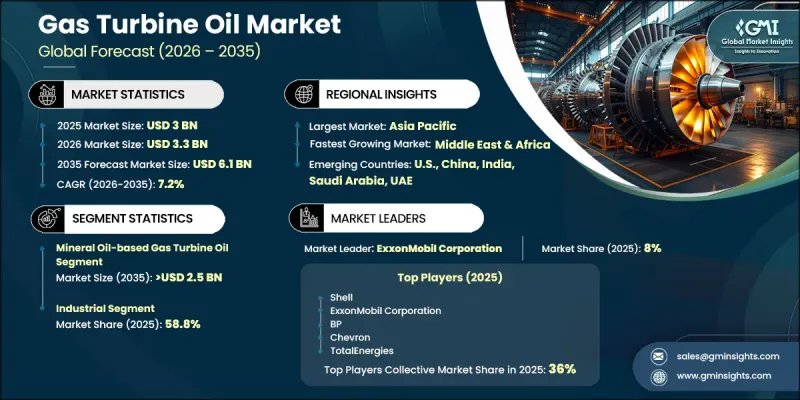
Growth in the gas turbine oil industry is driven by rising investments in power generation infrastructure and the increasing deployment of high-efficiency turbine systems by utilities and independent power producers. Expanding combined cycle power plants and peaking power units are significantly contributing to higher demand for advanced lubricants capable of withstanding extreme temperatures and oxidative stress. The growing focus on operational reliability and efficiency in modern power plants is further strengthening product adoption across the sector. In addition, the shift toward cleaner energy sources has accelerated the use of natural gas-based power generation, which in turn supports wider installation of gas turbines across industrial and utility applications. Gas turbine oil is specifically engineered to ensure smooth turbine operation under high temperature and pressure conditions by reducing friction, minimizing wear, and maintaining system cleanliness. These lubricants are formulated using advanced base oils and performance-enhancing additives that improve oxidation stability and deposit control. Increasing use of gas turbines across power utilities, manufacturing facilities, oil and gas operations, and large infrastructure projects continues to support sustained market expansion globally.
| Market Scope | |
|---|---|
| Start Year | 2025 |
| Forecast Year | 2026-2035 |
| Start Value | $3 Billion |
| Forecast Value | $6.1 Billion |
| CAGR | 7.2% |
The gas turbine oil market is also benefiting from increasing industrialization in emerging economies and rising demand for efficient energy systems. Industries are prioritizing longer equipment life, reduced maintenance requirements, and extended oil drain intervals, which is boosting demand for high-performance lubricants. Continuous technological improvements in lubricant formulation and growing adoption of energy-efficient industrial systems are further supporting long-term market development.
The industrial segment accounted for 58.8% share in 2025. Expansion of manufacturing activities and rapid industrial growth in developing regions are key factors driving demand within this segment. New industrial facilities and production plants are increasingly integrating gas turbine systems into their operations to enhance efficiency and energy output. Rising emphasis on reducing maintenance costs and extending lubrication cycles is further accelerating the adoption of advanced turbine oil solutions in industrial applications.
The mineral oil-based gas turbine oil segment is expected to reach USD 2.5 billion by 2035. These oils remain widely used due to their cost efficiency and compatibility with existing turbine systems, making them a preferred option for facilities seeking reliable lubrication without transitioning to more expensive synthetic alternatives. Advancements in refining processes such as hydrocracking and hydrotreating have further enhanced the performance characteristics of mineral oil-based formulations, improving their stability and operational efficiency in demanding turbine environments.
U.S. Gas Turbine Oil Market was valued at USD 530.1 million in 2025. Market growth in the country is driven by the need to improve operational efficiency and reduce maintenance expenses across power generation systems. Increasing investments in natural gas infrastructure and the integration of renewable-supported energy systems are further supporting demand for advanced turbine lubricants. The presence of modern power facilities and ongoing upgrades to energy infrastructure continue to strengthen market expansion across the United States.
Major companies operating in the Global Gas Turbine Oil Market include Shell, ExxonMobil Corporation, Chevron, BP, TotalEnergies, FUCHS, Castrol, Idemitsu, PETRONAS, Valvoline Global Operations, Afton Chemical, Eastman Chemical Company, Quaker Chemical Corporation, ADDINOL, NYCO, Gandhar Oil Refinery, Kuwait Petroleum Corporation, LUKOIL, Penrite Oil, and Eastern Petroleum. Companies operating in the gas turbine oil market are adopting several strategic measures to strengthen their competitive position and expand global reach. Manufacturers are investing in advanced formulation technologies to develop lubricants with superior oxidation resistance, thermal stability, and longer service life. Expansion of product portfolios tailored for different turbine types and operating conditions is helping companies address diverse industrial requirements. Strategic collaborations with power generation companies and industrial operators are supporting stronger distribution networks and long-term supply agreements. Businesses are also increasing their focus on research and development to improve lubricant efficiency and extend maintenance intervals. In addition, global players are expanding production capacities and strengthening regional presence to meet rising demand from emerging economies.
Table of Contents
Chapter 1 Methodology & Scope
- 1.1 Research approach
- 1.2 Quality commitments
- 1.2.1 GMI AI policy & data integrity commitment
- 1.2.1.1 Source consistency protocol
- 1.2.1 GMI AI policy & data integrity commitment
- 1.3 Research trail & confidence scoring
- 1.3.1 Research trail components
- 1.3.2 Scoring components
- 1.4 Data collection
- 1.4.1 Partial list of primary sources
- 1.5 Data mining sources
- 1.5.1 Paid sources
- 1.5.1.1 Sources, by region
- 1.5.1 Paid sources
- 1.6 Base estimates and calculations
- 1.6.1 Base year calculation for any one approach
- 1.7 Market estimates & forecasts parameters
- 1.8 Forecast model
- 1.8.1 Quantified market impact analysis
- 1.8.1.1 Mathematical impact of growth parameters on forecast
- 1.8.1 Quantified market impact analysis
- 1.9 Research transparency addendum
- 1.9.1 Source attribution framework
- 1.9.2 Quality assurance metrics
- 1.9.3 Our commitment to trust
- 1.10 Market definitions
Chapter 2 Executive Summary
- 2.1 Industry synopsis, 2022 - 2035
- 2.1.1 Business trends
- 2.1.2 Product trends
- 2.1.3 End use trends
- 2.1.4 Regional trends
Chapter 3 Industry Insights
- 3.1 Industry ecosystem analysis
- 3.1.1 Raw material availability & sourcing analysis
- 3.1.2 Manufacturing capacity assessment
- 3.1.3 Supply chain resilience & risk factors
- 3.1.4 Distribution network analysis
- 3.2 Industry impact forces
- 3.2.1 Growth drivers
- 3.2.2 Industry pitfalls & challenges
- 3.3 Regulatory landscape
- 3.4 Growth potential analysis
- 3.5 Porter's analysis
- 3.5.1 Bargaining power of suppliers
- 3.5.2 Bargaining power of buyers
- 3.5.3 Threat of new entrants
- 3.5.4 Threat of substitutes
- 3.6 PESTEL analysis
- 3.6.1 Political factors
- 3.6.2 Economic factors
- 3.6.3 Social factors
- 3.6.4 Technological factors
- 3.6.5 Legal factors
- 3.6.6 Environmental factors
- 3.7 Cost structure analysis of gas turbine oil
- 3.8 Emerging opportunities & trends
- 3.9 Digitalization & IoT integration
- 3.10 Growth in untapped markets & applications
- 3.11 Investment analysis & future prospects
- 3.12 Impact of AI & Generative AI on the market (Driven by Primary Research)
- 3.12.1 AI-Driven production optimization (Driven by Primary Research)
- 3.12.2 Predictive maintenance & fault detection (Driven by Primary Research)
Chapter 4 Competitive Landscape, 2026
- 4.1 Introduction
- 4.2 Company market share analysis, by region, 2025
- 4.2.1 North America
- 4.2.2 Europe
- 4.2.3 Asia Pacific
- 4.2.4 Middle East & Africa
- 4.2.5 Latin America
- 4.3 Competitive positioning matrix
- 4.4 Key developments
- 4.4.1 Mergers & acquisitions
- 4.4.2 Partnerships & collaborations
- 4.4.3 New product launches
- 4.4.4 Expansion plans & funding
- 4.5 Company tier benchmarking
- 4.5.1 Tier classification criteria & qualifying thresholds
- 4.5.2 Tier positioning matrix by revenue, geography & innovation
Chapter 5 Market Size and Forecast, By Product, 2022 - 2035 (USD Million)
- 5.1 Key trends
- 5.2 Mineral oil-based turbine oil
- 5.3 Synthetic turbine oil
- 5.4 Bio-based turbine oil
Chapter 6 Market Size and Forecast, By End Use, 2022 - 2035 (USD Million)
- 6.1 Key trends
- 6.2 Industrial
- 6.3 Utility
Chapter 7 Market Size and Forecast, By Region, 2022 - 2035 (USD Million)
- 7.1 Key trends
- 7.2 North America
- 7.2.1 U.S.
- 7.2.2 Canada
- 7.2.3 Mexico
- 7.3 Europe
- 7.3.1 UK
- 7.3.2 Russia
- 7.3.3 Italy
- 7.3.4 Germany
- 7.3.5 France
- 7.4 Asia Pacific
- 7.4.1 China
- 7.4.2 India
- 7.4.3 Japan
- 7.4.4 South Korea
- 7.5 Middle East & Africa
- 7.5.1 Saudi Arabia
- 7.5.2 UAE
- 7.5.3 Egypt
- 7.5.4 Algeria
- 7.6 Latin America
- 7.6.1 Brazil
- 7.6.2 Argentina
Chapter 8 Company Profiles
- 8.1 ADDINOL
- 8.2 Afton Chemical
- 8.3 BP
- 8.4 Castrol
- 8.5 Chevron
- 8.6 Eastern Petroleum
- 8.7 Eastman Chemical Company
- 8.8 Exxon Mobil Corporation
- 8.9 FUCHS
- 8.10 Gandhar Oil Refinery
- 8.11 Idemitsu
- 8.12 Kuwait Petroleum
- 8.13 LUKOIL Marine Lubricants
- 8.14 NYCO
- 8.15 Penrite Oil
- 8.16 PETRONAS
- 8.17 Quaker Chemical Corporation
- 8.18 Shell
- 8.19 TotalEnergies
- 8.20 Valvoline Global Operations

