PUBLISHER: Global Market Insights Inc. | PRODUCT CODE: 2045811

PUBLISHER: Global Market Insights Inc. | PRODUCT CODE: 2045811
Atmospheric Water Generator Market Opportunity, Growth Drivers, Industry Trend Analysis, and Forecast 2026 - 2035
The Global Atmospheric Water Generator Market was valued at USD 3 billion in 2025 and is estimated to grow at a CAGR of 8.9% to reach USD 7.1 billion by 2035.
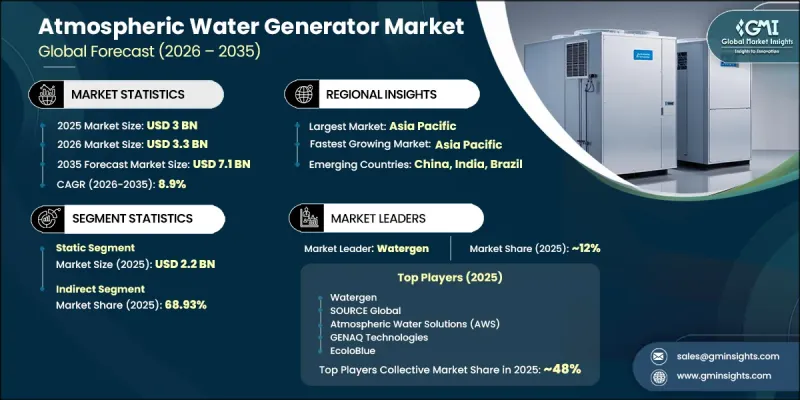
The industry is witnessing strong growth as demand for alternative and decentralized water supply solutions continues to rise across residential, commercial, and industrial sectors. Technological advancements in condensation efficiency, energy-optimized cooling systems, and advanced purification techniques such as multi-layer filtration, UV-based sterilization, and mineral enrichment are significantly improving system performance and reliability. Growing water scarcity concerns and increasing reliance on off-grid water generation systems are further strengthening adoption. The market is also benefiting from a shift away from conventional water sourcing methods toward atmospheric moisture extraction, which supports water independence and reduces dependency on centralized infrastructure. This transition is particularly relevant in regions facing water stress, emergency response requirements, and remote operational environments. Rising sustainability goals, climate resilience initiatives, and integration with renewable energy systems are further accelerating deployment. Continuous innovation, along with improved system scalability and operational efficiency, is shaping long-term growth prospects across global markets.
| Market Scope | |
|---|---|
| Start Year | 2025 |
| Forecast Year | 2026-2035 |
| Start Value | $3 Billion |
| Forecast Value | $7.1 Billion |
| CAGR | 8.9% |
The static atmospheric water generator segment held a share of 72.1% in 2025, reaching a USD 2.2 billion. This segment leads due to its suitability for fixed installations across residential complexes, commercial facilities, industrial operations, and large-scale water production setups. Its higher output capacity and ability to support continuous water generation make it a preferred choice for high-demand environments. Strong compatibility with centralized distribution systems and building infrastructure further enhances its adoption. The segment also benefits from integration with HVAC systems and smart building management platforms, improving operational efficiency. Its adaptability for installation in utility spaces such as rooftops, basements, and mechanical rooms enables seamless deployment without major structural modifications.
The indirect distribution channel accounted for 68.93% share in 2025. This channel includes retail partners, distributors, online platforms, and third-party vendors that enable wider market access and localized customer support. It plays a key role in expanding product availability across diverse regions, especially in emerging economies. The channel also supports financing options, installation assistance, and maintenance services, making atmospheric water generators more accessible to residential and small business users. Strong after-sales service networks and established distribution partnerships further enhance market penetration and customer reach.
North America Atmospheric Water Generator Market reached USD 700 million in 2025 and projected to grow at a CAGR of 9.1% through 2035. Growth in the region is supported by rising demand for sustainable and independent water supply systems, particularly in areas facing water infrastructure limitations. Increasing adoption of smart building technologies, renewable energy integration, and environmentally focused construction practices is strengthening market expansion. The region is also witnessing growing investment in IoT-enabled monitoring systems, predictive maintenance technologies, and solar-powered atmospheric water generation units, improving efficiency and operational reliability across applications.
Major companies operating in the Global Atmospheric Water Generator Market include SOURCE Global (formerly Zero Mass Water), Watergen, Skywell (formerly Island Sky Corporation), EcoloBlue, Inc., Ambient Water, Air2Water LLC, GENs AQUA Technologies S.L., Drinkable Air Technologies, WaterMaker India Pvt. Ltd., Atlantis Solar, Dew Point Manufacturing, Water Technologies International, Inc., Atmospheric Water Solutions (AWS), Akvo Atmospheric Water Systems Pvt. Ltd., Planets Water, and Hendrx Water. Companies in the atmospheric water generator market are focusing on expanding technological capabilities through continuous innovation in condensation efficiency, energy optimization, and purification systems. Many players are investing in research and development to improve water yield, reduce energy consumption, and enhance system durability under diverse climatic conditions. Strategic collaborations with renewable energy providers and IoT solution developers are helping integrate smart monitoring, automation, and predictive maintenance features. Businesses are also strengthening global distribution networks through partnerships with regional distributors and online platforms to improve accessibility. Expansion into water-stressed and off-grid regions is a key growth strategy, supported by customized product offerings.
Table of Contents
Chapter 1 Methodology and Scope
- 1.1 Market scope and definition
- 1.2 Research design
- 1.2.1 Research approach
- 1.2.2 Data collection methods
- 1.3 Data mining sources
- 1.3.1 Global
- 1.3.2 Regional/Country
- 1.4 Base estimates and calculations
- 1.4.1 Base year calculation
- 1.4.2 Key trends for market estimation
- 1.5 Primary research and validation
- 1.5.1 Primary sources
- 1.6 Forecast model
- 1.7 Research assumptions and limitations
Chapter 2 Executive Summary
- 2.1 Industry 360° synopsis
- 2.2 Key market trends
- 2.2.1 Regional
- 2.2.2 Type
- 2.2.3 Technology
- 2.2.4 Capacity
- 2.2.5 End Use
- 2.2.6 Distribution channel
Chapter 3 Industry Insights
- 3.1 Industry ecosystem analysis
- 3.1.1 Supplier landscape
- 3.1.2 Profit margin
- 3.1.3 Value addition at each stage
- 3.1.4 Factor affecting the value chain
- 3.2 Industry impact forces
- 3.2.1 Growth drivers
- 3.2.2 Industry pitfalls & challenges
- 3.2.3 Opportunities
- 3.3 Growth potential analysis
- 3.4 Regulatory landscape
- 3.5 Major market trends and disruptions
- 3.6 Technological and innovation landscape
- 3.6.1 Current technological trends
- 3.6.2 Emerging technologies
- 3.7 Pricing Analysis (Driven by Primary Research)
- 3.7.1 Historical Price Trend Analysis (Driven by Primary Research)
- 3.7.2 Pricing Strategy by Player Type (Premium / Value / Cost-plus) (Driven by Primary Research)
- 3.8 Future market trends
- 3.9 Trade statistics
- 3.9.1 Major importing countries
- 3.9.2 Major exporting countries
- 3.10 Porter's analysis
- 3.11 PESTEL analysis
- 3.12 Trade Data Analysis (Driven by Paid data source)
- 3.12.1 Import/Export Volume & Value Trends (Driven by Primary Research)
- 3.12.2 Key Trade Corridors & Tariff Impact (Driven by Primary Research)
- 3.12.3 Cross-Border Supply Chain Dynamics
- 3.13 Impact of AI & Generative AI on the Market
- 3.13.1 AI-Driven Disruption of Existing Business Models
- 3.13.2 GenAI Use Cases & Adoption Roadmap by Segment
- 3.13.3 Risks, Limitations & Regulatory Considerations
- 3.14 Capacity & Production Landscape (Driven by Primary Research)
- 3.14.1 Installed Capacity by Region & Key Producer (Modern vs. Traditional Trade) (Driven by Primary Research)
- 3.14.2 Capacity Utilization Rates & Expansion Pipelines (Driven by Primary Research)
Chapter 4 Competitive Landscape, 2025
- 4.1 Introduction
- 4.2 Company market share analysis
- 4.2.1 By region
- 4.2.1.1 North America
- 4.2.1.2 Europe
- 4.2.1.3 Asia Pacific
- 4.2.1.4 MEA
- 4.2.1.5 LATAM
- 4.2.1 By region
- 4.3 Company matrix analysis
- 4.4 Competitive analysis of major market players
- 4.5 Competitive positioning matrix
- 4.6 Key developments
- 4.6.1 Mergers & acquisitions
- 4.6.2 Partnerships & collaborations
- 4.6.3 New Product Launches
- 4.6.4 Expansion Plans
Chapter 5 Market Estimates and Forecast, By Type, 2022 - 2035 (USD Billion) (Thousand Units)
- 5.1 Key trends
- 5.2 Static
- 5.3 Mobile
Chapter 6 Market Estimates & Forecast, By Technology, 2022-2035 (USD Billion) (Thousand Units)
- 6.1 Key trends
- 6.2 Cooling condensation
- 6.3 Wet/Liquid desiccation
Chapter 7 Market Estimates & Forecast, By Capacity, 2022-2035 (USD Billion) (Thousand Units)
- 7.1 Key trends
- 7.2 1L-500L
- 7.3 500L-1000L
- 7.4 1000L-5000L
- 7.5 5000L-10,000L
Chapter 8 Market Estimates & Forecast, By End Use, 2022-2035 (USD Billion) (Thousand Units)
- 8.1 Key trends
- 8.2 Residential
- 8.3 Commercial
- 8.4 Industrial
Chapter 9 Market Estimates & Forecast, By Distribution Channel, 2022-2035 (USD Billion) (Thousand Units)
- 9.1 Key trends
- 9.2 Direct
- 9.3 Indirect
Chapter 10 Market Estimates & Forecast, By Region, 2022 - 2035, (USD Billion) (Thousand Units)
- 10.1 Key trends
- 10.2 North America
- 10.2.1 U.S.
- 10.2.2 Canada
- 10.3 Europe
- 10.3.1 UK
- 10.3.2 Germany
- 10.3.3 France
- 10.3.4 Italy
- 10.3.5 Spain
- 10.4 Asia Pacific
- 10.4.1 China
- 10.4.2 Japan
- 10.4.3 India
- 10.4.4 South Korea
- 10.4.5 Australia
- 10.5 Latin America
- 10.5.1 Brazil
- 10.5.2 Mexico
- 10.6 MEA
- 10.6.1 South Africa
- 10.6.2 Saudi Arabia
- 10.6.3 UAE
Chapter 11 Company Profiles
- 11.1 Top Global Players
- 11.1.1 Watergen
- 11.1.2 EcoloBlue, Inc.
- 11.1.3 GENAQ Technologies S.L.
- 11.1.4 Skywell
- 11.1.5 Air2Water LLC
- 11.1.6 SOURCE Global
- 11.1.7 Akvo Atmospheric Water Systems Pvt. Ltd.
- 11.1.8 Atmospheric Water Solutions (AWS)
- 11.2 Regional players
- 11.2.1 WaterMaker India Pvt. Ltd.
- 11.2.2 Atlantis Solar
- 11.2.3 Dew Point Manufacturing
- 11.2.4 Ambient Water
- 11.2.5 Water Technologies International, Inc.
- 11.3 Emerging Players
- 11.3.1 Drinkable Air Technologies
- 11.3.2 Hendrx Water
- 11.3.3 Planets Water

