PUBLISHER: Global Market Insights Inc. | PRODUCT CODE: 2061283

PUBLISHER: Global Market Insights Inc. | PRODUCT CODE: 2061283
EV Next-Generation Solid-State Battery Market Opportunity, Growth Drivers, Industry Trend Analysis, and Forecast 2026 - 2035
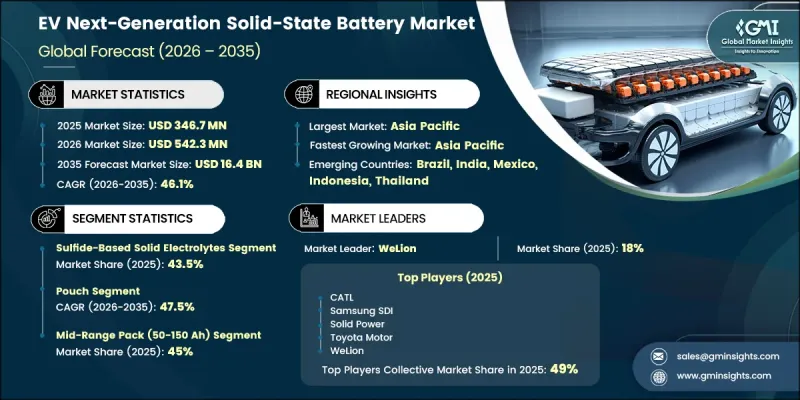
The Global EV Next-Generation Solid-State Battery Market was valued at USD 346.7 million in 2025 and is estimated to grow at a CAGR of 46.1% to reach USD 16.4 billion by 2035.
The EV next-generation solid-state battery industry is gaining significant traction as the automotive sector accelerates its transition toward advanced electric mobility solutions. Rising demand for electric vehicles continues to encourage battery manufacturers and automotive companies to invest heavily in next-generation battery technologies capable of delivering improved efficiency and enhanced driving performance. Solid-state batteries are attracting strong attention because they offer higher energy density, enabling electric vehicles to achieve extended driving ranges while maintaining compact battery sizes. Increasing consumer expectations for shorter charging times are also contributing to rapid technological progress across the market. Advanced battery architectures support improved ion conductivity and greater power output, helping reduce charging durations and improve overall vehicle convenience. Safety remains another major growth factor supporting adoption within the EV next-generation solid-state battery market. Compared to conventional battery technologies, solid-state systems provide enhanced thermal stability and lower safety risks, making them increasingly attractive for electric vehicle applications. Ongoing investments in battery innovation, manufacturing capabilities, and automotive electrification initiatives are expected to further strengthen market expansion globally over the coming years.
| Market Scope | |
|---|---|
| Start Year | 2025 |
| Forecast Year | 2026-2035 |
| Start Value | $346.7 Million |
| Forecast Value | $16.4 Billion |
| CAGR | 46.1% |
The sulfide-based solid electrolytes segment held a 43.5% share in 2025 and is anticipated to register a CAGR of 47.2% from 2026 to 2035. Sulfide-based electrolyte materials continue to gain strong commercial interest due to their superior ionic conductivity, which closely matches the performance characteristics of liquid electrolytes. These materials support faster charging capabilities and contribute to higher energy storage efficiency, making them highly suitable for next-generation electric vehicle battery systems. However, the segment continues to face manufacturing challenges associated with moisture sensitivity, which increases production complexity and overall processing costs within large-scale battery manufacturing operations.
The pouch segment accounted for 46.7% share in 2025 and is forecast to grow at a CAGR of 47.5% through 2035. Pouch cell batteries are widely preferred due to their lightweight structure and flexible packaging design, which support improved energy efficiency and optimized battery integration within electric vehicles. These batteries offer high energy density and allow greater customization for vehicle manufacturers seeking compact and efficient battery solutions. Despite these advantages, pouch cells remain vulnerable to swelling issues and limited structural durability, which continue to present engineering and performance challenges for manufacturers operating in the market.
U.S. EV Next-Generation Solid-State Battery Market reached USD 59 million in 2025 and is expected to grow at a CAGR of 45.9% between 2026 and 2035. The United States continues to emerge as a major innovation hub for advanced battery technologies due to increasing investments from venture capital firms, technology developers, and automotive manufacturers. Growing financial support for battery research and commercialization activities is accelerating product development timelines and strengthening domestic manufacturing capabilities. Strategic collaborations between battery developers and automakers are also becoming increasingly common as companies seek to secure long-term battery supply chains and accelerate electric vehicle production goals. In addition, automotive manufacturers are expanding investments in internal research programs and collaborative development agreements to strengthen their competitive position within the rapidly evolving solid-state battery industry.
Key companies operating in the EV Next-Generation Solid-State Battery Market include BYD, CATL, LG Energy Solution, Nissan, Panasonic Energy, ProLogium Technology, QuantumScape, Samsung SDI, SK On, Solid Power, Toyota Motor, and WeLion. Companies participating in the EV next-generation solid-state battery market are adopting multiple strategic initiatives to strengthen their market presence and technological leadership. Major industry participants are increasing investments in research and development activities focused on improving energy density, battery safety, charging speed, and manufacturing scalability. Strategic partnerships between automotive manufacturers and battery developers are becoming increasingly important for securing long-term supply agreements and accelerating commercialization efforts. Many companies are also expanding pilot production facilities and investing in advanced manufacturing infrastructure to support large-scale deployment of solid-state battery technologies. In addition, businesses are pursuing intellectual property development and patent expansion to strengthen competitive advantages within the evolving market landscape.
Table of Contents
Chapter 1 Methodology
- 1.1 Research approach
- 1.2 Quality Commitments
- 1.2.1 GMI AI policy & data integrity commitment
- 1.2.1.1 Source consistency protocol
- 1.2.1 GMI AI policy & data integrity commitment
- 1.3 Research Trail & Confidence Scoring
- 1.3.1 Research Trail Components
- 1.3.2 Scoring Components
- 1.4 Data Collection
- 1.4.1 Partial list of primary sources
- 1.5 Data mining sources
- 1.5.1 Paid sources
- 1.5.1.1 Sources, by region
- 1.5.1 Paid sources
- 1.6 Base estimates and calculations
- 1.6.1 Base year calculation
- 1.7 Forecast model
- 1.7.1 Quantified market impact analysis
- 1.7.1.1 Mathematical impact of growth parameters on forecast
- 1.7.1 Quantified market impact analysis
- 1.8 Research transparency addendum
- 1.8.1 Source attribution framework
- 1.8.2 Quality assurance metrics
- 1.8.3 Our commitment to trust
Chapter 2 Executive Summary
- 2.1 Industry 360° synopsis
- 2.2 Key market trends
- 2.2.1 Regional
- 2.2.2 Electrolyte
- 2.2.3 Battery form
- 2.2.4 Capacity range
- 2.2.5 Vehicle
- 2.3 TAM analysis, 2026-2035
- 2.4 CXO perspectives: Strategic imperatives
Chapter 3 Industry Insights
- 3.1 Industry ecosystem analysis
- 3.1.1 Supplier landscape
- 3.1.2 Profit margin
- 3.1.3 Cost structure
- 3.1.4 Value addition at each stage
- 3.1.5 Factor affecting the value chain
- 3.1.6 Disruptions
- 3.2 Industry impact forces
- 3.2.1 Growth drivers
- 3.2.1.1 EV range extension demand
- 3.2.1.2 Fast-charging requirement
- 3.2.1.3 Automotive safety improvement push
- 3.2.1.4 Government EV electrification mandates
- 3.2.2 Industry pitfalls and challenges
- 3.2.2.1 High manufacturing cost
- 3.2.2.2 Scalability challenges
- 3.2.3 Market opportunities
- 3.2.3.1 Premium EV segment expansion
- 3.2.3.2 Commercial fleet electrification
- 3.2.3.3 Strategic OEM-battery partnerships
- 3.2.3.4 Energy density breakthrough innovations
- 3.2.1 Growth drivers
- 3.3 Growth potential analysis
- 3.4 Technology and innovation landscape
- 3.4.1 Current technological trends
- 3.4.2 Emerging technologies
- 3.5 Pricing Analysis (Driven by Primary Research)
- 3.5.1 Historical Price Trend Analysis
- 3.5.2 Pricing Strategy by Player Type
- 3.6 Regulatory landscape
- 3.6.1 North America
- 3.6.1.1 U.S. Department of Energy (DOE)
- 3.6.1.2 National Highway Traffic Safety Administration (NHTSA)
- 3.6.2 Europe
- 3.6.2.1 European Commission Directorate-General for Mobility and Transport (DG MOVE)
- 3.6.2.2 European Chemicals Agency (ECHA)
- 3.6.3 Asia Pacific
- 3.6.3.1 Ministry of Industry and Information Technology (MIIT)
- 3.6.3.2 Ministry of Heavy Industries (MHI)
- 3.6.4 Latin America
- 3.6.4.1 Ministry of Development, Industry, Trade and Services (MDIC)
- 3.6.4.2 Secretariat of Economy (SE)
- 3.6.5 Middle East & Africa
- 3.6.5.1 Ministry of Industry and Advanced Technology (MoIAT)
- 3.6.5.2 Ministry of Industry and Mineral Resources
- 3.6.1 North America
- 3.7 Porter's analysis
- 3.8 PESTEL analysis
- 3.9 Trade Data Analysis (Driven by Primary Research)
- 3.9.1 Import/Export Volume & Value Trends
- 3.9.2 Key Trade Corridors & Tariff Impact
- 3.10 Patent analysis (Driven by Primary Research)
- 3.11 Capacity & Production Landscape (Driven by Primary Research)
- 3.11.1 Installed Capacity by Region & Key Producer
- 3.11.2 Capacity Utilization Rates & Expansion Pipelines
- 3.12 Impact of AI & Generative AI on the Market
- 3.12.1 AI-driven disruption of existing business models
- 3.12.2 Gen AI use cases & adoption roadmap by segment
- 3.12.3 Risks, limitations & regulatory considerations
- 3.13 Sustainability and environmental aspects
- 3.13.1 Sustainable practices
- 3.13.2 Waste reduction strategies
- 3.13.3 Energy efficiency in production
- 3.13.4 Eco-friendly initiatives
- 3.13.5 Carbon footprint considerations
- 3.14 Forecast assumptions & scenario analysis (Driven by primary research)
- 3.14.1 Base Case - key macro & industry variables driving CAGR
- 3.14.2 Optimistic Scenarios - Favorable macro and industry tailwinds
- 3.14.3 Pessimistic Scenario - Macroeconomic slowdown or industry headwinds
Chapter 4 Competitive Landscape, 2025
- 4.1 Introduction
- 4.2 Company market share analysis
- 4.2.1 North America
- 4.2.2 Europe
- 4.2.3 Asia Pacific
- 4.2.4 LATAM
- 4.2.5 MEA
- 4.3 Competitive analysis of major market players
- 4.4 Competitive positioning matrix
- 4.5 Key developments
- 4.5.1 Mergers & acquisitions
- 4.5.2 Partnerships & collaborations
- 4.5.3 New product launches
- 4.5.4 Expansion plans and funding
- 4.6 Company tier benchmarking
- 4.6.1 Tier classification criteria & qualifying thresholds
- 4.6.2 Tier positioning matrix by revenue, geography & innovation
Chapter 5 Market Estimates & Forecast, By Electrolyte, 2022 - 2035 ($Mn)
- 5.1 Key trends
- 5.2 Oxide-based solid electrolytes
- 5.3 Polymer-based solid electrolytes
- 5.4 Sulfide-based solid electrolytes
- 5.5 Composite/hybrid electrolytes
Chapter 6 Market Estimates & Forecast, By Battery Form, 2022 - 2035 ($Mn)
- 6.1 Key trends
- 6.2 Pouch
- 6.3 Prismatic
- 6.4 Cylindrical
Chapter 7 Market Estimates & Forecast, By Capacity Range, 2022 - 2035 ($Mn)
- 7.1 Key trends
- 7.2 Small Pack (Below 50 Ah)
- 7.3 Mid-Range Pack (50-150 Ah)
- 7.4 Large Pack (Above 150 Ah)
Chapter 8 Market Estimates & Forecast, By Vehicle, 2022 - 2035 ($Mn)
- 8.1 Key trends
- 8.2 Passenger cars
- 8.2.1 Sedan
- 8.2.2 SUV
- 8.2.3 Hatchback
- 8.3 Commercial Vehicles
- 8.3.1 LCV
- 8.3.2 MCV
- 8.3.3 HCV
Chapter 9 Market Estimates & Forecast, By Region, 2022 - 2035 ($Mn)
- 9.1 Key trends
- 9.2 North America
- 9.2.1 U.S.
- 9.2.2 Canada
- 9.3 Europe
- 9.3.1 Germany
- 9.3.2 UK
- 9.3.3 France
- 9.3.4 Italy
- 9.3.5 Spain
- 9.3.6 Russia
- 9.3.7 Netherlands
- 9.4 Asia Pacific
- 9.4.1 China
- 9.4.2 India
- 9.4.3 Japan
- 9.4.4 South Korea
- 9.4.5 Australia
- 9.4.6 Thailand
- 9.4.7 Indonesia
- 9.5 Latin America
- 9.5.1 Brazil
- 9.5.2 Mexico
- 9.5.3 Argentina
- 9.6 MEA
- 9.6.1 South Africa
- 9.6.2 Saudi Arabia
- 9.6.3 UAE
Chapter 10 Company Profiles
- 10.1 Global players
- 10.1.1 BMW
- 10.1.2 BYD
- 10.1.3 CATL (Contemporary Amperex Technology)
- 10.1.4 LG Energy Solution
- 10.1.5 Panasonic Energy
- 10.1.6 Samsung SDI
- 10.1.7 Toyota Motor
- 10.1.8 Volkswagen
- 10.2 Regional players
- 10.2.1 Automotive Cells Company (ACC)
- 10.2.2 General Motors (GM)
- 10.2.3 Hyundai Motor
- 10.2.4 Nissan Motor
- 10.2.5 SK Innovation / SK On
- 10.2.6 Stellantis
- 10.2.7 SVOLT Energy Technology
- 10.3 Emerging players
- 10.3.1 Factorial Energy
- 10.3.2 ProLogium Technology
- 10.3.3 QuantumScape
- 10.3.4 Solid Power
- 10.3.5 WeLion

