PUBLISHER: Global Market Insights Inc. | PRODUCT CODE: 2061299

PUBLISHER: Global Market Insights Inc. | PRODUCT CODE: 2061299
North America Cold Chain Equipment Market Opportunity, Growth Drivers, Industry Trend Analysis, and Forecast 2026 - 2035
North America Cold Chain Equipment Market was valued at USD 12.5 billion in 2025 and is estimated to grow at a CAGR of 6.9% to reach USD 24 billion by 2035.
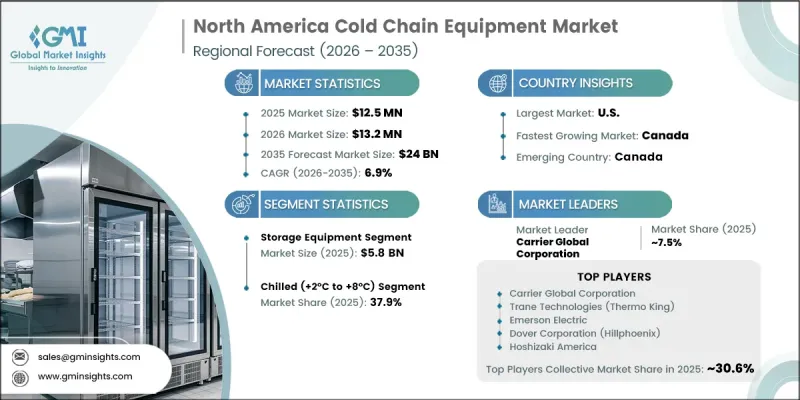
The market is experiencing steady growth as changing consumer lifestyles and rising demand for convenient food options continue to reshape consumption patterns across the region. Increasing preference for frozen meals, packaged foods, dairy products, and ready-to-eat items is driving the need for efficient temperature-controlled storage and transportation systems that preserve product quality and safety throughout the supply chain. Expansion of organized food retail networks, including supermarkets and online grocery delivery platforms, is further strengthening the demand for advanced cold chain infrastructure. Companies across the sector are increasingly investing in energy-efficient refrigeration technologies and smart temperature monitoring solutions to improve operational efficiency and reduce losses. At the same time, the rising consumption of perishable and temperature-sensitive products is sustaining long-term market expansion. Strong growth in pharmaceutical and biotechnology industries is also contributing significantly, as vaccines, biologics, specialty drugs, and laboratory products require strict temperature regulation from production to end use. This combined demand from food and healthcare sectors continues to reinforce market development across North America.
| Market Scope | |
|---|---|
| Start Year | 2025 |
| Forecast Year | 2026-2035 |
| Start Value | $12.5 Billion |
| Forecast Value | $24 Billion |
| CAGR | 6.9% |
The storage equipment segment generated USD 5.8 billion in 2025 and is expected to grow at a CAGR of 4.7% from 2026 to 2035. This segment holds a leading position in the North America cold chain equipment market due to rising investments in refrigerated warehouses, cold rooms, industrial cooling systems, and pharmaceutical-grade storage facilities. These systems play a critical role in maintaining consistent temperature conditions over long durations, ensuring product integrity in food processing, biologics preservation, vaccine storage, and pharmaceutical inventory management. The continuous expansion of frozen food logistics and organized cold storage infrastructure is further driving segment growth.
The chilled segment, operating within a temperature range of +2°C to +8°C, accounted for 37.9% share in 2025 and is projected to grow at a CAGR of 6.2% from 2026 to 2035. This segment remains highly important across the North America cold chain equipment market due to its widespread application in dairy products, pharmaceuticals, biologics, fresh produce, and other temperature-sensitive goods. Chilled storage and transportation systems help maintain stable cooling conditions, reducing spoilage and preserving product effectiveness throughout distribution and storage cycles. Rising demand for biologics and processed food products requiring controlled refrigeration is further supporting segment expansion.
U.S. Cold Chain Equipment Market reached USD 10.9 billion in 2025 and is expected to grow at a CAGR of 6.8% from 2026 to 2035. Market growth in the country is driven by strong demand from food processing, pharmaceutical manufacturing, grocery retail, and e-commerce distribution sectors. Increasing consumption of frozen and ready-to-eat food products is accelerating the adoption of advanced refrigeration systems, temperature-controlled storage units, and transport cooling solutions. The pharmaceutical sector also plays a crucial role, particularly in the distribution of vaccines and biologics that require strict temperature control throughout the supply chain.
Major companies operating in the North America cold chain equipment industry include Carrier Global Corporation, Trane Technologies (Thermo King), Emerson Electric, Johnson Controls International, Daikin, Danfoss A/S, and Dover Corporation (Hillphoenix). Regional participants include Hoshizaki America, Hussmann Corporation, Chart Industries, True Manufacturing, Welbilt, Lennox International, and Middleby Corporation. Emerging and specialized players in the North America cold chain equipment market include ThermoSafe (Sonoco Products), Peli BioThermal, Cold Chain Technologies, Haier Biomedical, va-Q-tec, Cryoport, and Epta Group (Anthony International). Companies operating in the North America cold chain equipment market are adopting several strategic initiatives to strengthen their competitive position and expand market reach. Manufacturers are increasingly focusing on developing energy-efficient and low-emission refrigeration systems to meet sustainability targets and regulatory requirements. Significant investments are being directed toward smart monitoring technologies, including IoT-enabled temperature tracking and predictive maintenance solutions, to enhance supply chain reliability and reduce product losses. Companies are also expanding their service portfolios by offering integrated cold chain solutions that combine storage, transportation, and monitoring systems. Strategic partnerships with food distributors, pharmaceutical companies, and logistics providers are further strengthening market presence.
Table of Contents
Chapter 1 Methodology & Scope
- 1.1 Market scope and definition
- 1.2 Research design
- 1.2.1 Research approach
- 1.2.2 Data collection methods
- 1.3 Data mining sources
- 1.3.1 Global
- 1.3.2 Regional/Country
- 1.4 Base estimates and calculations
- 1.4.1 Base year calculation
- 1.4.2 Key trends for market estimation
- 1.5 Primary research and validation
- 1.5.1 Primary sources
- 1.6 Forecast model
- 1.7 Research assumptions and limitations
Chapter 2 Executive Summary
- 2.1 Industry 360° synopsis
- 2.2 Key market trends
- 2.2.1 Country
- 2.2.2 Equipment type
- 2.2.3 Temperature range
- 2.2.4 Application
- 2.2.5 Mode of operation
- 2.2.6 Distribution channel
Chapter 3 Industry Insights
- 3.1 Industry ecosystem analysis
- 3.1.1 Supplier landscape
- 3.1.2 Profit margin
- 3.1.3 Value addition at each stage
- 3.1.4 Factor affecting the value chain
- 3.2 Industry impact forces
- 3.2.1 Growth drivers
- 3.2.1.1 Rising demand for temperature-sensitive transportation and storage solutions
- 3.2.1.2 Expansion of biologics, vaccines, and temperature-sensitive pharmaceutical products
- 3.2.1.3 Growing investment in organized cold storage infrastructure and food logistics
- 3.2.2 Pitfalls & Challenges
- 3.2.2.1 High installation and operational costs associated with advanced refrigeration systems
- 3.2.2.2 Energy consumption and maintenance complexity of cold chain infrastructure
- 3.2.3 Opportunities
- 3.2.3.1 Increasing adoption of IoT-enabled monitoring and automation technologies
- 3.2.3.2 Expansion of pharmaceutical cold chain infrastructure across emerging economies
- 3.2.1 Growth drivers
- 3.3 Growth potential analysis
- 3.4 Future market trends
- 3.5 Technology and innovation landscape
- 3.5.1 Current technological trends
- 3.5.2 Emerging technologies
- 3.6 Regulatory landscape
- 3.6.1 Standards and compliance requirements
- 3.6.2 Regional regulatory frameworks
- 3.6.3 Certification standards
- 3.7 Porter's analysis
- 3.8 PESTEL analysis
- 3.9 Pricing analysis (driven by primary research)
- 3.9.1 Historical price trend analysis (driven by primary research)
- 3.9.2 Pricing strategy by player type (premium / value / cost-plus) (driven by primary research)
- 3.10 Trade data analysis (HS Code 8418 for active refrigerating/freezing machinery and HS Code 9406 for insulated cold room structures) (driven by paid database)
- 3.10.1 Import/export volume and value trends (driven by paid database)
- 3.10.2 Key trade corridors and tariff impact (driven by paid database)
- 3.11 Impact of AI and generative AI on the market
- 3.11.1 AI-driven disruption of existing business models
- 3.11.2 GenAI use cases and adoption roadmap by segment
- 3.11.3 Risks, limitations and regulatory considerations
- 3.12 Capacity and production landscape (driven by primary research)
- 3.12.1 Installed capacity by region and key producer (driven by primary research)
- 3.12.2 Capacity utilization rates and expansion pipelines (driven by primary research)
Chapter 4 Competitive Landscape, 2025
- 4.1 Introduction
- 4.2 Company market share analysis
- 4.2.1 By Country
- 4.2.1.1 U.S.
- 4.2.1.2 Canada
- 4.2.1 By Country
- 4.3 Company matrix analysis
- 4.4 Competitive analysis of major market players
- 4.5 Competitive positioning matrix
- 4.6 Key developments
- 4.6.1 Mergers & acquisitions
- 4.6.2 Partnerships & collaborations
- 4.6.3 New product launches
- 4.6.4 Expansion plans
Chapter 5 Market Estimates & Forecast, By Equipment Type, 2022 - 2035, (USD Billion) (Thousand Units)
- 5.1 Key trends
- 5.2 Storage Equipment
- 5.3 Transportation Equipment
- 5.4 Monitoring & Control Systems
- 5.5 Temperature-Controlled Packaging
Chapter 6 Market Estimates & Forecast, By Temperature Range, 2022 - 2035, (USD Billion) (Thousand Units)
- 6.1 Key trends
- 6.2 Controlled Ambient (+15°C to +25°C)
- 6.3 Chilled (+2°C to +8°C)
- 6.4 Frozen (-18°C to -25°C)
- 6.5 Cryogenic (Below -80°C)
Chapter 7 Market Estimates & Forecast, By Application, 2022 - 2035, (USD Billion) (Thousand Units)
- 7.1 Key trends
- 7.2 Food & Beverages
- 7.2.1 Fruits & Vegetables
- 7.2.2 Dairy Products
- 7.2.3 Meat, Fish & Seafood
- 7.2.4 Processed Food & Ready-to-Eat Meals
- 7.2.5 Bakery & Confectioneries
- 7.2.6 Others
- 7.3 Pharmaceuticals
- 7.3.1 Vaccines
- 7.3.2 Biologics & Biosimilars
- 7.3.3 Temperature-Sensitive APIs
- 7.3.4 Clinical Trial Materials
- 7.4 Healthcare
- 7.4.1 Blood Products & Plasma
- 7.4.2 Organs & Tissue for Transplantation
- 7.4.3 Medical Supplies & Reagents
- 7.5 Chemicals
- 7.5.1 Specialty Chemicals
- 7.5.2 Volatile Compounds
- 7.6 Biotechnology
- 7.6.1 Cell & Gene Therapies
- 7.6.2 Research Samples & Biobanking
- 7.7 Others
Chapter 8 Market Estimates & Forecast, By Mode of Operation, 2022 - 2035, (USD Billion) (Thousand Units)
- 8.1 Key trends
- 8.2 Active Systems
- 8.3 Passive Systems
Chapter 9 Market Estimates & Forecast, By Distribution Channel, 2022 - 2035, (USD Billion) (Thousand Units)
- 9.1 Key trends
- 9.2 Direct Sales
- 9.3 Indirect Sales
Chapter 10 Market Estimates & Forecast, By Country, 2022 - 2035, (USD Billion) (Thousand Units)
- 10.1 Key trends
- 10.2 U.S.
- 10.3 Canada
Chapter 11 Company Profiles
- 11.1 Top Global Players
- 11.1.1 Carrier Global Corporation
- 11.1.2 Trane Technologies (Thermo King)
- 11.1.3 Emerson Electric
- 11.1.4 Johnson Controls International
- 11.1.5 Daikin
- 11.1.6 Danfoss A/S
- 11.1.7 Dover Corporation (Hillphoenix)
- 11.2 Regional Champions
- 11.2.1 Hoshizaki America
- 11.2.2 Hussmann Corporation
- 11.2.3 Chart Industries
- 11.2.4 True Manufacturing
- 11.2.5 Welbilt
- 11.2.6 Lennox International
- 11.2.7 Middleby Corporation
- 11.3 Emerging & Specialized Players
- 11.3.1 ThermoSafe (Sonoco Products)
- 11.3.2 Peli BioThermal
- 11.3.3 Cold Chain Technologies
- 11.3.4 Haier Biomedical North America
- 11.3.5 va-Q-tec North America
- 11.3.6 Cryoport
- 11.3.7 Epta Group (Anthony International)

