PUBLISHER: Global Market Insights Inc. | PRODUCT CODE: 2061337

PUBLISHER: Global Market Insights Inc. | PRODUCT CODE: 2061337
Asia Pacific Activewear Market Opportunity, Growth Drivers, Industry Trend Analysis, and Forecast 2026 - 2035
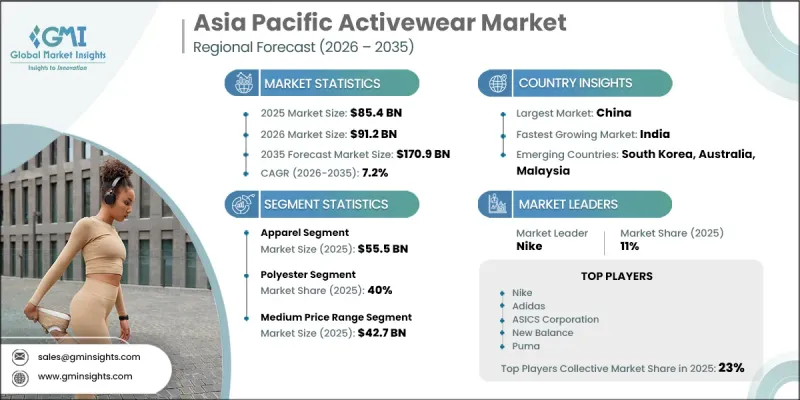
Asia Pacific Activewear Market was valued at USD 85.4 billion in 2025 and is estimated to grow at a CAGR of 7.2% to reach USD 170.9 billion by 2035.
Rising consumer awareness regarding health, wellness, and fitness is playing a major role in the expansion of the Asia Pacific activewear industry. Increasing concerns related to lifestyle-related health conditions are encouraging consumers to adopt more active routines, leading to stronger participation in physical activities and fitness-focused lifestyles. This shift is significantly increasing demand for activewear products that combine comfort, durability, and performance-oriented functionality. Consumers are increasingly viewing activewear as an everyday necessity rather than an occasional purchase, particularly as fitness participation continues to rise across urban and semi-urban populations. The market is also benefiting from the growing popularity of organized fitness facilities and digital workout platforms, which are encouraging regular exercise habits among consumers. Easy access to online fitness content and mobile wellness applications has further accelerated product adoption across multiple demographic groups. In addition, consumers are increasingly seeking apparel that supports both athletic performance and casual daily wear, contributing to the strong growth of athleisure trends across the Asia Pacific region.
| Market Scope | |
|---|---|
| Start Year | 2025 |
| Forecast Year | 2026-2035 |
| Start Value | $85.4 Billion |
| Forecast Value | $170.9 Billion |
| CAGR | 7.2% |
The apparel segment accounted for USD 55.5 billion in 2025. Growth within the apparel category is being supported by rising participation in fitness and recreational activities among diverse consumer groups, including young adults, working professionals, and female consumers. Increasing disposable income levels are also encouraging consumers to purchase a wider range of activewear products suited for different activities and lifestyle preferences. Expanding digital retail channels and e-commerce platforms are improving product accessibility and significantly influencing purchasing decisions across the region. Brands operating in the Asia Pacific activewear industry are increasingly focusing on localized product offerings, competitive pricing strategies, and sustainability-focused initiatives to strengthen their market presence and consumer engagement.
The polyester segment held a 40% share in 2025. Polyester continues to dominate activewear material demand across the region due to its strong balance of performance efficiency and cost-effectiveness. Manufacturers widely prefer polyester because of its lightweight structure, durability, and resistance to shrinking and wrinkling, making it highly suitable for sportswear and fitness apparel production. Consumers are also increasingly choosing polyester-based activewear because these products maintain their shape, comfort, and overall performance even after repeated usage and frequent washing cycles. The material's versatility and reliability continue to support its widespread adoption across multiple activewear categories.
China Activewear Market held a 48.5% share, generating USD 41.5 billion in 2025. The country remains one of the fastest-growing activewear markets in the region due to its expanding economy and rapidly increasing population of health-conscious consumers. Rising participation in fitness-related activities and outdoor recreation is driving strong demand for both performance-focused and fashion-oriented activewear products. Consumers are increasingly prioritizing product quality, comfort, design appeal, and brand reputation when making purchasing decisions. In addition, the growing influence of digital platforms and online trend adoption is accelerating consumer interest in fashionable athleisure products and supporting rapid market expansion across China.
Major companies operating in the Asia Pacific activewear market include global brands such as ASICS Corporation, Nike, Adidas, Puma, Under Armour, Lululemon Athletica, and New Balance. Regional participants include Peak Sport Products, Xtep International Holdings, Yonex Co., Ltd., FILA Korea, Kappa, Skechers, and Amer Sports. Emerging brands shaping the Asia Pacific activewear industry include MAIA ACTIVE, Outdoor Voices, Alo Yoga, Nimble Activewear, Running Bare, Icebreaker, and Vuori. Companies operating in the Asia Pacific activewear industry are implementing several strategic initiatives to strengthen their competitive position and expand market reach. Brands heavily invested in product innovation focused on comfort, moisture management, lightweight materials, and sustainable fabric technologies to meet changing consumer preferences. Many companies are also expanding their e-commerce capabilities and digital marketing campaigns to improve online visibility and strengthen direct-to-consumer engagement. Strategic collaborations with fitness influencers, athletes, and wellness communities are helping brands enhance customer loyalty and brand recognition across the region.
Table of Contents
Chapter 1 Methodology and Scope
- 1.1 Market scope and definition
- 1.2 Research design
- 1.2.1 Research approach
- 1.2.2 Data collection methods
- 1.3 Data mining sources
- 1.3.1 Global
- 1.3.2 Country
- 1.4 Base estimates and calculations
- 1.4.1 Base year calculation
- 1.4.2 Key trends for market estimation
- 1.5 Primary research and validation
- 1.5.1 Primary sources
- 1.6 Forecast model
- 1.7 Research assumptions and limitations
Chapter 2 Executive Summary
- 2.1 Industry 360° synopsis
- 2.2 Key market trends
- 2.2.1 Country
- 2.2.2 Product type
- 2.2.3 Material
- 2.2.4 Usage
- 2.2.5 Consumer group
- 2.2.6 Price
- 2.2.7 Distribution channel
Chapter 3 Industry Insights
- 3.1 Industry ecosystem analysis
- 3.1.1 Supplier landscape
- 3.1.2 Profit margin
- 3.1.3 Value addition at each stage
- 3.1.4 Factor affecting the value chain
- 3.2 Industry impact forces
- 3.2.1 Growth drivers
- 3.2.1.1 Rising health & fitness awareness
- 3.2.1.2 Increasing disposable income
- 3.2.1.3 Sports professionalization & league culture
- 3.2.2 Industry pitfalls & challenges
- 3.2.2.1 Supply chain complexity
- 3.2.2.2 Intense price competition
- 3.2.3 Opportunities
- 3.2.3.1 Digital fitness & smart wear integration
- 3.2.3.2 Sustainable & eco-friendly products
- 3.2.1 Growth drivers
- 3.3 Growth potential analysis
- 3.4 Technology and innovation landscape
- 3.4.1 Current technological trends
- 3.4.2 Emerging technologies
- 3.5 Pricing analysis, 2025 (driven by primary research)
- 3.5.1 Historical price trend analysis
- 3.5.2 Pricing strategy by player type (premium / value / cost-plus)
- 3.6 Regulatory framework
- 3.6.1 Environmental regulations & compliance
- 3.6.2 Labor & ethical standards (supply chain due diligence)
- 3.6.3 Chemical safety regulations (REACH, OEKO-TEX)
- 3.6.4 Trade policies & tariffs
- 3.6.5 Digital product passport (DPP) requirements
- 3.7 Trade data analysis (driven by paid database) (06039000)
- 3.7.1 Import/export volume & value trends
- 3.7.2 Key trade corridors & tariff impact
- 3.8 Impact of AI & generative AI on the market
- 3.8.1 AI-driven disruption of existing business models
- 3.8.2 GenAI use cases & adoption roadmap by segment
- 3.8.2.1 AI in demand forecasting & inventory optimization
- 3.8.2.2 Generative design for product innovation
- 3.8.2.3 Virtual try-on & fit prediction technologies
- 3.8.2.4 Personalized marketing & customer experience
- 3.8.3 Risks, limitations & regulatory considerations
- 3.9 Distribution infrastructure & channel penetration landscape (driven by primary research)
- 3.9.1 Channel coverage by region & format (modern vs. Traditional trade)
- 3.9.2 Last-mile infrastructure gaps & emerging channel shifts
Chapter 4 Competitive Landscape, 2025
- 4.1 Introduction
- 4.2 Company market share analysis
- 4.2.1 By country
- 4.2.1.1 China
- 4.2.1.2 India
- 4.2.1.3 Japan
- 4.2.1.4 South Korea
- 4.2.1.5 Australia
- 4.2.1.6 Malaysia
- 4.2.1.7 Indonesia
- 4.2.1.8 Vietnam
- 4.2.1 By country
- 4.3 Company matrix analysis
- 4.4 Competitive analysis of major market players
- 4.5 Competitive positioning matrix
- 4.6 Key developments
- 4.6.1 Mergers & acquisitions
- 4.6.2 Partnerships & collaborations
- 4.6.3 New product launches
- 4.6.4 Expansion plans
Chapter 5 Market Estimates and Forecast, By Product Type, 2022 - 2035 (USD Billion) (Million Units)
- 5.1 Key trends
- 5.2 Apparel
- 5.2.1 Top
- 5.2.1.1 T-Shirts
- 5.2.1.2 Tank tops
- 5.2.1.3 Sports bras
- 5.2.1.4 Jackets
- 5.2.1.5 Sweatshirts
- 5.2.1.6 Others (track suits, swimmer suits)
- 5.2.2 Bottom
- 5.2.2.1 Leggings
- 5.2.2.2 Shorts
- 5.2.2.3 Sweatpants
- 5.2.2.4 Track pants
- 5.2.2.5 Others (yoga pants, skirts)
- 5.2.3 Footwear
- 5.2.4 Accessories
- 5.2.4.1 Headwear
- 5.2.4.2 Gloves
- 5.2.4.3 Others (wrist bands, waist band)
- 5.2.1 Top
Chapter 6 Market Estimates and Forecast, By Material, 2022 - 2035 (USD Billion) (Million Units)
- 6.1 Key trends
- 6.2 Polyester
- 6.3 Nylon
- 6.4 Cotton
- 6.5 Blends
Chapter 7 Market Estimates and Forecast, By Usage, 2022 - 2035 (USD Billion) (Million Units)
- 7.1 Key trends
- 7.2 Running
- 7.3 Outdoor sports
- 7.4 Yoga & pilates
- 7.5 Gym & fitness training
- 7.6 Recreational activities
- 7.7 Others
Chapter 8 Market Estimates and Forecast, By Consumer Group, 2022 - 2035 (USD Billion) (Million Units)
- 8.1 Key trends
- 8.2 Male
- 8.3 Female
- 8.4 Kids
Chapter 9 Market Estimates and Forecast, By Price, 2022 - 2035 (USD Billion) (Million Units)
- 9.1 Key trends
- 9.2 Low
- 9.3 Medium
- 9.4 High
Chapter 10 Market Estimates and Forecast, By Distribution Channel, 2022 - 2035 (USD Billion) (Million Units)
- 10.1 Key trends
- 10.2 Online
- 10.2.1 E-commerce websites
- 10.2.2 Company websites
- 10.3 Offline
- 10.3.1 Specialty stores
- 10.3.2 Mega retail stores
- 10.3.3 Others (individual stores, department stores)
Chapter 11 Market Estimates and Forecast, By Country, 2022 - 2035 (USD Billion) (Million Units)
- 11.1 Key trends
- 11.2 China
- 11.3 India
- 11.4 Japan
- 11.5 South Korea
- 11.6 Australia
- 11.7 Malaysia
- 11.8 Indonesia
- 11.9 Vietnam
Chapter 12 Company Profiles
- 12.1 Global players
- 12.1.1 ASICS Corporation
- 12.1.2 Nike
- 12.1.3 Adidas
- 12.1.4 Puma
- 12.1.5 Under Armour
- 12.1.6 Lululemon Athletica
- 12.1.7 New Balance
- 12.2 Regional players
- 12.2.1 Peak Sport Products
- 12.2.2 Xtep International Holdings
- 12.2.3 Yonex Co., Ltd.
- 12.2.4 FILA Korea
- 12.2.5 Kappa
- 12.2.6 Skechers
- 12.2.7 Amer Sports
- 12.3 Emerging players
- 12.3.1 MAIA ACTIVE
- 12.3.2 Outdoor Voices
- 12.3.3 Alo Yoga
- 12.3.4 Nimble Activewear
- 12.3.5 Running Bare
- 12.3.6 Icebreaker
- 12.3.7 Vuori

