PUBLISHER: Mordor Intelligence | PRODUCT CODE: 2064434

PUBLISHER: Mordor Intelligence | PRODUCT CODE: 2064434
Activewear - Market Share Analysis, Industry Trends & Statistics, Growth Forecasts (2026 - 2031)
According to Mordor Intelligence, the activewear market size is expected to grow from USD 460.61 billion in 2025 to USD 487.86 billion in 2026 and is forecast to reach USD 652.43 billion by 2031 at a 5.99% CAGR over 2026-2031.
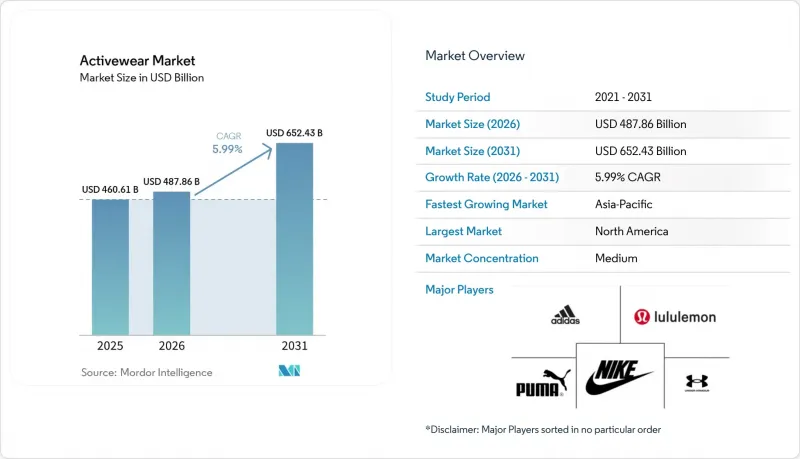
This report is Segmented by Product Type (Apparel, Footwear, Accessories), Activity (Running and Cycling, Gym and Fitness, and More), Category (Mass, Premium), End User (Men, Women, Kids), Distribution Channel (Supermarkets and Hypermarkets, Sporting Goods Retailers, and More), and Geography (North America, Europe, Asia-Pacific, South America, and More). The Market Forecasts are Provided in Terms of Value (USD).
Global Activewear Market Trends and Insights
Growing health and wellness awareness
Increasing health and wellness awareness is a key factor driving the global activewear market, as consumers across various age groups are placing greater emphasis on physical fitness, preventive healthcare, and active lifestyles. The rising participation in activities such as gym workouts, yoga, running, cycling, and recreational sports has led to higher demand for comfortable, functional, and performance-oriented apparel suitable for both exercise and casual wear. This trend is further bolstered by the growing popularity of athleisure, where consumers seek versatile clothing that blends style with functionality. The adoption of fitness routines is evident in the expanding membership base of fitness centers worldwide. According to the Health & Fitness Association, the United States fitness industry achieved record levels in 2024, with gyms, studios, and other fitness facilities attracting 77 million members. Membership further increased to 81 million Americans in 2025, representing a 5.2% growth from the previous year. This heightened engagement in fitness and wellness activities is driving consumers to invest more frequently in activewear products that provide enhanced comfort, flexibility, breathability, and moisture-management features, thereby contributing to the global market's growth.
Expansion of athleisure fashion trends
The growth of athleisure fashion trends is a key factor driving the global activewear market, as consumers increasingly seek clothing that combines athletic functionality with casual style. Activewear has transitioned from being limited to gyms, sports, or fitness routines to becoming a mainstream fashion category, widely used for work-from-home settings, travel, social outings, and everyday wear. This shift in consumer preferences toward comfortable, versatile, and stylish apparel has prompted brands to create products that integrate performance features such as stretchability, breathability, and moisture control with contemporary fashion designs. The rising influence of social media, celebrity endorsements, and fitness influencers has further fueled the popularity of athleisure by promoting sporty and wellness-focused lifestyles as fashionable choices. Additionally, evolving workplace dress codes and the growing demand for multifunctional clothing have increased the acceptance of activewear in non-athletic settings. Consequently, consumers are purchasing activewear more frequently for both functional and lifestyle needs, driving ongoing product innovation, brand partnerships, and market growth across global regions.
Counterfeit and low-quality imitation products
Counterfeit and low-quality imitation products pose a significant challenge to the global activewear market by undermining brand reputation, eroding consumer trust, and reducing overall market revenue. The growing demand for premium activewear brands has led to a notable rise in counterfeit activewear apparel, particularly distributed through online marketplaces and unauthorized retail channels. These imitation products often fail to meet the required standards for quality, durability, and performance, leading to negative consumer experiences and diminished confidence in authentic brands. Furthermore, counterfeit products intensify price competition, making it challenging for established companies to sustain profit margins while continuing to invest in product innovation and marketing efforts. According to U.S. Customs and Border Protection, wearing apparel ranks among the most frequently seized counterfeit products in 2024, with nearly 1 million units confiscated. The prevalence of counterfeit activewear not only results in financial losses for manufacturers but also diminishes brand exclusivity and hinders the growth of premium and technologically advanced activewear segments in the global market.
Other drivers and restraints analyzed in the detailed report include:
- Increasing participation in fitness and recreational activities
- Advancements in performance fabric technologies
- Volatility in raw material availability and fabric sourcing
For complete list of drivers and restraints, kindly check the Table Of Contents.
Segment Analysis
Apparel remains the largest product segment, accounting for 56.41% of the 2025 market. This dominance is driven by the growing adoption of athleisure fashion, increasing health consciousness, and rising participation in fitness and recreational activities. Consumers are prioritizing apparel that combines comfort, functionality, and style, enabling activewear to be worn not only during workouts but also in casual, travel, and work-from-home settings. Innovations in fabric technologies, such as moisture-wicking, stretchable, breathable, and temperature-regulating materials, are enhancing the appeal of activewear by improving both comfort and performance. Additionally, the influence of social media, fitness influencers, and celebrity collaborations has fueled demand for fashionable sportswear collections across diverse consumer groups. Factors such as the increasing participation of women in fitness activities, a growing preference for sustainable apparel, and rising demand for inclusive sizing and gender-neutral designs are further driving segment growth. The rapid expansion of e-commerce platforms and direct-to-consumer strategies has also improved product accessibility, encouraging frequent purchases of activewear apparel globally.
Footwear is the fastest-growing product segment, with a forecasted CAGR of 6.92% during 2026-2031. This growth is attributed to the increasing popularity of sports, fitness routines, outdoor recreational activities, and lifestyle-oriented athletic fashion trends. Rising consumer awareness about physical fitness and the importance of proper footwear for performance, comfort, and injury prevention has driven demand for specialized athletic shoes designed for activities such as running, training, hiking, and cycling. Technological advancements in footwear design, including lightweight materials, enhanced cushioning systems, shock absorption, ergonomic soles, and smart performance features, are attracting both professional athletes and everyday consumers. The influence of sneaker culture, celebrity endorsements, and limited-edition product launches has elevated athletic footwear into a significant fashion category beyond sports applications. Furthermore, factors such as rising urbanization, growing participation in marathons and fitness events, and increasing consumer preference for versatile footwear suitable for both athletic and casual wear are supporting continuous segment growth. The strong presence of global sportswear brands and the rapid expansion of online retail channels are further accelerating footwear sales in the activewear market worldwide.
The gym and fitness segment accounted for 36.42% of the 2025 market, driven by a growing global emphasis on physical health, weight management, strength training, and overall wellness. Factors such as rising gym memberships, the expansion of fitness center networks, and increased participation in activities like cardio workouts, high-intensity interval training (HIIT), functional fitness, and bodybuilding are encouraging consumers to invest in performance-oriented apparel. These garments are designed for comfort and durability, with consumers favoring activewear made from moisture-wicking, breathable, stretchable, and lightweight fabrics that enhance flexibility and support intense workout sessions. Additionally, the influence of fitness influencers, digital workout platforms, and social media fitness communities has heightened interest in stylish and branded gym apparel. The growing popularity of athleisure trends has further extended the use of gym activewear beyond fitness settings, making it suitable for casual and everyday wear. Technological advancements in compression fabrics, odor-control materials, and seamless garment construction are enhancing product appeal, while the expansion of e-commerce and direct-to-consumer channels is increasing the accessibility of gym-focused activewear globally.
The yoga and Pilates segment is projected to grow at a CAGR of 6.81% over 2026-2031, driven by increasing consumer focus on holistic wellness, mental health, flexibility, and low-impact fitness activities. Greater awareness of stress management, mindfulness, posture improvement, and body balance has significantly boosted participation in yoga and Pilates across various age groups worldwide. This has led to rising demand for specialized activewear that provides superior stretchability, softness, comfort, and freedom of movement during exercise sessions. Consumers prefer apparel made from lightweight, breathable, and non-restrictive fabrics that ensure comfort during prolonged wear and support flexibility-focused movements. The growing popularity of home-based wellness routines, virtual fitness classes, and boutique yoga studios has further accelerated demand for yoga and Pilates apparel. Additionally, the influence of wellness influencers, social media trends, and celebrity-endorsed yoga lifestyles has positioned yoga activewear as both functional and fashion-oriented. Increasing consumer interest in sustainable and eco-friendly fabrics, such as organic cotton and recycled materials, is driving innovation in this segment. Furthermore, the adoption of athleisure fashion continues to expand the use of yoga and Pilates apparel in everyday casual wear.
Geography Analysis
North America remains the largest activewear market globally, accounting for 37.64% of the 2025 market share. This dominance is attributed to the region's strong fitness culture, high participation in sports and recreational activities, and widespread adoption of athleisure fashion trends. Consumers in the United States and Canada are increasingly prioritizing health, wellness, and active lifestyles, driving demand for performance-oriented apparel and footwear suitable for gym workouts, running, yoga, outdoor activities, and everyday wear. The region benefits from the presence of leading global sportswear brands, continuous product innovation, and the rapid adoption of advanced fabric technologies that enhance comfort and functionality. Additionally, celebrity endorsements, fitness influencers, and social media-driven fashion trends significantly influence consumer purchasing behavior. The growing popularity of home fitness programs, premium activewear collections, and sustainable sportswear products further supports market growth. A well-developed e-commerce infrastructure, organized retail networks, and strong consumer spending on lifestyle and fitness products continue to accelerate activewear sales in North America.
Asia-Pacific is the fastest-growing activewear market, with a projected CAGR of 7.65% from 2026 to 2031. This growth is driven by rapid urbanization, increasing health awareness, and rising participation in fitness and sports activities across countries such as China, India, Japan, South Korea, and Australia. Greater exposure to global fitness trends, expanding middle-class populations, and growing interest in gym memberships, yoga, running, and outdoor recreation are encouraging more frequent purchases of activewear products. The rising influence of social media platforms, fitness influencers, and international sports events is strengthening consumer awareness of athletic fashion and wellness-focused lifestyles. Additionally, the growing popularity of athleisure apparel among younger consumers is driving the use of activewear for both fitness and casual wear. The region's rapidly expanding e-commerce sector, increasing smartphone penetration, and availability of both affordable and premium activewear brands are further contributing to market growth. Local manufacturing capabilities and significant investments by international sportswear companies in Asia-Pacific markets are enhancing product availability and competitive pricing.
The activewear markets in Europe, South America, and the Middle East and Africa are growing due to increasing consumer interest in health, fitness, and sports participation, along with the rising influence of athleisure fashion. In Europe, heightened awareness of wellness, sustainability, and outdoor recreational activities such as cycling, hiking, and running is driving demand for technologically advanced and eco-friendly activewear products. In South America, expanding participation in gym workouts, dance fitness, and outdoor sports, particularly among younger consumers, is supporting market growth. In the Middle East and Africa, increasing urbanization, rising fitness club memberships, and growing adoption of Western fashion and wellness trends are fueling demand for modern sportswear and athleisure apparel. Across these regions, social media influence, celebrity endorsements, and the expansion of international sportswear brands are enhancing consumer engagement with activewear products. Furthermore, improving retail infrastructure, rising penetration of online shopping platforms, and the increasing availability of both affordable and premium activewear collections are contributing to the continued growth of the market in these regions.
- Nike Inc.
- Adidas AG
- Puma SE
- Under Armour Inc.
- Lululemon Athletica Inc.
- Anta Sports Products Limited
- Li-Ning Company Limited
- ASICS Corporation
- New Balance Athletics Inc.
- Skechers USA Inc.
- Columbia Sportswear Company
- VF Corporation
- Decathlon S.A.
- Reebok International Limited
- FILA Holdings Corp.
- Gymshark Ltd.
- Athleta LLC
- Vuori Inc.
- Alo Yoga
- Patagonia, Inc.
Additional Benefits:
- The market estimate (ME) sheet in Excel format
- 3 months of analyst support
TABLE OF CONTENTS
1 INTRODUCTION
- 1.1 Study Assumptions and Market Definition
- 1.2 Scope of the Study
2 RESEARCH METHODOLOGY
3 EXECUTIVE SUMMARY
4 MARKET LANDSCAPE
- 4.1 Market Overview
- 4.2 Market Drivers
- 4.2.1 Growing health and wellness awareness
- 4.2.2 Expansion of athleisure fashion trends
- 4.2.3 Increasing participation in fitness and recreational activities
- 4.2.4 Advancements in performance fabric technologies
- 4.2.5 Rising influence of social media and fitness influencers
- 4.2.6 Increasing female participation in sports and fitness activities
- 4.3 Market Restraints
- 4.3.1 Counterfeit and low-quality imitation products
- 4.3.2 Volatility in raw material availability and fabric sourcing
- 4.3.3 Sizing inconsistencies and product return challenges
- 4.3.4 High dependency on seasonal and trend-based demand
- 4.4 Consumer Behavior Analysis
- 4.5 Regulatory Landscape
- 4.6 Technological Outlook
- 4.7 Porter's Five Forces
- 4.7.1 Threat of New Entrants
- 4.7.2 Bargaining Power of Suppliers
- 4.7.3 Bargaining Power of Buyers
- 4.7.4 Threat of Substitutes
- 4.7.5 Competitive Rivalry
5 MARKET SIZE AND GROWTH FORECASTS (VALUE)
- 5.1 By Product Type
- 5.1.1 Apparel
- 5.1.2 Footwear
- 5.1.3 Accessories
- 5.2 By Activity
- 5.2.1 Running and Cycling
- 5.2.2 Gym and Fitness
- 5.2.3 Yoga and Pilates
- 5.2.4 Dance Fitness
- 5.2.5 Others
- 5.3 By Category
- 5.3.1 Mass
- 5.3.2 Premium
- 5.4 By End User
- 5.4.1 Men
- 5.4.2 Women
- 5.4.3 Kids
- 5.5 By Distribution Channel
- 5.5.1 Supermarkets and Hypermarkets
- 5.5.2 Sporting Goods Retailer and Specialty Stores
- 5.5.3 Online Retail Stores
- 5.5.4 Other Distribution Channels
- 5.6 By Geography
- 5.6.1 North America
- 5.6.1.1 United States
- 5.6.1.2 Canada
- 5.6.1.3 Mexico
- 5.6.1.4 Rest of North America
- 5.6.2 Europe
- 5.6.2.1 Germany
- 5.6.2.2 United Kingdom
- 5.6.2.3 Italy
- 5.6.2.4 France
- 5.6.2.5 Spain
- 5.6.2.6 Netherlands
- 5.6.2.7 Poland
- 5.6.2.8 Belgium
- 5.6.2.9 Sweden
- 5.6.2.10 Rest of Europe
- 5.6.3 Asia-Pacific
- 5.6.3.1 China
- 5.6.3.2 India
- 5.6.3.3 Japan
- 5.6.3.4 Australia
- 5.6.3.5 Indonesia
- 5.6.3.6 South Korea
- 5.6.3.7 Thailand
- 5.6.3.8 Singapore
- 5.6.3.9 Rest of Asia-Pacific
- 5.6.4 South America
- 5.6.4.1 Brazil
- 5.6.4.2 Argentina
- 5.6.4.3 Colombia
- 5.6.4.4 Chile
- 5.6.4.5 Peru
- 5.6.4.6 Rest of South America
- 5.6.5 Middle East and Africa
- 5.6.5.1 South Africa
- 5.6.5.2 Saudi Arabia
- 5.6.5.3 United Arab Emirates
- 5.6.5.4 Nigeria
- 5.6.5.5 Egypt
- 5.6.5.6 Morocco
- 5.6.5.7 Turkey
- 5.6.5.8 Rest of Middle East and Africa
- 5.6.1 North America
6 COMPETITIVE LANDSCAPE
- 6.1 Market Concentration
- 6.2 Strategic Moves
- 6.3 Market Share Analysis
- 6.4 Company Profiles (includes Global level Overview, Market level overview, Core Segments, Financials (if available), Strategic Information, Market Share for key companies, Products, and Recent Developments)
- 6.4.1 Nike Inc.
- 6.4.2 Adidas AG
- 6.4.3 Puma SE
- 6.4.4 Under Armour Inc.
- 6.4.5 Lululemon Athletica Inc.
- 6.4.6 Anta Sports Products Limited
- 6.4.7 Li-Ning Company Limited
- 6.4.8 ASICS Corporation
- 6.4.9 New Balance Athletics Inc.
- 6.4.10 Skechers USA Inc.
- 6.4.11 Columbia Sportswear Company
- 6.4.12 VF Corporation
- 6.4.13 Decathlon S.A.
- 6.4.14 Reebok International Limited
- 6.4.15 FILA Holdings Corp.
- 6.4.16 Gymshark Ltd.
- 6.4.17 Athleta LLC
- 6.4.18 Vuori Inc.
- 6.4.19 Alo Yoga
- 6.4.20 Patagonia, Inc.
7 MARKET OPPORTUNITIES AND FUTURE OUTLOOK

