PUBLISHER: Global Market Insights Inc. | PRODUCT CODE: 2083132

PUBLISHER: Global Market Insights Inc. | PRODUCT CODE: 2083132
Europe Activewear Market Opportunity, Growth Drivers, Industry Trend Analysis, and Forecast 2026 - 2035
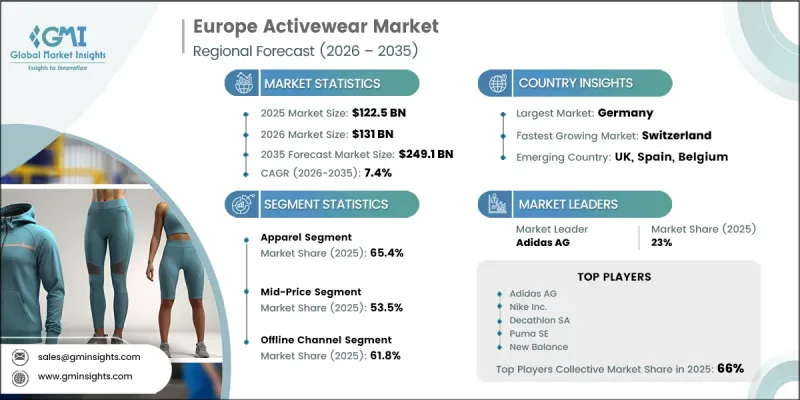
Europe Activewear Market was valued at USD 122.5 billion in 2025 and is estimated to grow at a CAGR of 7.4% to reach USD 249.1 billion by 2035.
Growth is fueled by long-term shifts in consumer wellness habits, rising disposable incomes across major European economies, and ongoing advancements in textile technologies and sustainable materials. Across the region, consumers are placing greater emphasis on health, fitness, and active living, resulting in higher participation rates in recreational and organized physical activities. This behavioral evolution has broadened the consumer base for activewear products across multiple age groups and demographics. Government-led initiatives promoting healthier lifestyles and investments in public fitness infrastructure have further supported market expansion. At the same time, the growing presence of fitness communities, workplace wellness initiatives, and specialized fitness facilities has encouraged more frequent purchases of activewear products. These factors have transformed activewear from a purely functional category into a lifestyle-driven segment, strengthening demand across urban and suburban markets throughout Europe.
| Market Scope | |
|---|---|
| Start Year | 2025 |
| Forecast Year | 2026-2035 |
| Start Value | $122.5 Billion |
| Forecast Value | $249.1 Billion |
| CAGR | 7.4% |
The apparel segment generated USD 80.1 billion, holding 65.4% share in 2025. The segment benefits from its extensive product range, which includes sportswear, training apparel, performance garments, casual active clothing, and outerwear designed for athletic activities. As consumers increasingly seek versatile clothing that combines comfort, functionality, and style, apparel continues to capture the largest share of spending. Growing interest in sustainable fashion and everyday active-inspired clothing has further strengthened category demand. Continuous product development focused on performance enhancement, comfort, durability, and environmentally responsible materials remains a significant factor supporting long-term growth within the apparel segment.
The mid-price category reached USD 65.5 billion in 2025, accounting for 53.5% share, and is forecast to record a CAGR of 8.7% through 2035. Market growth within this category is being driven by changing consumer purchasing preferences, as buyers increasingly seek products that offer a balance between affordability, quality, durability, and sustainability. Consumers are showing a greater willingness to invest in activewear products that provide enhanced performance features and longer product lifecycles. Additionally, wider availability of sustainably manufactured products at accessible price points has expanded the segment's appeal to a broader customer base. The combination of value-driven purchasing behavior and rising demand for environmentally conscious products continues to position the mid-price category as a key contributor to overall market growth.
Germany Activewear Market generated USD 28.4 billion in 2025. The country is anticipated to grow at a CAGR of 7.8% through 2035. Strong consumer engagement in health and fitness activities, combined with well-developed retail networks and growing digital commerce adoption, supports sustained market growth. A mature sporting culture, widespread participation in physical activities, and high levels of consumer spending on fitness-related products contribute to Germany's leading market position. The country also benefits from a diverse distribution ecosystem that includes sporting goods retailers, department stores, specialty outlets, and direct-to-consumer online channels. Continued investment in digital retail strategies and expanding e-commerce penetration are expected to further strengthen activewear sales across the German market.
Key companies operating in the Europe Activewear Market include Adidas AG, Nike Inc., Puma SE, Under Armour, New Balance, Lululemon Athletica, Decathlon SA, The North Face / VF Corp, Salomon SAS, On AG (On Running), Helly Hansen AS, Mammut Sports Group AG, Odlo International AG, Falke Group, Loffler GmbH, Pas Normal Studios, Zone3 Ltd, Maloja GmbH, X-Bionic AG, Saysky ApS, and Organic Basics ApS. Companies operating in the Europe Activewear Market are implementing a range of strategic initiatives to strengthen their competitive positions and expand market share. Product innovation remains a primary focus, with manufacturers investing heavily in advanced performance fabrics, sustainable materials, and functional product enhancements that improve comfort and durability. Many brands are expanding their direct-to-consumer capabilities through digital platforms to improve customer engagement, strengthen brand loyalty, and increase profit margins. Sustainability initiatives, including the use of recycled materials and environmentally responsible manufacturing processes, continue to play a critical role in brand differentiation.
Table of Contents
Chapter 1 Methodology and Scope
- 1.1 Market scope and definition
- 1.2 Research design
- 1.2.1 Research approach
- 1.2.2 Data collection methods
- 1.3 Data mining sources
- 1.3.1 Global
- 1.3.2 Country
- 1.4 Base estimates and calculations
- 1.4.1 Base year calculation
- 1.4.2 Key trends for market estimation
- 1.5 Primary research and validation
- 1.5.1 Primary sources
- 1.6 Forecast model
- 1.7 Research assumptions and limitations
Chapter 2 Executive Summary
- 2.1 Industry 360° synopsis
- 2.2 Key market trends
- 2.2.1 Country
- 2.2.2 Product type
- 2.2.3 Material
- 2.2.4 Usage
- 2.2.5 Consumer group
- 2.2.6 Price
- 2.2.7 Distribution channel
Chapter 3 Industry Insights
- 3.1 Industry ecosystem analysis
- 3.1.1 Supplier landscape
- 3.1.2 Profit margin
- 3.1.3 Value addition at each stage
- 3.1.4 Factor affecting the value chain
- 3.2 Industry impact forces
- 3.2.1 Growth drivers
- 3.2.1.1 Health & wellness culture
- 3.2.1.2 Higher disposable income
- 3.2.1.3 Innovation in materials & product design
- 3.2.2 Industry pitfalls & challenges
- 3.2.2.1 Fast-changing consumer preferences
- 3.2.2.2 Sustainability pressure
- 3.2.3 Opportunities
- 3.2.3.1 Sustainable activewear
- 3.2.3.2 Premium & luxury athleisure
- 3.2.1 Growth drivers
- 3.3 Growth potential analysis
- 3.4 Technology and innovation landscape
- 3.4.1 Current technological trends
- 3.4.2 Emerging technologies
- 3.5 Pricing analysis, 2025 (driven by primary research)
- 3.5.1 Historical price trend analysis
- 3.5.2 Pricing strategy by player type (premium / value / cost-plus)
- 3.6 Regulatory framework
- 3.6.1 Environmental regulations & compliance
- 3.6.2 Labor & ethical standards (supply chain due diligence)
- 3.6.3 Chemical safety regulations (REACH, OEKO-TEX)
- 3.6.4 Trade policies & tariffs
- 3.6.5 Digital product passport (DPP) requirements
- 3.7 Trade data analysis (driven by paid database) (06039000)
- 3.7.1 Import/export volume & value trends
- 3.7.2 Key trade corridors & tariff impact
- 3.8 Impact of AI & generative AI on the market
- 3.8.1 AI-driven disruption of existing business models
- 3.8.2 GenAI use cases & adoption roadmap by segment
- 3.8.2.1 AI in demand forecasting & inventory optimization
- 3.8.2.2 Generative design for product innovation
- 3.8.2.3 Virtual try-on & fit prediction technologies
- 3.8.2.4 Personalized marketing & customer experience
- 3.8.3 Risks, limitations & regulatory considerations
- 3.9 Distribution infrastructure & channel penetration landscape (driven by primary research)
- 3.9.1 Channel coverage by region & format (modern vs. Traditional trade)
- 3.9.2 Last-mile infrastructure gaps & emerging channel shifts
Chapter 4 Competitive Landscape, 2025
- 4.1 Introduction
- 4.2 Company market share analysis
- 4.2.1 By country
- 4.2.1.1 UK
- 4.2.1.2 Germany
- 4.2.1.3 France
- 4.2.1.4 Italy
- 4.2.1.5 Spain
- 4.2.1.6 Switzerland
- 4.2.1.7 Belgium
- 4.2.1.8 Netherlands
- 4.2.1.9 Nordics
- 4.2.1 By country
- 4.3 Company matrix analysis
- 4.4 Competitive analysis of major market players
- 4.5 Competitive positioning matrix
- 4.6 Key developments
- 4.6.1 Mergers & acquisitions
- 4.6.2 Partnerships & collaborations
- 4.6.3 New product launches
- 4.6.4 Expansion plans
Chapter 5 Market Estimates and Forecast, By Product Type, 2022 - 2035 (USD Billion) (Billion Units)
- 5.1 Key trends
- 5.2 Apparel
- 5.2.1 Top
- 5.2.1.1 T-Shirts
- 5.2.1.2 Tank tops
- 5.2.1.3 Sports bras
- 5.2.1.4 Jackets
- 5.2.1.5 Sweatshirts
- 5.2.1.6 Others (track suits, swimmer suits)
- 5.2.2 Bottom
- 5.2.2.1 Leggings
- 5.2.2.2 Shorts
- 5.2.2.3 Sweatpants
- 5.2.2.4 Track pants
- 5.2.2.5 Others (yoga pants, skirts)
- 5.2.3 Footwear
- 5.2.4 Accessories
- 5.2.4.1 Headwear
- 5.2.4.2 Gloves
- 5.2.4.3 Others (wrist bands, waist band)
- 5.2.1 Top
Chapter 6 Market Estimates and Forecast, By Material, 2022 - 2035 (USD Billion) (Billion Units)
- 6.1 Key trends
- 6.2 Polyester
- 6.3 Nylon
- 6.4 Cotton
- 6.5 Blends
Chapter 7 Market Estimates and Forecast, By Usage, 2022 - 2035 (USD Billion) (Billion Units)
- 7.1 Key trends
- 7.2 Running
- 7.3 Outdoor sports
- 7.4 Yoga & pilates
- 7.5 Gym & fitness training
- 7.6 Recreational activities
- 7.7 Others
Chapter 8 Market Estimates and Forecast, By Consumer Group, 2022 - 2035 (USD Billion) (Billion Units)
- 8.1 Key trends
- 8.2 Male
- 8.3 Female
- 8.4 Kids
Chapter 9 Market Estimates and Forecast, By Price, 2022 - 2035 (USD Billion) (Billion Units)
- 9.1 Key trends
- 9.2 Low
- 9.3 Medium
- 9.4 High
Chapter 10 Market Estimates and Forecast, By Distribution Channel, 2022 - 2035 (USD Billion) (Billion Units)
- 10.1 Key trends
- 10.2 Online
- 10.2.1 E-commerce websites
- 10.2.2 Company websites
- 10.3 Offline
- 10.3.1 Specialty stores
- 10.3.2 Mega retails stores
- 10.3.3 Others (individual stores, department stores)
Chapter 11 Market Estimates and Forecast, By Country, 2022 - 2035 (USD Billion) (Billion Units)
- 11.1 Key trends
- 11.2 UK
- 11.3 Germany
- 11.4 France
- 11.5 Italy
- 11.6 Spain
- 11.7 Switzerland
- 11.8 Belgium
- 11.9 Netherlands
- 11.10 Nordics
Chapter 12 Company Profiles
- 12.1 Global players
- 12.1.1 Adidas AG
- 12.1.2 Puma SE
- 12.1.3 Nike Inc.
- 12.1.4 Under Armour
- 12.1.5 New Balance
- 12.1.6 Lululemon Athletica
- 12.1.7 The North Face / VF Corp
- 12.2 Regional players
- 12.2.1 Decathlon SA
- 12.2.2 Salomon SAS
- 12.2.3 On AG (On Running)
- 12.2.4 Helly Hansen AS
- 12.2.5 Mammut Sports Group AG
- 12.2.6 Odlo International AG
- 12.2.7 Falke Group
- 12.3 Emerging players
- 12.3.1 Loffler GmbH
- 12.3.2 Pas Normal Studios
- 12.3.3 Zone3 Ltd
- 12.3.4 Maloja GmbH
- 12.3.5 X-Bionic AG
- 12.3.6 Saysky ApS
- 12.3.7 Organic Basics ApS

