
PUBLISHER: Global Market Insights Inc. | PRODUCT CODE: 2061361

PUBLISHER: Global Market Insights Inc. | PRODUCT CODE: 2061361
Industrial Vehicle Market Opportunity, Growth Drivers, Industry Trend Analysis, and Forecast 2026 - 2035
The Global Industrial Vehicle Market was valued at USD 45.6 billion in 2025 and is estimated to grow at a CAGR of 6.6% to reach USD 85.8 billion by 2035.
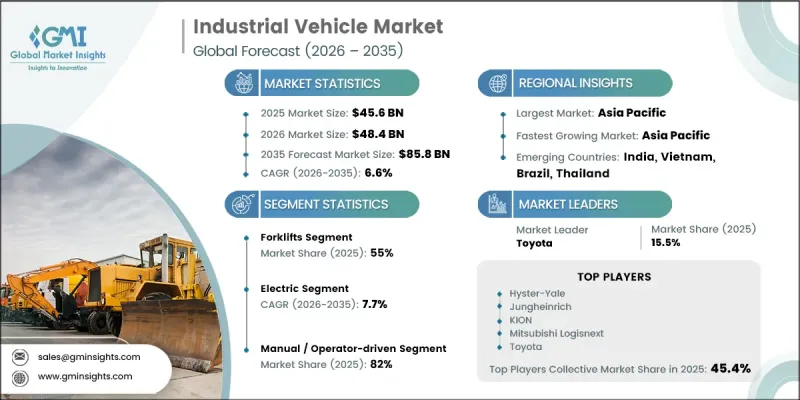
Rapid expansion of global warehousing and logistics activities continues to drive strong demand for industrial vehicles across multiple industries. Growing requirements from manufacturing facilities, logistics hubs, ports, and distribution networks are accelerating the adoption of industrial trucks and advanced material handling equipment. Rising investments in warehouse infrastructure and the development of modern smart logistics facilities are further strengthening industry growth. Technological advancements are also transforming the industrial vehicle sector, with increasing adoption of automation systems designed to improve operational efficiency, lower costs, and support environmentally sustainable operations. In addition, fleet management platforms and telematics solutions are becoming essential components within industrial vehicle operations. Real-time vehicle monitoring, predictive maintenance systems, and advanced usage tracking technologies are helping businesses improve fleet productivity while minimizing downtime. Companies are also implementing vehicle-to-vehicle communication technologies to optimize warehouse workflows and improve the movement of goods across industrial environments. These factors are collectively supporting the long-term expansion of the global industrial vehicle industry.
| Market Scope | |
|---|---|
| Start Year | 2025 |
| Forecast Year | 2026-2035 |
| Start Value | $45.6 Billion |
| Forecast Value | $85.8 Billion |
| CAGR | 6.6% |
The forklift segment accounted for 55% share in 2025 and is expected to grow at a CAGR of 6% between 2026 and 2035. Widespread deployment of forklifts across warehousing operations, manufacturing facilities, logistics centers, and port applications continues to support segment dominance. Demand for electric forklifts is increasing steadily due to lower emissions, reduced maintenance requirements, and growing focus on sustainable industrial operations. In addition, lithium-ion battery-powered forklifts are increasingly replacing internal combustion engine models, particularly in indoor environments where continuous and efficient material movement is essential for operational productivity.
The electric segment represented 71.4% share in 2025 and is anticipated to witness a CAGR of 7.7% through 2035. Electric-powered industrial vehicles are gaining significant popularity across warehouses, manufacturing plants, and distribution facilities due to their quieter operation, lower servicing requirements, and environmentally friendly performance. Increasing emphasis on operational efficiency and emission reduction is accelerating the adoption of electric forklifts and automated guided vehicles throughout industrial settings. Businesses are increasingly prioritizing electric-powered solutions to improve warehouse productivity and support sustainability initiatives across logistics and manufacturing operations.
China Industrial Vehicle Market held a 65% share and generated USD 14.7 billion in 2025. Strong industrialization, expanding manufacturing output, and continuous development of warehouse infrastructure are key factors supporting market growth across the country. Increasing e-commerce activities and rising investments in logistics and supply chain operations are further strengthening demand for industrial vehicles throughout China. As one of the world's leading manufacturing economies, the country continues to generate substantial demand for forklifts, tow tractors, and automated material handling systems to support growing industrial production and logistics requirements.
Major companies operating in the Global Industrial Vehicle Market include Crown Equipment, Daifuku, Heli, Hyster-Yale, JBT, Jungheinrich, KION, Komatsu, Mitsubishi Logisnext, and Toyota Industries. Companies operating in the industrial vehicle market are adopting several strategic initiatives to strengthen their competitive position and expand their market presence. Industry participants are heavily investing in automation technologies, electric vehicle development, and advanced fleet management systems to improve operational efficiency and sustainability. Many manufacturers are focusing on expanding their electric industrial vehicle portfolios, including battery-powered forklifts and automated guided vehicles, to meet rising demand for low-emission solutions. Strategic partnerships with logistics providers, warehouse operators, and technology companies are also helping businesses improve product deployment and customer reach. In addition, companies are increasing investments in smart warehouse technologies, telematics integration, and predictive maintenance systems to enhance fleet performance and reduce operational downtime.
Table of Contents
Chapter 1 Research Methodology
- 1.1 Research approach
- 1.2 Quality Commitments
- 1.2.1 GMI AI policy & data integrity commitment
- 1.2.1.1 Source consistency protocol
- 1.2.1 GMI AI policy & data integrity commitment
- 1.3 Research Trail & Confidence Scoring
- 1.3.1 Research Trail Components
- 1.3.2 Scoring Components
- 1.4 Data Collection
- 1.4.1 Partial list of primary sources
- 1.5 Data mining sources
- 1.5.1 Paid sources
- 1.5.1.1 Sources, by region
- 1.5.1 Paid sources
- 1.6 Base estimates and calculations
- 1.6.1 Base year calculation for any one approach
- 1.7 Forecast model
- 1.7.1 Quantified market impact analysis
- 1.7.1.1 Mathematical impact of growth parameters on forecast
- 1.7.1 Quantified market impact analysis
- 1.8 Research transparency addendum
- 1.8.1 Source attribution framework
- 1.8.2 Quality assurance metrics
- 1.8.3 Our commitment to trust
Chapter 2 Executive Summary
- 2.1 Industry 360° synopsis, 2022 - 2035
- 2.2 Key market trends
- 2.2.1 Regional
- 2.2.2 Vehicle
- 2.2.3 Propulsion
- 2.2.4 Level of Automation
- 2.2.5 End User
- 2.3 TAM Analysis, 2026-2035
- 2.4 CXO perspectives: Strategic imperatives
Chapter 3 Industry Insights
- 3.1 Industry ecosystem analysis
- 3.1.1 Supplier landscape
- 3.1.2 Profit margin analysis
- 3.1.3 Cost structure
- 3.1.4 Value addition at each stage
- 3.1.5 Factor affecting the value chain
- 3.1.6 Disruptions
- 3.2 Industry impact forces
- 3.2.1 Growth drivers
- 3.2.1.1 Expansion of warehousing and logistics operations
- 3.2.1.2 Rising industrial automation across manufacturing facilities
- 3.2.1.3 Increasing focus on operational efficiency and labor reduction
- 3.2.1.4 Growth in electric industrial vehicle adoption
- 3.2.2 Industry pitfalls and challenges
- 3.2.2.1 High initial investment costs
- 3.2.2.2 Battery charging limitations and downtime concerns
- 3.2.3 Market opportunities
- 3.2.3.1 Development of smart warehouses and automated facilities
- 3.2.3.2 Growth in emerging manufacturing economies
- 3.2.3.3 Adoption of lithium-ion battery powered vehicles
- 3.2.1 Growth drivers
- 3.3 Growth potential analysis
- 3.4 Technology and innovation landscape
- 3.4.1 Current technological trends
- 3.4.2 Emerging technologies
- 3.5 Pricing Analysis (Driven by primary research)
- 3.5.1 Historical Price Trend Analysis
- 3.5.2 Pricing Strategy by Player Type
- 3.6 Regulatory landscape
- 3.6.1 North America
- 3.6.1.1 U.S. OSHA powered industrial truck regulations
- 3.6.1.2 U.S. EPA nonroad vehicle emission standards
- 3.6.1.3 Canada mobile equipment safety regulations
- 3.6.1.4 Canada powered mobile equipment standards
- 3.6.1.5 Mexico forklift safety regulations
- 3.6.2 Europe
- 3.6.2.1 European Union machinery safety regulation
- 3.6.2.2 European Union workplace equipment safety directive
- 3.6.2.3 Germany industrial truck safety standards
- 3.6.2.4 Germany warehouse vehicle protection regulations
- 3.6.2.5 Germany industrial emission safety standards
- 3.6.3 Asia Pacific
- 3.6.3.1 China industrial vehicle safety regulations
- 3.6.3.2 China special equipment compliance standards
- 3.6.3.3 Japan forklift safety and inspection regulations
- 3.6.3.4 Australia forklift licensing regulations
- 3.6.3.5 India material handling equipment safety standards
- 3.6.4 Latin America
- 3.6.4.1 Brazil material handling safety regulations
- 3.6.4.2 Brazil machinery and equipment safety standards
- 3.6.4.3 Mexico forklift operational safety regulations
- 3.6.4.4 Mexico workplace equipment safety standards
- 3.6.4.5 Brazil industrial equipment compliance standards
- 3.6.5 Middle East & Africa
- 3.6.5.1 UAE workplace machinery safety regulations
- 3.6.5.2 UAE industrial equipment compliance standards
- 3.6.5.3 South Africa driven machinery regulations
- 3.6.5.4 South Africa lifting equipment operator standards
- 3.6.5.5 South Africa occupational equipment safety framework
- 3.6.1 North America
- 3.7 Porter's analysis
- 3.8 PESTEL analysis
- 3.9 Patent analysis (Driven by primary research)
- 3.10 Trade Data Analysis (Driven by paid database)
- 3.10.1 Import/export volume & value trends
- 3.10.2 Key trade corridors & tariff impact
- 3.11 Cost breakdown analysis
- 3.12 Impact of AI and Generative AI on the Market
- 3.12.1 AI Driven Disruption of Existing Business Models
- 3.12.2 GenAI Use Cases and Adoption Roadmap by Segment
- 3.12.3 Risks Limitations and Regulatory Considerations
- 3.13 Capacity & Production Landscape (Driven by Primary Research)
- 3.13.1 Installed Capacity by Region & Key Producer
- 3.13.2 Capacity Utilization Rates & Expansion Pipelines
- 3.14 Sustainability and environmental aspects
- 3.14.1 Sustainable practices
- 3.14.2 Waste reduction strategies
- 3.14.3 Energy efficiency in production
- 3.14.4 Eco-friendly Initiatives
- 3.14.5 Carbon footprint considerations
- 3.15 Forecast assumptions & scenario analysis (Driven by Primary Research)
- 3.15.1 Base Case- Key Macro & Industry Variables Driving CAGR
- 3.15.2 Optimistic Scenarios- Favorable macro and industry tailwinds
- 3.15.3 Pessimistic Scenario - Macroeconomic slowdown or industry headwinds
Chapter 4 Competitive Landscape, 2025
- 4.1 Introduction
- 4.2 Company market share analysis
- 4.2.1 North America
- 4.2.2 Europe
- 4.2.3 Asia Pacific
- 4.2.4 LATAM
- 4.2.5 MEA
- 4.3 Competitive analysis of major market players
- 4.4 Competitive positioning matrix
- 4.5 Key developments
- 4.5.1 Mergers & acquisitions
- 4.5.2 Partnerships & collaborations
- 4.5.3 New Product Launches
- 4.5.4 Expansion Plans and funding
- 4.6 Company tier benchmarking
- 4.6.1 Tier classification criteria & qualifying thresholds
- 4.6.2 Tier positioning matrix by revenue, geography & innovation
Chapter 5 Market Estimates & Forecast, By Vehicle, 2022 - 2035 (USD Mn, Units)
- 5.1 Key trends
- 5.2 Forklifts
- 5.3 Tow Tractors
- 5.4 Container Handlers
- 5.5 Aisle Trucks
- 5.6 Automated Guided Vehicles (AGVs)
- 5.7 Others
Chapter 6 Market Estimates & Forecast, By Propulsion, 2022 - 2035 (USD Mn, Units)
- 6.1 Key trends
- 6.2 Internal Combustion Engine (ICE)
- 6.2.1 Diesel
- 6.2.2 Gasoline
- 6.2.3 LPG/CNG
- 6.3 Electric
- 6.3.1 Lithium-ion Powered Vehicles
- 6.3.2 Lead-acid Battery Vehicles
- 6.4 Hybrid Vehicles
- 6.5 Hydrogen Fuel Cell Vehicles
Chapter 7 Market Estimates & Forecast, By Level of Automation, 2022 - 2035 (USD Mn, Units)
- 7.1 Key trends
- 7.2 Manual / Operator-Driven
- 7.3 Semi-Autonomous
- 7.4 Fully Autonomous
Chapter 8 Market Estimates & Forecast, By End User, 2022 - 2035 (USD Mn, Units)
- 8.1 Key trends
- 8.2 Manufacturing
- 8.3 Logistics & Warehousing
- 8.4 Construction
- 8.5 Mining
- 8.6 Agriculture
- 8.7 Ports & Shipping
- 8.8 Others
Chapter 9 Market Estimates & Forecast, By Region, 2022 - 2035 (USD Mn, Units)
- 9.1 Key trends
- 9.2 North America
- 9.2.1 US
- 9.2.2 Canada
- 9.3 Europe
- 9.3.1 Germany
- 9.3.2 UK
- 9.3.3 France
- 9.3.4 Italy
- 9.3.5 Spain
- 9.3.6 Russia
- 9.3.7 Norway
- 9.3.8 Netherlands
- 9.3.9 Sweden
- 9.4 Asia Pacific
- 9.4.1 China
- 9.4.2 India
- 9.4.3 Japan
- 9.4.4 Australia
- 9.4.5 South Korea
- 9.4.6 Singapore
- 9.4.7 Thailand
- 9.4.8 Indonesia
- 9.4.9 Vietnam
- 9.5 Latin America
- 9.5.1 Brazil
- 9.5.2 Mexico
- 9.5.3 Argentina
- 9.6 MEA
- 9.6.1 South Africa
- 9.6.2 Saudi Arabia
- 9.6.3 UAE
- 9.6.4 Turkey
Chapter 10 Company Profiles
- 10.1 Global Players
- 10.1.1 Crown Equipment
- 10.1.2 Hyster-Yale
- 10.1.3 Jungheinrich
- 10.1.4 KION
- 10.1.5 Komatsu
- 10.1.6 Mitsubishi Logisnext
- 10.1.7 Toyota Industries
- 10.2 Regional Players
- 10.2.1 Anhui Heli
- 10.2.2 Combilift
- 10.2.3 Doosan Bobcat
- 10.2.4 EP Equipment
- 10.2.5 Hyundai Construction Equipment
- 10.2.6 Kalmar (Cargotec)
- 10.2.7 Manitou
- 10.2.8 Volvo
- 10.3 Emerging Players / Disruptors
- 10.3.1 BYD Forklift
- 10.3.2 Daifuku
- 10.3.3 JBT
- 10.3.4 Noblelift Intelligent Equipment
- 10.3.5 Plug Power

